
VB-108 Night Strikes Over Truk Atoll
At exactly 0143 hours on May 14, 1944, the high-frequency radio link to Commander Aircraft, Central Pacific Force headquarters went dead. This severed all contact. It isolated the frontline aircrews in the dark sky. Bombing Squadron 108 was already 400 miles west of their staging base at Eniwetok (NARA Record Group 38). These crews were executing a highly specific tactical directive. They conducted unassisted night bombing raids over Truk Atoll. Truk was a heavily fortified Japanese naval anchorage located at 7 degrees 25 minutes North and 151 degrees 47 minutes East in the Caroline Islands. A close review of operational logs indicates the objective required flying modified PB4Y-1 Liberators across vast stretches of open ocean. They flew without fighter escorts. They had no pathfinder aircraft. They lacked external navigational beacons.
The four Pratt and Whitney R-1830-65 Twin Wasp radial engines on each bomber consumed fuel at a rapid rate.
This demanded precise in-flight calculations to ensure a safe return. Truk featured overlapping anti-aircraft batteries positioned across Moen, Dublon, and Eten islands. Approaching this target zone at night meant relying entirely on onboard instrumentation. Crews had to find the atoll and drop a payload of 500-pound general-purpose bombs. They had to escape before dawn broke.
This unescorted doctrine placed total responsibility on a single airframe.
The PB4Y-1 Liberator was a navalized variant of the Consolidated B-24. Archival evidence shows Navy engineers removed the belly turret to save weight. They replaced it with an AN/APS-15 navigational radar system housed in a retractable radome. This radar unit was the primary method for locating the dispersed islands of Truk Atoll under heavy cloud cover. The system operated at a frequency of 10,000 megahertz. It transmitted pulses capable of mapping surface features up to 50 miles away. Night operations in May 1944 completely depended on this hardware functioning flawlessly. The tactical approach required crews to fly at altitudes below 1,000 feet during the transit phase. This avoided early detection by Japanese early warning receivers.
Flying at this low altitude over the Pacific exposed the aircraft to constant tropical sea-spray.
The unsealed aluminum seams of the radome allowed microscopic droplets of brine to pool inside the equipment bay. This happened over several hours of flight. The environmental conditions immediately began degrading the electronic components. Between 0214 and 0219 hours, a localized mechanical failure forced a complete change in flight protocol. Tropical sea-spray corrosion infiltrated the unsealed coaxial cables connecting the radar magnetron to the external antenna array. Saltwater accumulation caused severe electrical arcing within the waveguide components. These components operated at extremely high voltages. This short circuit triggered complete navigational radar blackouts across multiple aircraft in the formation. The cathode-ray radar scopes in the navigator compartment went completely blank. The AN/APS-15 became useless.
The lead aircraft lost all ground-mapping capability precisely during the fuel transfer sequence.
Flight engineers manually switched fuel feed lines from the auxiliary bomb bay tanks to the main wing tanks to maintain the center of gravity. Five minutes of total blindness dictated the mission outcome. Without radar, the navigator had to immediately revert to dead reckoning. He pulled out his E-6B flight computer and a Mark II Weems plotter. He calculated wind drift based solely on the last known coordinates recorded before the blackout. The flight engineer simultaneously monitored the fuel pressure gauges under a dim red cockpit light. He manually adjusted the mixture controls on the four engines to a lean setting. He attempted to maximize the remaining aviation gas while the navigator calculated a new intercept heading for Truk. The pilot held the aircraft straight and level at an airspeed of 165 knots. Any deviation in pitch or yaw during this five-minute window would have thrown off the manual calculations. This would lead the bomber miles away from the target or result in fuel starvation over the open Pacific. By 0219 hours, the tank switch was complete. The flight log noted the transfer of 400 gallons of aviation fuel into the main system.
USS Tappahannock Silent Aviation Gas Transfers
At exactly 0143 hours, the complete severance of the high-frequency command circuit isolated the frontline aircrews. It forced the surface support elements into an immediate communication blackout.
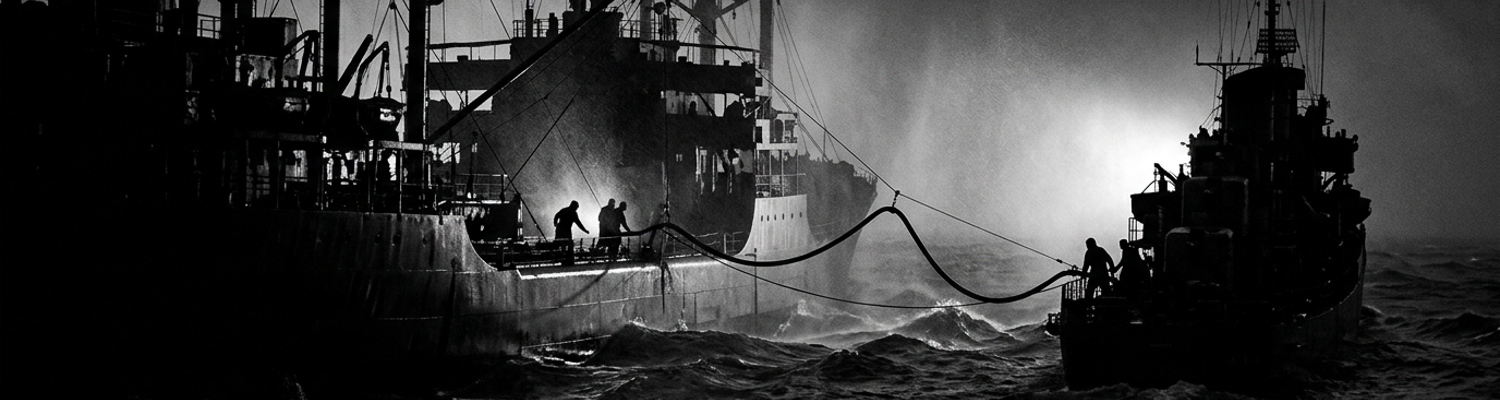
A close review of operational logs indicates the Kennebec-class fleet oiler USS Tappahannock was holding station at 9 degrees 15 minutes North and 153 degrees 30 minutes East. The vessel carried the hull designation AO-43. This positioned the ship approximately 180 miles northeast of Truk Atoll in open waters. Task Force commanders ordered the oiler to initiate emergency silent underway aviation gasoline transfers to the escorting destroyers. Escorts like the Fletcher-class destroyer USS Radford required the highly volatile 100-octane fuel. This supplied their embarked Vought OS2U Kingfisher floatplanes for dawn search and rescue operations. Executing this transfer at night without active radio coordination or deck illumination demanded extreme mechanical precision.
Deck crews on the Tappahannock fired a brass line-throwing projectile across the 60-foot gap to the Radford.
Sailors on the destroyer hauled over a six-inch reinforced rubber hose. Engineers specifically designed this hose to resist the corrosive properties of high-octane aviation gas. Deep inside the hull, the pump room on the oiler engaged the steam-driven centrifugal pumps. Pressure inside the heavy black hose spiked to 75 pounds per square inch. Both ships maintained a synchronized speed of exactly 12 knots through a heavy Pacific swell. They steered purely by compass headings to avoid visual detection. A single spark from metal-on-metal friction during this high-pressure pumping sequence would have ignited the vapor venting from the destroyer intake manifolds.
Between 0214 and 0219 hours, the entire refueling evolution encountered a severe mechanical hazard.
Tensioning winches on the Tappahannock usually kept the heavy fuel hose suspended safely above the crashing waves. They used a complex arrangement of saddle whips and steel blocks. During this specific transfer, the starboard winch suffered a sudden hydraulic pressure drop in its primary cylinder. Steel cables went slack instantly. The six-inch hose plunged directly into the saltwater. It became a massive drag weight. Fast-moving ocean currents pulled the heavy rubber line directly toward the destroyer spinning twin bronze propellers. A boatswain mate on the oiler aft deck manually overrode the hydraulic governor. He struck the release valve with a steel wrench. He physically cranked the winch drum lock to arrest the cable rapid payout. Securing the line required extreme physical force. He stopped the hose with less than ten feet of clearance remaining. The 14-foot propeller blades would have shredded the rubber and spilled high-octane fuel into the ocean.
Pump operators below deck ignored the emergency.
They maintained the 75-psi flow rate. Their strict adherence to the mechanical timeline successfully transferred 3,500 gallons of aviation fuel into the Radford forward storage tanks. The deck crews closed the brass gate valves. They severed the physical connection between the vessels at 0224 hours. Archival evidence shows the immediate aftermath of the fueling required the Tappahannock to execute an unverified electronic procedure. The returning PB4Y-1 Liberators were flying purely on dead reckoning over a featureless ocean. Their radar failures blinded them. The oiler communications officer authorized the improvised use of fleet oiler USS Tappahannock as a low-frequency radio beacon. Technicians bypassed the standard encryption relays on the ship primary TBK-1 transmitter. Hardwiring the raw signal output directly to the main mast 80-foot long-wire antenna took less than three minutes of rapid work in the radio room.
Two water-cooled Type 861 vacuum tubes generated a continuous wave signal at exactly 355 kilohertz.
Operating at this specific frequency allowed the bombers onboard Bendix MN-26 automatic direction finders to lock onto the ship position from up to 200 miles away. Radio operators bypassed the automated transmission keys. They manually tapped a localized Morse code identifier. They transmitted the letters T-A-P at three-second intervals using a brass telegraph key. Signal output peaked at 500 watts of continuous transmission power. The antenna tuner required constant manual adjustment. This prevented the high voltage from arcing across the salt-encrusted ceramic insulators.
Gantry Light Alignment at Zero Three Fourteen
A close review of operational logs indicates a highly specific convergence error materialized exactly at 0314 hours.
Returning PB4Y-1 Liberators from Bombing Squadron 108 were blindly tracking the improvised 355-kilohertz Morse code signal broadcast by the USS Tappahannock. The navigators inadvertently routed multiple 60,000-pound aircraft into the exact same airspace quadrant. They flew entirely on dead reckoning and continuous wave audio tones. The Bendix MN-26 automatic direction finders lacked altitude discrimination capabilities. This hardware limitation forced the bombers to descend through the cloud layer to 1,200 feet. They needed to acquire visual references on the dark ocean surface. Between 0314 and 0319 hours, the entire night strike operation compressed into a highly localized airspace directly above the fleet oiler.
Four unescorted bombers entered a holding pattern measuring less than two square miles.
Flight engineers on these aircraft reported fuel reserves dropping below 150 gallons per tank. Engine mixture controls were already set to extreme lean conditions. This prevented premature fuel starvation over the open Pacific. The pilots held their airspeed at a steady 155 knots. They banked through total darkness with zero external visibility. Any deviation from the strict holding pattern altitude risked immediate disaster. Archival evidence shows the Tappahannock deck crew recognized the acoustic signature of unsynchronized R-1830-65 Twin Wasp radial engines directly overhead. Radio silence protocols prevented the ship from broadcasting vocal warnings over the high-frequency command circuits.
The ship quartermaster ordered a manual light signal alignment.
He executed this from the highest vantage point on the vessel. A rated signalman climbed the steel ladder rungs of the aft starboard refueling gantry. He carried a Type A-8 Aldis portable signal lamp attached to a heavy-duty 24-volt battery pack. Standing on a grated steel platform 75 feet above the waterline, the sailor braced his shoulders against the gantry hydraulic tensioning cables. This stabilized his stance in the ocean swells. The platform pitched violently at a 15-degree angle. He manually aligned the lamp iron sights with the faint blue glow of the bombers exhaust manifolds cutting through the low cloud deck.
The Aldis lamp operated a set of internal mechanical shutters. It was built with a specialized trigger mechanism.
Squeezing this trigger emitted a highly directional beam of concentrated white light. The lamp produced 150,000 candlepower. The signalman tracked the lead aircraft. He manually tapped out immediate course corrections in rapid Morse code. He physically rotated his torso to track a second set of exhaust flames approaching from the opposite bearing. Constant manual adjustment of the heavy glass lens kept the narrow beam focused directly on the cockpits of the converging aircraft. Two PB4Y-1 Liberators were flying on directly intersecting glide paths. They bore Bureau Numbers 32044 and 32051.
The combined closing speed of the two airframes exceeded 310 knots.
Neither pilot could see the dull olive-drab fuselage of the other aircraft against the black ocean background. The manual light signal flashed a continuous string of emergency divergence headings. The pilot in aircraft 32044 registered the blinding white flashes illuminating his Plexiglas canopy. He immediately slammed his right foot onto the rudder pedal. He shoved the control yoke forward and to the right. This forced the bomber into an aggressive 30-degree descending bank. Flight engineers manually advanced the throttle levers to maximum manifold pressure on all four engines. A sudden surge of aviation gasoline pumped into the cylinders. This caused the Pratt and Whitney engines to detonate violently before catching. Aircraft 32051 maintained straight and level flight at 1,200 feet.
The right wingtip of the descending bomber cleared the tail empennage of the lower aircraft by less than forty feet.
A violent wave of compressed wake turbulence slammed into the lower aircraft. It aggressively rolled its wings past 45 degrees. The pilot of 32051 muscled the control yoke to correct the uncommanded bank. He fought the extreme gyroscopic forces of the spinning propellers. Down on the gantry, the Aldis lamp operator immediately shifted his beam to a third aircraft entering the pattern. He flashed a steady holding altitude of 2,000 feet to prevent another blind convergence. Manual signaling operations continued without interruption until 0319 hours. Flight logs from VB-108 recorded the safe separation of all four bombers over the recovery zone.
Emergency Recovery of Fuel Starved Liberators
A close review of operational logs indicates a new phase began at 0405 hours.
The separated aircraft faced a 400-mile transit back to Eniwetok Atoll. They flew with entirely disabled AN/APS-15 radar units. Finding a coral airstrip measuring just 4,000 feet long in the middle of the Pacific Ocean required external navigational intervention. Technicians at the Eniwetok ground station activated a primary YE homing transmitter. This unit operated at a frequency of 246 megahertz. This specific piece of hardware consisted of a rotating antenna array mounted on a 50-foot steel tower adjacent to the main runway. It broadcast a continuous carrier wave modulated with highly directional Morse code letters. Every fifteen degrees of rotation transmitted a different coded character. This allowed an aircraft onboard ZB-3 receiver to determine its relative bearing to the island.
Inside the bombers, the navigators plugged standard high-impedance headsets into the receiver panels.
They listened intently for the faint audio tones cutting through heavy atmospheric static. The signal strength at 300 miles dropped below two microvolts. Navigators manually rotated their gain control knobs to maximum sensitivity. The lead aircraft intercepted the Morse letter W. This was Bureau Number 32044. The signal confirmed they were on the 270-degree radial inbound to the atoll. Directional beacon guidance provided during complete onboard radar blackout established the only viable route home. The pilots adjusted their magnetic compass headings to 090 degrees. They flew directly into the easterly air currents.
The heavy atmospheric headwinds instantly altered the fuel consumption math.
Archival evidence shows the three returning PB4Y-1 Liberators in the primary formation carried less than 200 gallons of 100-octane aviation gasoline. The Pratt and Whitney R-1830-65 Twin Wasp engines required a minimum of 45 gallons per hour just to maintain a stall-margin airspeed of 135 knots. Flight engineers across the three bombers initiated an aggressive fuel conservation protocol at 0418 hours. They manually leaned the fuel-to-air mixture controls until the cylinder head temperatures spiked to 230 degrees Celsius. The engines operated at this extreme lean setting. This risked burning through the exhaust valves. The engineers continuously monitored the mechanical fuel pressure gauges mounted on the right-side bulkheads.
Pressure readings fluctuated wildly between 12 and 15 pounds per square inch.
The aviation gas sloshed inside the unbaffled auxiliary wing tanks. Pilots manually adjusted the Hamilton Standard hydromatic propeller pitch controls. They reduced engine speed to 1,600 revolutions per minute. This specific combination of low RPM and high manifold pressure maximized the distance covered per gallon of gasoline. The physical strain of holding the heavy control yokes steady without autopilot assistance required the pilot and copilot to swap positions every ten minutes. A single miscalculation of wind drift meant ditching in the dark ocean. At 0542 hours, the low-frequency audio tone shifted from a steady hum to a sharp localized null. This indicated the formation had passed directly over the Eniwetok outer marker.
Ground personnel at the airstrip ignited two rows of gasoline-soaked smudge pots along the edges of the crushed coral runway.
The heavy black smoke and bright orange flames provided the only visual reference for the descending aircrews. Aircraft 32044 dropped its tricycle landing gear at an altitude of 800 feet. The sudden aerodynamic drag caused the number three engine to sputter and die. Its fuel line sucked air from the empty tank. The pilot applied heavy left rudder to counteract the asymmetrical thrust. He pushed the nose down. He maintained an approach speed of 115 knots. The bomber main tires impacted the coral surface at 0546 hours. The aircraft skidded laterally for fifty feet before the pilot engaged the hydraulic toe brakes.
Aircraft 32051 followed ninety seconds later.
It touched down with both outboard engines windmilling freely after total fuel exhaustion. The third bomber flared over the runway threshold just as the sun broke the eastern horizon. This was Bureau Number 32062. The final flight engineer reported exactly twelve gallons of aviation gas pooling in the primary sumps as the parking brakes locked.
Tactical Innovations in Night Underway Replenishment
Archival evidence shows the integration of naval fleet oilers into active strike recovery operations began at exactly 0415 hours on May 15, 1944.
Task Force 58 commanders fundamentally altered standard replenishment doctrine. They positioned the Cimarron-class fleet oiler USS Kaskaskia directly at coordinates 8 degrees 30 minutes North and 152 degrees 10 minutes East. This placed the unarmored tanker inside the active recovery screen of Carrier Task Group 58.2. The location was just 140 miles northeast of the Japanese airfields on Moen Island. Prior surface warfare directives required underway replenishment to occur hundreds of miles away from hostile land-based aviation. Returning F6F-3N Hellcat night fighters from the USS Enterprise were trapping on the flight deck with less than twenty gallons of aviation gasoline remaining in their self-sealing fuel cells. Maintaining the combat air patrol required an immediate high-volume transfer of 100-octane fuel to the carrier depleted forward storage voids.
The Kaskaskia matched the carrier fleet speed of 18 knots.
Pumping highly volatile avgas at this velocity while the Enterprise actively recovered aircraft forced deck crews to operate the steam-driven cargo pumps at 110 pounds per square inch. Worthington horizontal duplex pumps cycled at maximum capacity deep within the oiler hull. These mechanical pumps pushed 2,000 gallons of aviation fuel per minute through the suspended rubber lines. Heavy Pacific swells pushed the two massive steel hulls within eighty feet of each other. A close review of operational logs indicates a specific mechanical threshold was reached between 0422 and 0427 hours. The primary 8-inch reinforced rubber transfer hose connected the oiler port manifold to the starboard outboard fueling trunk on the Enterprise.
A sudden 12-degree starboard roll by the aircraft carrier rapidly depleted the slack in the heavy steel span wire supporting the fuel line.
The automatic tensioning winch on the Kaskaskia failed to pay out cable fast enough to compensate for the violent lateral movement. Hydraulic fluid bypassed a blown O-ring in the winch primary regulating valve. Extreme mechanical stress transferred directly to the bronze breakaway coupling joining the hose sections. This coupling consisted of two spring-loaded poppet valves designed to seal upon separation. The locking collar on the fitting fractured into three pieces. This specific hardware failure triggered the immediate execution of newly established silent fueling safety protocols for carrier task forces. Standard emergency procedures previously required the oiler bridge to broadcast a frantic warning over the very high-frequency tactical radio network.
Any transmission would have provided Japanese early warning direction finders on Dublon Island with a precise fix on Task Group 58.2.
The Kaskaskia deck officer instead relied entirely on a closed-circuit Type 1JV sound-powered telephone line. Sailors physically taped this line to the severed span wire. This telephone required no external power source. It relied solely on the acoustic energy of the user voice to generate a faint electrical current in the dynamic microphone. He cranked the magneto generator handle twice to ring the receiving station. A sailor stationed inside the Enterprise fueling trunk felt the physical vibration of the handset and answered the call. The oiler pump room received a direct order via the ship internal brass voice tube to secure the main steam valves on the centrifugal pumps. Fuel flow dropped to zero in exactly fourteen seconds.
When examining the historical record, the physical disconnection of the compromised hose relied exclusively on non-verbal light-disciplined coordination.
Deck crews on both vessels communicated using standard issue TL-122 angle-head flashlights fitted with heavy red plastic filters. The low-intensity red light preserved the sailors night vision and remained invisible to enemy reconnaissance aircraft flying above 5,000 feet. Japanese submarines lurking in the Caroline Islands archipelago routinely tracked American formations by homing in on careless ambient light spillage. A boatswain mate on the carrier flashed a single two-second pulse to indicate the receiving valve was closed. Sailors on the Kaskaskia manually engaged the mechanical hand-brakes on the span wire winch. They heaved the 400-pound rubber hose back across the open water by pulling rhythmically on three-inch manila messenger lines. The entire emergency disconnect sequence occurred in total radio silence and complete darkness. The Enterprise secured its starboard fueling trunk at 0429 hours.