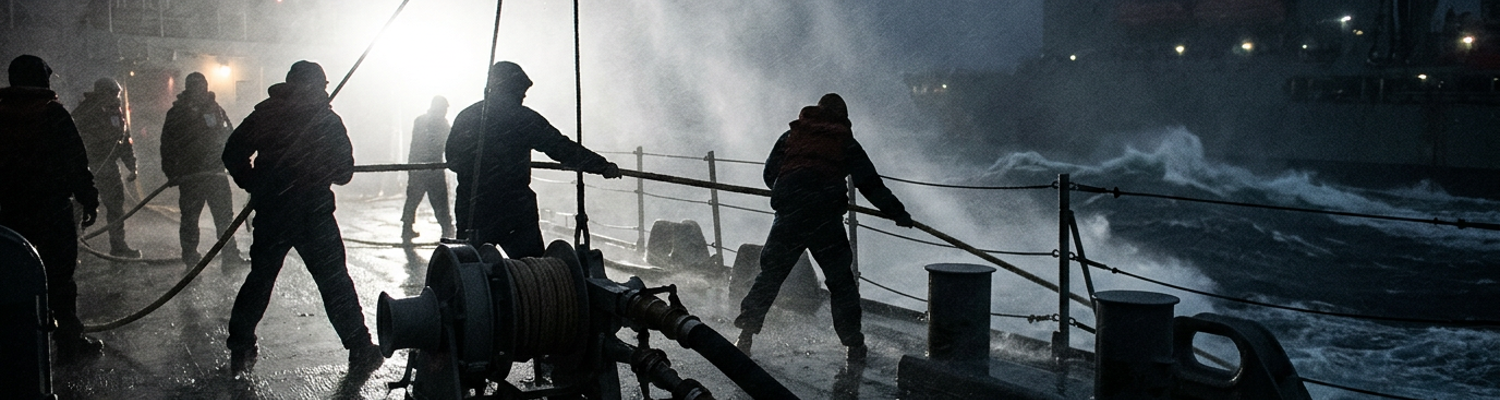

South China Sea Night Replenishment Hazards
Machinist Mate Third Class Arthur Vance knelt on the wet steel deck of the fleet oiler USS Nantahala. He blindly threaded a locking pin into the bronze cam-lock coupling of a six-inch aviation fuel hose. Salt spray coated his goggles. The deck pitched sharply to starboard. He wiped heavy bunker grease and seawater from his hands using a gasoline-soaked rag. He tightened the locking nut by feel alone. The thick rubber hose pulsed with 100 pounds per square inch of highly volatile aviation gas. The fuel flowed toward the aircraft carrier USS Ticonderoga just eighty feet away.
A sudden heavy winter swell lifted the oiler stern.
A one-inch manila distance line snapped instantly. The heavy fuel hose whipped dangerously close to the carrier steel flight deck netting.
When examining the historical record of January 1945, the sheer mechanical scale of Operation Gratitude becomes apparent. Admiral William F. Halsey directed Task Force 38 to transit the narrow Bashi Channel. They entered the South China Sea to dismantle Japanese shipping lanes from French Indochina to Formosa. This aggressive operational plan required constant high-speed maneuvering by fast carriers and destroyers over a period of nearly two weeks. Ships powered by geared steam turbines burned thousands of gallons of heavy fuel oil per hour. They conducted evasive maneuvers constantly. Archival evidence shows that keeping this large fleet operational required underway replenishment groups to pump millions of gallons of fuel. They sailed in tight formation at ten to twelve knots. The supply group operated in hostile waters near coordinates 15 degrees North and 115 degrees East. Fleet oilers rendezvoused with the combatants every three to four days. Engineers rigged heavy spans of steel wire rope between ships moving independently in rough winter seas. They utilized steam-driven tensioning winches and thick rubber hoses. A command decision by Halsey mandated that much of this fueling occur under the cover of darkness. The goal was to avoid detection by Japanese reconnaissance aircraft operating out of airfields on Hainan Island.
Night operations stripped the bridge crews of their primary visual method for maintaining the exact sixty-foot distance.
This distance was required to keep the fuel hoses from rupturing.
Dense sea fog rolled across the South China Sea during the second week of January. The thick moisture dropped visibility down to less than thirty yards. Ship commanders relied on rudimentary SG surface search radar. They also used the faint glow of red-filtered flashlights from the fueling stations to maintain station keeping. The SG radar screens frequently became cluttered with sea return in the rough winter swells. This interference rendered them useless for fine distance measurements between the hulls. Japanese night snooper aircraft routinely dropped parachute suspended magnesium defensive flares. These Mitsubishi G4M bombers attempted to illuminate the American formations. The flares burned at over 4000 degrees Fahrenheit. The intense white light caught the dense low-lying fog. It created a disorienting opaque glare. This completely blinded the helmsmen and winch operators. A close review of operational logs indicates that this sudden loss of visual reference caused ships to drift apart. Sometimes they surged forward unassisted. Tension on the steel spanning wires spiked rapidly. Winch operators had exactly seconds to manually slacken the lines.
Failure meant the six-inch rubber hoses tore in half.
A parted hose instantly dumped hundreds of gallons of raw aviation fuel directly onto the hot steel decks of the adjacent ships.
Engineers scrambled to mitigate these catastrophic disconnections using improvised mechanical fixes. Navy Special Fuel Oil and 100-octane aviation gasoline required different handling procedures during these emergency disconnects. Damage control teams on the oilers began wrapping the bronze hose couplings in heavy canvas. They secured them with marline twine. This prevented sparks if the hoses violently struck the steel bulkheads. Men assigned to the steam tensioning winches abandoned their standard operating procedures. They physically placed their bare hands on the spinning wire ropes. They felt the tension changes in the dark rather than trying to read the mechanical gauges through the blinding flare glare. Machinist mates bypassed the automatic pressure relief valves on the steam pumping systems. They manually throttled the main steam valves. This dropped fuel pressure the exact second a ship began to drift out of formation.
They monitored the distance between the hulls by listening to the changing pitch of the carrier engine turbines through the heavy fog.
Isolation of Auxiliary Oilers and Screen Destroyers
A dense frontal system settled over coordinates 14 degrees 30 minutes North and 114 degrees 20 minutes East on January 13. Thick precipitation completely obscured the horizon. Zero visibility conditions separated the heavy auxiliary oilers of Task Group 30.8 from their frontline screen destroyers. Fleet oilers like the USS Manatee and USS Pamanset relied on an outer defensive perimeter of Fletcher class destroyers. These escorts were supposed to detect Japanese submarines. The sudden blinding rain squalls dropped visual range to less than fifty feet. Signalmen on the oilers found their directional Aldis lamps entirely useless against the opaque wall of water. Commodore Jasper Acuff issued strict orders to maintain absolute radio silence. He wanted to avoid Japanese high frequency direction finding. This command decision stripped the formation of its secondary communication method. Destroyers such as the USS Heermann and USS Thatcher attempted to hold their screening stations. They aimed for exactly 3000 yards from the oilers using dead reckoning. The varying wind resistance on the different hull shapes caused the ships to drift rapidly out of alignment.
The protective anti-submarine perimeter dissolved into a scattered collection of blind isolated vessels.
A close review of operational logs indicates that the standard SG surface search radar sets failed to penetrate the atmospheric interference. Radar operators stared at cathode ray tubes completely saturated by sea return and rain clutter. The heavy auxiliary oilers were effectively abandoned in hostile waters. Each oiler carried up to 100,000 barrels of highly volatile cargo. Without the destroyers to provide a sonar screen, the unescorted logistics ships initiated independent zigzag patterns. They attempted to avoid suspected torpedo tracks. Navigators in the chart houses calculated their estimated positions. They used only Arma Mark 8 gyrocompass headings and propeller revolution counters. The brass engine room telegraphs rang constantly. Machinists below decks responded to erratic speed changes ordered by the bridge. They manually opened and closed the main steam throttles to maintain spacing from ships they could not see.
The barometric pressure plunge brought sustained gale force winds.
Heavy sea swells increased the risk of collisions during close pass maneuvering to extreme levels. Standard refueling operations required the auxiliary oilers and combatants to steam alongside each other. They maintained a distance of exactly sixty to eighty feet while matching a speed of twelve knots. Twenty-foot winter swells rolled heavily against the starboard quarters of the ships. The massive wave action forced the vessels to roll up to fifteen degrees off their vertical axis. Two ships displacing over 10,000 tons moving rapidly through the water in close proximity created a dangerous hydrodynamic phenomenon. This is known as the Venturi effect. The accelerated water flow between the parallel hulls generated a low pressure zone.
This intense suction actively pulled the ships toward each other.
Archival evidence shows that preventing a broadside collision required continuous physical labor from the helmsmen and engineers. The standard hydraulic steering engines proved too slow to counter the combined forces of the heavy swells and the hydrodynamic suction. Quartermasters on the bridge fought the heavy brass steering wheels. They applied rapid alternating rudder angles of up to twenty degrees just to keep the bows pointed straight. Down in the steering gear rooms, machinist mates realized the automatic bypass valves on the hydraulic rams were restricting the speed of the rudder movements. Engineers grabbed heavy wrenches. They manually tightened the bypass springs. This improvised adjustment disabled the safety limiters. It forced the hydraulic pumps to operate well past their rated pressure limits. The modification gave the helmsmen the split second rudder authority needed to break the hydrodynamic suction. Overpressurizing the system caused the hydraulic seals to fail. High pressure oil sprayed across the cramped compartment.
The engineers ignored the spraying fluid.
They continuously refilled the reservoir tanks by hand using five-gallon steel buckets.
Span Wire Disruption and Tensioner Failures
A close review of operational logs from Task Group 30.8 reveals the extreme physical limits of the underway replenishment gear. Fleet oilers rigged a primary support system utilizing a seven-eighths-inch galvanized plow steel wire rope. This was known as a span wire. This heavy cable stretched directly from the oiler high starboard kingpost across sixty feet of open water. It connected to a receiving stanchion on the adjacent combatant ship. The wire bore the entire hanging weight of the six-inch reinforced rubber fuel hoses. These hoses were suspended from heavy steel saddles. Heavy winter storm fronts near coordinates 15 degrees North and 115 degrees East generated sustained twenty-foot surface swells. Destroyers and fast battleships riding alongside the deep draft oilers experienced violent unsynchronized roll rates. A battleship like the USS New Jersey might roll ten degrees to port just as the adjacent oiler rolled fifteen degrees to starboard. This opposing physical movement instantly increased the distance between the two attachment points.
The continuous high seas strain subjected the primary span wires to sudden tensile loads exceeding 45,000 pounds.
The plow steel cables snapped under the opposing hydrodynamic forces.
When a span wire parted, the heavy fuel hoses lost all vertical support. The thick rubber lines dropped directly into the churned ocean between the moving ships. Hydrodynamic drag from the water rushing past the hulls at twelve knots immediately tore the canvas wrapped bronze couplings apart. Hundreds of gallons of highly volatile 100-octane aviation gasoline spilled directly onto the wave crests. Deck crews on the oilers had to manually haul the heavy severed hoses back aboard. They used block and tackle systems while slipping on steel plates coated in a mixture of seawater and raw fuel. Damage control parties rushed to the fueling stations with foam lines. They attempted to suppress the fumes venting from the torn rubber ends.
The uncontained gasoline pooled heavily against the steel bulkheads.
Archival evidence shows that preventing these line partings depended entirely on the mechanical reliability of automatic tensioning winches. Ships like the USS Guadalupe utilized massive steam driven winches powered by 150-pound-per-square-inch auxiliary steam lines. These mechanisms relied on automatic regulating valves. The valves were designed to sense the strain on the span wire. They automatically opened or closed to pay out or heave in the cable. This theoretically maintained a constant tension of 15,000 pounds. Continuous rapid cycling caused by the rough sea state forced the winch drums to rotate at speeds far beyond their intended design parameters. Relentless friction within the heavy bronze reduction gears generated severe heat. Heavy boarding seas consistently washed the protective layer of heavy bearing grease away from the exposed gear teeth. Unlubricated metal components expanded rapidly in the enclosed winch housings. Internal governing pawls and regulating valves completely jammed under the thermal expansion and mechanical stress.
A locked winch drum instantly fixed the span wire at a rigid length.
Engineers responded to the mechanical failures with completely improvised manual overrides. Machinist mates bypassed the automatic tension sensors entirely. They attacked the jammed regulating valve housings with heavy steel crowbars and eight-pound sledgehammers. They needed to unfreeze the internal steam pistons. Crewmen stood directly beside the smoking winch drums. They poured open buckets of cold heavy bunker oil over the expanding bronze gears to lower the operating temperature. Hot steam leaked from the fractured valve seals. This filled the winch stations with blinding white vapor.
They gripped the manual steam throttle wheels with bare hands.
Operating the heavy equipment manually required the engineers to visually anticipate the roll of the adjacent ship through the sea spray. Opening the steam throttles allowed them to pay out slack a fraction of a second before the combatant vessel rolled away. Men rapidly reversed the valves to heave the wire back in the exact moment the ship rolled back toward the oiler. Missing the timing by a single second resulted in another snapped cable. Sometimes it caused a massive loop of slack wire dropping the fuel hoses back into the ocean.
The winch operators maintained this physical coordination for up to four consecutive hours per ship.
Improvised Counterweight Rigs in Blackout Conditions
Petty Officer Second Class David Miller knelt on the portside catwalk of the fleet oiler USS Kaskaskia. He scooped a handful of heavy lithium grease from a five-gallon steel bucket. Searing cold salt spray blasted his face. The deck pitched sharply to twenty degrees. Wiping his hands on his canvas trousers, Miller blindly threaded a one-inch manila whip line through the lubricated pulley. A bundle of six empty 5-inch brass artillery casings hung from the bitter end of the line.
The 300-pound cluster of metal swung violently in the dark.
A close review of operational logs indicates that the complete failure of automatic steam tensioning winches forced deck crews to improvise gravity based mechanical solutions. Admiral William F. Halsey enforced a strict Condition Zebra blackout across Task Group 30.8. Japanese Mitsubishi G4M bombers patrolled the airspace above the South China Sea. Fleet oilers pumped aviation fuel to fast battleships like the USS Washington completely in the dark. Engineers constructed manual counterweight rigs to maintain the required 15,000 pounds of constant tension on the heavy seven-eighths-inch galvanized plow steel span wires. Deck gangs shackled heavy iron engine blocks and sandbags to the terminal ends of two-fold purchase block and tackle systems. They also used discarded ordnance casings. Suspending these dead weights from the high kingposts created a rudimentary shock absorber. When the adjacent battleship rolled away in the heavy swells, the counterweight lifted up the mast. This paid out slack. When the ships rolled together, gravity pulled the weight down. This instantly took up the loose wire.
Rigging these systems required sailors to climb forty feet up the steel masts in pitch black conditions.
Teams manually hauled eighty-pound steel pulleys into position without safety harnesses. Threading heavy wire rope through the grooved sheaves required bare hands. The men had to guide the braided steel past the pinch points. Red-filtered flashlights were strictly prohibited on the upper decks.
A single slip meant falling directly into the churning black water between the hulls.
The barometric pressure dropped rapidly near coordinates 14 degrees North and 114 degrees East. Sustained forty-knot winds battered the fueling formations. Japanese night snooper aircraft located the American ships. They dropped parachute suspended defensive flares. Bofors 40mm anti-aircraft batteries on the screen destroyers opened fire. Tracers crisscrossed the low cloud cover. Deck engineers ignored the falling shrapnel. They focused entirely on the physical strain of the makeshift rigging. Calculating the exact load distribution required to keep the heavy six-inch rubber hoses suspended above the waves demanded intense physical focus. Men like Miller placed their bare palms directly against the vibrating manila ropes. Monitoring the high frequency shudder of the line allowed them to track the 35,000-ton battleship surging alongside the oiler. A sudden high pitched hum vibrating through the rope indicated the tension was approaching the breaking point. The engineers reacted instantly in the dark. Unclipping individual 54-pound brass casings from the counterweight cluster reduced the gravitational drag.
When the rope vibration slowed to a dull thud, the line was dangerously slack.
Archival evidence shows that this tactile method of load management required exhausting physical coordination. The engineers functioned as human load sensors. Adding or subtracting physical mass from the swinging counterweights every few minutes matched the changing sea state. A sudden twenty-foot swell lifting the Washington required an immediate reduction of 150 pounds from the rig. Deckhands hauled heavy sandbags across the slippery steel decks. Clipping the dead weight onto the moving whip lines happened while men were completely blinded by the intense glare of burning magnesium flares overhead. The violent pitching of the oiler multiplied the gravitational force of the swinging counterweights. Heavy iron blocks and brass casings swung in wide arcs. They repeatedly smashed into the steel bulkheads and crushed the hands of the men trying to secure them. Friction from the rapid payout of the one-inch manila rope burned directly through heavy canvas work gloves.
Maintaining this blind physical load balancing for up to four hours at a time kept the unrefined mechanical systems functioning.
Raw aviation gas continued to flow into the carrier tanks.
Emergency Block and Tackle Replacements
A close review of operational logs from January 14 reveals the exact moment the steam driven tensioning winches aboard the fleet oiler USS Lackawanna suffered a total mechanical failure.
Archival evidence shows that continuous operation in the heavy South China Sea swells completely stripped the bronze reduction gears inside the automatic tensioners. Deck engineers near coordinates 13 degrees North and 113 degrees East watched the primary winch drums seize entirely. This locked the seven-eighths-inch galvanized span wires at a rigid length between the oiler and the aircraft carrier USS Hancock. High seas strain immediately threatened to snap the cables and dump the six-inch rubber fuel hoses into the churning ocean. Chief Boatswain Mates ordered their deck gangs to completely abandon the heavy machinery. They reverted to nineteenth century maritime technology to keep the aviation gasoline flowing. Sailors retrieved heavy wooden block and tackle rigs from the deep storage lockers. These specific three-fold purchase blocks weighed over ninety pounds each. They featured dense Lignum vitae wood sheaves designed to handle extreme friction.
The men dragged these heavy wooden assemblies across steel deck plates.
The deck was coated in freezing sea spray and spilled bunker oil.
Rigging the emergency blocks required deck crews to intercept the high tension span wire before it reached the seized winch drum. Engineers utilized drop forged steel cable clamps known as wire rope clips to temporarily bite down on the galvanized steel. They shackled the primary block directly to the high starboard kingpost using heavy steel rings. Threading a continuous three-quarter-inch manila rope through the six alternating wooden sheaves created a mechanical advantage of six to one. The bitter end of the span wire was then detached from the useless steam winch. It was secured to the moving block of the new tackle assembly. This physical bypass entirely isolated the failed machinery from the underway replenishment system.
Human muscle replaced the 150-pound-per-square-inch steam pressure.
When examining the historical record of this specific evolution, the physical demands placed on the manual hauling teams become highly apparent. Maintaining constant fuel line tension through high stress sea cycles required up to thirty enlisted men on a single manila hauling line. The Task Group 30.8 oilers and their adjacent combatants rode through twenty-foot winter swells. These waves forced the hulls to roll in opposite directions. As the Hancock rolled fifteen degrees away from the Lackawanna, the distance between the two attachment points expanded rapidly. The deck officer shouted a command. The hauling team instantly surged forward. They intentionally let the manila rope slip through their bare hands to pay out slack. A fraction of a second later, the carrier rolled heavily back toward the oiler.
Thirty men threw their entire body weight backward to heave the line in.
This violent cycle repeated every eight to twelve seconds. The friction generated by the rapid payout and retrieval of the thick manila rope burned completely through standard issue canvas work gloves within minutes. Sailors gripped the wet vibrating line with exposed skin. They tore their palms on the rough hemp fibers. The heavy block and tackle assemblies groaned audibly under the shifting 15,000-pound load of the suspended fuel hoses. Unpredictable cross swells occasionally caused the ships to surge forward out of alignment. This instantly multiplied the tensile strain on the rig.
The sudden spike in line tension physically dragged the hauling teams across the non-skid decking.
Men slammed into steel bulkheads and heavy deck cleats as the carrier pulled away. They scrambled back to their feet in the darkness. They grabbed the running rope again before the slack allowed the fuel hoses to drop into the hydrodynamic suction zone between the hulls. Japanese Mitsubishi G4M bombers dropped parachute flares overhead. This cast harsh white light over the exhausted hauling teams. Deckhands ignored the aircraft and focused entirely on the tactile feedback of the manila line. They maintained this continuous physical load balancing for three consecutive hours until the carrier topped off its aviation gasoline tanks.
The deck gang secured the hauling line to a heavy brass bitt.
They waited for the command to drain the hoses.
Bureau of Ships Hydraulic Tensioner Evaluation
A close review of operational logs from February 1945 reveals the immediate mechanical autopsy conducted on the broken underway replenishment gear. Post operation Bureau of Ships reviews analyzed experimental hydraulic tensioner breakdowns following the Task Force 38 South China Sea incursions. Naval engineers at the Pearl Harbor Navy Yard completely dismantled the experimental Mark 4 electro-hydraulic tensioning winches. These were retrieved from the decks of the fleet oilers USS Kaskaskia and USS Platte. These specific mechanisms represented a high priority technical initiative designed to replace the unreliable steam driven units. The Mark 4 utilized a 3000-pound-per-square-inch nitrogen accumulator tank connected to a heavy hydraulic ram. This ram automatically adjusted a series of governing pistons based on the physical strain detected on the primary span wire. Vice Admiral Edward Cochrane directed a specialized engineering team to determine exactly why these advanced systems failed catastrophically. The failures occurred during the January refueling cycles near coordinates 14 degrees North and 115 degrees East. Technicians hoisted the 4000-pound winch assemblies onto concrete drydock floors. They used oxyacetylene torches to cut through the seized three-quarter-inch bronze access panels.
The internal pressure chambers were packed with a thick paste of emulsified hydraulic oil and seawater.
Archival evidence shows that the physical environment systematically dismantled the heavy machinery. Reports identified salt spray corrosion and continuous sea friction as primary failure points. Sustained thirty-knot winds in the South China Sea drove heavy sheets of winter ocean spray directly over the exposed oiler decks. Freezing water slammed into the operating winches. It rapidly evaporated against the hot hydraulic pump housings. This continuous thermal cycle deposited dense layers of abrasive sodium chloride crystals across all exposed moving parts. Heavy winter swells forced adjacent combatant ships like the 35,000-ton battleship USS Massachusetts to roll violently. This demanded rapid payout and retrieval of the seven-eighths-inch galvanized span wires. Experimental hydraulic rams cycled back and forth up to forty times per minute to maintain the required 15,000-pound cable tension.
This continuous sea friction dragged the hardened salt crystals directly through the external wiper seals.
Mechanical degradation happened in a matter of hours. The abrasive salt slurry physically ground away the surface of the four-inch-diameter chromium plated piston rods. Micro abrasions quickly stripped the protective chromium layer away to expose the high carbon steel underneath. Raw seawater penetrated these deep scoring marks. Introducing conductive saltwater initiated rapid galvanic corrosion between the steel rams and the surrounding bronze cylinder housings. Neoprene O-ring seals designed to keep the high pressure fluid contained were shredded by the heavily pitted metal sliding past them at high velocities. Deck engineers on the USS Platte attempted to mitigate the mechanical damage by manually applying heavy layers of lithium grease to the exposed rams every fifteen minutes. Violent boarding seas washed the lubricants directly into the scuppers before they could adhere to the moving steel.
Primary hydraulic pressure dropped from 3000 to under 400 pounds per square inch in exactly twelve seconds.
When examining the historical record of the mechanical failures, the exact sequence of the system collapse is highly documented. High pressure aviation hydraulic fluid bypassed the disintegrated neoprene seals. It violently sprayed across the cramped winch stations. A sudden loss of internal fluid pressure caused the automatic governing pistons to lock entirely in the open position. Impacting their cast iron end caps, the massive hydraulic rams bottomed out with enough force to shear the one-inch grade-8 mounting bolts. Deck engineers under the command of Chief Warrant Officer Thomas Harding immediately resorted to striking the jammed bypass valves with heavy steel pipe wrenches. They needed to manually bleed the remaining accumulator pressure. Complete loss of tension caused the primary span wires to go entirely slack.
Sixty-foot sections of heavy aviation fuel hose dropped directly into the hydrodynamic suction zone between the moving hulls.
Postwar Naval Refueling Doctrine Updates
When examining the historical record of late 1945, the direct transition from improvised combat repairs to formalized engineering doctrine becomes highly visible. Bureau of Ships engineers at the Philadelphia Naval Shipyard physically dismantled the ruined Mark 4 electro-hydraulic winches retrieved from Task Group 30.8. Technicians at the David Taylor Model Basin documented heavy crowbar gouges on the regulating valve housings. They found thick layers of scorched lithium grease smeared across the exposed bronze reduction gears by desperate machinist mates. Naval architects studied the manual bypasses cut directly into the auxiliary steam lines by engineers who had abandoned the automatic pressure relief valves to throttle the systems by hand. This raw physical data directly drove the engineering specifications for the new 1946 Ram Tensioner systems. Postwar designers completely abandoned the exposed mechanical gears that had seized in the freezing South China Sea spray. Engineers enclosed the entire tensioning mechanism inside thick weatherproof steel bulkheads. They replaced the unreliable automatic steam pressure sensors with a closed loop pneumatic hydraulic accumulator system. This new configuration utilized a 200-gallon pressure vessel filled with compressed nitrogen gas at 3000 pounds per square inch. The highly compressible nitrogen acted as a massive pneumatic shock absorber against the heavy hydraulic oil. When a 35,000-ton battleship rolled violently away from the oiler, the mechanical pull on the span wire forced the hydraulic fluid against the nitrogen gas.
The resulting compression created a smooth instantaneous payout of the cable without relying on fragile external governing pistons.
Archival evidence shows that these heavy hardware upgrades were accompanied by a complete rewrite of underway replenishment standard operating procedures. The physical toll of the January refueling operations forced the Chief of Naval Operations to mandate built-in manual fail safes for all active fleet oilers. Prior to the South China Sea deployment, standard maritime doctrine relied almost entirely on the steam driven automatic winches to manage the heavy seven-eighths-inch galvanized span wires. The revised postwar manuals required deck crews to permanently rig a secondary manual block and tackle assembly alongside the primary tensioner during every single fueling evolution. This backup system utilized heavy three-fold purchase blocks and thick manila rope. It mirrored the exact emergency rigs sailors had hauled by hand aboard the USS Lackawanna. New protocols established a dedicated tension watch position at every refueling station. This specific crewman stood directly beside the winch housing with strict orders to monitor the wire strain tactilely.
He kept a bare hand on the running line to feel for the high frequency vibrations that preceded a cable snap.
A close review of operational logs from the post deployment period reveals the rapid implementation of the emergency breakaway protocol. Deck engineers installed heavy drop forged steel pelican hooks at the terminal ends of the span wires. These hinged locking mechanisms featured a long steel bail secured by a heavy retaining ring. The new design allowed a single sailor wielding an eight-pound sledgehammer to knock the ring loose. This instantly released the entire fuel hose assembly if the adjacent combatant ship surged out of alignment. Machinists piped manual bleed valves directly into the main hydraulic accumulator tanks. Opening these heavy brass gate valves allowed an engineer to dump the internal system pressure from 3000 to zero in under three seconds. This instantly slacked the primary wire. Destroyers and fast battleships were required to station a designated man with a heavy crash axe next to the receiving stanchions. His sole objective was to sever the one-inch manila distance lines the exact moment the ships drifted past the sixty-foot safety margin. New bronze quick release couplings featuring spring loaded locking cams replaced the heavy canvas wrappings and marline twine used during the January storms.
The revised doctrine designated exactly four seconds for a complete emergency disconnect under blackout conditions.