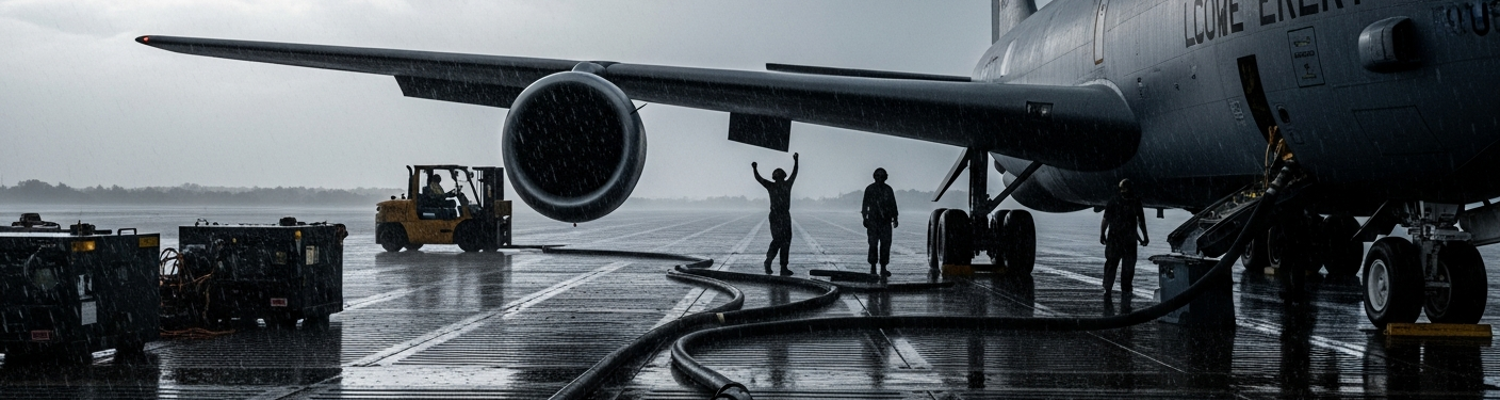

A single B-52 Stratofortress could carry dozens of 750-pound M117 bombs, naval mines, or a combination of AGM-86 cruise missiles and B61 nuclear gravity bombs. Multiplied across the Strategic Air Command (SAC) fleet, this represented a civilization-ending potential. This entire apparatus of global power depended on one of the most volatile commodities in warfare: jet fuel. The tankers that carried it, primarily the KC-135 Stratotanker, were the absolute linchpin of strategic deterrence.
Dispersal was a core tenet of SAC doctrine. To prevent a successful Soviet first strike against concentrated bomber and tanker fleets, the Air Force planned to scatter its assets across a wide array of locations. This concept extended to forward operating locations, often in allied nations, designed to support tankers and enable bombers to remain airborne. Archival evidence (per USAF Manual 88-15) shows this doctrine called for the rapid deployment of tanker elements to airfields completely unsuited for large, jet-powered aircraft. These were often former WWII strips, civilian airports, or designated stretches of highway in West Germany. The plan was to turn these locations into functioning refueling hubs within hours. This task fell to specialized units like the Rapid Engineer Deployable Heavy Operational Repair Squadron Engineers, or RED HORSE.
These self-sufficient engineering units were expected to arrive in an austere environment and perform miracles of rapid construction under the threat of attack. The entire concept was a high-stakes gamble. It traded the security of a main operating base for the theoretical safety of dispersion.
A close review of operational logs reveals the difficulty of this task. Ground support infrastructure at these remote Cold War airfields was either nonexistent or dangerously limited. Instead of paved concrete, RED HORSE teams would lay down thousands of sections of pierced steel planking (PSP), also known as Marston Mat. Each 10-foot section weighed around 66 pounds and had to be interlocked by hand to create a usable, if bumpy, surface over unprepared ground. Jet blast could dislodge these planks or send debris into sensitive engines. There were no permanent hangars. Crews worked in the open, exposed to arctic cold or desert heat, using portable lighting. Fuel was not stored in hardened, underground tanks. It was held in massive, vulnerable, collapsible rubber bladders, sometimes called “blivets.” These bladders, with capacities up to 200,000 gallons, could be deployed quickly but were susceptible to punctures and contamination. The ground was a network of hoses and pumps, all representing single points of failure. The aerospace ground equipment, the power carts, air compressors, and hydraulic test stands, was limited and subject to high failure rates, turning every routine task into a significant challenge.
Strategic dispersal rested on the assumption that ground support equipment, dropped into unprepared fields, would function reliably. A close review of maintenance write-ups from the period demonstrates this assumption was flawed. The mechanical backbone of any forward location, the fuel pumps, power generators, and aircraft starter carts, was a constant source of failure. Portable fuel pumps, essential for moving jet fuel from rubber bladders to the aircraft, were particularly notorious. Maintenance records indicate that failures were frequently traced to contaminated fuel clogging filters. Debris, water, and sediment from the bottom of the hastily deployed bladders would get sucked into the pump mechanism, leading to engine stalls.
Power generation was another point of constant struggle. The gas turbine-powered A/M32A-60 “Dash 60” cart, a combination generator and air source, was a common sight, as was the diesel A/M32A-86. These units provided the electricity for lighting, tools, and avionics testing. They were also prone to failures that could paralyze operations. Maintenance bulletins frequently cited issues with fuel control solenoids and faulty ignition boxes. Turbine blades could be fouled by dust, leading to overheating. The failure of a single generator could plunge a maintenance tent into darkness. More pressing was the MA-1A air starter cart, necessary to spin the jet engines of a B-52 or KC-135. Its failure meant an aircraft was a static target, unable to get airborne. The loss of a starter cart could ground every bomber it was meant to support.
The physical environment waged its own war on the machinery. Extreme weather had a profoundly degrading effect on equipment. In the intense cold of a Greenland or Norwegian winter, the challenges were immediate. Standard lubricants and hydraulic fluids would thicken, preventing systems from operating. Rubber hoses and seals became brittle, cracking under pressure and leading to fluid leaks difficult to repair with frozen fingers. Batteries would lose a significant portion of their cranking power in sub-zero temperatures. During exercises in arid regions, the opposite problem occurred. Fine sand and dust would infiltrate every mechanism, clogging air filters on generators and abrading electrical contacts. The intense heat could cause vapor lock in fuel lines and degrade rubber components. After-action reports from exercises repeatedly noted that equipment designed for temperate climates could not withstand the sustained punishment of these operational extremes.
Dispersal hinged on the idea that billion-dollar aircraft could be maintained far from their home bases. A review of maintenance after-action reports reveals this was a fiction. The most significant handicap was the lack of specialized workshops. At a main operating base in the United States, an engine change on a KC-135 Stratotanker was a complex but routine procedure. It was performed inside a climate-controlled hangar with level concrete floors, overhead cranes, and every tool at hand. At a dispersed operating location, the same task became a hazardous undertaking. Maintenance crews from units like the 819th RED HORSE Squadron were expected to perform depot-level repairs in the open air.
There was no protection from the elements. A sudden downpour could introduce water into a partially assembled J57 turbojet engine, risking internal corrosion. A gust of wind could send dust into open hydraulic lines or sensitive avionics bays, creating conditions for a future in-flight emergency.
Heavy repairs, such as replacing a damaged landing gear assembly, were rendered nearly impossible. Such procedures require absolute stability and precision, using heavy jacks to lift the airframe and laser alignment tools to ensure components are installed within microscopic tolerances. On the uneven surface of interlocking steel mats laid over soft ground, this was a gamble. A maintenance chief overseeing a KC-135 bogie change during a REFORGER exercise noted his primary fear was a jack shifting in the mud. This could cause the entire multi-ton aircraft to settle, potentially shearing the jack point and crippling the airframe beyond field repair.
The doctrinal solution was improvisation, primarily through makeshift shelters. These were not sophisticated, deployable hangars; they were often little more than heavy-duty canvases and ropes. Archival photographs from exercises like “Certain Challenge” show maintenance teams stretching tarps from the wing of one KC-135 to the tail of another, creating a crude roof over a third aircraft. In other cases, ground support vehicles were arranged in a rectangle to serve as a windbreak, with a tarp lashed over the top. These setups offered minimal protection. A tarp, improperly secured, could act as a sail in high winds, ripping free and striking the aircraft skin. In freezing rain, the weight of accumulated precipitation could cause the entire structure to collapse onto the work area.
Inside these flapping shelters, maintainers worked under pressure. The goal was to reduce the aircraft’s time on the ground. Tasks that were straightforward in a depot, like troubleshooting a faulty fuel-quantity indicator system, became maddeningly difficult. With only portable light stands casting long shadows, mechanics would drop essential fasteners into the mud. The constant drone and exhaust fumes from diesel generators filled the enclosed space. Contamination was a constant threat. A single grain of sand blown under the tarp and into an open hydraulic reservoir could score the inside of an actuator, leading to a slow leak that might only become apparent at 30,000 feet. Every repair completed under these conditions was a testament to the crew’s skill and a roll of the dice.
The strategic dispersal concept came down to a simple arithmetic of consumption. A single KC-135 required more than 31,000 gallons of fuel for a mission load. A deployed wing of fifteen tankers could burn through nearly half a million gallons in a single sortie cycle. This did not account for the fuel consumed by the B-52s they were there to support. The established military supply chain, built on massive depots and pipelines, was an inflexible instrument, incapable of responding to the demands of a dispersal during a crisis. The official military-specification fuel, JP-8, was a carefully refined kerosene with a complex package of additives for anti-icing and corrosion inhibition. There was never enough of it in the right place at the right time.
A review of quartermaster operational doctrine reveals the accepted, high-risk solution: local procurement. Upon arrival at a dispersed location, a critical task fell to small teams from an attached Quartermaster Petroleum Platoon. Their mission was to go out into the surrounding civilian economy and acquire massive quantities of jet fuel. This was a chaotic scramble for resources. Operating with payment vouchers, these non-commissioned officers would fan out to regional airports, commercial fuel depots, and even large agricultural cooperatives, negotiating on the spot for their entire stock of Jet A-1 fuel. They were commodity traders dropped into a war zone. The fuel they secured was then transported back to the airfield in whatever vehicles could be hired, often civilian tanker trucks of questionable maintenance.
This improvisation introduced a near-certainty of contamination. Civilian Jet A-1 is chemically almost identical to military JP-8, but it lacks the military-specified additive package. More dangerously, its handling and storage standards were inconsistent. Archival analysis of engine failure incidents from this period repeatedly points to contaminated fuel as a primary cause. Water was the most common enemy. It would enter the supply chain through condensation in poorly maintained civilian storage tanks or rainwater leaking through bad seals. Once this tainted fuel was pumped into the collapsible fuel bladders, the water would settle to the bottom, right where the fuel pump intakes sat. A second killer was microbial growth. Bacteria and fungi could thrive at the interface between water and jet fuel, forming a thick sludge that could clog filters and corrode an aircraft’s integral wing tanks.
The results were recorded in maintenance logs. Consider a KC-135 from the 100th Air Refueling Wing, forward-deployed to a Spanish air base during a NATO drill. The crew takes on a full load of fuel, a blend of pre-positioned JP-8 and thousands of gallons of Jet A-1 purchased that morning from a commercial distributor. Before loading, a POL (Petroleum, Oils, and Lubricants) airman performs a field quality check using a standard test kit. This involves visually inspecting a sample and using a chemical test to detect free water. The sample passes. What the test cannot detect is the finely suspended water dissolved within the fuel itself, or the dormant microbial spores from the bottom of the Spanish depot’s tank. The tanker takes off, climbing through 25,000 feet. The outside air temperature drops below minus 40 degrees Celsius. The dissolved water precipitates out and freezes into microscopic ice crystals. These crystals flow through the fuel system until they accumulate on the fine mesh screens of the engine fuel controls, slowly starving the J57 turbojets. An engine flames out, then a second. Only by executing an emergency descent into warmer air does the crew manage to restart the engines. A subsequent inspection of the fuel tanks reveals the beginnings of microbial sludge and internal corrosion, a direct result of sourcing fuel from outside the closed military system.
Strategic Air Command’s operational plans during the Cold War reveal a reliance on a supply chain that was fundamentally brittle. The doctrine of dispersing bombers and tankers to austere locations was built on the assumption that JP-8 fuel could be delivered on demand. The established logistics network, including the NATO Pipeline System, was designed for predictable, peacetime consumption rates at large bases. It was an inflexible system of depots and pipes, unsuited for the sudden demands of a dispersed force. A real-world activation would have seen this network overwhelmed, with fuel shipments competing for priority on congested rail lines and roads.
This was operational paralysis.
The unreliability of these delivery schedules became a recurring issue during NATO readiness exercises. After-action reports from REFORGER exercises document instances where tanker wings, deployed to secondary airfields in West Germany, were left waiting for fuel convoys that were days behind schedule. A POL team at a dispersed site might have their fuel bladders ready, but the trucks from the nearest depot would be stuck in military traffic. Planners at SAC headquarters in Omaha could move assets across the globe, but they could not guarantee the timely arrival of a few dozen tanker trucks on a German backroad.
The consequences of these fuel shortages were immediate. A deployed KC-135 wing commander, facing half-empty fuel bladders, had to make impossible choices. Archival training scenarios show that a planned twelve-ship tanker mission, designed to support a wing of B-52s on airborne alert, would be slashed to a four-ship launch. This meant that the bombers, already in the air, would receive significantly less fuel than planned. Their time on station would be cut by hours.
This reduction in available fuel had cascading effects. Some bombers would be forced to return to base early. Others might have to divert to other allied airfields, disrupting the alert cycle. In some documented exercise scenarios, KC-135s were forced to perform “buddy-buddy” refueling, where one tanker offloads fuel to another simply to get the second tanker far enough forward to reach its assigned bomber. This was a grossly inefficient use of a limited resource. Every gallon of fuel burned to refuel another tanker was a gallon that could not go to a B-52. This fuel uncertainty created a constant state of flux, with crews being briefed for missions that were then canceled. The failure to deliver jet fuel directly translated into a tangible degradation of the United States' nuclear deterrent. A B-52 that could not be refueled was a short-range aircraft.
The official supply system was inadequate. A review of maintenance deviations from Cold War-era SAC exercises reveals a culture of unauthorized repairs, born from the necessity of keeping tankers mission-capable. The logistics chain was too slow to support the tempo demanded by dispersal doctrine. When a critical component failed on a KC-135 or its older cousin, the KC-97, waiting for a replacement part from a depot was not an option. This forced maintenance crews into doctrinal defiance, where technical orders were treated as guidelines.
This was most evident in cannibalization. At any given austere strip, it was common for one tanker to become a designated “hangar queen,” an unofficial parts depot. A KC-135 with a cracked wing spar, a non-repairable issue in the field, would be systematically stripped to keep its brethren flying. A functioning hydraulic pump would be pulled to replace a failed unit on another jet. An entire engine control unit or flight control actuator would be removed and installed on an otherwise healthy aircraft. This process, while effective, created an administrative backlog and risked installing a component that was itself close to failure. Archival maintenance forms (such as AFTO Form 781A) show these swaps were often documented with vague language to avoid scrutiny.
The older KC-97 Stratofreighter, with its four complex Pratt & Whitney R-4360 Wasp Major radial engines, presented its own challenges. These 28-cylinder engines were notorious for oil leaks. Field repairs often involved fabricating new gaskets from inappropriate materials or applying non-specified sealants to stop a leak long enough for one more mission. A common unauthorized fix involved bypassing faulty cylinder head temperature sensors, a dangerous gamble that could allow an engine to overheat without warning.
When cannibalization was not enough, crews turned to the local economy. After-action reports show maintenance teams regularly procuring materials from civilian suppliers to fabricate replacement parts. A maintenance NCO might take a jeep into a nearby West German town to buy high-pressure hydraulic lines from an agricultural supply store or sheet metal from a local fabricator. The risks were enormous. That hydraulic hose, designed for a tractor, was not rated to handle military-grade hydraulic fluid or the temperature extremes at 30,000 feet. The sheet metal, of an unknown alloy, might be used to patch non-structural damage, but its use violated every principle of airframe engineering. Wires and electrical connectors were sourced from automotive shops to repair non-critical systems, introducing components that lacked the required shielding and vibration resistance. Every one of these field-expedient repairs was a deviation from airworthiness standards, a silent bet that the locally sourced part would hold together.
Personnel accounts from SAC dispersal exercises reveal a state of continuous pressure on enlisted ground crews. The doctrine hinged on their ability to generate sorties under temporary and unstable conditions. For a POL airman or a KC-135 crew chief, this translated into a relentless operational tempo. Schedules were nonexistent. Crews worked until the job was done, with 12-hour shifts being the minimum during readiness drills like REFORGER. The work itself was physically punishing. The air at a dispersed site was a thick cocktail of atomized JP-8 fuel, hydraulic fluid, and the roar of A/M32A-60 generator carts and aircraft auxiliary power units.
Pressure to meet sortie generation goals was absolute. A wing commander’s performance was judged by the ability to meet the numbers dictated by unannounced Operational Readiness Inspections. This pressure flowed directly downhill to the 19-year-old airman connecting a fuel hose in the freezing rain. Every minute an aircraft sat on the ground, it was a vulnerable target. The objective was to turn it around as quickly as possible. This created an environment where procedural shortcuts became a constant temptation. A fuel spill was not just an environmental hazard but a time loss that could draw the ire of the chain of command. A dropped tool or a cross-threaded bolt was a potential crisis that could cause a mission to be scrubbed.
Living under the constant threat of global thermonuclear war exacted a severe psychological toll. The mission these airmen supported was the deterrence of an apocalyptic exchange. They worked daily on and around aircraft that were the primary delivery system for this deterrence, handling the fuel that would allow nuclear-armed B-52s to reach targets inside the Soviet Union. This created a unique form of chronic stress. Every task was performed with the knowledge that a mistake could have consequences far beyond a normal industrial accident. A mid-air collision during refueling was a potential nuclear incident, as demonstrated by the 1966 Palomares B-52/KC-135 accident in Spain.
The act of refueling itself was a source of acute stress. Operations were chaotic, conducted in all weather, around the clock. An airman responsible for the “wet wing” defueling and refueling of a KC-135 had to navigate a labyrinth of fuel cells and valves inside a cramped, vapor-filled space. Outside, the flight line was a hazardous dance of fuel bowsers and pressurized hoses. The potential for static electricity discharge, a primary cause of ramp fires, was ever-present, requiring strict adherence to grounding procedures even when crews were fatigued. The physical effects of exposure to jet fuel, dizziness, skin irritation, and nervous system depression, were a daily reality for POL and maintenance personnel. The combination of time pressure, hazardous materials, and the stakes of the mission created an environment where combat fatigue could set in without a single shot being fired.