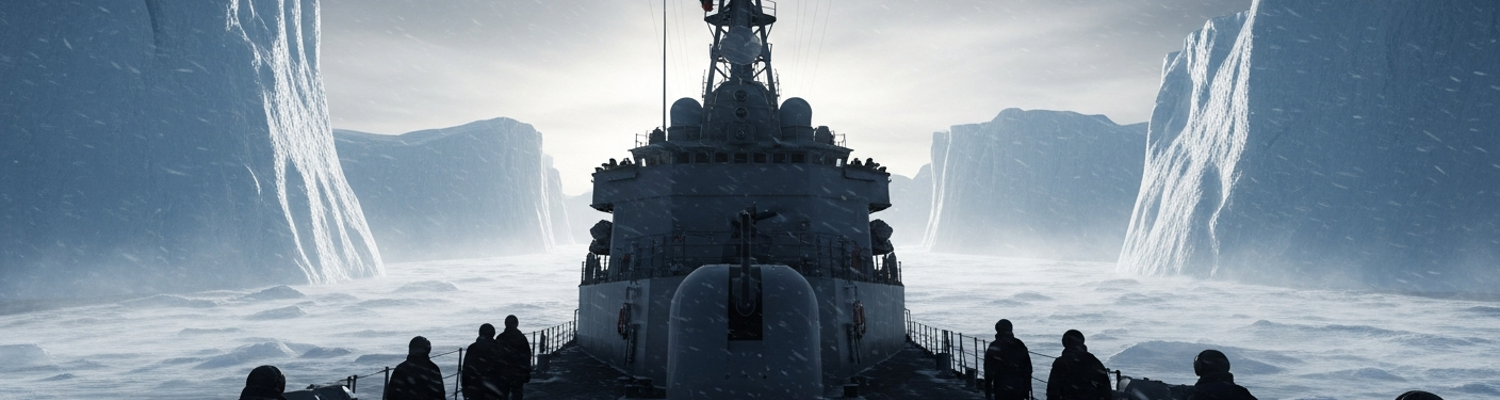

Petty Officer Second Class David Jensen listened. The air in the USS O’Bannon’s Combat Information Center was thick with ozone and stale coffee, but the sound was in his headset. A low, rhythmic hiss from the passive sonar array towed a mile behind the destroyer. His job, performed a thousand times, was to filter the Arctic cacophony. He dialed down sensitivity, ignoring the groans of ice floes and the chatter of snapping shrimp. His fingers moved with practiced ease across the AN/SQS-53 sonar display’s control panel. He was hunting for the specific pump signature of a Victor-III class submarine, a sound drilled into him at Fleet Sonar School. The mechanical harmonics that began to resolve from the static were not that. Too regular for geology. Too quiet for any known Soviet vessel.
This was Operation Frozen Gauntlet.
Declassified naval archives (NARA Record Group 38) show the deployment, designated Task Group 21.4, was an exercise in calculated aggression. The force was built for forward anti-submarine warfare. Two Spruance-class destroyers, the USS O'Bannon and USS Comte de Grasse, formed the ASW core. Their powerful gas turbine engines and massive sonar domes made them ideal hunters in the deep, cold waters of the Norwegian Sea. Air cover and long-range missile defense were provided by the new Aegis cruiser, the USS Ticonderoga. Somewhere in the depths ahead, the Los Angeles-class nuclear attack submarine USS Bremerton acted as a silent scout. Their station was a box on a map in the Barents Sea approaches, a deliberately provocative position to test the outer defenses of the Soviet Northern Fleet’s bastion. The orders from Commander, Second Fleet were direct: establish an anti-submarine screen, assert freedom of navigation, and report all Soviet responses. Mission planners in Norfolk had not fully accounted for the effect of sustained sub-zero temperatures on the hydraulic systems of the destroyers’ deck equipment or the increased brittleness of radar waveguide seals.
The anomalous contact, designated Master-1, was classified as a probable submarine within minutes. Its acoustic signature matched nothing in the ship’s recognition library, sending a ripple of tension through the CIC. The O’Bannon’s captain, a career surface warfare officer, faced a difficult choice. Remaining on passive sonar risked losing the target at the extreme edge of detection. Bridge-to-CIC audio logs show the captain authorizing a shift to active sonar. The powerful SQS-53 transmitter flooded the water with high-energy sound waves. The response was immediate. The sonar repeater showed the target accelerate, but not away. It maneuvered with precision, tucking itself into the acoustic shadow of a lumbering Finnish cargo freighter passing through the patrol area. The Soviet vessel was now acoustically invisible, masked by the freighter’s propeller noise. The tactical action officer aboard the O’Bannon confirmed the ship's Mk 116 anti-submarine fire control system had a solution. The ASROC launchers on the foredeck were armed.
The confrontation was a direct test of the 1980s Maritime Strategy. This forward-leaning doctrine advocated for attacking the Soviet fleet in its home waters at the outset of any conflict, a significant departure from the previous containment posture. Operation Frozen Gauntlet was one of the first live implementations of this aggressive policy. The appearance of a submarine so quiet it could nearly evade a Spruance-class destroyer’s top-of-the-line sensor suite was a shock. It confirmed intelligence whispers of a new generation of Soviet submarine technology designed to close the acoustic gap the US Navy had long enjoyed. The incident with the freighter exposed a flaw in the operational plan. The rules of engagement were not equipped for the complex realities of a crowded, contested battlespace where military and civilian traffic intermingled. The captain of the O’Bannon could not risk harassing a neutral vessel to reacquire the target without creating an international incident far exceeding his authority. The Soviet submarine had used both physics and international law as a shield.
The Soviet response was not proportional. Within hours of the O'Bannon's sonar contact, the SPY-1A radar screens in the Ticonderoga's Combat Information Center began to populate. Declassified intelligence summaries show the Soviet Northern Fleet sortie was a massive show of force. From the Kola Peninsula, a pair of Tupolev Tu-95 Bear-D maritime reconnaissance aircraft established a high-altitude patrol pattern, their search radars systematically mapping the American task group’s position for unseen strike elements. They were soon joined by a full squadron of Tu-22M Backfire bombers, supersonic aircraft built to hunt carrier groups with heavy, stand-off anti-ship missiles. On the surface, radar tracks resolved into two distinct Soviet surface action groups. The first was led by a Kirov-class nuclear-powered battlecruiser, one of the largest and most heavily armed surface combatants in the world. It was screened by a Kara-class cruiser and two Krivak-class frigates. The second group was built around a Slava-class cruiser, the Soviet's own phased-array radar missile ship, and was accompanied by three additional destroyers. The American task group was bait.
This array of forces presented the commander of Task Group 21.4 with an impossible tactical problem. The core of the Soviet threat lay in its layered, multi-axis missile capability. The Kirov and its escorts carried dozens of P-700 Granit anti-ship missiles, seven-ton weapons capable of supersonic speeds and designed to be fired in swarms. Doctrinal analysis of Soviet naval tactics indicated these swarms operated as a network; one missile would fly high to designate targets for the others approaching at wave-top height. If the spotter was shot down, another missile in the swarm would automatically take its place. This attack would be simultaneous with air-launched Kh-22 missiles from the Backfire bombers. While the USS Ticonderoga's Aegis Combat System was the most advanced naval air defense system in the world, its fire control channels could be saturated. It could not kill them all. The US task force was also operating within easy range of Soviet land-based naval aviation, adding another threat vector.
Then, silence.
After the initial surge of Soviet forces onto the tactical plot, an unnatural stillness descended. The Soviet surface groups took up shadowing positions just over the horizon, their radar emissions painting the American ships, their weapons cold. The Backfire bombers circled in wide orbits far outside missile range. On the bridge of the USS Comte de Grasse, lookouts could occasionally spot the superstructure of a Krivak frigate cresting a distant wave before it disappeared. Aboard the American ships, crews remained at General Quarters. Damage control teams were suited up below decks. Missile launch keys were in their locks. For hours, the two forces drifted in a state of suspended aggression. The airwaves were silent. No challenges. No warnings. It was a confrontation of presence, a test of nerve conducted in the crushing cold of the high Arctic. The operational logs from the Ticonderoga show a steady stream of requests to higher headquarters for clarification on the rules of engagement. The requests went unanswered.
Aboard the USS Ticonderoga, the tactical crisis was rapidly superseded by a bureaucratic one. Maintenance logs from Operation Frozen Gauntlet show that at 04:38 local time, an engineering watchstander noted a pressure drop in the nitrogen circulation system for the aft-facing array of the SPY-1A radar. The extreme and sustained sub-zero temperatures had caused a hairline fracture in a section of cast aluminum waveguide, a component channeling the radar’s microwave energy. The operational impact was severe. A significant portion of the cruiser’s southern-facing radar coverage was now degraded, creating a blind spot toward the shadowing Soviet groups. Standard procedure called for immediate replacement, but an inventory check revealed the unthinkable. There were no spare waveguide assemblies of that type aboard the ship. The failure was considered so statistically improbable by the system’s designers that it was not included in the ship’s Coordinated Shipboard Allowance List. This oversight brought the ship’s Supply Officer into a direct and crippling conflict with Title 32 of the Code of Federal Regulations, specifically the procurement protocols in section 47.11a, intended for peacetime fiscal management.
These specific fiscal controls were not written by warfighters but by Pentagon comptrollers in the 1970s. Their express purpose was to enforce accountability and prevent wasteful spending by standardizing the procurement process across the Department of the Navy. Under these rules, ordering a non-stocked, high-value part like a SPY-1 waveguide section was a multi-stage, deliberate process. It required a formal request routed through the Naval Supply Systems Command (NAVSUP), verification of necessity, a search of shore-based inventories, and, if the part was not in a depot, the solicitation of bids from approved vendors. The framework assumed the ship was operating in a non-hostile environment, where a delay of weeks for a replacement part was an acceptable logistical inconvenience. It was a system designed for routine maintenance in Norfolk, not for a forward-deployed warship facing down a fleet of missile-armed bombers in the Barents Sea.
The result was procedural paralysis. The Ticonderoga’s supply officer transmitted a CASREP (Casualty Report) message of the highest precedence, detailing the equipment failure and its impact on mission capability, urgently requesting an emergency air-drop of the required part. The message was received by the Commander of the Atlantic Fleet, but the material request portion was automatically routed to a NAVSUP detachment in Mechanicsburg, Pennsylvania. There, procurement officers, bound by the Code of Federal Regulations, began the painstaking process of sourcing the component. They had to follow the letter of the law, a law written for a world without Backfire bombers circling overhead. While accountants in Pennsylvania searched for a part number, the commander of Task Group 21.4 was forced to physically reorganize his defenses. The USS Comte de Grasse was ordered to break its ASW patrol and shadow the Ticonderoga’s stern, using its own sensors to cover the Aegis cruiser’s new blind spot. This decision stretched the anti-submarine screen dangerously thin, compromising the task group’s primary mission.
The cascade of equipment failures extended beyond the Ticonderoga’s primary radar. An analysis of task group communications logs reveals a systemic deficiency in supposedly “ice-hardened” gear. On the USS O’Bannon, the primary high-frequency antenna array for long-range communications began to exhibit a high Voltage Standing Wave Ratio, indicating a severe impediment to its broadcast power. An inspection team discovered that the specialized coaxial cable, procured as a standard MIL-SPEC item, had become brittle in the sustained cold. Its outer insulation had cracked, allowing wind-driven sea spray to penetrate the shielding, where it promptly froze into an insulating layer of ice around the center conductor. This crippled the destroyer’s ability to send or receive secure voice and data transmissions over the horizon. The ship was forced to rely on less-secure, line-of-sight UHF radio that could be easily intercepted by the shadowing Soviet intelligence-gathering vessels.
Archival procurement records show that the MIL-SPEC standards for components like coaxial cables were not written with the extreme, persistent cold of the high Arctic in mind. The regulations codified in Title 32 prioritized uniformity and cost-control across the fleet, creating a system hostile to specialized equipment. While commercial off-the-shelf (COTS) cables with superior low-temperature performance were available from Scandinavian manufacturers, the Navy’s procurement process was not structured to acquire them. Approving a non-standard component from a foreign, non-DoD-approved vendor was a bureaucratic ordeal that could take years, a timeline incompatible with the urgent operational needs of a forward-deployed task force. The system was designed to buy thousands of identical items for a global fleet, not a handful of specialized parts for a niche environment. The O’Bannon was equipped with gear that met legal requirements but failed operational physics.
The procurement blind spots also created a more immediate physical danger. Standard naval surface-search radars were notoriously unreliable for spotting smaller ice hazards like growlers, dense, nearly submerged chunks of glacial ice that can weigh thousands of tons. Bridge logs from the USS Comte de Grasse indicate two near-misses with such icebergs detected by lookouts only at the last minute, not by the ship’s AN/SPS-55 radar. The radar returns from growlers were often indistinguishable from sea clutter. Specialized commercial ice-penetrating radar systems that could mitigate this risk existed, but like the ice-hardened cables, they were outside the massive, inflexible DoD procurement system. There was no National Stock Number for such a device, and therefore no straightforward path to acquiring one. This left the safety of the billion-dollar warships and their crews dependent on the eyesight of sailors exposed to the arctic wind.
The emergency itself failed to override the bureaucracy. The Category 4 CASREP message transmitted by the Ticonderoga regarding its failed SPY-1 waveguide was a document of the highest possible urgency. Per procedure, the message was received simultaneously by fleet commanders and by NAVSUP in Mechanicsburg. While operational commanders understood the tactical crisis, the supply officers in Pennsylvania were bound by a different set of imperatives. Their legal mandate was to follow a deliberate, multi-step process for sourcing a high-cost, non-stocked part. The concept of an emergency that required circumventing this process did not exist in their framework outside a formal declaration of war. The request for the waveguide sat in an electronic queue, designated as "Unfunded Requirement," pending a fiscal review, while the Task Group it was meant to protect was left half-blind in hostile waters.
The breakdown began not with a bang, but with a diagnostic alert. Communications logs from the USS O’Bannon show the high-frequency radio array, the ship’s primary link for secure, over-the-horizon messaging, was rendered inoperative. The high Voltage Standing Wave Ratio alarm indicated the transmitter’s power was being reflected back into the radio room, a condition that can physically damage the unit. An inspection team determined the MIL-SPEC coaxial cable leading to the masthead antenna had become brittle and cracked. This single component failure severed the destroyer’s connection to the task group’s command-and-control network. The ship was now reliant on line-of-sight UHF transceivers, the AN/WSC-3 radio sets, for all communications.
This was not a tenable solution.
Any transmission on these frequencies would be instantly intercepted by the Soviet Vishnya-class intelligence gathering ship (AGI) shadowing the task force. These purpose-built spy ships were floating electronic nets, designed to record and analyze every stray radio wave. The American task group commander, operating from the Ticonderoga, could no longer send encrypted tactical data or complex orders to the O’Bannon without the Soviet command structure listening in. The flow of information from the Aegis cruiser’s powerful sensors to its forward ASW screen was choked off. Command authority fragmented. The captain of the O’Bannon was now operating in a bubble, forced to make tactical decisions based on his own ship’s limited sensor picture, blind to the wider operational situation.
The tactical geometry of the task group began to unravel. The primary mission, establishing a robust anti-submarine screen, had already been compromised when the USS Comte de Grasse was pulled back to cover the USS Ticonderoga’s radar blind spot. Now, with the O’Bannon deaf to long-range command, the last vestiges of a coordinated ASW posture dissolved. Operational logs indicate the O’Bannon was forced to abandon its assigned patrol sector and steam closer to the main body, simply to remain within the limited range of the unsecure UHF radios. The task group, designed to project power over a wide area, was now huddled together. This left a massive gap in the ASW barrier, a gap through which the new Soviet submarine, Master-1, could now pass completely undetected.
Even the task group’s submerged asset, the attack submarine USS Bremerton, was lost to the command structure. Standard procedure for communicating with a submerged submarine involved broadcasts from specialized TACAMO aircraft, which relayed Very Low Frequency (VLF) signals capable of penetrating seawater. With the surface ships unable to securely relay a request for such a broadcast, the Bremerton continued to operate on its last known orders, unaware the surface force it was scouting for was crippled. After-action reports (AAR 21-4-84) show a force that had ceased to function as a unified command. The Ticonderoga was half-blind, the Comte de Grasse was out of position, and the O’Bannon was on a short electronic leash.
In the cramped electronics workshop of the USS O’Bannon, the tactical collapse manifested as a series of component failures. A review of the ship’s maintenance logs shows a desperate, round-the-clock effort to keep the ship’s last lines of communication open. Lieutenant Junior Grade Michael Chen, the ship's Electronics Materiel Officer and a recent Naval Academy graduate, found himself leading this fight. His logs document a growing disillusionment, not with his crew, but with the procurement system that had supplied him with gear that was legally compliant but operationally inadequate. His primary focus became the ship’s AN/WSC-3 UHF transceivers, the “Whiskey-3” radios that were now the O’Bannon’s only link to the task group. The extreme cold was causing the final power amplifier modules within the radios to fail at an alarming rate. The thermal stress from repeated heating during transmission and rapid cooling during standby was causing microscopic fractures in the ceramic substrates of the amplifier chips.
It was a problem of physics.
The engineering team under Chen’s direction began a systematic campaign of cannibalization. The ship was a closed system, a sealed box of resources. After-action reports reveal the ship’s secondary navigation radar, an AN/SPS-64, was one of the first systems to be stripped. Its high-power RF driver modules contained transistors that, while not a perfect match, were far more robust than the ones failing in the WSC-3 radios. Chen’s team, consisting of two senior enlisted Electronics Technicians and a handful of junior sailors, established a grim production line. One team would carefully desolder the required transistors and their associated heat sinks from the radar boards. Another team would then attempt to integrate these scavenged parts into the damaged UHF radio chassis. They were operating without schematics for such a modification, relying on the senior technicians' decades of experience and an intuitive understanding of radio frequency engineering.
The core of the effort was crude battlefield engineering. The scavenged transistors from the SPS-64 radar were physically larger and had different power and impedance characteristics. To make them work, the technicians constructed new mounting brackets out of sheet aluminum cut from a damaged ventilation duct. Heat dissipation was the primary concern. Using thermal paste from the ship’s limited electronics stores, they mounted the transistors to oversized heat sinks also pulled from the defunct radar set. The most complex step was creating a new impedance matching network, a small, hand-built circuit to ensure that power could flow into the new transistor efficiently without reflecting back. A surviving photograph of one modified radio shows this network was built using copper wire stripped from a lighting fixture and small ceramic capacitors taken from a non-essential shipboard intercom unit.
The modified AN/WSC-3 transceiver was a monstrosity of exposed wires and mismatched components, but it worked. A test transmission to the nearby USS Comte de Grasse confirmed a stable, if noisy, communications link. The jury-rigged power amplifier was not efficient and it drew significantly more power from the ship’s electrical grid, but it was functional. Operational logs indicate the O’Bannon was able to re-establish a tenuous data link with the Ticonderoga, receiving short, coded tactical updates every twenty minutes. This improvised fix did not restore the task group to full capability, but it pulled the O’Bannon back from the brink of total isolation. The flow of information, though constricted to a trickle, had resumed. The engineering team had bought the task group commander time, using scrap metal and ingenuity to overcome a systemic failure of procurement.
The immediate response to the cascading equipment failures was a grim, calculated tactical reorganization. The commander of Task Group 21.4, faced with a blind spot in his flagship’s Aegis radar, could not wait for a spare part from Pennsylvania. The request for the SPY-1A waveguide assembly had entered the peacetime procurement system of NAVSUP. Archival evidence shows it was treated not as an urgent warfighting requirement but as an unfunded, non-stock-listed material request that required administrative review. The task group commander’s solution was immediate. He ordered the USS Comte de Grasse to abandon its anti-submarine patrol sector and take up station 2,000 yards astern of the USS Ticonderoga. From this position, the destroyer would use its own AN/SPS-49 air search radar to scan the southern sector, attempting to cover the Aegis cruiser’s new blind spot. This maintained a semblance of a coherent air defense picture, but at a severe cost to the ASW screen.
The environment itself was a constant, grinding adversary. The surface-search radars aboard the destroyers, the AN/SPS-55 sets, proved functionally useless for detecting ice. Bridge logs from the O’Bannon and Comte de Grasse record multiple emergency course corrections to avoid growlers and bergy bits. After one near-miss, where a lookout on the O’Bannon spotted a growler the size of a small house at a range of less than 400 yards, the task group commander was forced to impose new restrictions.
He had to rely on his sailors' eyes.
Maximum speed for the entire formation was reduced to twelve knots, hampering their ability to respond dynamically. On all three surface ships, dedicated “ice lookouts” were posted on the exposed bridge wings for four-hour watches, armed with gyro-stabilized binoculars. This was a brutal duty, exposing sailors to wind chills well below freezing and placing a significant additional strain on the ships’ already taxed watch bills. Maintaining the simple coherence of the naval formation became a primary and exhausting task.
The most desperate fight for coherence was happening inside the ships. Aboard the USS Comte de Grasse, the strain of constant maneuvering and the thermal stress caused a failure in a primary navigation aid. The main console for the AN/SSN-2 Ship's Inertial Navigation System (SINS), which provided precise heading and velocity data for the fire control systems, went dark. Technicians traced the fault to a burned-out power regulation board for the display’s cathode-ray tube. An inventory check confirmed the inevitable: no spares. It was a depot-level repair item. The ship’s lead Petty Officer for electronics maintenance, however, recalled seeing a similar power board inside the chassis of the newly installed AN/UQN-4A Sonar Sounding Set, a sophisticated digital depth finder. Under peacetime rules, cannibalizing one major system to repair another was a court-martial offense. Here, it was the only option. The technicians carefully extracted the board from the depth finder, a system deemed non-essential for the immediate fight.
It did not fit.
The board from the UQN-4A was physically smaller and used a different wiring harness. The technicians fabricated a mounting bracket from a piece of scrap aluminum cut from a damaged food locker. Using wiring diagrams drawn by hand from memory, they began the painstaking process of soldering more than two dozen jumper wires, one by one, from the SINS console’s harness to the scavenged board. They had to bypass the board’s original voltage inputs, routing power directly from the console’s main bus through a resistor scavenged from a teletype machine to step the voltage down. After three hours of delicate work, they restored power. The display flickered to life, but the image was distorted, compressed vertically. The replacement board could not fully regulate the specific deflection voltages required by the older SINS display tube. It was an ugly, unauthorized, and technically improper fix, but it gave the ship’s Tactical Action Officer back his navigation data, displayed on a flattened, but readable, screen.