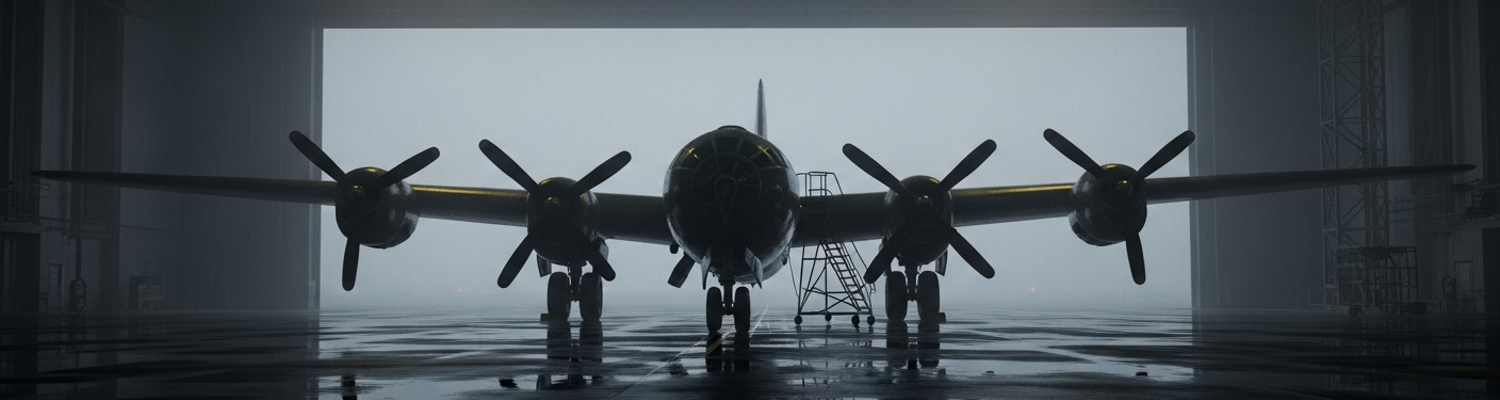

In 1939, the United States Army Air Corps was planning for a war it might have to fight alone. The strategic fear was a Europe overrun by Axis forces, leaving America without forward airfields. This anxiety produced a formal requirement issued in December 1939 for a "superbomber" capable of attacking targets from continental U.S. bases. The specification demanded an aircraft that could fly 400 miles per hour, carry 2,000 pounds of bombs over a combat radius of 2,667 miles, and operate at altitudes previously unreachable. Boeing, having funded its own long-range bomber studies since 1938, presented its Model 345. It was selected as the XB-29. The program would become the single most expensive weapons project of the war, costing approximately $3 billion, a figure that dwarfed the $1.9 billion spent on the Manhattan Project. The delivery system was more expensive than the apocalyptic weapon it was designed to carry.
The Superfortress was an aircraft of entirely new systems. It was one of the first production bombers with fully pressurized crew compartments, a technology from Garrett AiResearch that was a tactical necessity, not a comfort. It allowed the B-29 to operate above 30,000 feet, beyond the effective range of most anti-aircraft artillery and interceptors. The design split the crew into forward and aft pressurized sections, linked by a tunnel over the unpressurized bomb bays. A single puncture from enemy fire could cause a catastrophic explosive decompression. Equally advanced was the General Electric central fire-control system. Gunners used periscopic sights from blisters in the pressurized fuselage to aim four remote-controlled turrets, each armed with .50 caliber machine guns. An analog computer calculated for airspeed, distance, and bullet drop, permitting one gunner to control multiple turrets.
Its heart was also its most persistent flaw. Four Wright R-3350 Duplex-Cyclone 18-cylinder radial engines were rushed into production and proved notoriously unreliable. They were prone to severe overheating, especially the rear cylinders which received poor airflow. The problem was amplified by the use of a lightweight magnesium alloy in the crankcase. Once ignited by an engine fire, the magnesium burned with such intensity it could sever the main wing spar in seconds. Flight crews in the China-Burma-India theater, operating in tropical heat at maximum weight, faced a constant threat of engine failure. A significant number of B-29 losses were from operational accidents, not enemy action.
The danger was not hypothetical. On February 18, 1943, the second XB-29 prototype (serial number 41-0003) experienced an engine fire shortly after takeoff from Boeing Field in Seattle. Boeing’s chief test pilot, Edmund T. Allen, was at the controls. The fire spread to the wing, causing a structural failure that sent the bomber crashing into the Frye and Company meatpacking plant. Allen, his 10-man crew, and 19 workers on the ground were killed. The disaster nearly derailed the entire program. For crews operating from forward bases, the grim joke was that the engine manufacturer was deadlier than the Japanese. Of 414 B-29s lost during the bombing campaign against Japan, archival evidence shows 267 were from engine fires and other operational accidents.
Just as troublesome was the cabin pressurization system. This complex network of seals, ducts, and blowers was a constant source of maintenance failures. Leaks were common. A single puncture from flak could trigger an explosive decompression, instantly filling the cabin with fog and subjecting the crew to the deadly effects of high-altitude exposure. Many crews lost faith in its reliability, deliberately depressurizing the aircraft before entering combat zones. This forced them to fly at lower altitudes, negating the B-29’s primary defensive advantage.
The financial burden was without precedent. The B-29 program's total cost exceeded $3 billion in wartime dollars. This enormous expenditure funded the aircraft themselves, with early prototypes costing over $3.3 million each, and a vast new industrial infrastructure. Massive assembly plants were built in Wichita, Kansas; Renton, Washington; and Marietta, Georgia. The Army Air Forces committed to this gamble early, ordering hundreds of production B-29s months before the first prototype had even flown.
The initial strategic doctrine for the B-29 was built on flawed assumptions. Operation Matterhorn, conceived in 1943, based the bombers in India, using forward airfields in China’s Chengdu Valley to strike Japan. This chained the world’s most advanced bomber to a ruinous logistical arrangement. With the Burma Road cut, every gallon of fuel and every bomb had to be flown over the Himalayan mountain range, a route known as "The Hump". A close review of operational logs from the XX Bomber Command shows B-29s were forced to become their own supply transports. For one B-29 to fly a single combat sortie from China, it required the fuel from multiple other B-29s flying supply runs. Some bombers were converted into fuel tankers, stripped of combat equipment to haul seven tons of gasoline per trip.
The first mission against Japan proper on June 15, 1944, targeting the Imperial Iron and Steel Works at Yawata, exposed the failure. Of 75 aircraft dispatched, only 47 bombed the target area. Post-mission analysis indicated only a single bomb struck the factory complex. Seven B-29s were lost, the majority to accidents and mechanical failures.
This logistical self-destruction was compounded by strict adherence to the doctrine of high-altitude, daylight, precision bombing. The B-29 was the physical embodiment of this theory, designed to fly above 30,000 feet and deliver bombs with supposed pinpoint accuracy using the Norden bombsight. The doctrine, developed for Germany’s large industrial centers, was a poor fit for Japan’s dispersed network of cottage industries. Post-mission photo reconnaissance in late 1944 revealed abysmal accuracy. One analysis from January 1945 showed only 12 percent of bombs landed within 1,000 feet of their aiming point.
The machine’s greatest antagonist was the sky itself. American planners had almost no knowledge of the jet stream, a ribbon of high-velocity wind circling the globe. Over Japan, crews at 30,000 feet encountered winds exceeding 200 miles per hour. These winds made a mockery of precision bombing. A B-29 with a tailwind could find its ground speed pushed over 450 miles per hour, giving the bombardier an impossibly short window to acquire the target. Flying into a headwind slowed the bomber to a crawl, making it a stationary target for anti-aircraft guns. The Norden bombsight could not compute such extreme wind drift. The high-altitude doctrine was broken, not by enemy action, but by fuel logistics and the atmosphere over Japan.
By January 1945, the XXI Bomber Command in the Mariana Islands was failing. The high-altitude campaign under Brigadier General Haywood S. Hansell, a chief architect of the doctrine, produced insufficient results. The pressure from Washington for tangible results became intense. The arrival of Major General Curtis LeMay on January 20, 1945, to relieve Hansell was a direct consequence of this failure. LeMay, a pragmatist known for his results-oriented leadership, was given a clear mandate: succeed where established doctrine had failed.
LeMay’s analysis concluded the B-29’s primary adversary was the atmosphere. His solution was radical. It went against every facet of his crews' training. He ordered an abandonment of high-altitude daylight missions in favor of low-altitude night attacks. The new plan called for individual B-29s, not formations, to approach targets between 5,000 and 9,000 feet. This immediately solved the jet stream problem. Flying at night was a calculated risk based on intelligence suggesting Japan’s night fighter force was small and their ground-based anti-aircraft guns lacked effective radar guidance for low-level targets. The shift also involved a change in munitions from high-explosive bombs to incendiaries, designed to exploit the wood and paper construction of Japanese cities. The objective was no longer to snipe at factories but to burn out entire industrial zones.
To enable this pivot, the B-29 was physically transformed. LeMay ordered the bombers stripped of most defensive armament to save weight and maximize payload. The sophisticated General Electric remote-controlled turret systems, their .50 caliber machine guns, and thousands of rounds of ammunition were removed. In most cases, only the tail gunner position was retained. This measure saved thousands of pounds, allowing each B-29 to carry a larger bomb load, increasing from an average of three tons per aircraft to nearly six tons for the first Tokyo raid. The bombers were loaded with E-46 cluster bombs, which scattered dozens of M-69 napalm-filled bomblets. For the crews, this change was psychologically jarring. They were being sent low and slow over a hostile city in a largely disarmed aircraft.
The largest single air raid of the war unfolded on the night of March 9-10, 1945. Codenamed Operation Meetinghouse, the attack involved B-29s from the 73rd, 313th, and 314th Bombardment Wings taking off from the Marianas. Of the 334 Superfortresses dispatched, 279 reached their target, a densely packed 12-square-mile residential area of Tokyo. Pathfinder aircraft arrived first, dropping incendiaries to create a flaming ‘X’ marking the target. For the next two and a half hours, the B-29s dropped 1,665 tons of bombs.
This was destruction by design. The primary weapon was the M-69 incendiary bomblet. Each was a six-pound, 20-inch-long hexagonal steel tube filled with jellied gasoline, or napalm. They were packed into 500-pound E-46 "aimable clusters," which opened at 2,000 feet, scattering 38 individual M-69s. A cotton streamer deployed from each bomblet, orienting it to strike a roof fuze-first. It was engineered to punch through light roofing material. A few seconds after impact, a timing fuze detonated a small charge, igniting and forcefully ejecting the flaming napalm up to 100 feet. A single B-29 could unleash 1,520 individual fire sources.
The result was a firestorm. The density of the fires, fed by strong winds, coalesced into a single, uncontrollable conflagration. The intense heat generated its own weather system, creating tornadic updrafts so violent they could flip a B-29. Temperatures on the ground reached 1,800 degrees Fahrenheit. The inferno consumed nearly 16 square miles of central Tokyo. Over 100,000 people were killed in a single night, a figure exceeding the initial death tolls of Hiroshima or Nagasaki. The firestorm consumed so much oxygen that many victims died from suffocation. Over a million people were left homeless.
The strategic shift raised profound ethical questions. LeMay’s tactics deliberately targeted entire urban areas. USAAF planning documents from late 1944 show an official authorization to designate Japanese urban areas as acceptable targets. The justification rested on the decentralized nature of Japanese war production, with thousands of small workshops in residential neighborhoods. This logic erased the distinction between combatant and non-combatant. The choice to attack at night ensured civilians would be in their homes. LeMay himself acknowledged that had the Allies lost, his actions would have been prosecuted as war crimes.
The debate over the necessity of the firebombing continues. The primary justification was military necessity, that it would shorten the war and prevent a bloody Allied invasion projected to cost hundreds of thousands of American lives. Proponents argue that Japan’s leadership showed no willingness to surrender and only overwhelming destruction could force an end to the conflict. Conversely, a large body of opinion holds that the deliberate targeting of civilians was a war crime. Critics point out that by 1945, Japan’s navy was neutralized and its cities faced starvation from a naval blockade, suggesting surrender could have been achieved without mass killing.
The devastation of Japan’s cities directly contributed to the internal surrender debate. Archival records from the Japanese Supreme Council for the Direction of the War, the "Big Six," reveal a paralyzed leadership. The hardline military faction remained committed to a final battle. However, the firebombing had a severe impact on civilian morale. An estimated 8.5 million people fled the cities. While military leaders were unmoved by civilian suffering, Emperor Hirohito and moderate civilian leaders were profoundly affected. In his surrender broadcast on August 15, 1945, Hirohito referenced the enemy’s use of a "new and most cruel bomb" and its toll on innocent lives as a reason for ending the war. While this was a direct reference to the atomic bombs, the groundwork had been laid by months of relentless firebombing that had already obliterated 67 Japanese cities.
The B-29’s operational peak arrived with a weapon that redefined global power. A special batch of bombers, designated "Silverplate," were heavily modified. Assigned to the 509th Composite Group, they were stripped of all gun turrets except the tail position. Their bomb bays were altered with new pneumatic doors and a custom release mechanism for the atomic bombs. On August 6, 1945, the Silverplate B-29 Enola Gay dropped the "Little Boy" device on Hiroshima. Three days later, Bockscar dropped the "Fat Man" bomb on Nagasaki. The B-29 remains the only aircraft to have delivered nuclear weapons in combat.
Its moment of absolute power was fleeting. The same jet propulsion technology Germany had been developing rendered the piston-engine bomber obsolete. The arrival of the Boeing B-47 Stratojet in 1951 was the beginning of the end. With six jet engines and swept wings, the B-47 could exceed 600 miles per hour. The B-29’s final major combat deployment during the Korean War (1950-1953) exposed its vulnerability. In skies patrolled by Soviet-built MiG-15 jet fighters, the Superfortress became a slow target. Combat reports from late 1951 detail heavy losses, forcing the Far East Air Force to restrict B-29s to night-only missions. The introduction of the eight-engine B-52 Stratofortress in 1955 sealed the B-29's fate. After its brief, violent career, the B-29 was quickly relegated to support roles and retired from USAF service entirely by 1960.