
Garrison Deployment at Daley Barracks
Field service manuals described border security as an orderly sequence of interlocking fire plans and clear lines of authority. Troopers arriving in Lower Franconia found no neat administrative transitions or cooperative planning meetings waiting for them. The 2nd Squadron of the 14th Armored Cavalry Regiment took over the garrison in Bad Kissingen (later designated Daley Barracks) in May 1951, inheriting a cluster of stone buildings originally built for the German military alongside a chaotic tangle of rival jurisdictions. United States Constabulary units, civilian border customs agents, and local German police had already carved the frontier into personal fiefdoms, guarding their radios, informants, and patrol logs with bitter territorial jealousy. Squadron officers spent their first weeks arguing over fuel allocations and jurisdictional boundaries with stubborn Constabulary administrators who resented being replaced, while mechanics struggled in open, unheated bays to coax worn out engines to life.
Mechanics hammered frozen grease out of wheel hubs while staff planners finally pushed the unit into the field to confront the external threat. The squadron assumed forward screening sectors along the rugged Bavarian Thuringian border, where thick pine forests, steep ravines, and narrow dirt tracks made vehicular movement treacherous. State Department liaisons warned the cavalry officers that aggressive patrols might spark an international crisis, while senior Army commanders demanded visible, uncompromising shows of strength along every frontier mile. Subordinate troop commanders had to balance these contradictory orders without clear communication gear, as their tactical radios could not penetrate the iron rich hills to reach headquarters in Bad Kissingen. Patrol leaders quickly realized that help would not come if an incident broke out, forcing young sergeants to make split second decisions whenever armed groups moved through the tree line.
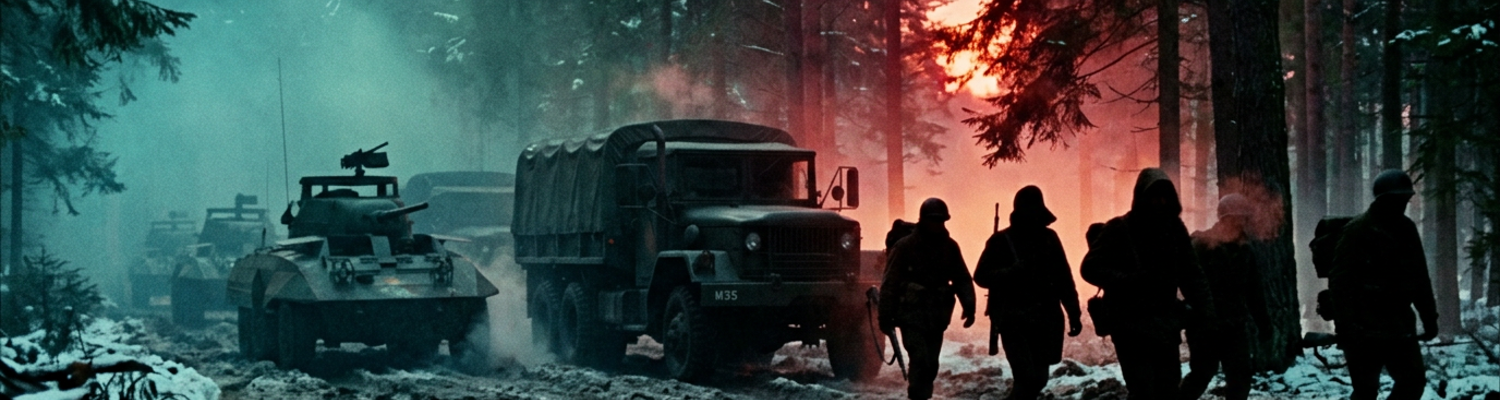
Sergeants established round the clock stationary observation posts and mounted patrols directly opposite Soviet forces, staring through dust covered binoculars at watchtowers and freshly dug trench lines only hundreds of yards away. Soldiers endured biting mountain winds inside crude timber bunkers, rotating every two hours to avoid frostbite while tracking the movements of Soviet motorized infantry and East German frontier guards. M8 armored cars and quarter ton trucks ground through deep mud on narrow trails, frequently snapping drive shafts on hidden rocks and requiring crews to winch their own vehicles out under the open gaze of Red Army spotters. Civilian intelligence officers occasionally arrived unannounced at these forward bunkers, demanding access to logbooks while refusing to share their own reconnaissance reports with the cavalry platoon leaders.
Platoon leaders diverted valuable manpower to escort these secretive intelligence teams, leaving observation posts undermanned during unexpected snowstorms that blinded the valley. Soviet patrols exploited these whiteout conditions by advancing directly to the border markers to photograph the American positions and test response times. Troopers cranked the hand traversers of their vehicle guns, aiming down the barrel sights at shadowy silhouettes in the fog while awaiting orders that consistently failed to come across dead radio nets. Vehicle commanders held their fire, restarted their stalled engines, and shifted their armored cars into blocking positions across the snowy tracks.
Mechanical Degradation of Border Patrol Vehicles
Tracks spun and clutch plates slipped inside the hulls as the six wheeled vehicles strained against the heavy ruts, threatening to strand the crews in full view of Soviet observers. Patrol units relied on aging World War II surplus M8 armored cars that suffered from rusted transfer cases and seized carburetors after years of outdoor storage in wet European depot yards. Drivers wrestled with stiff mechanical shifters while condensed water contaminated the fuel tanks, causing the six cylinder engines to misfire and stall whenever a crew attempted to climb a steep embankment. Constabulary supply officers in Heidelberg and rear area Ordnance depots hoarded the few functional engine blocks, insisting that cavalry border regiments held lower priority than administrative motor pools stationed near Frankfurt. Regimental leaders sent urgent supply requisitions down the chain of command, but bureaucratic staff officers routinely rejected the forms over minor clerical discrepancies and conflicting property books.
Staff officers at Daley Barracks abandoned formal supply channels and authorized mechanics to strip dead hulls in the unheated maintenance bays to keep a fraction of the squadron mobile. Persistent shortages of replacement components forced mechanics to cannibalize non operational reconnaissance vehicles, pulling clean bearings, distributor caps, and brake drums off broken hulls parked behind the stone garages. Motor sergeants kept secret tallies of scavenged parts in desk drawers to conceal the unauthorized swaps from visiting Army inspectors who threatened disciplinary action for violating official maintenance protocols. Soldiers applied blowtorches and heavy sledgehammers to frozen suspension assemblies, fitting salvageable wheel hubs onto operational armored cars while bitter winter winds swept across the open courtyard. Supply officers from neighboring units occasionally inspected the motor pool and attempted to confiscate cannibalized hulls for scrap quotas, triggering shouting matches with cavalry lieutenants who refused to surrender their only sources of spare metal.
Metal fatigue and patchwork repairs took an immediate toll once the armored cars returned to the frontier to conduct tactical patrols. Mechanical breakdowns severely impaired response times and screening continuity along unimproved border trails, creating wide gaps in the observation network whenever a transfer case locked or a steering arm snapped on a rocky slope. Troopers who lost mobility on high mountain passes had to dismount into the deep snow and establish hasty perimeter defenses with carbines and light machine guns while their radios crackled with unanswered distress calls. Civilian customs officials and German border police regularly refused to tow the disabled armored cars or let cavalrymen use their landline phones, insisting that civil agencies had no legal authorization to assist military units. Wrecker teams dispatched from Daley Barracks took hours to crawl through icy forest roads, frequently getting stuck themselves and leaving forward crews isolated without heat or warm rations.
Crews isolated in the freezing forests watched helplessly as Soviet motorized units across the demarcation line recognized the breakdown patterns and exploited the disrupted patrol schedules by staging armed probes into the blind spots. Red Army scout cars advanced along parallel valley roads whenever an American patrol vehicle stalled, using the delays to mark blind spots and chart response speeds along the sector boundary. Troop commanders had to divert their few running quarter ton trucks to tow crippled M8s out of open fields before Soviet cameras could record the recovery efforts. Sergeants tied heavy steel tow cables between the bumpers, engaged low gear, and dragged the dead armored cars back toward Daley Barracks under the direct observation of Soviet border guards.
Jurisdictional Disputes with German Border Authorities
Guards watched steel tow cables drop onto the wet pavement outside the town gates, where the squadron Military Police detachment became ensnared in jurisdictional disputes with nascent West German border guards and local police. German patrolmen established stationary inspection points along the primary avenues leading to Daley Barracks, stopping military supply trucks and demanding written transit permits under new regional civil codes. American MP sergeants refused to acknowledge German authority over Allied military personnel, ordering their drivers to ignore the signal paddles and push past the wooden barricades. German police officials retaliated by denying American military police access to local communications lines and filing criminal trespass complaints with the civil administration in Würzburg. Provost marshals countered these legal challenges by posting armed cavalry guards at every road junction, ordering them to disarm any local officer who attempted to halt an American military convoy.
Convoy escorts and jeep patrols expanded this standoff into the town center after dark, where conflicting authorities clashed over the detention of civilians and enforcement of off post curfews in Bad Kissingen. Military police swept through local gasthauses and alleys to enforce a midnight curfew on all persons found near American billets, loading both soldiers and German nationals into open trucks for processing at Daley Barracks. German magistrates and town officials protested that American occupation ordinances were expiring, insisting that local police held exclusive legal authority over German citizens within the municipality. Desk sergeants inside the provost marshal office refused to release civilian suspects, locking them in temporary holding cells while intelligence teams checked their identities against lists of suspected communist couriers. Municipal officers responded by shadowing American patrol teams on foot, stepping between cavalrymen and civilian suspects to spark physical scuffles on the sidewalks.
Sidewalk scuffles spilled over into checkpoints along the forest roads, as a complete lack of unified protocols created severe friction during emergency border incidents and civilian encounters. Nascent West German border guards operated under ministerial guidelines that required extensive paperwork before initiating any tactical response, whereas cavalry troops operated under standing combat alerts that demanded immediate armed intervention along the frontier line. Confusions peaked whenever refugees breached the barbed wire fences separating East and West Germany, drawing both American scout teams and German border police to the same frontier sector. Cavalry patrols moved to secure escapees for rapid military debriefings, while German border guards seized the refugees to process them through civilian refugee camps. German customs officers positioned their patrol vans across the narrow forest roads to prevent American ambulances and scout cars from transporting wounded escapees to Daley Barracks.
Ambulance drivers revved their six wheel scout cars and pushed the civilian vans into the roadside ditches to clear a path for the medical convoys. West German state officials immediately submitted formal diplomatic complaints to American occupation authorities, citing unlawful property damage and violations of sovereign police powers. Squadron staff officers rejected the protests and compiled operational logs showing that German administrative interference regularly delayed tactical responses to Soviet border probes. Radio nets at Daley Barracks remained unlinked to civilian emergency frequencies, leaving patrol leaders unable to identify whether distant armed formations in the woods were friendly border guards or East German infiltration squads. Squadron leaders responded by issuing direct orders for cavalry gunners to train their machine guns on any unidentified armed group that crossed American patrol routes without prior clearance.
Internal Rivalries Across Seventh Army Provost Commands
Gunners kept their fingers hooked around the spade grips of their machine guns along the border road, but the hair trigger readiness of the cavalry squads quickly ran headlong into a policing crisis inside the rear echelons. Seventh Army Provost Marshal administrators engaged in severe inter agency friction with Army Criminal Investigation Division investigators over who held the legal authority to police troops, secure checkpoints, and conduct searches around Bad Kissingen. Provost marshal officers in Heidelberg viewed their uniformed military police battalions as the supreme law enforcement authority across the entire military community, demanding direct control over all incident reports and weapons confiscations. Criminal Investigation Division agents rejected this command structure entirely, operating in civilian clothes under a separate theater chain of command that granted them broad investigative independence. Desk sergeants under the provost marshal responded by barring CID investigators from entry gates at Daley Barracks, refusing to share daily duty logs and turning away plainclothes agents who arrived to inspect weapons racks and armory records.
Agents bypassed the blocked barracks gates by establishing covert surveillance posts in rented rooms across Bad Kissingen, targeting the illicit supply pipelines that fed the local underground economy. Investigative overlaps and bureaucratic infighting hindered inquiries into black market activities and violent garrison infractions across the surrounding rural district. Military police patrols regularly launched uncoordinated raids on off post taverns and storage barns, kicking down doors and scattering evidence just as plainclothes agents were preparing to catch major smuggling networks in the act. Uniformed desk officers arrested German middlemen and seized truckloads of stolen motor oil, tires, and ration cartons, only to release key suspects before CID detectives could question them about military supply sergeants running the theft rings. Violent brawls between cavalry troopers and local civilians in village dance halls created similar turf wars, with provost marshal patrols hauling bloody soldiers into base lockups while CID agents demanded custody to investigate knife wounds and missing service pistols.
Pistols and case files piled up inside the provost marshal office as administrators and CID supervisors fought over who possessed the legal standing to present testimony to military magistrates. Administrative rivalries led to delayed prosecutions and competing chains of command over base police functions, paralyzing the disciplinary system across Lower Franconia. Staff Judge Advocate attorneys at Seventh Army headquarters received duplicate, contradictory case packets for single offenses, with military police charging suspects with minor insubordination while CID investigators recommended general courts martial for grand larceny. Competing claims of command authority meant base commanders received conflicting orders regarding who was in charge of daily police patrols, guardhouse management, and perimeter security checks. Provost marshals claimed total command over the base stockade, whereas CID leaders demanded unrestricted access to interrogate prisoners and hold material witnesses in separate holding cells. Legal officers had to postpone court hearings repeatedly because the competing agencies refused to cross certify evidence, lockbox custody logs, or ballistics reports.
Reports stacked up on desks while judges dismissed dozens of formal charges as statutory detention limits expired before prosecutors could untangle the conflicting police records. Guardhouse guards at Daley Barracks had to release violent offenders back to their cavalry troops, returning insubordinate soldiers to frontline reconnaissance platoons while their alleged crimes remained unpunished. Squadron officers discovered that stolen weapons, black market fuel, and contraband rations continued to move through Bad Kissingen because neither police organization could mount a coordinated sting operation without the other agency sabotaging the arrest warrants. Provost marshals doubled their gate guards to inspect every arriving supply vehicle, while CID teams shadowed those same gate guards from parked sedans across the street to document instances of police misconduct. Squadron leaders dealt with the ongoing stalemate by assigning their own combat sergeants to patrol the barracks corridors with clubs and sidearms, taking physical custody of their own soldiers to bypass both rival police commands.
Command Prioritization of Frontline Troop Strength
Combat sergeants marched detained cavalrymen out of temporary holding cells and sent them straight back to motor pool grease pits before criminal investigators could file formal charges. Strategic imperatives to defend the Fulda frontier incentivized leadership to maintain squadron operational headcounts at all costs. Seventh Army war plans required the 2nd Squadron to screen eighty miles of rugged border country where Soviet motorized divisions gathered in Thuringia for a potential armored thrust. Observation posts on the high ridges and armored scout cars patrolling the muddy river valleys depended on complete three man and four man crews to operate their radios, heavy machine guns, and vehicle sights. Cavalry troops operating below full table of organization headcounts faced immediate operational downgrades from higher headquarters, stripping local troop commanders of their authority and triggering disruptive administrative audits from rear echelon inspectors. Staff officers at Daley Barracks calculated that losing a single trained gunner or mechanic weakened the frontline defense far more than any garrison infraction committed in the taverns of Bad Kissingen.
Officers across the forward reconnaissance troops translated this tactical reality into an unwritten policy of garrison protection. Frontline commanders systematically overlooked severe personnel misconduct to prevent readiness downgrades. Troopers who engaged in drunken street fights, crashed tactical trucks into civilian fences, or sold military fuel on the regional black market avoided formal disciplinary hearings. Officers quietly discarded written complaints submitted by West German municipal police, tossing civilian damage claims into company wastebaskets rather than forwarding them to the judge advocate general in Frankfurt. Squadron leaders handled violent assaults and property destruction with internal punishments, ordering soldiers to dig drainage ditches, repair armored car suspensions through the night, or endure physical beatings from their platoon sergeants inside locked supply rooms. Stockade sentences that would remove a scout car driver from the daily patrol schedule remained out of the question as long as Soviet border guards watched the sector from elevated wooden observation towers.
Towers on the eastern ridges kept the pressure high, prompting clerks inside the squadron orderly rooms to alter daily duty rosters and shift personnel records between file cabinets to shield offending troopers from outside investigators. Informal administrative diversion kept trained combat and police personnel on duty despite repeated behavioral violations. First sergeants reassigned troublesome drivers and military police specialists to remote border observation posts along the Bavarian ridges whenever Criminal Investigation Division agents arrived at Daley Barracks with arrest warrants. Investigators searching the garrison found empty bunks while company rosters falsely listed the wanted men as essential scouts on extended field maneuvers near the demarcation line. Administrative officers delayed court martial packets by requesting endless character references, transferring personnel files between different battalion headquarters, and misplacing incident reports until statutory deadlines for prosecution expired. Gunners who repeatedly violated garrison orders stayed behind their machine guns in forward bunkers, protected from judicial action by superiors who valued a steady trigger finger over a clean disciplinary record.
Superiors actively blocked rear echelon agents, and investigators encountered persistent bureaucratic obstruction whenever they attempted to enter forward observation posts to serve detention papers. Squadron sentries at Daley Barracks gates and frontier checkpoints cocked their carbines and refused entry to rear echelon provost agents, citing emergency border readiness rules established by the regimental commander. Provost marshals in Heidelberg filed formal protests alleging widespread obstruction of justice, but theater commanders consistently backed the cavalry leadership whenever tensions flared along the Thuringian border. Rear area attorneys could not overcome the blunt reality that Bad Kissingen held the front line against thirty thousand Warsaw Pact soldiers stationed across the hills. Reconnaissance crews climbed back into their armored cars at dawn, secured their ammunition boxes, and steered their six wheeled vehicles out of the barracks gates toward the border markers.
The Albert DeSalvo Record and Command Leniency
Markers along the outbound route were checked by Albert DeSalvo, who exercised law enforcement authority that rested on deeply flawed command decisions. Assigned as a military police sergeant inside the 2nd Squadron headquarters company, DeSalvo carried the sidearm and badge required to police the surrounding border villages, enforce off post curfews, and arrest unruly soldiers. Regimental leaders placed him in charge of garrison security despite repeated warnings about his unstable temperament, erratic interactions with German civilians, and persistent disciplinary infractions. The handling of his case demonstrated institutional leniency and compromised vetting within the regiment military police apparatus. Provost officers overlooked these alarming behavioral patterns because constant frontline deployments drained manpower, leaving the military police detachment desperate for experienced noncommissioned officers to manage guardhouses and gate checkpoints. Desk sergeants routinely ignored troubling conduct reports from local German constables, choosing to keep uniformed personnel on active patrol rather than sideline trained military policemen for psychiatric reviews.
Sergeants kept him on duty, and DeSalvo used his daily patrol assignments to enter private civilian homes and off post billets without oversight, pushing his misconduct far past minor garrison infractions. Complaints from German authorities eventually forced squadron commanders to strip him of his badge and hand the matter over to military justice officers. Evidence of severe offenses accumulated, and 14th Armored Cavalry MP Sergeant Albert DeSalvo was court-martialed in 1950 yet still received an eventual honorable discharge. Squadron leaders reduced his rank and assigned him to internal work details, but staff officers deliberately avoided sending him to a federal military prison or issuing a dishonorable dismissal. Command staff wanted to settle the scandal quietly within the regiment to prevent Seventh Army investigators from probing broader security failures at Bad Kissingen. DeSalvo finished his required enlistment term on base work details, signed his final separation paperwork, and walked away from Daley Barracks with full veteran benefits.
Benefits and clean separation documents remained intact until attorneys unsealed them when DeSalvo became the subject of intense litigation following his violent crimes in Massachusetts. DeSalvo military personnel records were entered into federal court exhibits during later civil proceedings in the United States. Federal clerks entered the court martial transcripts, guardhouse logs, and company evaluation sheets into the court record to show how cavalry authorities had responded to his early offenses at Daley Barracks. Judges reviewed these evidentiary exhibits, discovering that regimental officers had documented his predatory behavior without alerting civilian police or placing permanent warnings on his military identity record. Legal teams presented the unredacted 14th Armored Cavalry packets to demonstrate that command staff had possessed clear evidence of his dangerous tendencies during his Cold War border deployment.
Deployment records exposed the coverup, but commanders at Daley Barracks faced no immediate repercussions from the sealed trial transcripts, maintaining the same compromised vetting practices across their border police details. Staff officers continued to prioritize headcount quotas over background checks, assigning troublesome recruits directly to military police patrols whenever troop strengths dropped along the frontier. Desk sergeants routinely shredded German civilian incident reports and dismissed off post assault complaints to shield active military policemen from outside scrutiny. Squadron officers ordered their remaining patrolmen to strap on their sidearms, board their canvas topped utility trucks, and resume checkpoint duties along the roads leading to the Thuringian border.