
The Theoretical Framework of Joint Board 353
Operational records from the American interwar period reveal a significant gap between military theory and field capability. The document shaping this era’s thought on air-ground cooperation was Joint Board 353, titled “Employment of Army Air Forces.” Formulated in the mid-1920s, its proposals were a direct response to the static attrition of World War I. The board sought to reintroduce mobility to warfare by integrating the airplane as a decisive instrument for ground commanders.
The board’s report established a clear mission hierarchy for airpower. First, achieve air superiority. Second, isolate the battlefield by striking enemy communications and supply lines. Third, provide direct support to ground troops by attacking enemy formations. This structure, logical on paper, was created by a General Staff dominated by ground officers. They viewed the Air Corps primarily as a support branch, a perspective that clashed with the Air Corps' own developing theories of independent strategic bombing. The doctrine mandated the placement of Air Corps liaison officers with ground units to coordinate requests for air support. In theory, this allowed an infantry commander to call upon aerial firepower with speed and precision.
This was a radical concept.
The doctrine’s most ambitious element was its focus on targeting an enemy’s command and control apparatus. The theory asserted that the most efficient use of limited air assets was not to indiscriminately bomb trench lines, but to paralyze the enemy by eliminating its leadership and communication hubs. This idea, a forerunner to modern decapitation strike theories, envisioned aircraft as tools for surgical attacks deep behind enemy lines. Planners theorized that destroying headquarters units, telephone exchanges, and key vehicle traffic would fatally compromise an enemy’s ability to react to a breakthrough. This would permit a smaller friendly ground force to achieve decisive results. The targeting process was designed as an integrated effort, combining intelligence on enemy dispositions with operational plans to identify high-value command targets. The objective was to generate chaos and organizational collapse, leaving frontline forces vulnerable to defeat in detail.
The entire structure of Joint Board 353 rested on a flawed assumption regarding the existence of reliable air-ground communications. The doctrine was written far ahead of the technology needed for its implementation. A chasm existed between the document’s call for seamless coordination and the complete absence of practical logistical planning for the specialized equipment this demanded. The primary communication tool was meant to be the radio, but early models like the SCR-68 airborne radiotelephone and its ground counterpart, the SCR-67, were primitive and fragile. A robust supply chain for their unique vacuum tubes, batteries, or replacement parts did not exist. Records show that Air Liaison Officers assigned to ground units were often isolated, equipped with radios that could not communicate with the aircraft they were meant to direct. The issues were systemic. Mismatched frequencies, lack of power from hand-cranked generators, or sets too cumbersome for mobile infantry units were common. The Army Signal Corps developed different radio sets in isolation, meaning many, like the SCR-300 and SCR-536, could not even communicate with each other, let alone with aircraft. This forced a regression to primitive methods like signal panels, flares, and message drops, all of which were slow, imprecise, and useless for the rapid, dynamic targeting envisioned by the doctrine's authors.
Air Liaison Officer Communication Failures
Archival evidence points to a functional paralysis at the core of the air-ground liaison system. The Air Liaison Officer, or ALO, was conceived as the human link between a ground commander’s needs and the firepower overhead. Embedded in infantry or armored command posts, this Air Corps officer’s function was to translate the ground battle into precise targets for attack aircraft. Yet, these officers were often isolated figures, unable to perform their duty. The doctrine that created their role failed to provide its most important tool: a dedicated, reliable, and standardized communication channel. The ALO was part of the ground unit, but his command flowed through a separate Air Corps hierarchy. This organizational disconnect was a problem. The technological disconnect was fatal.
He was an interpreter rendered mute.
The electronic foundation of the ALO’s world was supposed to be the SCR-series field radio, specifically sets like the SCR-284. On paper, it was a command set for communication between regiments and battalions. In practice, it was a logistical burden. The complete SCR-284 system, with its BC-654 transceiver, power unit, and accessories, weighed over 100 pounds. It was designed for a three-man transport load, making it profoundly unsuited for fluid, fast-moving warfare. The unit was also mechanically fragile. Transport by jeep over rough terrain was known to damage the sensitive vacuum tubes and internal components, often forcing units to disassemble the radio and have soldiers carry the heavy pieces by hand. Maintenance reports from field signal depots (NARA Record Group 111) show a constant struggle to source replacement parts, especially the delicate vacuum tubes whose filaments would snap from the vibration of combat vehicles. A divisional supply officer might have an inventory of fifty SCR-284s, but on any given day, fewer than half would be operational due to the chronic lack of simple, replaceable components.
Even with a functioning radio, it was often starved for power or broadcasting on the wrong frequency. The SCR-284 transmitter was powered by a hand-cranked generator, the GN-45, which required a soldier to turn a crank constantly to produce the necessary voltage. This was a significant drain on manpower in a forward command post, and the generator's noise was a tactical liability, drawing enemy mortar and artillery fire. The receiver ran on a separate dry-cell battery pack, typically a 90-volt “B” battery and a 1.5-volt “A” battery. These batteries were in notoriously short supply throughout the war, with military demand far outstripping industrial production capacity. The most debilitating failure, however, was the frequency mismatch. The Army Signal Corps developed ground radios like the SCR-284, which operated in the 3.8 to 5.8 MHz range, in near-total isolation from the Air Corps. Aircraft like the P-47 Thunderbolt were equipped with the SCR-274-N “Command Set,” a modular system that operated on entirely different frequency bands. An ALO with a perfectly powered and functioning radio on the ground was electronically invisible to the pilot overhead. The entire theory of surgical air support collapsed at this final, insurmountable electronic gap.
Inter-Service Logistical Competition
An examination of internal War Department records reveals a fundamental conflict at the center of the American war effort. On paper, the Army Ground Forces and the Army Air Forces (AAF) were partners within a unified command structure established in March 1942. Operationally, they were rivals competing for the same pool of industrial resources, manpower, and funding. The division was doctrinal. Ground commanders viewed air power as a direct extension of the ground battle, flying artillery to be summoned on demand. Conversely, a powerful faction within the AAF high command, schooled in theories of independent air power, saw their primary role as strategic. Their focus was on long-range heavy bombers like the B-17 and B-24, which they believed could win the war by dismantling Germany’s industrial capacity. This ideological divide created a bureaucratic battleground. A ground commander’s request for close air support assets was not a simple tactical matter. It was an entry in a zero-sum logistical ledger, weighed directly against the needs of the strategic bombing campaign.
This institutional friction had direct and ruinous consequences for the supply of munitions intended for ground support. A review of ordnance production and shipping manifests from 1943 to 1945 shows a clear bias. The industrial supply chain was overwhelmingly optimized to manufacture and transport the heavy ordnance required by strategic bombing fleets: 500-lb, 1000-lb, and 2000-lb general-purpose bombs designed to demolish factories and railway yards. For ground troops, these weapons were often too powerful and inaccurate for close-quarters combat. An infantry company pinned down by a single machine-gun nest required precision. It needed lighter munitions like 100-lb or 250-lb bombs and, especially, high-velocity aircraft rockets (HVARs) that a fighter-bomber could deliver accurately without endangering friendly troops positioned only a few hundred yards away. Yet, these specific munitions were consistently deprioritized in production schedules. Archival evidence shows fighter-bomber groups frequently arriving over the battlefield with bomb loads ill-suited for their targets. This forced pilots into desperate, low-level strafing runs with their .50-caliber machine guns, a tactic often ineffective against dug-in positions that left the aircraft highly vulnerable to ground fire.
The prioritization of strategic bombing also directly starved tactical air forces of dedicated aircraft. The industrial and logistical focus was on producing a massive fleet of four-engine heavy bombers. Aircraft specifically designed for the ground-attack role, such as the Douglas A-20 Havoc or the dive-bombing Vultee A-36 Apache, were produced in far smaller numbers and often relegated to less important theaters. The primary aircraft forced into the close air support role in Europe was the Republic P-47 Thunderbolt. It was an exceptional high-altitude escort fighter, but it was not a purpose-built ground-attack plane. Its conversion to a fighter-bomber was an adaptation born of necessity. Allocations of these airframes to tactical air commands were constantly delayed or reduced in favor of building up fighter groups whose primary mission was to escort bomber streams into Germany. A ground division fighting in the Hürtgen Forest was in direct competition for air assets with the Eighth Air Force’s campaign against German oil production, and the needs of the strategic bombers almost invariably took precedence.
The Breakdown of Forward Munition Resupply
Ninth Air Force logistical records from the campaign in France reveal a supply system undone by the speed of the Allied advance. The support machinery that sustained fighter-bomber groups from permanent bases in the United Kingdom did not translate to the continent. In England, units operated from established airfields with concrete runways and hardened ordnance depots. In France, they flew from Advanced Landing Grounds (ALGs), which were often just graded dirt strips or fields covered in pierced steel planking, hastily constructed by engineer battalions.
A ruinous process.
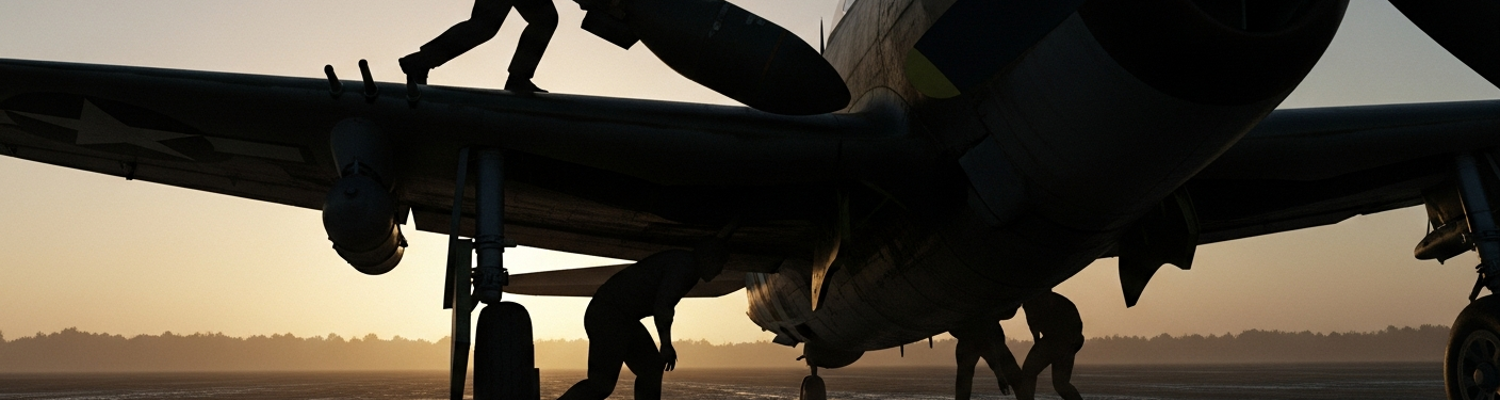
Munitions were not held in bunkers but in open-air dumps, exposed to weather. The supply chain’s main artery was the truck convoy, most famously the Red Ball Express, which prioritized fuel and rations above ordnance. When ammunition convoys did arrive at a forward depot, they were often composed of general-purpose GMC CCKW trucks not designed for ordnance transport. The subsequent journey to the ALGs over shell-pocked and muddy secondary roads was punishing. Reports indicate that the constant vibration could damage sensitive bomb fuzes before they ever reached the flight line. There was a near-total absence of specialized material handling equipment. Forklifts and bomb cranes were rear-echelon luxuries. At the ALGs, ground crews were forced to manually unload hundreds of bombs and rocket crates, then haul them through mud to dispersal areas where aircraft were being rearmed.
The problem was compounded by the sheer variety of ordnance demanded. A supply officer at an ALG faced an impossible task. A request from ground forces to neutralize an enemy tank column required specific munitions, such as the 5-inch High-Velocity Aircraft Rocket, a weapon that proved effective but was in a constant state of short supply. An infantry unit pinned down by machine-gun nests needed lighter 100-lb or 250-lb general-purpose bombs with instantaneous fuzes for fragmentation effect. An attack on a concrete bunker required heavier 500-lb bombs fitted with delayed-action fuzes for penetration. Each combination of bomb body, fuze type, and tail fin assembly represented a distinct logistical item that had to be sourced from depots hundreds of miles away. Archival manifests show that the supply system, already strained, was overwhelmed. It was far simpler to ship vast quantities of a single ordnance type, and due to the strategic bombing campaign’s priorities, that ordnance was typically the 500-lb GP bomb. Fighter-bomber groups frequently found themselves with an abundance of these bombs when they desperately needed rockets or smaller fragmentation weapons.
The direct consequence of these infrastructural and supply-chain deficiencies was a severe degradation of sortie rates. A sortie is a single combat mission by one aircraft. The ability to generate multiple sorties per aircraft per day was the metric of tactical airpower’s effectiveness. In the fluid battle following the Normandy breakout, the ability to quickly rearm and refuel a returning P-47 Thunderbolt was paramount. An efficient ground crew at a well-supplied base could turn an aircraft around in under an hour. At the muddy, poorly-stocked ALGs of France, this process could stretch to three or four hours. Fuel often had to be hand-pumped from 55-gallon drums. Ammunition for the eight .50-caliber machine guns had to be de-linked, inspected, and manually fed into the wing bays. Bombs weighing up to 500 pounds each were often wrestled into place by teams of exhausted men. Every minute spent waiting for the right bomb or searching for a compatible fuze was a minute the aircraft was not in the air. Operational logs from IX Tactical Air Command show that on many days, squadrons could only mount one or two sorties per pilot, effectively halving their planned combat power at the precise moment ground forces needed it most.
Operational Tempo and Signal Compromise
IX Tactical Air Command after-action reports from the summer of 1944 detail severe operational friction. The measure of success for close air support was the time elapsed between a ground unit’s request for fire and the moment bombs impacted the target. Doctrine demanded this process be nearly instantaneous. The physical process was anything but. A company commander pinned down by a German machine-gun nest initiated a request that began a long journey up the chain of command. The request was often relayed by a runner to the battalion command post, where it was transcribed and sent via field telephone, if the lines were not cut by artillery, to the regimental Air Liaison Officer. From there, it was radioed to a command and control center, which then had to vector available fighter-bombers to the target grid. Each step introduced delays. The cumulative time from request to strike often exceeded an hour. A target that was a threat at 10:00 AM was frequently gone by the time P-47s arrived overhead at 11:15 AM.
The physical apparatus of communication was profoundly unreliable. Field reports from Signal Corps depots detail a constant struggle with the SCR-series radios. The SCR-284, a common command post radio, was heavy, fragile, and power-hungry. Its sensitive vacuum tubes were prone to failure from the vibration of transport in a jeep. Its power source, the GN-45 hand-crank generator, was a liability. It required at least one soldier to be dedicated to cranking it, and its distinctive noise acted as a beacon for German mortar and artillery fire, inviting destruction upon the command posts it was meant to serve.
A functioning radio was not a guarantee of communication. It was an invitation to enemy intelligence. A review of Allied signal security documentation (Record Group 457) reveals a near-constant state of compromise. U.S. forces at the tactical level were notorious for poor radio discipline. Transmissions were frequently sent in the clear or using simple, easily broken codes. Operators often spoke freely, referencing map coordinates or unit dispositions without proper encryption. German radio intercept units, the Funkhorchkompanien, were highly proficient at monitoring these frequencies. Declassified intercepts confirm that German commanders were often able to form a substantially accurate picture of the Allied order of battle based on insecure radio traffic. The consequences were immediate. A command post that transmitted a close air support request could expect counter-battery fire on its position within minutes. A flight of P-47s dispatched to a target grid would often find German anti-aircraft batteries alerted and waiting, a direct result of the initial support request being intercepted and relayed to German air defense units. The system designed to bring fire on the enemy was actively betraying the location of friendly forces.
Doctrinal Resistance and Bureaucratic Inertia
Army Air Forces internal communications reveal an institutional culture resistant to integrating ground support requirements into its core doctrine. The leadership of the autonomous AAF, formed in June 1941, was dominated by proponents of strategic bombing. They viewed the purpose of air power as winning the war independently, not serving as an adjunct to ground forces. This viewpoint, solidified in foundational documents like the July 1943 Field Manual 100-20, “Command and Employment of Air Power,” established a clear hierarchy of missions. Gaining air superiority was the first priority, followed by interdiction of enemy supply lines, with direct support of ground troops ranked a distant third. This was not a tactical preference. It was an ideological conviction that long-range bombers striking an enemy’s industrial heartland could achieve victory on their own. Ground commanders, conversely, saw air power as flying artillery, a force to be parceled out and controlled by divisions to solve immediate battlefield problems. This doctrinal chasm meant that requests for close air support were often seen by the AAF high command as a diversion of assets from the primary strategic campaign.
This doctrinal schism resulted in the slow development of joint training exercises. A review of pre-war and early-war training schedules shows two services preparing for different conflicts in near-total isolation. Army Ground Forces conducted large divisional exercises, such as the Louisiana Maneuvers of 1941, involving hundreds of thousands of troops. Historical analyses of these maneuvers show that air support was often an afterthought. Requests for aviation units frequently went unfulfilled. When aircraft did participate, the coordination was primitive. There was no integrated system for pilots and ground controllers to practice identifying and striking targets under realistic conditions.
They had never trained together.
The Army established sprawling training areas like the Desert Training Center in California, but joint exercises remained rare and superficial. Air Corps pilots trained to fly in formation and engage in high-altitude combat, not to distinguish a friendly tank from an enemy one in the dust of a ground engagement. This lack of combined training meant that pilots arrived in combat theaters with little understanding of ground tactics, and ground commanders had no realistic sense of air power’s capabilities or limitations.
Long-term effects of inter-service funding disputes crippled the acquisition of specialized ground-attack equipment. The AAF’s institutional fixation on strategic bombing translated directly into budgetary and industrial priority. An analysis of wartime appropriations reveals an overwhelming focus on manufacturing heavy bombers like the B-17 and B-24 and the high-altitude escort fighters that protected them. Aircraft designed for the ground-attack mission, which required durability and stable low-level flight characteristics, were consistently deprioritized. The Vultee A-36 Apache, a purpose-built dive-bomber variant of the P-51, was produced in a limited run of only 500 aircraft and saw its service life cut short in 1944. Instead, the P-47 Thunderbolt was adapted out of necessity. This funding bias extended to munitions. The logistical chain was optimized to produce and ship the 500-lb and 1000-lb general-purpose bombs needed for the bomber campaign. The specialized ordnance for ground support, including smaller fragmentation bombs, napalm, and particularly high-velocity aircraft rockets, was often in a state of chronic short supply at the front.