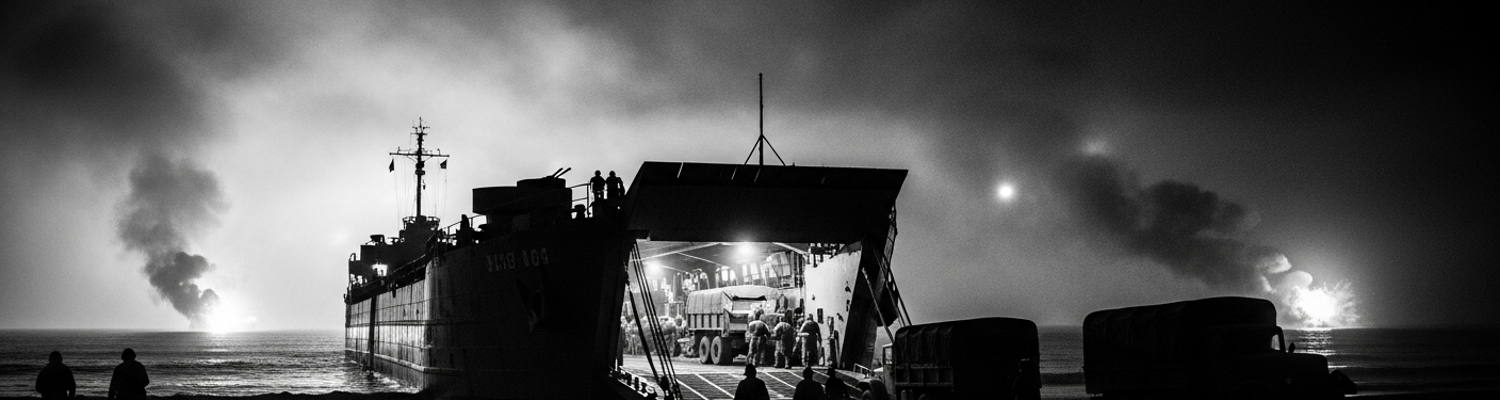

Genesis of a Forced Operation
The plan for Operation Shingle was activated in early January 1944 under intense political pressure from Winston Churchill. Naval planners under Rear Admiral Frank J. Lowry were tasked with assembling an invasion fleet to land two divisions eighty miles behind the German Gustav Line. The objective was to outflank the defenses deadlocking the Allied advance on Rome. The timeline was compressed. Major General John P. Lucas, commander of the U.S. VI Corps, documented his reservations regarding the adequacy of his forces for the assault, a view shared by other American commanders who saw the two-division landing as a significant risk. Despite these operational concerns, the strategic imperative to break the stalemate in Italy pushed the operation forward.
On the night of January 21-22, 1944, Task Force 81, a combined U.S. and Royal Navy armada, approached the Italian coast. The force was organized into two main elements. Task Force X-Ray, commanded by Lowry, was to land American forces, while a British contingent operated under a subordinate command. At 0200 on January 22, landing craft ramps dropped on the beaches near Anzio and Nettuno. The U.S. 3rd Infantry Division landed on the beach designated X-Ray, and the British 1st Infantry Division assaulted the beach designated Peter. U.S. Rangers secured the port of Anzio itself. The initial landings achieved near-total surprise. German resistance was so minimal that by noon, assault units had reached their D-Day objectives, advancing three to four miles inland by nightfall. By the end of the day, 36,000 Allied soldiers and over 3,200 vehicles were ashore. Casualties were exceptionally low: 13 killed and 97 wounded.
The initial quiet was deceptive. Naval power quickly transitioned from an amphibious assault role to a sustenance function. Field Marshal Albert Kesselring, the German commander in Italy, reacted with unexpected speed, redirecting units to contain the new Allied lodgment. Within a week, eight German divisions surrounded the beachhead. The fight to hold the perimeter became a contest of supply and firepower, with the ships of Task Force 81 central to the effort. Naval gunfire from cruisers like USS Brooklyn (CL-40) and HMS Penelope (97), along with numerous destroyers, provided a shield of high-explosive shells that broke up German counterattacks. On February 9, for example, the USS Brooklyn fired 580 six-inch rounds to repulse German advances. This floating artillery was indispensable as land-based guns were still being emplaced.
The Strained Mediterranean Supply Chain
The Anzio beachhead was a small, exposed pocket, entirely dependent on the sea for its existence. Every soldier, every bullet, and every ration had to be transported across the water from Naples in a continuous, vulnerable stream. This supply chain, known as the Anzio Express, relied primarily on Landing Ships, Tank (LSTs), which shuttled pre-loaded trucks directly onto the beaches. The anchorage became a hunting ground. The Luftwaffe conducted frequent dusk raids with bombers armed with Henschel Hs 293 and Fritz X radio-guided glide bombs. These attacks inflicted a steady toll. The destroyer HMS Janus and the cruiser HMS Spartan were sunk by these weapons. The hospital ship St. David was also sunk in a raid on January 24. German artillery, including the Krupp K5 railway gun nicknamed Anzio Annie, shelled the congested port and supply dumps without pause. In response, the Royal Navy withdrew its larger cruisers, reducing the volume of available gunfire support. The naval supply line, though constantly contested by bombs, shells, and mines which claimed the minesweeper USS Portent on the first day, never broke. This relentless flow of supplies enabled the VI Corps to hold its ground.
Archival records show the precariousness of the Allied logistical position in the Mediterranean by February 1944. Anzio was an additional, insatiable demand on a system already stretched to its limit. The logistical hub at Naples, captured and reactivated in October 1943, had to balance the requirements of the main Fifth and Eighth Army fronts with the new needs of the Anzio lodgment. VI Corps required an average of 4,000 tons of supplies daily. The shuttle of ships running the 120-mile route from Naples became the beachhead's artery. To optimize turnaround, Fifth Army logisticians pre-loaded trucks in Naples. These vehicles could then roll directly off the LSTs at Anzio, discharge their cargo at inland dumps, and return to the port for the voyage back. This cycle placed a heavy burden on the port of Anzio, which by early February could handle eight LSTs, eight Landing Craft, Tank (LCTs), and fifteen Landing Craft, Infantry (LCIs) at one time.
Luftwaffe and Schnellboot Interdiction
The destroyers and escort vessels providing anti-aircraft and naval gunfire support could not abandon their stations to refuel and rearm. Their continuous presence was non-negotiable, especially during the intense German counterattacks of February. Records show that ships like USS Brooklyn expended hundreds of six-inch rounds in a single day. This rate of fire demanded a method for replenishing magazines and fuel tanks while ships remained on their defensive stations. The solution was underway replenishment, a hazardous operation conducted in a combat zone. Oilers and ammunition ships sortied from Naples, often under cover of darkness, to rendezvous with combatants at sea. For destroyers, this meant pulling alongside a larger vessel, often in challenging seas, while crews connected heavy fuel hoses and manhandled ammunition. The evolution left both ships vulnerable, steaming in predictable patterns and unable to take evasive action. A German air or E-boat attack during this process would have been catastrophic. The need to cycle warships back to Naples for more extensive replenishment and repairs thinned the defensive screen, forcing planners into a high-stakes rotation schedule.
German forces understood that the beachhead would collapse if its maritime lifeline could be severed. Beyond the threat from guided bombs and heavy artillery, a more persistent campaign of attrition was waged against the convoys. German E-boats (Schnellboote) based out of ports to the north conducted regular nighttime raids on the shipping lanes between Naples and Anzio, creating a constant torpedo threat for the slow-moving LSTs and Liberty ships. Luftwaffe aircraft also engaged in conventional bombing, strafing, and aerial mine-laying in the approaches to the harbor. These mines were a continual hazard, claiming minesweeper YMS-30 on January 25. Over the course of the campaign, Allied naval forces would lose 17 ships, including cruisers and destroyers, to enemy action. Each loss, whether a major warship like the British cruiser HMS Spartan or a workhorse LST, had a ripple effect, reducing gunfire support, diminishing cargo capacity, and forcing logistical planners to adapt with fewer resources.
Unexpected Attrition of Naval Assets
Operational logs for Task Force 81 show that the initial success of the landing was immediately undermined by losses to the naval screen. On January 22, the American minesweeper USS Portent (AM-106) struck a mine while clearing approach lanes and sank with 18 of her crew. The next day, the British destroyer HMS Janus (F53), having just fired nearly 500 shells in support of troops ashore, was hit during a dusk air attack. Reports conflict on the exact weapon, citing either an aerial torpedo or a Fritz X guided bomb. The result was not in dispute: the destroyer’s magazine exploded, she broke in half, and sank in twenty minutes with the loss of 159 sailors.
The most advanced threat came from Luftwaffe bombers launching Henschel Hs 293 radio-controlled glide bombs. These weapons allowed German aircraft to stand off beyond the range of conventional anti-aircraft fire and guide the missile onto a target. On January 29, during a dusk raid, a Dornier Do 217 bomber launched an Hs 293 that struck the British anti-aircraft cruiser HMS Spartan (95). The bomb penetrated the ship, starting uncontrollable fires and causing her to capsize and sink within an hour. Forty-six men were killed. The loss of a modern cruiser specifically deployed to defend the anchorage from air attack sent a shockwave through the naval command.
This attrition was not limited to warships. The supply vessels themselves suffered a parallel campaign of destruction. The hospital ship HMHS St. David, clearly marked and illuminated, was bombed and sunk on January 24 with 96 souls lost. The Landing Ships, Tank were prime targets. On January 26, an LST carrying men of the U.S. Army’s 83rd Chemical Mortar Battalion struck a mine ten miles from shore. The ship was laden with ammunition and phosphorous shells, which ignited, complicating rescue efforts in the rough, icy water. The loss of the Liberty ship Elihu Yale on February 15 was another blow, removing a vessel capable of carrying immense tonnage. Each sinking, whether from a glide bomb, a mine, an E-boat torpedo, or a shell from the Anzio Annie railway gun, had a direct impact on the daily flow of the 4,000 tons of supplies required to sustain VI Corps.
The Washington-London Strategic Reassessment
Archival evidence from the first week of February 1944 indicates a grim mood in the Pentagon. The Anzio landing was a British-conceived operation, advanced by Churchill against American reservations. Washington’s military leadership, particularly Army Chief of Staff George C. Marshall, viewed the Italian campaign as a strategic diversion of men and material from the upcoming cross-Channel invasion, Operation OVERLORD. The news that the Anzio beachhead was contained and under ferocious counterattack confirmed their fears. Communications between Marshall and Allied commanders in the Mediterranean reveal an anxiety that Anzio was becoming a drain on resources earmarked for the buildup in England. American planners had reluctantly agreed to delay the transfer of landing craft from the Mediterranean to support the landing. Now those assets were being destroyed or were tied to the defense of the beachhead. The debate in Washington was about how to stop the hemorrhage of resources and prevent the crisis from compromising the D-Day timetable.
In London, the reassessment was more urgent. Prime Minister Winston Churchill was the primary political architect of Operation Shingle. The transformation of his flanking maneuver into a static battle of attrition was a source of deep frustration. On February 11, he sent a message to General Harold Alexander, the theater commander, expressing disappointment over the standstill at Anzio. He was astounded that a force of over 70,000 men was being held in place by a German force they initially outnumbered. Within the British Chiefs of Staff committee, the reaction was equally severe. The loss of modern Royal Navy warships, including HMS Spartan and HMS Janus, to German glide bombs was a heavy price. For Alan Brooke, Chief of the Imperial General Staff, the Anzio crisis was the predictable outcome of overreaching with insufficient force.
Geopolitical Ramifications and Command Miscalculation
The crisis forced a high-stakes debate over the allocation of landing craft. Planning documents for Operation OVERLORD show that its viability was predicated on a precise timetable for the arrival of amphibious vessels in the United Kingdom, especially the Landing Ship, Tank. Planners had agreed to retain 88 LSTs in the Mediterranean for the Anzio landing, on the condition that they would be released in time for the Normandy buildup. The heavy attrition at Anzio and the absolute necessity of the supply line from Naples upended this schedule. LSTs were being damaged by shellfire, mines, and air attacks, requiring repair in theater. Every vessel dedicated to supplying the besieged VI Corps was one that could not begin the journey to England. The Combined Chiefs of Staff were forced into a series of tense reviews, weighing the possibility of the Anzio beachhead collapsing against the certainty that every day of delay made hitting the May target for OVERLORD less likely. The needs of the two fronts were in direct, irreconcilable conflict, a zero-sum game centered on the availability of these specialized ships.
The diplomatic shockwaves were directly tied to the naval losses in the Anzio anchorage. The sinking of HMS Janus on January 23rd was a severe blow, but it was the loss of the anti-aircraft cruiser HMS Spartan six days later that alarmed the Admiralty in London. Spartan had been specifically deployed to provide a defensive shield against the Luftwaffe, yet she was destroyed by the very weapon she was meant to counter. This demonstrated a German technological advantage in anti-shipping warfare that Allied countermeasures were struggling to defeat. Naval records show that these losses, combined with the constant threat from mines and E-boats, forced the Royal Navy to pull its larger cruisers from the anchorage, reducing the volume of naval gunfire support for the troops ashore. For the British, who had championed the operation, the loss of modern warships for a stalemate was a bitter result.
The Psychological Toll of Combat Logistics
A review of operational logs reveals a disconnect between the logistical plan for Operation Shingle and the conditions at the beachhead. The strategy depended on the use of LSTs pre-loaded with trucks, a system designed to rapidly build up supplies for a swift breakout. Planners in Naples envisioned an efficient cycle of beaching, unloading, and returning. This model failed to account for the speed of the German reaction. Instead of supporting a mobile advance, the supply chain became the sole lifeline to a static siege, where the port and anchorage were the epicenter of the battlefield. German observers on the surrounding Alban Hills had a commanding view of the entire beachhead, allowing them to direct artillery with precision. The two Krupp K5 railway guns were specifically tasked with interdicting the port. The sound of their 283mm shells became a constant feature of life in the anchorage. Every LST, taking minutes to unload its cargo of trucks, was a stationary target for a weapon that could fire every four to seven minutes. The idealized operational plan dissolved into a minute-by-minute gamble under the guns.
The psychological burden fell most heavily on the junior officers tasked with executing the supply plan. For an Army lieutenant in a port battalion or a Navy ensign aboard an LST, the war was a relentless cycle of targeted danger. Their duty was to oversee the unloading of ammunition, fuel, and rations while being systematically shelled and bombed. The dusk air raids were a particular source of dread, as Luftwaffe bombers used the silhouetted ships to aim their guided bombs. Sailors could do nothing but watch the guided munitions descend. Work on the beaches and docks was a frantic race against incoming artillery. An officer directing trucks off an LST ramp was aware that his ship, packed with high explosives and gasoline, was a potential bomb. He was also responsible for the lives of the stevedores and drivers working in the open. The sight of the HMHS St. David sinking on January 24th, or the LST carrying phosphorous shells exploding on January 26th, were not abstract reports but visceral experiences that compounded the feeling of being hunted. These young officers were forced to weigh mission demands against a visible, grisly cost, making decisions under a level of sustained pressure that planning staffs could not fully comprehend.
This disconnect fostered a sense of helplessness among logistical personnel. They were aware that their survival and the survival of VI Corps depended on factors beyond their control. The men on the beach could not stop the German gunners on the hills, nor could they counter the Luftwaffe’s guided bombs. They could only continue their work and watch as destroyers and cruisers tasked with protecting them were hit and sunk. The loss of a major warship like HMS Spartan was not a distant naval event; it was the visible evaporation of their shield, witnessed from the shore, which amplified the feeling of abandonment. Reports sent back to Fifth Army headquarters could detail the tonnage unloaded or the ships damaged, but they could not convey the psychological corrosion of working in a space where every square yard was pre-sighted by enemy artillery. This created a condition where personnel became resigned to the fact that their actions, however disciplined, could be rendered meaningless by a single shell for which there was no countermeasure.