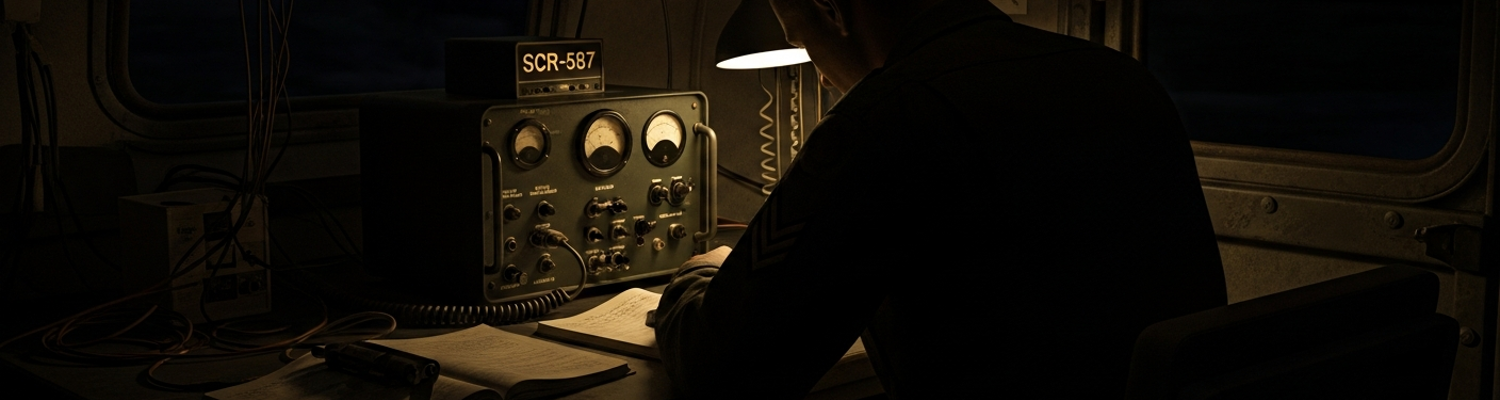

A division preparing for offensive operations in 1941 carried 75,000 tons of supplies. This manifest included M1 Garand rifles, 105mm howitzers, M3 Stuart light tanks, and stores of fuel and rations. The most decisive new weapon in the U.S. Army’s arsenal was not listed. It was intangible. It was the capacity to intercept an enemy’s communications directly from the air.
The electromagnetic spectrum had become a battlefield.
Operational logs from the U.S. Army Signal Corps reveal an institution tasked with mastering a technology it did not fully comprehend. The interwar period saw radio evolve from a novelty into a primary tool of state power. The airwaves were a dense environment of commercial broadcasts, civilian traffic, and military communications. This was driven by the refinement of the triode vacuum tube, which enabled amplification of weak signals, and the superheterodyne circuit, which provided new levels of tuning precision. For the Signal Corps, an organization founded on visual signals and telegraphy, this presented a challenge. Early efforts in radio intelligence during the Mexican Punitive Expedition (1916-17) and World War I provided a foundation, but the quiet years of the 1920s and 30s required the development of a coherent intelligence discipline from the ground up.
The SCR-587 was the material result of these interwar aspirations. It was conceived as a strategic listening post, not a tactical tool for frontline use. Its purpose was long-range interception of high-frequency (HF) signals from fixed stations or specialized vehicles far behind combat lines. The receiver was a heavy apparatus filled with vacuum tubes, demanding a stable power source and skilled operators. Its design prioritized sensitivity and selectivity across a broad frequency spectrum to monitor the distant communications of potential adversaries. The core function was to listen, log, and identify, building a map of enemy communication networks for cryptanalysts. The existence of such a device signaled a doctrinal shift within the Army, an acknowledgment that future conflicts would be won with information.
This mission required the Signal Corps to invent the discipline of American signals intelligence. This extended beyond procuring receivers. It involved creating training programs for a new type of soldier, the radio intercept operator. It meant establishing the first dedicated Radio Intelligence Companies, like the 125th at Fort Lewis, and determining their place in the Army’s command structure. Rivalry with other branches for resources and mission control was constant. The development of signal intelligence was not a linear progression. It was a process marked by bureaucratic infighting, limited budgets during the Great Depression, and a struggle to convince a ground-combat-focused officer corps of its importance. The pioneers of Army SIGINT were contending with the technical challenges of a new medium and the institutional inertia of their own military.
Protracted Development Challenges
Records from the Signal Corps Engineering Laboratories at Fort Monmouth, New Jersey, show a development cycle for the SCR-587 beset by technical setbacks. The project was based on vacuum tube technology, and the tubes were a consistent source of failure. Engineers contended with the fragility of thermionic valves, which were susceptible to damage from vibration. The local oscillator circuits, necessary for tuning, suffered from severe thermal drift. As the vacuum tubes heated the receiver’s chassis, their operating characteristics changed, causing the intercept frequency to wander. An operator monitoring an enemy net on 8.3 MHz might find the receiver on 8.4 MHz after thirty minutes, requiring constant manual re-tuning. Archival evidence (NARA Record Group 111-SC) shows repeated project delays due to efforts to engineer better ventilation and more stable oscillator designs, using specialized components that were themselves in short supply.
This technical struggle was amplified by a conflict over control of the electromagnetic spectrum. The SCR-587 was an HF receiver designed for the 2 to 12 MHz bands. The receiver's operational range became a subject of dispute within the American military bureaucracy. The Interdepartmental Radio Advisory Committee (IRAC) was a forum where the Army, Navy, and Army Air Forces competed for exclusive control over frequency blocks. The U.S. Navy claimed large segments of the lower HF spectrum for ship-to-shore channels. The Air Forces demanded dedicated frequencies for long-range command nets. These demands forced Signal Corps engineers to alter the design of the SCR-587’s front-end tuning circuits. A decision made in a Washington D.C. committee rendered months of work at Fort Monmouth obsolete, forcing a redesign of coil windings and capacitor arrays. Each change initiated a cascade of documentation and re-testing, extending the development timeline.
Layered on top of these issues was the Signal Corps' own procurement bureaucracy. The path from prototype to field equipment was a sequence of approvals. A minor modification, like moving a control knob or specifying a non-standard vacuum tube, required an Engineering Change Proposal. This document would move from development engineers at Camp Coles to administrative offices at Fort Monmouth, then to budget analysts and contracting officers. This process could halt physical progress for weeks. While intelligence from Europe stressed the need for advanced intercept equipment, the SCR-587 program was often hindered by its own administrative procedures. The system, designed for accountability, proved too slow for wartime urgency.
Initial Deployment Deficiencies
Initial reports from the 128th Signal Radio Intelligence Company in North Africa following Operation Torch in late 1942 detailed the SCR-587’s poor performance. The receiver, designed in a controlled environment, was not prepared for a field campaign. Its primary power requirement, a stable 115-volt AC source, was often met by portable PE-75 gasoline generators. Maintenance logs from the 128th show repeated instances of voltage irregularities from these generators causing failure of the receiver’s 6L6 power amplifier tubes. Fine Saharan dust penetrated the unsealed chassis, coating the variable capacitors of the tuning assembly and causing short circuits. The act of moving the equipment was destructive. The receiver, weighing over 150 pounds, was not ruggedized for transit over rough tracks in a GMC CCKW truck. Solder joints on intermediate frequency transformer cans would crack, and vacuum tubes would shatter.
Even when operational, the receiver’s design limited its tactical utility. The SCR-587 was a long-range strategic intercept receiver, optimized for capturing HF skywave signals bounced off the ionosphere. Its rhombic or long-wire antenna kits required significant space and time to erect. This design was ill-suited for the mountainous terrain of Tunisia, which created dead zones. Commanders on the ground required intelligence on immediate German threats. These threats communicated using lower-power groundwave signals or on very-high-frequency (VHF) channels for tank-to-tank communication. The SCR-587 and its antenna system were not designed to capture these signals. An operator could attempt to tune in a transmission from Berlin while the VHF chatter of a Panzer division forming for a counter-attack just over the next ridge remained undetectable.
This disconnect between the SCR-587’s purpose and battlefield demands caused friction. Divisional G-2 intelligence officers expected Signal Radio Intelligence detachments to provide immediate warnings. The intelligence produced by the SCR-587 teams, such as logged call signs and frequency usage charts, was strategically valuable for mapping the enemy’s order of battle over weeks, but it rarely answered immediate tactical questions. Archival evidence shows an increase in unofficial field modifications. Operators in Italy began attempting to wire in different audio filters to better isolate voice signals. They bypassed standard antenna inputs, creating crude dipole antennas from field telephone wire to gain sensitivity to local VHF signals. These modifications were an indictment of the procurement process. The army had delivered a strategic listening post when the front lines needed a tactical ear.
European Theater Electromagnetic Spectrum
In the European Theater of Operations, the SCR-587 was immersed in electromagnetic chaos. The high-frequency bands were a dense cacophony of competing signals. Operational logs from Allied intercept stations document a constant battle against this noise. The spectrum was saturated with Allied and Axis transmissions. An American operator trying to isolate a German transmission found it buried under Allied logistical communications, British bomber streams, and civilian propaganda broadcasts. The physical environment also created problems. Post-war research showed that shockwaves from large-scale bombing raids could disturb the ionosphere, weakening and distorting long-range signals. Natural atmospheric conditions, especially at night, added distant, irrelevant transmissions to the local noise floor.
The German military waged an adaptive campaign of communications security. Captured German training manuals, such as Merkblatt 48c/42, show a doctrine built on minimizing transmission time and forbidding plain text. German radio procedure was an art of concealment. Units were assigned code names, often words for plants or animals like Ahorn (Maple) or Biber (Beaver), changed on a regular schedule. All significant information was disguised using a substitution list from a communication table, or Sprechtafel. German radio operators were trained to use brief, procedural language and a phonetic alphabet to reduce time on the air, minimizing their vulnerability to Allied direction-finding. This discipline meant that even if an SCR-587 operator located a German net, the intercepted traffic was often a short burst of code words with little immediate intelligence value.
For the radio intelligence personnel of units like the 128th Signal Radio Intelligence Company, these factors created large operational challenges. The receiver’s known issue with thermal frequency drift became a liability. An operator might zero in on a faint German command net, only for the receiver’s heated vacuum tubes to cause the frequency to wander as a transmission began. They would have to retune, hunting through the noise and often missing the message. The experience for the operator was one of high psychological pressure. After-action reports mention the exhaustion and mental fatigue of operators working eight-hour shifts. They were contending with a chaotic spectrum, a disciplined enemy, and the instability of their own equipment.
Battlefield Modifications and Operator Resourcefulness
The gap between the SCR-587’s strategic function and tactical needs led to a campaign of unsanctioned innovation. Operational logs from radio intelligence companies in Italy show that the cumbersome antenna systems were often discarded. In mountainous terrain, operators needed directional antennas to pinpoint local German transmissions. They fabricated their own using salvaged field telephone wire, wooden poles, and metal scraps. A soldier from the 128th Signal Radio Intelligence Company could rotate one of these jury-rigged antennas, listening for the peak in signal strength that indicated the bearing of an enemy command post. It was a rudimentary form of direction finding that transformed the passive listening post into an active hunting tool.
External modifications were followed by electronic surgery. The SCR-587’s broad selectivity was a liability in the signal-dense European theater. A weak Morse code transmission was often buried under adjacent signals and noise. Company-level technicians began implementing ad-hoc filtering circuits. Field maintenance reports (as found in NARA Record Group 338) point to a common practice of attempting to narrow the receiver's intermediate frequency (IF) passband. A more successful technique involved modifying the audio output stage. Technicians scavenged capacitors and inductors from damaged equipment to construct passive low-pass and band-pass filters. These external filter boxes, plugged into the headphone jack, were designed to pass only a narrow slice of audio frequencies, typically centered around the 800 Hz tone of a Morse signal. The modification muted the high-pitched squeals and low-frequency hum of interference, allowing an operator to isolate the target signal.
Success, however, depended on the skill of the individual intercept operator. They developed strategies to cut through the noise. Operators learned to recognize the unique fist of individual German radiomen, the distinct rhythm of their Morse code, allowing them to track units even when call signs changed. This required intense concentration. When hunting for a new net, an operator would rock the dial, slowly sweeping the tuning knob back and forth across a small frequency segment for hours. They manipulated the receiver’s Beat Frequency Oscillator (BFO) to change the pitch of the code, creating a distinct audio signature for a target frequency. The most organized operators maintained hand-drawn charts, logging frequency, time, and call signs on graph paper to visualize enemy communication patterns.
Tactical Intelligence Contributions
After-action reports from Army and Corps level G-2 intelligence sections show the SCR-587's contribution was not in the immediate firefight. Its value was in the accumulation of data that provided a detailed portrait of the German military. Without decrypting a single message, traffic analysis allowed intelligence officers to build an electronic order of battle. By logging call signs, frequencies, and transmission schedules, analysts could identify German divisions, track their movements, and map their command hierarchy. A sudden increase in radio traffic from a quiet sector was a reliable indicator of an impending attack. The resourcefulness of operators who recognized the Morse code fist of individual radiomen allowed them to follow specific units even after code names changed. This information, combined with data from aerial reconnaissance and prisoner interrogations, was foundational to high-level command decisions.
Its operational life was short.
The end of the Second World War marked the beginning of a rapid obsolescence for the SCR-587. Its vacuum tube architecture was rendered antique by new technologies. The most significant was the transistor, a solid-state device that performed the same functions as a vacuum tube at a fraction of the size and power consumption. This enabled a new generation of portable and reliable field radios. Concurrently, tactical communication was migrating from the high-frequency (HF) bands into the very-high-frequency (VHF) and ultra-high-frequency (UHF) spectrums. This shift offered clearer, line-of-sight communication for mobile units, a domain the HF-focused SCR-587 was not designed to monitor. Post-war receivers, like the AN/GRR-5, were built for these new realities, offering broader frequency coverage in a more rugged package. The SCR-587 was left behind.
The final factor was financial. The end of hostilities triggered a massive contraction of the American defense budget. Military spending was slashed by 1948. A review of federal budgets for the immediate post-war years shows a pivot in national priorities. The new threat was the Soviet Union, and the new doctrine was containment, built on atomic weapons and long-range aircraft. Funding flowed to the Air Force and its strategic bomber programs, as well as guided missile projects. In this fiscal environment, maintaining stocks of aging hardware like the SCR-587 was an unjustifiable expense. Signal Corps funding was focused on developing next-generation cryptographic equipment and satellite communication systems. The SCR-587 receivers were declared surplus, relegated to warehouses, and eventually scrapped or sold to hobbyists.
Post-War Decommissioning and Data Integration
The physical hardware was gone, but its product, a vast amount of captured intelligence, remained. The challenge of the post-war period was managing the paper logs, intercept transcripts, and traffic analysis charts generated by SCR-587 operators. This data was not centralized. It existed as disparate collections of handwritten notes and typed reports, stored at the field headquarters of individual Signal Radio Intelligence companies and then shipped to various depots. A logbook from a detachment in Sicily might be stored thousands of miles from a corresponding logbook from a unit in France that tracked the same German radio net after it was redeployed. There was no digital database or standardized format.
This fragmentation was magnified by the institutional architecture of American intelligence. On September 15, 1945, the Signal Security Agency was reorganized into the new Army Security Agency (ASA). The ASA was one piece of a fractured intelligence community, existing alongside powerful Navy and Air Force intelligence organizations, each with its own archives. Fusing data was a slow, inefficient process. An analyst attempting to build a comprehensive picture of German command-and-control would need to manually request and deconflict paper records from multiple service archives. The creation of the Armed Forces Security Agency (AFSA) in 1949 and the National Security Agency (NSA) by presidential directive on November 4, 1952, were attempts to solve this problem of decentralization.
By the time a centralized national-level intelligence structure was in place, much of the granular data captured by the SCR-587 was effectively lost. The paper records were vulnerable to decay, misplacement, and destruction. Inter-agency rivalries meant that data collected by one service was often not shared or was shared in a redacted form. Archival evidence shows that intelligence material was stored at facilities like Arlington Hall and Vint Hill Farms Station, but much of it was never fully indexed or cross-referenced. While high-level summaries were preserved, the raw intercept logs, the day-to-day work of the SCR-587 operator, often were not. The potential to conduct a full-scale historical analysis of the Axis electronic order of battle dissolved within these bureaucratic and archival silos.