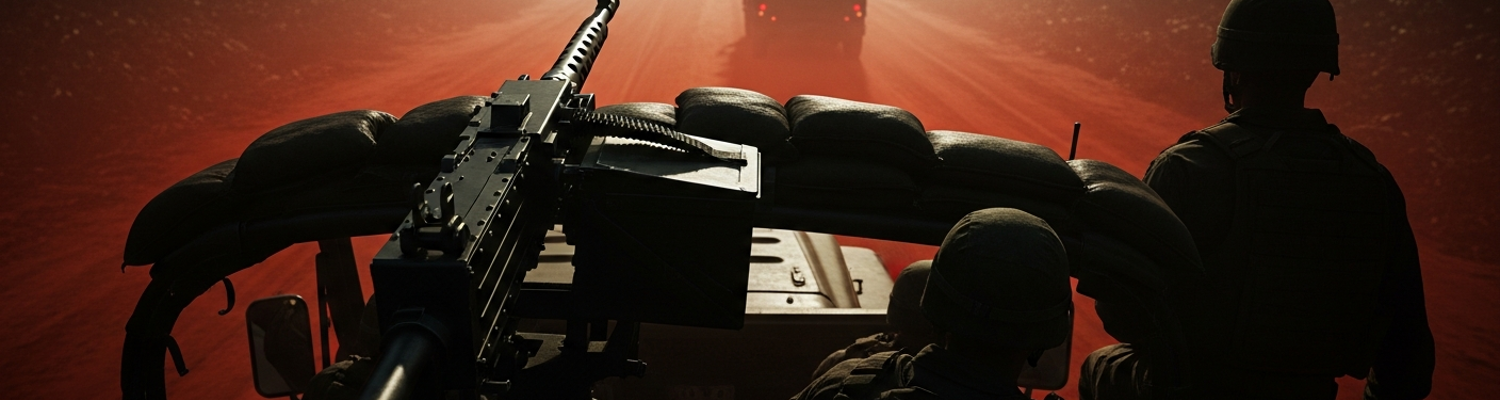

The operational schedules for 1968 presented to commanders of the 1st Military Police Battalion were a study in impossibility. American troop escalation demanded a logistics pace that the existing infrastructure could not support. A war of maneuver required a constant flow of materiel, and this materiel had to move by ground. This reality placed a heavy burden on units like the 1st MP Battalion, whose duties expanded from traditional law enforcement into the high-risk domain of convoy escort. They were assigned the task of guarding vulnerable columns of heavy trucks through a landscape with no conventional rear area. Every road was a potential front line.
This was a non-linear battlefield.
A review of archival records (NARA Record Group 472) shows the primary role of Military Police battalions evolved with the conflict's escalation. While the 716th MP Battalion was engaged in urban security in Saigon during the Tet Offensive, the 1st MP Battalion became defined by highway security. Its mission was to keep the logistical arteries of the American war effort open. These arteries were the roads, often crude routes connecting coastal supply depots like Cam Ranh Bay and Qui Nhon with inland firebases. An entire operation for a maneuver battalion could depend on the timely arrival of a single convoy carrying 105mm artillery shells or C-rations. MP gun jeeps, armed with M60 machine guns and occasionally 40mm grenade launchers, provided the primary defense for dozens of soft-skinned supply trucks. Doctrine called for a ratio of one gun truck or jeep for every ten transport vehicles, a thin screen of protection. Operational logs detail a relentless cycle of daily convoys, such as those supporting the 1st Infantry Division’s base at Quan Loi.
The roads themselves were weapons. Routes like National Route 19, a key east-west corridor to the Central Highlands, contained infamous choke points. The Mang Yang Pass on QL-19 was a known ambush site where Viet Cong and NVA forces exploited steep, narrow terrain. Ambushes were planned operations. Enemy forces prepared L-shaped or linear kill zones, initiated by command-detonated mines or RPGs aimed at the lead and trail vehicles to trap the convoy. A review of after-action reports from 1968 reveals a common tactical sequence. An initial explosion halted the column, followed by intense machinegun, mortar, and automatic weapons fire from concealed positions. Attackers were often within 15 to 20 feet of the road, hidden by dense jungle or in spider holes. The psychological toll of this constant, unseen threat was severe. The enemy goal was not just the destruction of supplies but the erosion of morale and the disruption of American operational capability.
The American military in Vietnam consumed roughly 760,000 tons of supplies and 71,000 tons of ammunition monthly. Helicopters provided a link for isolated units but could not move the bulk required for large-scale operations. Ground convoys were the foundation of the logistical system. A successful ambush did more than destroy trucks; it could starve an infantry company of ammunition, deny a firebase its artillery rounds, and halt offensive operations across a tactical zone. The closure of a route like Highway 19, even for days, could isolate major bases in Pleiku, a strategic goal the PAVN/VC pursued. Commanders needed supplies to prosecute the war, while the MPs escorting them knew that establishing a routine made them a predictable target.
Operational logs show that Military Police convoy commanders were consistently let down by the intelligence apparatus. The Military Assistance Command, Vietnam (MACV) was structured for a conventional war. Intelligence products delivered to tactical units like the 1st MP Battalion were often generic. A convoy commander preparing to run QL-19 might receive a report of high enemy activity within a 20-square-kilometer area, information that was effectively useless. What was needed was specific, timely intelligence: the location of a sighted NVA reconnaissance team, evidence of new bunker construction, or intercepted enemy communications. A systemic failure to grasp the nature of the insurgency meant that US intelligence often underestimated enemy strength. This gap between the strategic intelligence picture and the tactical need meant MP gun jeep crews drove into zones that headquarters considered vaguely hostile but were, in reality, prepared kill boxes.
This intelligence vacuum was compounded by severe operational blind spots. Communication was fragile. The standard AN/PRC-25 radio depended on line-of-sight, a significant drawback in the jungle and hills of the Central Highlands. A convoy stretched over several kilometers could lose contact between its lead, middle, and trail elements. The enemy knew this and targeted command jeeps with their long whip antennas to decapitate the convoy’s leadership in the opening moments of an ambush. Weather also degraded operations. The monsoon season could ground aircraft and turn roads into sludge, but it also had a debilitating effect on communications. Torrential rain and high humidity could short-circuit radio equipment and degrade FM signals. NVA and Viet Cong forces used this atmospheric cover, timing movements for periods when they knew American forces were most blind. A convoy commander could find himself with no air support, no artillery, and no way to talk to his own men.
Alone on the road.
Aerial reconnaissance was a resource almost never available to MPs protecting convoys. The demand for air assets was insatiable. Scarce resources like RF-4C Phantom and RF-101 Voodoo reconnaissance jets were tasked with high-priority missions over North Vietnam or the Ho Chi Minh Trail. Helicopter gunships and light observation helicopters like the O-1 Bird Dog, which could have provided eyes ahead of the convoys, were almost always allocated to support active infantry operations. This was a result of doctrinal priorities; supply convoys were classified as administrative movements, not tactical operations, placing them low on the list for combat support. Without aerial scouts to spot the signs of an ambush, the lead MP jeep was the primary reconnaissance element. The men in that jeep were driving blind into areas not visually cleared by friendly forces.
A review of convoy escort logs from 1968 shows the environment itself degraded American tactical capabilities. In the Central Highlands, pre-dawn movements were shrouded in dense, ground-hugging fog. Visibility was reduced to mere feet. For the lead elements of a 1st MP Battalion convoy, this meant driving unable to spot the tripwires of mines or the disturbed earth of a fighting position. The fog clung to the triple-canopy jungle on roads like QL-19, providing concealment for NVA and Viet Cong units. When the sun burned the fog away, it was replaced by dust. The unpaved laterite roads, pulverized by multi-ton trucks, kicked up enormous plumes of fine red dust. This cloud enveloped the convoy, making it impossible for drivers to see the vehicle ahead, leading to collisions and a loss of column integrity.
Gunners on the M60s in MP jeeps found their fields of fire obscured within seconds. They could not see the roadside. This particulate cloud acted as a smokescreen for attackers, allowing them to initiate an ambush and then reposition or withdraw before effective fire could be returned. The dust clogged engine air filters, leading to mechanical failures that could halt a convoy in a kill zone. It made visual signals useless, forcing total reliance on fragile radio communications. A commander led a column where each element was isolated in its own bubble of red dust.
The challenges of visibility were magnified during night engagements. While night convoys were less frequent, necessity sometimes forced them. When an ambush occurred after dark, the standard response was to deploy illumination. This was often done with hand-held flare guns or 40mm parachute flares from M79 grenade launchers. This tactic frequently proved counterproductive. The sudden glare of a magnesium flare destroyed the night vision of MP escort teams and drivers. For minutes after a flare ignited, American personnel were left with bleached-out vision, unable to see into the shadows. NVA and VC fighters, positioned in deep cover, were shielded from the direct light. For them, the flare worked as intended, perfectly silhouetting the American trucks and gun jeeps against the brightened sky. They could see their targets while the defenders were blinded.
This created a paradox. The tool meant to illuminate the battlefield plunged defenders into sensory chaos. The flickering light cast dancing shadows easily mistaken for enemy movement, causing panicked bursts of fire at nonexistent targets. The strobing effect made it nearly impossible for a gunner to track a target or for a commander to assess the disposition of his own forces. An after-action report from an engagement on QL-13 (document ID A8-34-C) details how friendly-fire incidents were directly attributed to the disorienting effect of parachute flares, which made it impossible to distinguish friend from foe.
When a Military Police gun jeep was hit, the medical response was governed by a system that moved at the speed of paper. The process for requesting a medical evacuation helicopter was a bureaucratic gauntlet. The moment a soldier was wounded, a medic began treatment while the convoy commander initiated a 9-Line Medevac Request over the radio. This was not a simple call for help. It was a rigid, nine-point data transmission that had to be perfect. An error in the grid coordinates for the pickup zone, the radio frequency, the number of patients, or the description of enemy activity could lead to the request being rejected. For an MP unit in a chaotic ambush, obtaining a flawless 8-digit grid coordinate for a landing zone was a difficult task.
The request traveled up a layered chain of command. From the MP platoon leader’s radio, it went to the 1st MP Battalion’s Tactical Operations Center. A radio operator transcribed it onto a form. That form was passed to a duty officer who had to contact the controlling brigade or division headquarters on a different radio net. At that level, another officer reviewed the request before forwarding it to the supporting aviation unit. Each step introduced a delay. A wounded soldier with massive blood loss had minutes to live. The administrative chain of approval could consume thirty minutes before a pilot even received the mission.
This delay was built into the communications architecture. An Army MP convoy operated on a standard FM frequency, using AN/VRC-46 or AN/PRC-25 radios. The dedicated Army medevac helicopters, callsign Dustoff, belonged to a separate aviation brigade and monitored their own frequencies. The Air Force, which operated rescue helicopters like the HH-3E Jolly Green Giant, used different VHF and UHF radio bands. There was no universal emergency channel. A convoy commander could not speak directly to the inbound helicopter pilot. Information was relayed through multiple operators, a game of telephone where details about the landing zone or the enemy’s position were frequently lost.
Asset allocation became a source of inter-service friction. An Army division commander in a major ground operation had first claim on all available Dustoff helicopters. A request from an MP convoy, a support unit, was placed lower in the priority queue. MP commanders reported hearing helicopters flying nearby, en route to other missions, while their own urgent requests went unanswered. The situation was worse when the only available asset was Air Force. The primary mission for Air Force rescue crews was recovering downed pilots. A request to divert a high-value HH-3E from its alert status to pull wounded soldiers from a roadside ambush had to go through a separate joint-service command center. Army commanders could not order an Air Force helicopter into action; they had to formally request it. Operational logs detail instances where requests were denied because the ground situation was deemed too hot for an expensive Air Force asset, leaving Army units to fend for themselves.
When an ambush detonated, the medical clock started ticking. For a wounded Military Policeman in the kill zone, the first point of care was a fellow MP or a company medic, often working under direct fire. Analysis of convoy ambush reports from 1968 reveals that a secure casualty collection point was a luxury that rarely existed. Medics administered battle dressings and applied tourniquets in the ditch alongside a burning truck or behind the thin steel of a jeep. Triage, the process of sorting casualties by the urgency of their wounds, was not a deliberate medical procedure. It was a series of frantic decisions made in seconds amidst a firefight.
The initial treatment was a stopgap. Survival depended on rapid helicopter evacuation to a surgical hospital. The administrative friction was compounded by a rigid separation of military branches. A pilot might arrive over the ambush site with an inaccurate understanding of the ground situation, forcing them to circle and search for a safe landing zone while casualties bled out. The problem became significantly worse if the only available helicopter belonged to the Air Force. A review of operational logs shows that Air Force commanders, protective of their specialized aircraft, would sometimes deny a request if the landing zone was deemed too hot, a judgment that Army Dustoff crews, who routinely flew into active firefights, would have likely overridden.
The consequences of these delays were felt directly in the morale of the MP units. Soldiers understood that if they were hit, their survival was subject to a lottery of radio signal strength, procedural perfection, and inter-service politics. This knowledge fostered a deep-seated cynicism and a feeling of abandonment. It corroded the trust between the men on the road and the headquarters that directed them. This had a tangible effect on tactics. Convoy commanders, knowing a timely medevac was not guaranteed, sometimes became more focused on protecting the wounded they already had than on aggressively counter-attacking the enemy. This hesitancy could cede the initiative to the attackers. The unreliability of the system forced MP units to develop their own desperate solutions, such as loading critically wounded men onto the beds of undamaged trucks and making a high-speed run for the nearest base camp, gambling that the speed of the truck was a better bet than the speed of the bureaucracy.