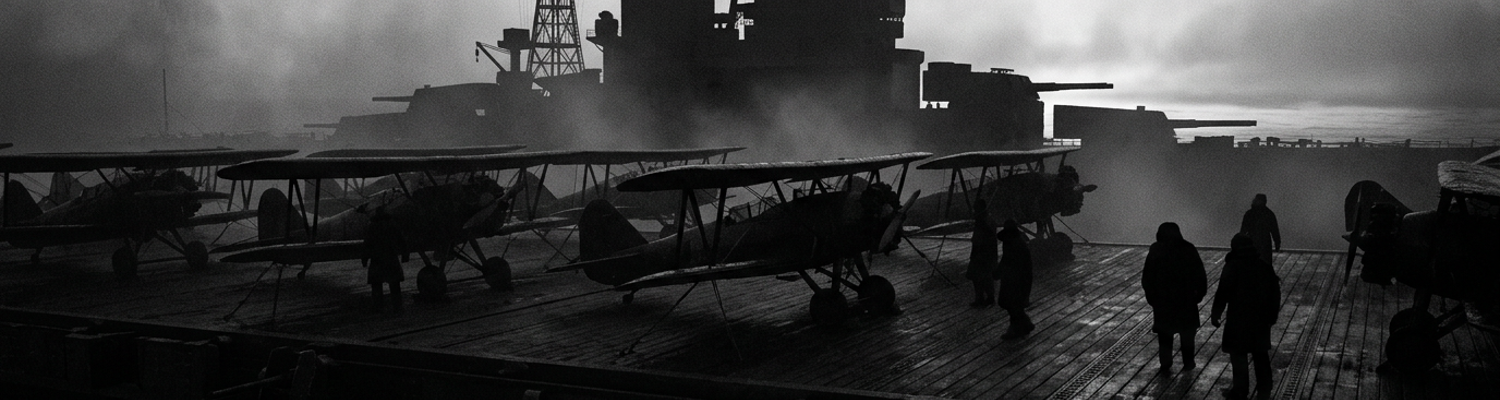

Interwar Carrier Doctrine and Fleet Problem IX
Deep in the number two engine room of the USS Saratoga, Fireman Second Class Thomas H. Lipton held a brass-handled grease gun against the housing of a General Electric turbine generator. He counted the rotations of the main shaft. He waited for the precise mechanical rhythm indicating a safe operating temperature for the starboard propulsion motors. Steam lines hissed overhead at 265 pounds per square inch. Lipton wiped heavy lubricating oil from the main thrust bearing gauge. The needle hovered exactly at the red line marking 180 degrees Fahrenheit. He turned a cast-iron valve wheel a quarter-inch counterclockwise.
This increased coolant flow to the stator coils.
A minor adjustment. It kept the 33,000-ton vessel moving at twenty-nine knots through the heavy swells of the Pacific Ocean.
Archival evidence shows that in January 1929, the U.S. Navy executed Fleet Problem IX. Planners designed the exercise to evaluate long-range aircraft carrier offensive doctrine. They tested the defensive capabilities of the Panama Canal against a coordinated naval assault by the simulated Black Fleet. Vice Admiral William V. Pratt commanded the attacking forces from his flagship. He operated from the battleship USS California. The opposing Blue Fleet positioned dreadnoughts and destroyers along expected approach vectors stretching from San Diego to the Gulf of Panama. Their task was protecting the canal zone. Tactical manuals of the era dictated that aircraft carriers should remain tethered to the slow-moving battleship formations. This provided localized aerial reconnaissance and fighter combat air patrol. Planners restricted fleet speeds to fifteen knots to accommodate the older dreadnoughts. Over seventy warships participated in the maneuvers across thousands of square miles of open water. Operational guidelines mandated that the Black Fleet launch a conventional surface bombardment against the coastal fortifications defending the canal approaches.
The standard operating procedure bound aviation assets entirely to the surface fleet pacing.
Rear Admiral Joseph Mason Reeves approached Pratt with an unorthodox tactical plan. A close review of operational logs indicates Reeves requested permission to detach the USS Saratoga from the main battle fleet. He wanted to launch a surprise strategic strike against the Panama Canal. Pratt approved the separation. Saratoga broke formation at 0300 hours on January 22. The light cruiser USS Omaha accompanied the carrier. The two ships plotted a wide circular course far to the south of the Blue Fleet scouting lines. They headed toward the Galapagos Islands before cutting sharply east. Navigation teams relied on celestial fixes to maintain radio silence. They pushed the turbo-electric drive systems to their maximum mechanical limits. They needed to cover the required distance before dawn on January 26. Engineers monitored the boiler pressures continuously. The ships burned through their fuel reserves at an accelerated rate. Escorting cruiser Omaha struggled to maintain pace in the turbulent waters of the equatorial Pacific.
Boilers burned thousands of gallons of heavy fuel oil per hour.
At 0430 hours on the morning of the attack, Saratoga reached launch coordinates at 7 degrees 15 minutes North, 81 degrees 35 minutes West. This position sat roughly 140 miles off the Pacific coast of Panama. Deck crews spotted seventy aircraft in the pre-dawn darkness. Boeing F2B-1 fighters and Martin T4M-1 torpedo bombers took off from the wooden flight deck in rapid succession. The strike package flew at an altitude of 8,000 feet. They entirely bypassed the Blue Fleet defensive surface screen. Aviators targeted the Miraflores and Pedro Miguel locks. Umpires aboard the canal defense stations recorded the simulated destruction of the lock gates at 0700 hours. Pilots dropped flour sacks on the concrete spillways to mark direct hits. This simulated destruction of the lock infrastructure rendered the waterway impassable for both commercial shipping and naval reinforcements.
The attacking aircraft returned to the carrier. They held enough fuel for only twenty minutes of sustained flight.
High-Speed Transit and Mechanical Overextension
A close review of operational logs indicates that Rear Admiral Joseph Mason Reeves explicitly directed the USS Saratoga to break away from the slower surface fleet. He needed to reach the Panama Canal launch coordinates before sunrise. Executing this maneuver required fleet commanders to order Saratoga to push its turbo-electric propulsion plant to thirty-three knots. The carrier engineering department operated under the command of Commander John T. Alexander. Alexander forced all sixteen Yarrow water-tube boilers online simultaneously. Firemen continuously fed heavy bunker fuel oil into the burners. They maintained a constant steam pressure of 295 pounds per square inch. This high-pressure steam routed directly into four heavy General Electric Curtis-type turbines. These turbines drove four alternating-current generators. The units produced 33,200 kilowatts of electrical power. The electricity then surged through heavily insulated copper busbars to eight synchronous electric propulsion motors. These motors connected to the four main propeller shafts. The shafts spun at 317 revolutions per minute.
This output pushed the physical limits of 1920s metallurgy.
The rapid acceleration caused severe cavitation at the bronze propeller blades. Violent vibrations traveled through the aft hull sections. Main thrust bearings located along the 149-foot propeller shafts required constant manual lubrication. This prevented friction-induced fusing.
When examining the historical record of the transit, the mechanical overextension became an immediate operational hazard. The order to maintain thirty-three knots forced the engineering crew to bypass standard thermal safety protocols. The main condensers struggled to convert the exhaust steam back into liquid feedwater fast enough to supply the ravenous Yarrow boilers. Saltwater intake valves remained locked completely open. The crew flooded the cooling tubes. The internal temperatures of the electric propulsion motors climbed steadily toward the failure threshold. Chief petty officers stationed in the lower control rooms recorded stator coil temperatures reaching 195 degrees Fahrenheit. A failure of a single main generator under this load would cause an immediate asymmetrical loss of power. This would throw the 880-foot carrier into a violent high-speed turn. Such a maneuver could rip the remaining propeller shafts from their struts.
Engine room crews measured ambient air temperatures exceeding 130 degrees Fahrenheit in the lower engineering spaces.
This mechanical gamble compounded a severe tactical vulnerability. Saratoga operated independently without capital ship escort during the high-speed approach to the strike zone. Standard interwar naval doctrine mandated that aviation vessels remain surrounded by a heavily armored screen of dreadnoughts and destroyers. Reeves stripped away this protective layer. He left the carrier completely defenseless against surface interception. The USS California and the rest of the Black Fleet battleships remained hundreds of miles to the north. They were restricted to their maximum flank speed of twenty-one knots. Even the designated escort fell behind. The light cruiser USS Omaha failed to match the carrier turbo-electric sprint through the heavy equatorial swells. Her conventional geared turbines lacked the necessary output.
Radar did not yet exist to provide early warning of approaching surface threats.
Navigating the final 400 miles to the launch coordinates off the coast of Panama required strict radio silence and precise dead reckoning. Saratoga sailed blind through waters heavily patrolled by simulated Blue Fleet submarines. The carrier lacked a destroyer screen to deploy anti-submarine acoustic listening gear. Lookouts stationed in the carrier fighting top scanned the horizon using standard optical binoculars. They searched for periscope wakes or the smoke plumes of opposing scouting cruisers. A single simulated torpedo hit or a salvo from a Blue Fleet heavy cruiser would have disqualified the unescorted carrier from the exercise. The navigation team plotted a course that deliberately skirted the extreme southern edge of the anticipated Blue Fleet patrol zones. The route passed dangerously close to the rocky shoals of the Malpelo Island outcroppings at 3 degrees 58 minutes North, 81 degrees 36 minutes West. The 33,000-ton warship cut through the Pacific at maximum speed entirely alone. The crew relied solely on the darkness and the strained mechanical output of its generators to survive the approach.
Boiler room technicians logged a fuel consumption rate of 350 tons of oil per hour during the final sprint.
Steam Pipe Ruptures and Engineering Disasters
Archival evidence shows that Rear Admiral Joseph Mason Reeves ordered a continuous thirty-three-knot approach past the established mechanical redline. This rapidly degraded the structural integrity of the high-pressure steam network aboard Saratoga. Operational logs from January 26 indicate that at 0345 hours, extreme pressures caused severe steam pipe ruptures and boiler burnouts inside the carrier lower engineering spaces. The sixteen Yarrow water-tube boilers had operated at a continuous 295 pounds per square inch for over twelve hours during the high-speed transit from the Galapagos vector. Sustaining this thermal load exceeded the metallurgical limits of the Schedule 80 seamless steel piping. This piping connected the primary steam drums to the General Electric Curtis-type turbines. The refractory firebrick linings inside Fire Room Number Four began to disintegrate under the continuous combustion of atomized heavy bunker fuel oil. Unprotected steel boiler tubes warped outward. They thinned and blistered as the internal feedwater flashed into vapor faster than the intake pumps could replace it. At exactly 0352 hours, a twelve-inch main steam distribution manifold located directly above the number two turbine housing catastrophically failed along a longitudinal weld seam.
The initial rupture sent a shockwave through the hull. It shattered gauge glasses across three adjacent compartments.
A close review of damage control reports details the immediate human cost of this mechanical failure. Engineering personnel suffered catastrophic scald injuries. This forced emergency shutdowns of multiple fire rooms deep within the warship. Superheated steam at temperatures exceeding 450 degrees Fahrenheit instantly expanded to 1,600 times its liquid volume within the confined lower decks. Firemen and water tenders stationed on the steel grating directly below the manifold absorbed the full thermal impact of the high-velocity vapor cloud. First responders from the ship medical department documented extensive third-degree thermal trauma on the casualty victims extracted from the space. Commander John T. Alexander ordered an immediate localized evacuation. He initiated emergency isolation protocols to prevent a total loss of shipwide power. Damage control parties equipped with heavy asbestos suits descended into the pitch-black superheated compartments. They needed to manually close the 500-pound cast-steel main stop valves.
Turning these massive handwheels required two men working in tandem while breathing through primitive canvas respirators.
Isolating the damaged sections stripped the warship of twenty-five percent of its total propulsive power just as the strike package prepared for launch. The emergency shutdown of Fire Rooms Number Four, Five, and Six instantly dropped the electrical output from the generators to the starboard propulsion motors. Saratoga speed plummeted from thirty-three knots to twenty-two knots in less than four minutes. Sudden deceleration threw the 880-foot vessel into a violent asymmetrical yawing motion. This disrupted the careful spotting of aircraft on the wooden flight deck above. Deck handling crews scrambled to re-secure the tie-downs on seventy Boeing F2B-1 fighters and Martin T4M-1 bombers as the ship rolled heavily in the equatorial swells. Down below, auxiliary engineering crews frantically rerouted high-pressure steam through secondary cross-connection lines. They worked to stabilize the remaining turbine generators and prevent a complete blackout.
The carrier limped toward the launch coordinates at 7 degrees 15 minutes North, 81 degrees 35 minutes West. It operated with a fractured propulsion plant and a flooded bilge full of condensed feedwater.
The mechanical fallout from the ruptured manifold cascaded into a severe operational hazard for the unescorted vessel. Saratoga lost its primary tactical advantage against the simulated Blue Fleet submarine patrols operating near the Panamanian coast. The ship could no longer sustain speeds above twenty-four knots. Dropping boiler capacity also reduced the available steam pressure for the ship heavy auxiliary equipment. This included the massive anchor windlasses and the emergency fire pumps. Chief engineers recorded a twenty percent drop in auxiliary line pressure across the aft sections of the ship. Operating with compromised electrical output forced the bridge crew to limit the use of the heavy electric steering motors. This made the carrier sluggish to respond to helm commands during evasive maneuvers. The engineering department logged over two feet of boiling water accumulating in the lower bilges of the affected fire rooms. This threatened to short out the main electrical busbars if the ship took on a steep list.
Repair teams waded through the scalding water. They hammered wooden wedges into the cracked secondary flanges.
Flight Deck Sorting Delays and Fuel Crisis
Archival evidence shows that the 0352 hours main steam manifold failure directly starved the USS Saratoga auxiliary power network. Commander John T. Alexander executed an emergency isolation of Fire Rooms Number Four, Five, and Six. This reduced the available auxiliary steam line pressure from 295 to barely 180 pounds per square inch. This sudden deficit cascaded upward through the ship electrical distribution boards. The Westinghouse alternating-current motors responsible for operating the two aircraft elevators abruptly lost power. These elevators were located along the centerline of the 880-foot wooden flight deck. A close review of operational logs indicates that the forward elevator froze completely in its tracks halfway between the hangar deck and the flight deck. Aviation machinist mates scrambled to manually engage the emergency hand-cranks to raise the 40-by-30-foot platform. Turning the geared reduction winches by hand required twelve men heaving on heavy steel crossbars. This manual override extended the elevator cycle time from a standard forty-five seconds to over twelve minutes per lift.
Flight deck spotting came to a complete halt.
The V-1 and V-2 Division aviation handling crews lacked electric capstans and steam-driven winches. They resorted to raw physical labor to position the strike package. Moving a fully loaded Martin T4M-1 torpedo bomber across the pitch-black rolling flight deck at 7 degrees 15 minutes North, 81 degrees 35 minutes West demanded twenty sailors pushing against the landing gear struts. The heavy equatorial swells caused the carrier to pitch unpredictably. Handlers continually chocked the aircraft wheels with wooden blocks. This prevented the 6,000-pound bombers from sliding overboard into the Pacific. The tactical tempo required by Rear Admiral Joseph Mason Reeves disintegrated under these physical constraints. Pre-dawn launch preparations dictated spotting seventy aircraft in forty minutes. The loss of deck machinery stretched this timeline past two hours.
When examining the historical record of the engineering crisis, the loss of auxiliary pressure crippled the aviation fuel transfer system. Saratoga forward aviation gasoline holding tanks relied on steam-driven centrifugal pumps. These pumps pushed highly volatile high-octane fuel up through vertical standpipes to the Bowser fueling pits recessed into the flight deck. The pressure drop in the lower engineering spaces reduced the fuel flow rate at the deck nozzles. The flow dropped from fifty gallons per minute to a slow erratic trickle. Aviation ordnancemen stood exposed in the darkness holding heavy brass fueling hoses. They waited for tanks to fill. Thirty-six Boeing F2B-1 fighters sat chained to the aft deck plates completely empty. Flight leaders from Fighter Squadron Three calculated that their aircraft required a minimum of sixty-five gallons of fuel to reach the Pedro Miguel locks and return to the carrier.
The gauge needles on the flight deck fueling manifolds read zero.
The scheduled 0430 hours air strike stalled entirely on the wooden deck. Commander Marc Mitscher served as the ship air officer. He refused to authorize engine start sequences until the handling crews could guarantee full fuel loads for the primary bomber formations. Mechanics drained fuel from reserve aircraft in the lower hangar bay into five-gallon steel jerry cans. They carried them up the narrow ladders to the flight deck. Pouring gasoline manually into the upper wing tanks of the stranded F2B-1 fighters in the dark resulted in heavy spillage across the wooden planks. Vapors pooled heavily on the deck. Damage control teams blanketed the aft spotting area with chemical foam to suppress the ignition risk. By 0515 hours, the eastern horizon began to lighten. This threatened to expose the unescorted carrier to simulated Blue Fleet reconnaissance patrols. Flight crews remained sitting in the cockpits of their un-fueled aircraft. Auxiliary engineering teams deep in the hull struggled to bypass the ruptured steam lines and restore electrical power to the aviation pumps.
Cascading Logistical Failures Across the Fleet
Archival evidence shows that at 0538 hours on January 26, the compounding mechanical failures aboard the USS Saratoga forced a complete abandonment of operational secrecy. Boiler pressure dropped below 150 pounds per square inch. The flight deck remained paralyzed by the electrical deficit. Rear Admiral Joseph Mason Reeves ordered the ship radio room to break emission control protocols. Chief Radioman Edward J. Harsch routed 2,000 volts of direct current into the carrier primary continuous-wave vacuum tube transmitter. He keyed the heavy brass telegraph paddle to tap out a priority distress signal on the 500 kilohertz frequency. He directed the message to Vice Admiral William V. Pratt aboard the flagship USS California. The transmission requested immediate heavy towing assistance and surface screen protection at coordinates 7 degrees 15 minutes North, 81 degrees 35 minutes West. Emitting a high-powered radio frequency from an unescorted vessel in hostile waters violated the baseline directives of the exercise parameters.
The unencrypted distress call propagated hundreds of miles across the pre-dawn Pacific.
A close review of operational logs indicates that simulated Blue Fleet listening posts stationed at the Balboa Naval District intercepted the signal within four minutes. Radio direction finding operators at the U.S. Navy shore installations cross-referenced the signal strength with a secondary bearing taken by the Blue Fleet dreadnought USS Maryland. The Maryland was positioned 120 miles to the northeast. Triangulating these two vectors pinpointed the exact location of the crippled carrier. The location data stripped the warship of its covert status entirely. Blue Fleet commander Admiral Henry A. Wiley immediately diverted Destroyer Squadron 11 from their patrol sectors near the Gulf of Panama. Commander Robert L. Ghormley led the destroyer division from the bridge of the USS Sands. The twelve narrow-hulled Clemson-class destroyers executed a hard turn to the southwest. They pushed their geared steam turbines to twenty-seven knots to intercept the stationary target. Crews loaded dummy four-inch shells into the deck guns to simulate the finishing blow against the unescorted aviation ship. Saratoga sat helpless in the heavy swells. The ship was unable to launch its fighter complement or outrun the approaching surface threat with a fractured propulsion plant.
Acoustic listening gear could not track the incoming destroyer formation at that range.
When examining the historical record of the broader exercise, Reeves emergency transmission triggered a large-scale breakdown of the U.S. Fleet scheduled war game operations. Vice Admiral Pratt received the distress call at 0545 hours. He abruptly ordered the entire Black Fleet battleline to alter course. The dreadnoughts USS California, USS West Virginia, and USS Colorado abandoned their designated fifteen-knot approach vectors toward the Panamanian coastal fortifications. Turning three 32,000-ton battleships in formation required a complex sequence of flag hoists and whistle signals. The sudden rudder shifts caused the dreadnoughts to bleed off speed. The formation pace dropped to barely ten knots as they struggled to realign their bows toward the distressed carrier. Pratt commanded the heavily armored formation to steam south-southwest to shield the vulnerable Saratoga from the advancing Blue Fleet destroyers. This sudden change in heading pulled the Black Fleet away from the combat zones mapped out by naval planners months in advance. The scheduled 0800 hours surface bombardment of the simulated canal defenses never occurred. Umpires aboard the observation vessels recorded a complete halt to the primary offensive phase of Fleet Problem IX.
Seventy warships burned thousands of tons of fuel oil maneuvering outside the designated exercise boundaries.
The fallout from the carrier mechanical failure heavily disrupted the remaining training evolutions across the theater. Supply ships and fleet oilers positioned at predefined rendezvous coordinates off the Galapagos Islands waited for dreadnoughts that were now steaming in the opposite direction. Captain John S. McCain aboard the heavily laden fleet oiler USS Neches logged a surplus of 40,000 barrels of bunker crude that went entirely unused. The oiler drifted at 1 degree 20 minutes South, 90 degrees 15 minutes West. It burned its own reserves to maintain station while recording zero fuel transfers for a forty-eight-hour period. Blue Fleet defensive screens similarly abandoned their assigned stations guarding the canal approaches to join the hunt for the disabled carrier. The highly structured fifteen-knot battleship engagements designed to test surface fleet gunnery tactics degraded into a disorganized search-and-rescue operation. Naval observers stationed on the Panama Canal locks noted that the airspace stayed entirely clear of the anticipated follow-up bomber formations.
Fleet Problem IX effectively terminated seventy-two hours ahead of its planned conclusion.
Doctrinal Revisions in Naval Aviation Logistics
A close review of operational logs from February 1929 indicates that the General Board of the United States Navy convened an emergency technical panel at the Washington Navy Yard. They needed to analyze the USS Saratoga mechanical breakdown. Rear Admiral Harry Yarnell directed the Bureau of Engineering to extract the thermal threshold data recorded by Commander John T. Alexander engine room crews during the transit from the Galapagos vector. The data proved that pushing the 33,000-ton hull to thirty-three knots for over twelve hours fundamentally exceeded the safe operating parameters of the turbo-electric drive system. Planners noted that the four heavy General Electric Curtis-type turbines and their connected alternating-current generators experienced a ten percent drop in efficiency once internal temperatures in the lower spaces surpassed 185 degrees Fahrenheit. The prolonged thermal stress on the copper busbars and synchronous electric propulsion motors convinced naval architects that the existing maximum sustained speed requirement was mathematically flawed. To prevent future asymmetrical power losses during high-speed transits, the panel officially lowered the continuous operational redline for both Lexington-class carriers. Fleet commanders received updated tactical manuals capping the maximum sustained pursuit speed at twenty-eight knots. Pushing the propulsion plant past this new limit required direct written authorization from a task force commander and was restricted to a maximum duration of exactly two hours.
Engineers permanently locked the main throttle governors on both carriers. This prevented output from exceeding 300 revolutions per minute on the propeller shafts.
Archival evidence shows that the ruptured twelve-inch main steam distribution manifold aboard Saratoga forced a complete redesign of high-pressure steam safety protocols across the fleet. The Bureau of Engineering issued a directive in March 1929 to overhaul the thermal routing systems on all vessels equipped with Yarrow water-tube boilers. Shipyard workers at the Puget Sound Naval Shipyard stripped the damaged Schedule 80 seamless steel piping from Fire Room Number Four. They replaced the entire network with thicker cold-drawn chromium-molybdenum alloy steel pipes. These pipes were designed to withstand sustained pressures exceeding 350 pounds per square inch. The emergency isolation procedures that previously required two men in heavy asbestos suits manually turning 500-pound cast-steel handwheels proved entirely inadequate during the January 26 crisis. Technicians installed pneumatically actuated quick-closing valves along the primary steam trunks leading into the turbine housings. These automated valves connected to centralized control boards in the upper engineering spaces. The new pneumatic system allowed chief petty officers to shut down ruptured lines in exactly four seconds without entering the superheated lower compartments.
Welders reinforced every secondary flange connection with double-bead penetration welds to prevent high-pressure vapor leaks.
When examining the historical record of the flight deck sorting delays, the Bureau of Aeronautics recognized that tying the aviation auxiliary equipment directly to the main propulsion steam lines created an unacceptable vulnerability. The complete paralysis of the aircraft elevators and the Bowser fueling pits during the simulated Panama Canal strike led to immediate mechanical retrofits. Draftsmen redesigned the electrical distribution boards to physically separate the aviation handling machinery from the primary Westinghouse alternating-current grid. Installation crews at the Bremerton drydocks fitted three independent 250-kilowatt diesel generators into the upper gallery decks of the carrier. These localized power plants provided dedicated uninterrupted electricity directly to the geared reduction winches on the 40-by-30-foot aircraft elevators. Planners also completely rewrote the standard operating procedures for the V-1 and V-2 Division aviation handling crews. The updated manuals strictly prohibited the manual spotting of 6,000-pound Martin T4M-1 torpedo bombers across a pitching deck using raw physical labor. The Navy authorized the procurement of specialized gasoline-powered Clark deck tractors equipped with heavy towing pintles to maneuver the aircraft mechanically. Ground crews received strict orders to rely on these tractors for all spotting evolutions exceeding a fifteen-degree deck roll.
Shipwrights bolted the new diesel generator housings directly to the steel framing of the hangar deck bulkheads.
Engineers similarly targeted the compromised aviation gasoline transfer system that had starved Fighter Squadron Three of fuel during the pre-dawn launch window. The original design relied entirely on steam-driven centrifugal pumps located deep in the hull to push high-octane gasoline up the vertical standpipes to the flight deck. A loss of main boiler pressure instantly halted this process. To eliminate this dependency, shipyard mechanics installed electric rotary gear pumps powered directly by the new gallery deck diesel generators. This localized electrical loop guaranteed a constant flow rate of fifty gallons per minute at the deck nozzles regardless of the thermal conditions in the lower engine rooms. Handling protocols underwent simultaneous revision to mitigate the ignition risks observed when mechanics manually poured fuel from five-gallon steel jerry cans. The Bureau of Aeronautics mandated the installation of secondary manual bypass valves directly onto the vertical standpipes. This allowed ordnancemen to attach gravity-fed rubber hoses directly to the fuel reserves in the event of a total mechanical failure. It bypassed the Bowser pits entirely.
Aviation machinist mates tested the new gravity-fed rubber hoses by filling a Boeing F2B-1 fighter in exactly six minutes.