
Aleutian Submarine Deployments and Arctic Operating Hazards
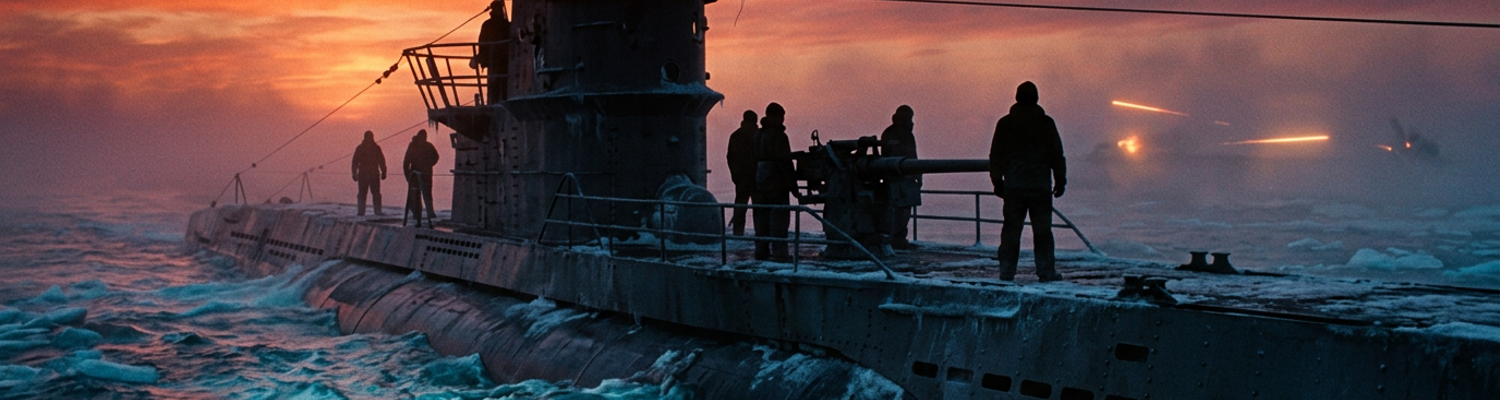
Submarine operations staging out of Dutch Harbor unraveled into chaos as sub-zero gales, perpetual fog, and severe icing battered the western Aleutians. Freezing spray instantly encased deck guns, periscope shears, and exhaust valves in thick layers of solid ice, dragging the vessels down by the head. Lookouts lashed themselves to the open bridge shears with heavy hemp line while sixty-knot williwaw winds knocked men off their feet and blinded them with sleet. Commanders ordered frequent emergency dives to wash the topside ice buildup away in the warmer subsurface brine, but diving brought new crises of its own. Frigid seawater at thirty degrees chilled the uninsulated steel hulls within minutes, causing ambient interior temperatures to plunge below freezing throughout the living and propulsion spaces. Every hatch closure sealed trapped moisture inside the steel envelope, transforming the internal compartments into dripping cold-storage vaults.
S-class submarines, aging relics of the First World War, lacked modern environmental controls, causing heavy internal condensation that fouled critical electrical contacts and froze bilge lines. Dripping water poured down the curved hull plating, pooling behind switchboards and sparking bright electrical arcs that filled the control room with acrid insulation smoke. Electricians stood watch with dry rags and canvas covers, constantly wiping down the main motor controls to prevent catastrophic fires while standing in ankle-deep slush. Bilge lines froze solid where they drained into the pump manifolds, forcing engine crews to thaw emergency drain valves with blowtorches to keep the boats from losing buoyancy. Torpedo crews discovered that heavy grease on the tube doors had hardened into brittle paste, locking the outer doors shut and leaving the forward room unable to fire on short notice. Captains ordered their crews to manually chip away the hardened grease using brass scrapers while the submarines drifted blindly along their assigned interception sweeps.
Crews navigated treacherous volcanic passes and submerged pinnacle rocks without reliable hydrographic charts or radar, compounding their mechanical troubles with extreme geographic danger. Navigators relied on crude nineteenth-century sounding sketches that omitted submerged volcanic spires rising hundreds of feet from the seabed directly in the center of patrol channels. Ripping tidal currents in the narrow straits between Unalaska and Kiska pushed submerged boats miles off course at speeds exceeding eight knots, rendering dead-reckoning plots completely useless. Sonar operators strained over their headphones to detect the roar of breaking waves or the hollow ping of sound gear bouncing off sheer underwater cliffs, knowing that a single glancing blow would crush the single-walled hulls. Lookouts on the surface could rarely see beyond the bow through the dense bank of maritime fog, forcing officers to identify nearby islands by the smell of sulfur fumes venting from active volcanoes. Commanders repeatedly surfaced in pitch darkness only to find their hulls grinding against kelp beds yards from sheer rock faces, forcing immediate reversals of the diesel engines to back away into deep water.
Officers at Dutch Harbor ignored reports of these submerged pinnacles and blinding storms, demanding that submarines maintain rigid attack positions to protect Army bases that refused to share basic weather data. Senior Army commanders in the theater guarded their operational independence, declining to coordinate reconnaissance flights with naval headquarters and leaving submarine crews to guess when friendly bombers were operating overhead. Army patrol planes repeatedly attacked American submarines attempting to recharge batteries on the surface in poor visibility, mistaking the low silhouettes for enemy targets. Naval staff officers retaliated by withholding patrol schedules from Army headquarters, prioritizing territorial authority over the basic safety of the men at sea. Submarine captains faced disciplinary reprimands from desk-bound superiors for breaking patrol lines, even when retreating from uncharted rocks or seeking shelter from hurricane-force gales that threatened to roll their boats. Captains routed their battered vessels southward toward the Puget Sound Navy Yard, pulling away from the Aleutian combat zone to seek the heavy industrial dry docks required to rebuild their frozen machinery.
Eleventh Air Force Fratricide and Inter-Service Discord
Shrapnel gouges along the superstructure of USS S-28 documented that the physical trauma driving these boats south came as much from American airpower as from Arctic weather or enemy depth charges. Inadequate recognition protocols and misidentifications led friendly aircraft, including a U.S. Navy patrol floatplane that attacked USS S-28, to mistakenly target American S-boats, forcing submarine watchstanders to scramble down the conning tower ladder under fire. Bridge lookouts fired colored recognition flares and hoisted signal panels onto the bridge rails, but passing airmen failed to understand the naval pyrotechnic codes or mistook the distress smoke for anti-aircraft puffs. Submarine commanders had to vent their ballast tanks and crash dive into the icy sea to escape American aerial bombs that detonated close enough to shatter interior light bulbs, pop high-pressure fittings, and tear deck planking away from the steel frames. Water surged into the bilges through split seams as the battered submarine leveled off at sixty feet, its crew listening to the dull thuds of their own allies continuing their bombing run above.
Eleventh Air Force pilots dropped those bombs because low-hanging cloud banks, blowing snow, and thick maritime drizzle distorted every silhouette on the water. Army air crews routinely mistook surfaced American submarines for Imperial Japanese Navy vessels during low-visibility patrols off Kiska and Attu. Aviators received minimal training in naval ship recognition, leading flight leaders to assume that any low-slung vessel riding the crests near the occupied islands belonged to Tokyo. Submarine crews running their loud diesel engines on the surface to recharge drained storage batteries had only seconds to spot an aircraft dropping out of the low cloud ceiling at three hundred feet. Men on the open bridge struggled to fire designated recognition rockets into the fog before heavy machine-gun slugs punched through the deck plates and splattered against the periscope standards. Captains could not risk holding course to verify an aircraft identity when a single fifty-caliber bullet through the pressure hull would prevent the submarine from submerging.
Commanders at Dutch Harbor erupted in fury over these near-fatal aircraft strafings, but their formal protests produced only bitter arguments across service lines. Rigid command boundaries between Army Air Forces units and naval task forces fostered intense friction and mutual distrust among forward commanders. Army generals answered strictly to their own regional command, while naval task force admirals answered to Pacific Fleet headquarters in Hawaii, creating two separate wars fought in the exact same airspace and ocean passes. Staff officers on both sides refused to establish joint operations rooms, guard shared radio frequencies, or distribute daily flight grids to submerged patrol divisions. Submarine officers quickly concluded that the air staff treated their boats as expendable targets, while air officers accused naval captains of cowardly operating habits and inadequate surface coordination. Forward commanders exchanged biting teletype dispatches and formal memorandums of protest, leaving combat crews to navigate the deadly airspace without reliable communication or coordinated support.
Submarine captains altered their operational routines at sea to survive this uncoordinated combat environment, refusing to surface during daylight hours even when high-seas battery charging became critical. Skippers kept their diesel exhaust valves sealed and remained submerged in freezing water for eighteen hours at a stretch, running propulsion cells down to empty rather than exposing their boats to Eleventh Air Force patrol bombers. Battery gases gathered in unventilated living compartments while condensation dripped onto the electrical control boards, compounding internal breakdowns that Dutch Harbor tender repair crews could not remediate. When mechanical failures finally forced boats back into port, naval staff officers found hulls peppered with friendly machine-gun rounds and ballast tanks buckled inward by American aerial depth bombs. Fleet engineers directed the damaged S-boats to clear Alaskan waters entirely and steer south for the industrial dry docks at Bremerton. Puget Sound Navy Yard shipfitters cut away bent structural ribs, replaced ruptured fuel lines, and repaired the heavy physical wreckage left behind by inter-service crossfire.
Bureau of Ordnance Disputes and Torpedo Failures
Shipfitters clearing ruptured compartments at the Puget Sound Navy Yard also hauled out unfired torpedoes from forward handling rooms whose crews had watched weapon after weapon fail during combat runs off Kiska and Attu. Frontline submariners lodged persistent complaints regarding defective Mark 14 torpedoes and their Mark 6 exploders that failed to detonate upon striking enemy hulls. Patrol logs from boats returning to Dutch Harbor described textbook periscope approaches against Japanese transports, where torpedoes ran true and struck the targets amidships with a hollow clang of metal on metal, only to sink harmlessly to the ocean floor without an explosion. Torpedo officers discovered that the firing pins inside the Mark 6 exploders mounted on newer Mark 14 torpedoes crumpled on impact against vertical armor plating instead of driving forward into the detonator caps. Torpedo tender mechanics inspecting unexploded warheads pulled from the Alaskan surf found bent guide rods, misaligned striker heads, and delicate magnetic induction coils that had short-circuited in the frigid maritime atmosphere long before reaching the targets. Captains compiled stack after stack of formal patrol reports and physical fragments, sending detailed technical affidavits south to Bremerton and east to Washington to prove that the primary submarine weapon of the United States Navy was fundamentally broken.
Ordnance authorities at the Bureau of Ordnance and the Newport Torpedo Station dismissed reports of frozen pneumatic valves and erratic torpedo runs as operator incompetence. Staff officers and civilian design engineers in Washington insisted that prewar testing at the Newport Torpedo Station was beyond question, blaming frontline crews for sloppy maintenance, improper gyro angle calculations, and poor firing discipline in rough seas. Aleutian commanders pushed back against these reprimands by presenting recovered mechanical evidence showing that thirty-degree seawater congealed the heavy lubricating grease inside the torpedo steering engines and froze pneumatic depth-setting valves into solid blocks of ice. Frozen pneumatic valves trapped high-pressure air and forced the torpedoes to run ten to fifteen feet deeper than their dial settings, causing weapons to sail harmlessly under the keels of shallow-draft enemy supply ships. Horizontal rudders locked by frozen moisture sent other weapons broaching wildly through the surface swell or running in erratic circles that threatened the firing submarine itself. The Washington Navy Yard continued to reject the field reports and refused to authorize mechanical changes, forcing crews to load the defective weapons back into their firing tubes.
Destroyers of the Imperial Japanese Navy capitalized on this administrative impasse by violently counterattacking American boats whose presence was instantly betrayed by the useless weapons. Bureaucratic denial in Washington delayed crucial mechanical modifications, forcing Aleutian crews to risk counterattacks after firing dud torpedoes. Submarines that had maneuvered within two thousand yards of Japanese convoys to fire their spreads had to watch the torpedoes bounce off enemy hulls without exploding, leaving long white bubble tracks in the icy water that led enemy destroyers straight back to the periscope. Japanese sub-chasers followed those tracks and saturated the attack positions with rolling patterns of depth charges, battering American hulls, blowing out internal lighting circuits, and fracturing high-pressure hydraulic lines throughout the machinery spaces. Submarine captains had to dive to dangerous depths without functioning weapons to defend themselves, dodging underwater rock pinnacles in the dark. Crews nursed their bruised, leaking boats south toward Puget Sound for another round of heavy emergency overhauls while enemy transports sailed away untouched.
USS S-35 Battery Fire and Chlorine Gas Emergency
USS S-35 faced sudden destruction before it could reach safe harbor in December 1942, when heavy seas off Amchitka forced salt water into the forward battery well, initiating an intense electrical fire. Freezing ocean brine poured down the conning tower hatch and through compromised deck fittings, cascading across sixty large lead-acid storage cells that powered the propulsion motors. Electrical arcs instantly erupted along the submerged terminal posts, vaporizing copper bus bars and setting wooden cell separators into violent combustion. Billowing clouds of acrid black smoke poured out of the battery well into the adjoining crew quarters and control room, forcing watchstanders to drop deck hatches and seal watertight bulkheads. Trapped heat inside the sealed battery compartment rapidly climbed past three hundred degrees, blistering the paint on structural bulkheads while the crew fought to keep the rolling submarine level in sixty-knot winds.
Seawater interacting with battery acid generated dense clouds of lethal chlorine gas inside the sealed submarine. Boiling sulfuric acid inside the shattered storage jars released pure chlorine vapor as the salt brine broke down under extreme electrical heat and current. Greenish-yellow fumes seeped around cable gaskets and through ventilation ducts, displacing breathable air throughout the living spaces and machinery flats. Sailors grabbed canister rescue masks from emergency lockers, but the basic charcoal filters fouled within minutes against the high concentration of corrosive acid vapors. Stifling smoke and chemical vapor turned the interior atmosphere into an opaque, toxic fog, cutting visibility to zero and snuffing out emergency flashlights.
Crewmen suffered severe chemical burns to their corneas and respiratory tracts while fighting through thick black smoke to execute manual damage control. Volunteers crawled flat on their bellies into the battery space, feeling their way along scorching deck frames to locate the burning electrical connections by hand. Sailors discharged portable carbon dioxide extinguishers directly into the open battery trays, choking back waves of nausea as hydrochloric acid fumes formed on their damp skin and inside their eyes. Electricians used insulated pry bars and heavy rubber gloves to tear melting disconnect switches free from the main bus, cutting off the catastrophic current flow before another arc could burn a hole through the pressure hull. Men collapsed unconscious across the deck plates as chemical fluids filled their lungs, forcing their shipmates to drag them out through the escape trunk by their boot heels before returning to the flames.
Electricians finally smothered the last smoldering cables after hours of blind physical labor, isolating the ruined battery bank from the rest of the electrical grid. Watch officers ordered the submarine blown to the surface, cracking the bridge hatch into the freezing gale to vent the lethal chlorine fog into the Alaskan storm. Sub-zero air rushed into the compartments to flush out the poison, but half the crew lay incapacitated with blinded eyes, raw throats, and blood pooling in their mouths. Medical supplies at sea offered no relief beyond sterile saline and morphine, prompting the captain to abandon his patrol sector and nurse the crippled boat eastward toward the naval base at Dutch Harbor. Fleet surgeons at Dutch Harbor evacuated the burned submariners to shore hospitals while shipyard engineers condemned the ruined forward compartments. Commanders routed USS S-35 south to the Puget Sound Navy Yard for structural reconstruction and a complete replacement of its electrical systems.
Puget Sound Navy Yard Structural Overhauls
USS S-35 limped through towering ocean swells during an emergency transit across the stormy North Pacific, arriving at Puget Sound Navy Yard in January 1943 for a four-month rebuild. Shipyard tugs hauled the blackened hull into a dry dock at Bremerton, where dockside workers pumped out the basin to expose sheets of blistered hull steel, dented ballast casings, and thick encrustations of salt. Shipyard administrators immediately clashed with naval task force commanders over repair priorities, as operational headquarters demanded the submarine return north within weeks to counter Japanese patrols while yard superintendents refused to release a structurally unsound boat. Dock workers scraped away toxic residue from the forward compartments while industrial blowers forced fresh air through the interior spaces so laborers could enter without respirators. Riggers hauled out tangled bundles of fried copper wiring, cracked battery jars, and waterlogged bunks, piling tons of chemical-soaked debris onto dockside flatcars for disposal. Yard managers established around-the-clock shift rotations to strip the forward section down to its bare structural ribs before cold weather and persistent salt moisture could corrode the underlying steel any further.
Bremerton yard mechanics tackled the gutted interior by replacing charred electrical mains, reconstructing corroded battery compartments, and rebuilding burned-out ballast systems that had failed under the combined assault of fire and seawater. Electricians pulled thousands of feet of heavy insulated cable through narrow hull penetrations, soldering fresh junctions to replace circuits ruined during the chlorine gas emergency. Welders cut away structural floor plates in the battery wells where pooling acid had eaten deep pits into the load-bearing frames, replacing the ruined metal with heavy structural steel coated in thick layers of acid-resistant rubber paint. Boilermakers re-plumbed the compressed-air manifolds and emergency blow valves for the ballast tanks, swapping warped copper piping for heavier naval brass capable of surviving high-pressure shocks. Inter-service squabbling over scarce raw materials slowed the reconstruction, as regional Army procurement officers refused to release priority allocations of copper bus bars and specialized pumps that had been set aside for territorial airfields. Navy expediters circumvented the Army supply chain by cannibalizing decommissioned hulls and rerouting naval stockpiles from California to keep the Bremerton repair lines functioning.
Yard engineers and naval architects utilized this dismantled state to gather critical empirical data from S-35 regarding pressure-hull resilience and material fatigue under Arctic combat conditions. Metallurgists scraped core samples from the pressure hull and placed ultrasonic testers against the riveted hull plates to measure how severe sub-zero thermal cycling had weakened the steel. Stress tests revealed microscopic fracture patterns along external framing lines where repeated transitions between freezing surface air and cold subsurface sea pressures had flexed the hull beyond peacetime engineering estimates. Architects documented that heavy depth-charge detonations and williwaw-induced pounding had bowed several forward transverse bulkheads, creating structural distortions that Dutch Harbor repair tenders had failed to diagnose. Technical specialists drafted comprehensive metallurgical reports that challenged prewar design manuals, proving that Arctic operations caused rapid brittleness in mild steel plating and required reinforced hull stiffeners. Navy draftsmen immediately drew up new blueprints to incorporate these structural reinforcements into all subsequent submarine overhauls.
Shipfitters installed these reinforced stiffening rings along the forward hull before crane operators lowered new lead-acid battery cells into the reconstructed wells. Riggers bolted steel hatch frames into place and tested watertight seals under hydrostatic pressure to verify that the reconstructed compartments could withstand deep submerged operations. Yard electricians completed the final hookups of the propulsion switchboards, running diagnostic load tests against dockside power generators to confirm that no residual shorts lingered in the rewound auxiliary motors. Tugboats nudged the rebuilt submarine out of the dry dock basin in late spring, allowing sea-trial crews to conduct shallow dive tests in Puget Sound. Captains issued sailing orders for the boat to return to the Aleutian front, sending the reinforced submarine back into the freezing gales of the North Pacific.