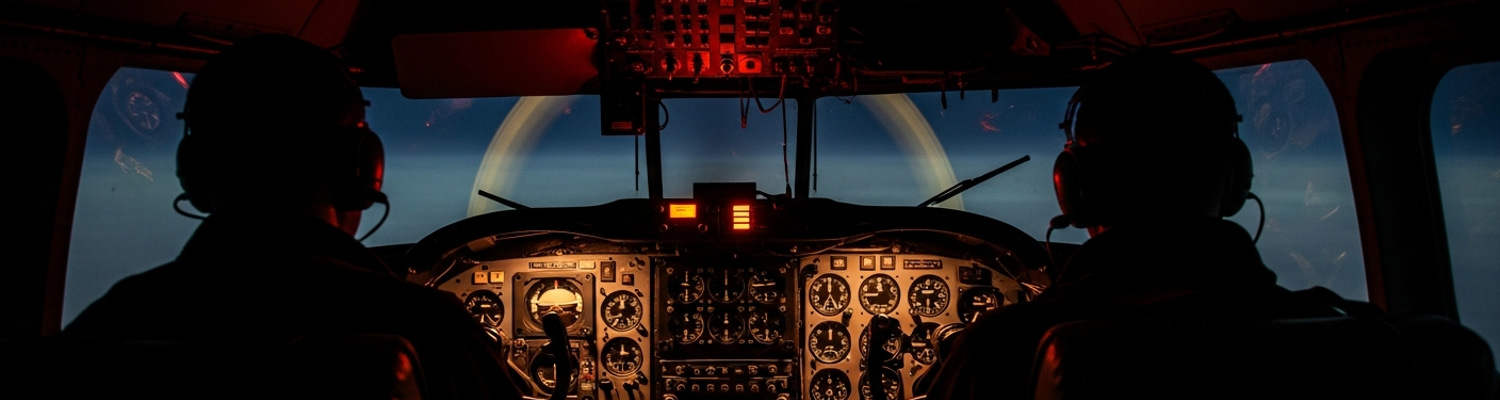

The oil pressure gauge for the starboard engine of the Douglas C-47 vibrated violently. Its needle dropped with sickening speed. Inside the cockpit, the pilot fought the controls as the transport, laden with supply canisters for a French Resistance circuit, began a gut-wrenching yaw. Below, the designated drop zone, a field supposedly marked by three bonfires, was indistinguishable from a dozen other dark patches of Norman countryside. The mission was a failure before the first canister even left the bay.
This single mechanical fault was a symptom of a far deeper, institutional sickness within the Allied air arms. The United States Army Air Forces had entered the war institutionally obsessed with a singular concept: the war-winning potential of high-altitude, daylight strategic bombing. A review of pre-war spending and development shows a doctrine shaped almost entirely by theories from the Air Corps Tactical School. These held that fleets of self-defending heavy bombers like the B-17 Flying Fortress could cripple an enemy’s industrial web and make bloody ground warfare obsolete. This belief consumed the budget, engineering talent, and intellectual energy. Close air support was a secondary, tactical mission, a diversion of precious air assets from their true purpose. Providing such support to scattered, ill-equipped, and secretive bands of irregulars was not just neglected. It was doctrinally nonexistent.
The pilots were trained for a different war.
Archival evidence from headquarters, Western Flying Training Command (NARA Record Group 18), reveals a pilot production pipeline engineered for this strategic vision. From primary flight training at fields like Thunderbird Field in Arizona to advanced instruction across California, the syllabus was rigid and standardized. It was geared toward producing crews for conventional warfare. Cadets spent hundreds of hours mastering formation flying, navigating by instrument over vast landscapes, and executing bombing runs on clearly delineated, static target ranges in the desert. They learned to communicate with ground-based forward air controllers using standardized radio equipment like the SCR-522 and pre-arranged codes. They expected to support uniformed divisions with clear front lines and objectives.
There was no module for identifying a camouflaged German staff car based on a partisan’s frantic hand signals. No training exercise simulated a low-level attack run through a steep, wooded ravine in the Balkans while trying to avoid hitting nearby civilians. The entire system was designed to mass-produce pilots who could operate as cogs in a large, airborne machine, not as lone hunters capable of the improvisation and snap judgment required to support guerrilla operations. This disconnect created an almost insurmountable operational chasm. A review of operational logs from the Fifteenth Air Force’s Balkan Air Force illustrates the problem. A P-47 Thunderbolt pilot, trained to spot tank columns and artillery emplacements, was of limited use when the target was a specific, unmarked building in a dense village that briefly housed a Gestapo officer. Communication was a primary point of failure. Partisan groups lacked the heavy, power-hungry radios found in Allied vehicles, relying instead on captured enemy sets, unreliable hand-cranked clandestine radios, or simple signal fires. This forced aircrews to rely on visual recognition in high-speed, low-altitude passes. The political complexity was another factor for which air doctrine had no answer. In Yugoslavia, providing air support to Tito’s Partisans risked alienating the Chetniks, and vice-versa. In Poland, the political gulf between the Home Army and Soviet-backed partisans meant that targeting information from one group could be a deliberate attempt to mislead the Allies into attacking a rival. The AAF’s command structure was built for clear chains of command and unambiguous targeting data flowing from corps-level headquarters, not for navigating the internecine political struggles of occupied nations.
A close review of operational logs from the Special Operations Executive (SOE) and Office of Strategic Services (OSS) reveals the physical hardware of communication was a primary point of failure. The standard clandestine radio, such as the B2 or “Jedburgh” set, was a fragile instrument for the conditions of fieldwork. Weighing over 20 kilograms and dependent on a hand-cranked generator or a heavy lead-acid battery, these sets were a liability before a single signal was sent. Their delicate vacuum tubes were susceptible to fracture from the impact of a parachute drop. Moisture from a rain-soaked forest in the Ardennes could corrode contacts and render the set useless. Power was a constant struggle. The hand-crank generator required a second person, was physically demanding, and created noise that could betray a team’s position.
The greatest threat was detection.
German Funkabwehr (radio counterintelligence) units were adept at radio direction-finding. Using vehicle-mounted and even portable direction finders like the “Gürtelpeiler,” they could triangulate a transmitter’s position with lethal speed. This forced partisan radio operators into a deadly routine: transmit a coded message in a short burst of a few minutes, then immediately break down the entire apparatus and flee. A dropped transmission crystal or a faulty power unit could sever a resistance circuit’s only connection to Allied command for weeks, leaving them isolated. Even when a message got through, significant language barriers created a chasm of misunderstanding. An American P-47 pilot flying over the Vercors Massif, trained to communicate with uniformed ground controllers speaking clear English, was ill-equipped to decipher the rapid, heavily accented, and static-filled French of a Maquis fighter under fire. A review of pilot training syllabi from 1943 to 1944 shows no meaningful foreign language component for tactical aircrews. This linguistic gap reduced complex tactical direction to a set of crude, pre-arranged signals. Signal fires in an “L” shape might mean “All clear to land,” while colored smoke or fabric panels could designate a target. These methods lacked any capacity for nuance. After-action reports from the Balkan Air Force are filled with instances of pilots misidentifying targets. A partisan group’s desperate hand signals or last-minute verbal corrections over a weak radio link were frequently lost in translation. This resulted in attacks on the wrong building or supply drops landing squarely in the hands of German patrols. The communication chain was a complex and slow-moving system, designed for methodical vetting, not for the fluid speed of irregular warfare. An intelligence report from a Polish Home Army scout noting the location of a temporary German panzer refueling depot did not go directly to an Allied airbase. The scout reported to a cell leader, who passed the information to a radio operator. That operator, hunted by German forces, would send a coded message to a listening station in Britain. At an SOE or OSS headquarters, the message was decrypted, translated, and then subjected to analysis to confirm its credibility. Only after this lengthy process was the target request forwarded to the appropriate air command, such as the Ninth Air Force. By the time a mission could be planned, aircraft assigned, and crews briefed, the panzers spotted days earlier were dozens of miles away. Operational summaries from Jedburgh teams in France show the typical delay between an initial observation and an Allied aircraft appearing overhead was between 18 and 72 hours. An eternity in a guerrilla skirmish.
The consequences of flawed doctrine and failed communication were written in rubble across occupied Europe. A review of operational logs from the USAAF’s Twelfth and Fifteenth Air Forces reveals a pattern of devastating bombing errors during missions intended to support partisan forces. The city of Zadar, on the Dalmatian coast, became a tragic example. Between November 1943 and October 1944, Allied aircraft bombed the city dozens of times. The stated goal was to interdict German forces, but the method of choice, high-altitude carpet bombing, was catastrophically imprecise for a dense urban area with no major industrial or military significance. On November 2, 1943, bombers from the 12th Air Force struck the city, destroying an orphanage. A later attack on December 16 involved fifty B-25 medium bombers dropping ninety tonnes of bombs, hitting civilian shelters and killing up to 200 people. By the end of the campaign, an estimated 80% of Zadar’s buildings were destroyed. Civilian deaths numbered at least 1,000, though some Italian and German estimates placed the number far higher.
These were not isolated incidents.
Across France, similar tragedies unfolded as the air war intensified. Over 57,000 French civilians were killed by Allied bombing during the war, with high-altitude raids by the USAAF noted for their inaccuracy. In Rouen on September 5, 1942, a B-17 raid attempting to hit a rail yard saw less than 20 percent of its bombs strike the target, killing 140 civilians and wounding 200 more. Entire towns like Vire were 95% destroyed. The fury of the liberated was palpable. A French woman from Cherbourg, writing to her husband in a German prison camp in June 1944, described the Allied pilots as bandits and assassins for the destruction of her city. This animosity was a direct byproduct of tactical and technological limitations. The bombers were not equipped for the surgical precision needed to support guerrillas. The resulting devastation fueled local resentment that complicated the efforts of Allied agents on the ground and handed a powerful propaganda tool to Axis occupiers. The root of many of these mistaken attacks lay in the agonizing delays inherent in the chain of command. A partisan unit’s intelligence was perishable. A German convoy on a road, a temporary fuel dump, or a staff meeting in a village house were fleeting targets. By the time a flight of P-47 Thunderbolts arrived over the designated coordinates, the target was often long gone. Faced with an empty road and pressure to produce results, pilots were often left to search for secondary targets of opportunity, a practice that exponentially increased the risk of misidentification and striking civilian gatherings or the very partisan units they were sent to protect.
A review of internal Allied communications reveals an organization at war with itself. The concept of a unified command for special operations was an alien one, resulting in a fractured and inefficient structure. At the strategic level, the American Office of Strategic Services (OSS) and the British Special Operations Executive (SOE) were fundamentally different entities reporting to different masters. SOE was an independent British ministry, born in 1940 and reporting to the Minister of Economic Warfare. This structure gave it autonomy but also isolated it from the military command. The OSS, established later, was subordinate to the U.S. Joint Chiefs of Staff. This created constant conflict over jurisdiction and control. A joint command structure for the Jedburgh teams, for instance, was only established after significant argument over who had ultimate authority. This bureaucratic infighting cascaded down to the operational level. An SOE agent in France ultimately answered to their headquarters on Baker Street in London. An OSS agent a few kilometers away answered to a different command in Washington or a theater-specific headquarters.
They were not on the same team.
This division was made worse by the rigid hierarchies of the conventional air forces. The USAAF’s Operation Carpetbagger, responsible for dropping agents and supplies, was an Eighth Air Force asset. Its B-24 Liberators were technically under the control of a bomber command, not the OSS agents they were transporting. Mission planning was a constant negotiation. An OSS country chief could not simply order an air asset to support his ground teams. The request had to travel through OSS channels, then be formally passed to the appropriate AAF command, like the 801st and later 492nd Bomb Group. There it was weighed against other priorities, such as weather, aircraft availability, and the air force’s own strategic objectives. There was no standardized procedure for this. Archival records show a confusing mess of liaison officers and ad-hoc committees attempting to bridge the gap, a system that bred delay. Personal animosity and institutional ego were as obstructive as any German anti-aircraft battery. A deep-seated cultural divide existed between the established military branches and the new, unconventional special operations units. Many senior military leaders viewed SOE and OSS with suspicion, seeing them as amateurish, dangerously independent, and a drain on valuable resources. The most prominent opponent was Air Marshal Arthur “Bomber” Harris, head of RAF Bomber Command. Harris was a fervent believer in winning the war solely through the concentrated might of the heavy bomber offensive against German cities. He viewed the diversion of his Halifax bombers to the SOE’s 138 and 161 (Special Duties) Squadrons for “penny-packet” missions as a wasteful distraction from the main effort. His resistance was an active and sustained bureaucratic fight to retain every aircraft for the bombing campaign. This created a climate of competition, not cooperation. The OSS and SOE themselves were frequently rivals, competing for influence and resources. A review of operations in Italy and the Balkans shows British SOE and American OSS teams sometimes backing rival partisan factions, driven by the separate geopolitical objectives of their respective governments. The practical result of these bureaucratic divisions was a system where intelligence was not shared between agencies. It was hoarded as a source of institutional power. An SOE agent, an OSS operative, a French Resistance scout, and an RAF photo-reconnaissance pilot could all possess pieces of the same puzzle, but there was no single table upon which those pieces could be assembled in time. Each organization used its own encryption methods and maintained its own fiercely guarded chain of command.
The failures in air-ground cooperation with Resistance forces during the Second World War directly forced a dramatic re-evaluation of tactical air doctrine. Post-war analysis, particularly of the flawed support in France and the chaotic experiences of the Balkan Air Force, revealed that the institutional obsession with strategic bombing had created a generation of pilots unprepared for the realities of supporting ground troops. The hard-won lessons from operations in North Africa and Italy had begun to illustrate the effectiveness of integrated air-ground operations, but these were exceptions to a rule dominated by a rigid separation of command. Military leaders were forced to acknowledge that the crude methods used were not just ineffective but actively counterproductive. In response, services began to formalize the need for dedicated training that brought aviators and ground soldiers together.
The Korean War accelerated this evolution.
It acted as a proving ground where the consequences of poor coordination were paid for daily. The conflict hammered home the necessity for a permanent, professionalized cadre of air-ground specialists, moving away from the ad-hoc solutions of World War II. This was the genesis of the modern air-ground controller. The concept of the Joint Terminal Attack Controller (JTAC) is a direct descendant of the wartime struggle to solve the problem of fratricide and targeting error. The rudimentary Forward Air Controllers (FACs) of 1944 were a desperate improvisation. Post-war analysis showed that even this was not enough. The controller on the ground needed to be a specialist who understood aircraft capabilities, munitions effects, and the complexities of communication in a contested environment. The evolution from the World War II FAC to the modern JTAC was a process of professionalization and technological integration. The lessons learned from dropping bombs on the wrong village in France directly led to the establishment of rigorous, standardized training and certification for ground-based controllers. This new doctrine mandated that no ordnance could be dropped without the positive control of a qualified observer on the ground, a fundamental shift from the wartime practice of pilots seeking “targets of opportunity.” The modern JTAC, equipped with laser designators, GPS, and encrypted radios, is the technological and doctrinal solution to the problems that plagued the Jedburghs and the Maquis. The war’s chaotic experience also reshaped special operations doctrine, embedding the liaison officer as a non-negotiable component of any mission. The creation of three-man Jedburgh teams, with their specific inclusion of a commander for liaison and a dedicated radio operator, was a direct attempt to solve this problem. Post-war, this concept was formalized. The U.S. Army Special Forces, born from the ashes of the OSS, institutionalized the role of the liaison element, ensuring that special operations teams had a direct, established link to the air and fire support assets they depended on. Secure and reliable communication became an obsession. The wartime reliance on fragile, heavy, and easily detectable radios was deemed unacceptable. The post-war era saw a focused drive to develop man-portable, encrypted communication systems, a direct response to the lethal effectiveness of German radio direction-finding units. The legacy of the OSS, which was dissolved only to be reborn as the Central Intelligence Agency, was one of innovation in both tradecraft and technology, with a heavy emphasis on secure communications to protect its operatives and ensure the integrity of its intelligence.