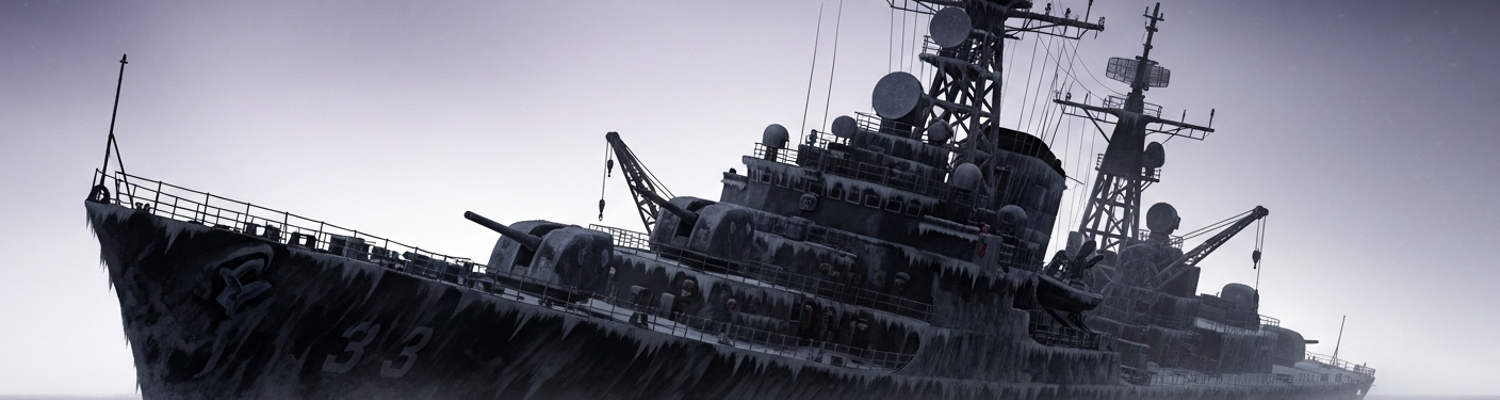

Vigilant Adrift Inside the Soviet Perimeter
By 1968, the Soviet Northern Fleet had turned the Barents Sea into a maritime fortress. A declassified CIA analysis from the period (Document Ref: 78-T-92) details a force of approximately 150 operational submarines based on the Kola Peninsula, including nuclear attack boats and ballistic missile platforms. This underwater force was supported by a dense surface network of cruisers, destroyers, and smaller escorts operating under the protection of land-based naval aviation. The entire strategic concept rested on the bastion principle: creating a heavily sanitized maritime zone where Soviet ballistic missile submarines (SSBNs) could patrol with near-total immunity. This area, a core component of the Soviet Union’s nuclear deterrent, was layered with hydrophone arrays, patrolled by ships of the 7th Operational Squadron, and surveilled by long-range aircraft. Unidentified vessel entry was an invitation for an immediate response.
The USS Vigilant was inside this perimeter.
A close review of operational logs shows the terminal failure began during a scheduled underway replenishment (UNREP) with the oiler USNS Pawcatuck. In the heavy seas common to the Barents, the high-tensioned fuel rig connecting the two ships experienced a violent snap-back during a swell. The heavy bronze probe of the fueling-at-sea station on the Vigilant, a converted Banner-class ship never designed for such open-ocean logistics, was wrenched from its housing. This event did more than sever the fuel transfer; it tore the entire port-side fuel receiving manifold away from the deckhouse bulkhead. The rupture cascaded into the ship’s engineering spaces. Seawater immediately began to contaminate the primary fuel storage tanks. Critically, the shock of the impact and subsequent emergency shutdown procedures created a pressure differential that damaged the feed pumps supplying the ship’s two Foster Wheeler D-type boilers. Without fuel, and with its primary propulsion system compromised by contaminated lines and damaged pumps, the Vigilant lost all headway. The vessel was dead in the water.
The loss of mobility was absolute. The loss of location was a fiction. An underway replenishment is a high-signature event, visible on any surface-search radar for dozens of miles. The sudden stop, the separation of the two vessels, and the subsequent radio traffic, however brief and coded, would have painted a clear picture of distress for any Soviet monitoring station. Archival evidence indicates the Northern Fleet’s 392nd Independent Long-Range Reconnaissance Aviation Regiment was activated within the hour. A Tupolev Tu-95RTs Bear-D maritime surveillance aircraft was vectored to the Vigilant’s last known position. This specific variant was designed to find and target surface ships for other assets. The Vigilant, an intelligence-gathering vessel operating under the thin guise of environmental research, was now a stationary target. Its mission was compromised and its crew was trapped in the heart of the Soviet Union’s most heavily defended naval sanctuary with no ability to flee.
Emergency Replenishment Catastrophe
The decision to attempt a high-risk UNREP in the Barents Sea was driven by operational necessity. Post-incident analysis of the Vigilant’s logs indicates a low fuel state, compelling the ship’s commander to rendezvous with the oiler USNS Pawcatuck despite deteriorating conditions. Navigational records confirm the sea state was already at 6, characterized by wave heights between four and six meters, significant sea spray, and marginal visibility. For a vessel like the Vigilant, a converted Banner-class AGER, this was a severe test of stability. These ships were known for being top-heavy and possessing poor handling characteristics in heavy seas. The UNREP commenced using the Standard Tensioned Replenishment Alongside Method (STREAM), with the ships maintaining a separation of approximately 180 feet while steaming on a parallel course. The physical forces generated by the rough seas placed an immediate and powerful strain on the highline rigging connecting the two vessels.
This hazardous evolution became catastrophic with the sudden onset of a localized arctic squall. Within minutes, visibility dropped to near-zero in a complete whiteout. The deck crews, already struggling with the pitching and rolling of the ships, could no longer maintain visual contact with their counterparts across the churning water. Helmsmen on both the Vigilant and the much larger Pawcatuck were now steering blind, relying on radar and shouted commands to maintain their course and separation. In a standard UNREP, even a one-degree deviation in heading can cause the ships' sterns to swing together due to hydrodynamic suction. In the chaos of the whiteout, a swell, unseen by either bridge, lifted the Pawcatuck’s stern while simultaneously dropping the Vigilant into a trough. The distance between the two ships closed with terrifying speed. The emergency breakaway signal was given, but the sequence of failures had already been set in motion.
The physical consequences for the Vigilant were immediate. The violent slackening and subsequent snapping of the tensioned spanwire exerted a force far beyond the structural tolerance of the Vigilant’s port-side fueling station. The heavy bronze probe of the fueling rig was ripped out. Technical debriefings from the engineering crew revealed that the entire fueling manifold, a complex assembly of pipes, valves, and steel plating, was torn away from the deckhouse bulkhead it was bolted to. This rupture created a gaping hole, allowing thousands of gallons of frigid seawater to flood the connection point and cascade directly into the ship’s fuel receiving lines. The mixture of diesel fuel marine and corrosive saltwater created a toxic, slick mess across the weather decks and began to pour into the primary fuel storage bunkers. The ship’s engineers reacted by initiating an emergency shutdown of the fuel system to prevent the contaminated mixture from reaching the boilers. This sudden stop, combined with the shock of the manifold’s destruction, sent a pressure wave through the fuel feed lines. This shock caused damage to the feed pumps for the ship’s two Foster Wheeler D-type boilers. With its fuel supply fatally compromised by seawater and its boiler pumps shattered, the Vigilant lost all propulsion.
AN/SLQ-X ELINT Suite Malfunction
The intelligence mission of the USS Vigilant depended on the experimental AN/SLQ-X electronic intelligence suite. A post-mortem engineering analysis shows this system was a developmental bridge between older vacuum tube technology and emerging solid-state electronics. Its core function was to provide wide-spectrum analysis of Soviet radar and communications emissions, a capability far exceeding the standard AN/WLR-1 receivers installed on most naval vessels of the period. The AN/SLQ-X’s design incorporated high-gain vacuum tube amplifiers for initial signal reception, which were then coupled to a bank of early transistorized processors for demodulation and analysis. This hybrid configuration required a dedicated and highly stabilized power supply, converting the ship’s main 440-volt AC power into multiple, precisely regulated DC voltages. It also demanded a closed-loop freon cooling system to manage the heat generated by the vacuum tubes. A review of the ship’s electrical logs shows that the emergency shutdown during the UNREP sent a series of damaging power transients through the ship’s grid. These surges fatally damaged the AN/SLQ-X’s sensitive power converter. The primary failure occurred in the high-voltage rectifier circuit, which in turn caused a cascading overload that seized the bearings on the primary freon coolant pump. Without cooling, the system’s vacuum tubes would have overheated and failed within minutes of operation.
This failure occurred at the most critical moment of the Vigilant’s deployment. With the ship dead in the water, the arrival of the Tupolev Tu-95RTs Bear-D initiated the exact intelligence-gathering scenario the mission was designed for. Cryptologic technicians in the ship’s Sensitive Compartmented Information Facility (SCIF) attempted to bring the AN/SLQ-X online as the Soviet aircraft began its initial surveillance pass. Their objective was to capture the specific electronic signature of the Bear-D’s powerful Big Bulge surface search radar, a key intelligence priority. Operational records from the SCIF detail a frantic 15-minute sequence. The system initially powered on, but warning lights for the coolant system immediately illuminated. Technicians initiated a manual reboot, hoping to clear a false error code, a common procedure for temperamental experimental gear. On the second attempt, a loud pop was heard from the power supply cabinet, followed by the distinct smell of burning electrical insulation. The main circuit breaker for the AN/SLQ-X tripped and could not be reset. The entire suite was offline. At that exact moment, the ship’s more primitive AN/WLR-1 receiver detected the first powerful sweeps of the Bear-D’s radar, painting the crippled American vessel.
The loss of the AN/SLQ-X rendered the Vigilant almost completely deaf to the nuances of the unfolding tactical situation. The ship’s mission was to collect, analyze, and record unique parametric data: pulse repetition frequency, scan pattern, pulse width, and any frequency-hopping characteristics. This data was essential for developing effective electronic countermeasures for the US fleet. The AN/SLQ-X was the only system aboard capable of this fine-grain analysis and high-fidelity magnetic tape recording. With its failure, the cryptologic team could only note the presence of the Bear-D’s radar using the basic WLR-1, which provided little more than a general bearing and signal strength. They could not determine if the radar was operating in a standard search mode or a more aggressive surface-track mode. They could not identify the specific electronic fingerprint of that particular aircraft’s radar set. The intelligence-gathering justification for the Vigilant’s hazardous journey into the Barents Sea was nullified.
Satellite Communications Blackout
A post-incident review of the Vigilant’s communication logs reveals a near-simultaneous collapse of all long-range connectivity, beginning with its most advanced system. The ship was equipped with a developmental AN/WSC-3 UHF satellite terminal, a link for transmitting encrypted teletype messages back to Naval Security Group headquarters. This system relied on a mechanically complex, gyro-stabilized six-foot parabolic antenna to maintain a precise lock on the Navy’s nascent constellation of tactical communications satellites. The series of power surges that had destroyed the AN/SLQ-X ELINT suite also sent a cascade of unregulated current into the satellite terminal’s control unit. The primary damage occurred in the circuits governing the antenna’s tracking motors. Without the ability to actively compensate for the ship’s rolling in the Barents Sea, the narrow beam of the antenna lost its lock on the satellite. Radiomen in the ship’s communications center reported seeing the signal-strength meter drop to zero as the system went offline. Attempts to manually reacquire the satellite by bypassing the fried motor controllers and physically manhandling the antenna proved impossible; the ship’s chaotic movement and the radome’s ice-encrusted surface made the task a suicidal impossibility for any deck crew. The power surge also corrupted the interface to the ship’s primary cryptographic unit, rendering any potential connection unsecured.
This forced the communications team to rely on conventional high-frequency radio.
This fallback position was immediately untenable due to a wall of electromagnetic interference. The primary source was the Soviet Tupolev Tu-95RTs Bear-D aircraft circling overhead. Its powerful Big Bulge surface-search radar, designed to detect ships over vast ocean distances, saturated the RF spectrum with high-energy pulses. Analysis of the Vigilant’s surviving radio operator logs describes the ship’s own HF receivers being completely overloaded; instead of coherent signals, the radio room was filled with static and a rhythmic pulsing that matched the sweep rate of the Soviet radar. This was compounded by what cryptologic analysts later assessed to be a deliberate and sophisticated electronic warfare campaign orchestrated from the Kola Peninsula. Soviet strategic electronic warfare doctrine focused on the complete disruption of an enemy’s command and control network. The Barents Sea bastion was blanketed by high-power jammers designed to create a bubble of electromagnetic denial. The Vigilant was caught in the middle of this electronic battlespace, its lower-power HF transmitters unable to burn through the overwhelming noise generated by both the proximal aircraft and distant, powerful shore-based jammers.
The extreme weather and the ship’s high-latitude position created a final, insurmountable barrier. The arctic environment is notoriously hostile to high-frequency radio. Auroral activity, a common phenomenon at such latitudes, causes significant disturbances in the ionosphere, the layer of the atmosphere that HF radio signals bounce off of to achieve long-range transmission. This auroral absorption can effectively create a radio blackout for trans-polar circuits, a condition that can last for days. The ionosphere above the crippled ship became an unstable, fluctuating barrier rather than a reliable reflector. The physical conditions on the ship were atrocious. The violent sea state made the ship an unstable platform, while heavy sea spray and freezing temperatures coated every exposed surface, including the long-wire and whip HF antennas, in a thick layer of ice. This ice buildup would have severely detuned the antennas, degrading their ability to radiate or receive signals effectively. A final, desperate attempt to send a distress signal on an emergency frequency, logged by the chief radioman, resulted in no discernible response.
Barents Sea Deployment Hardships
The USS Vigilant’s insertion into the Barents Sea in late 1968 was an exercise in calculated risk. A review of the ship’s operational orders reveals a mission profile that pushed the vessel far beyond its intended design parameters. The Vigilant, a Banner-class AGER, was a converted light cargo ship never meant for the conditions of the high north. Naval architecture assessments of the class noted a high center of gravity and poor seakeeping characteristics, making it susceptible to instability in the heavy, short-period waves common to the Arctic. Compounding this inherent design flaw was the ship’s minimal armament of just two .50-caliber machine guns, a token defense for a vessel tasked with operating on the doorstep of the Soviet Northern Fleet's main bases. The deployment placed this fundamentally unsuited ship into one of the most heavily militarized maritime zones on the planet. The operational tempo was relentless. The crew was tasked with maintaining a continuous electronic surveillance patrol, a mission that left no margin for error in a region known for its hostile weather and the constant presence of Soviet naval and air assets.
The environment's assault was immediate.
Meteorological logs from the deployment detail a punishing environment of sub-zero gales. Sea spray, whipped into the air by sustained high winds, flash-froze upon contact with the ship’s cold-soaked superstructure. This phenomenon, known as structural icing, is a severe hazard for any vessel, but it was particularly perilous for the already top-heavy Vigilant. Ice accumulation adds weight high above the ship’s center of gravity, reducing its stability and making it prone to capsizing in heavy seas. Shipboard records document the formation of de-icing parties, working around the clock in brutal conditions to physically attack the ice. Armed with steam wands and heavy mallets, these teams fought a losing battle on weather decks that were slick with frozen spray and constantly awash with frigid seawater. Every antenna, mast, and piece of topside equipment became encased in an ever-thickening layer of ice, degrading the performance of navigation and communication systems. The roll period of the ship began to change, a documented warning sign of dangerously low stability. The physical toll on the crew was severe, with the constant risk of frostbite and being swept overboard, but the toll on the ship itself was greater. With each passing hour, the Vigilant grew heavier and more unstable.
Inside the ship’s electronic intelligence spaces, a separate battle was waged against exhaustion. A post-mission analysis of the cryptologic watch logs points to a state of profound sleep deprivation among the ELINT crew. The ship’s primary mission demanded 24-hour monitoring of the dense electromagnetic spectrum over the Kola Peninsula. The area was saturated with signals from Soviet early-warning radars, naval surface-search and fire-control systems, and airborne patrol aircraft. There was no respite. The sheer volume of signal activity meant the ELINT team operated in a condition of perpetual high alert. Standard watch rotations disintegrated as every operator was needed to track, identify, and record the constant stream of intercepts. Personnel records indicate that key analysts were averaging fewer than four hours of broken sleep per day. Such levels of sleep deprivation are known to cause severe cognitive degradation, slowing reaction time and impairing the complex analytical judgment required to distinguish routine signals from imminent threats. The relentless auditory and visual cascade of Soviet electronic activity became a form of psychological attrition, grinding down the crew’s mental acuity long before any single catastrophic event occurred.