
Pre-War Radio Doctrine Assumptions
A request for communication support, born of sudden, inexplicable silence, became a recurring event in the early Pacific campaigns. Such a failure was, according to the doctrine of the time, nearly impossible. The pre-war communications strategy of the U.S. Army was built on a foundation hardened by the experience of World War I. That conflict, defined by static trench lines across Europe, allowed for the development of robust, if cumbersome, communication systems. Planners relied on extensive telephone wires and high-powered, vehicle-mounted radio sets that operated from fixed positions. Reliability was predicated on stable fronts and the ability to lay and maintain physical lines or establish large, static antenna arrays. The doctrine that emerged from this period viewed radio as a tool for connecting higher echelons, regiment to division, division to corps, over the relatively open and predictable terrain of a European battlefield. Man-portable sets were still in their infancy. The prevailing assumption was that battlefield communication would largely mirror the established civilian infrastructure of the day: point-to-point connections over known distances.
This was a foundational miscalculation.
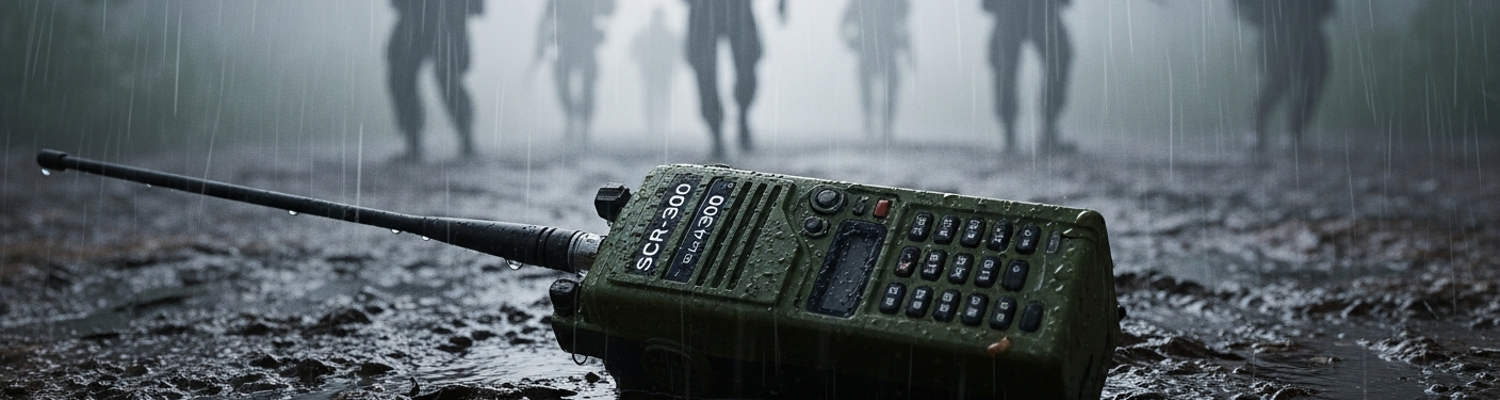
Operational logs show that theoretical ranges published in equipment manuals were treated as gospel. The SCR-284, a 100-pound set that often had to be broken down and carried by multiple men, was rated for 5 to 20 miles. The newer SCR-300 backpack set, a 35-pound unit, promised a reliable three-to-five-mile range. These numbers were achieved in tests conducted at Fort Knox, Kentucky, or across the temperate fields of the United States. The transition to frequency modulation (FM) from amplitude modulation (AM) was a significant technological leap, promising clearer signals with less static, a fact proven in controlled demonstrations. The manuals presented these range figures not as optimistic possibilities but as baseline performance guarantees. The entire edifice of small-unit tactics was being rewritten to incorporate the idea that a company commander could, at any time, speak directly to his platoon leaders. This promise of constant, clear voice communication shaped the very structure of command and control on the eve of the war.
Standardized training protocols reinforced this misplaced confidence. At the U.S. Army Signal School at Fort Monmouth, New Jersey, thousands of radio operators were drilled in rote procedures. From 1924 to 1947, this was the central nervous system for all Army communications training. Archival evidence shows that instruction focused on immaculate equipment maintenance, precise frequency calibration, and by-the-book antenna deployment for optimal line-of-sight transmission. Trainees became experts at operating their sets in the manicured fields of New Jersey or during large-scale stateside maneuvers like those at Pine Camp, New York. The curriculum was designed to produce technicians, not improvisers. It assumed the operator would have the time, space, and calm to erect his antenna perfectly and troubleshoot his set as if in a laboratory. The training scenarios never included torrential monsoons, the corrosive effects of salt spray, or the need to operate a radio while submerged in mud and under direct enemy fire.
The most significant failure was in the assumptions made about environmental factors. Planning documents from the interwar period are filled with calculations based on the rolling hills of Europe and the dry plains of North America. The concept of line-of-sight was a clean, geometric principle. The Pacific theater rendered it a black joke. The triple-canopy jungles of Guadalcanal and New Guinea were not merely visual obstructions; they were dense, humid, and saturated with water, acting as a massive sponge that soaked up radio waves. A hill that appeared on a map as a simple elevation change was, on the ground, a sheer, vegetation-choked ridge that created a complete radio shadow just a few hundred yards away. Delicate vacuum tubes, not yet ruggedized for combat, shattered from the concussion of nearby explosions. Humidity and fungus infiltrated radio casings, corroding contacts and shorting out circuits in a process dubbed “tropical deterioration” by bewildered scientists. Batteries designed for temperate climates died with shocking rapidity in the oppressive heat, and the volcanic soil of the islands had different ground conductivity properties than what the equipment was designed for, disrupting wave propagation.
Pacific Theater Environmental Challenges
The operational environment of the Pacific theater presented a catastrophic assault on communications equipment, for which no amount of stateside training could have prepared Signal Corps personnel. Extreme humidity was the most insidious and pervasive enemy. A review of after-action reports from campaigns in New Guinea and the Solomon Islands reveals a consistent pattern of equipment failure directly attributable to moisture. This phenomenon, which scientists would label “tropical deterioration,” was a systemic crisis. The air itself, saturated with water, became a conductive medium that shorted circuits and corroded delicate contacts. Fungal growth, spurred by the combination of heat and near-constant 90-percent-plus humidity, was rampant. This was not a slow decay. Archival evidence shows that fungus would visibly bloom on Bakelite casings, leather straps, and, most destructively, across the waxed paper and fabric insulation of internal components like capacitors and wiring. These growths created new, unwanted electrical pathways that rendered sets inoperable. Radio manufacturers, like Galvin, had begun applying protective varnish coatings as a fungicide treatment, but these measures were not universally implemented or consistently effective in the face of such overwhelming environmental pressure. Batteries were another point of critical failure; the intense heat accelerated the internal chemical reactions, drastically shortening their lifespan and causing them to fail unexpectedly. A battery rated for many hours of use in Europe might last only a fraction of that time in the oppressive heat of a Guadalcanal jungle, leaving units suddenly and completely isolated.
Beyond the direct assault on the hardware, the very medium through which signals traveled became a suffocating barrier. The triple-canopy jungles, a defining feature of islands like New Guinea and Bougainville, were devastatingly effective at absorbing and scattering radio waves. The high water content within the dense layers of foliage, from the towering 90-foot trees to the impenetrable undergrowth, acted as a massive sponge for radio frequency energy. Quantitative field measurements conducted by the Signal Corps confirmed the extreme attenuation. An SCR-300, which boasted a reliable three-to-five-mile range in the clear fields of Fort Knox, saw its effective broadcast distance shrink to a few hundred yards in the jungle. Sometimes, it was less. A platoon leaving the company perimeter could become a ghost, inaudible to a commander standing less than a quarter-mile away. This signal degradation was not uniform. It was a chaotic and unpredictable mess of dead zones and fleeting pockets of clarity. The rugged, mountainous topography of islands like New Georgia compounded the issue, creating complete radio shadows that blocked line-of-sight transmissions, the foundational principle upon which VHF radios like the SCR-300 operated. A hill that was a simple contour line on a map was, on the ground, a sheer, vegetation-choked ridge that made communication with forces on the other side impossible.
The physical struggle to simply move and deploy the equipment was a battle in itself. The larger “portable” sets, essential for company and battalion-level nets, were anything but. The SCR-284, a critical link in the command chain, was a 100-pound behemoth that had to be broken down into multiple 40- and 50-pound loads for transport. In the terrain of Guadalcanal or Burma, this meant multiple men, already burdened with their own combat gear, struggling through knee-deep mud and up treacherous slopes to haul the components. The 45-pound BC-654 transmitter/receiver unit alone was described as being the size and shape of a window air conditioner, an almost comically awkward burden in the jungle. Damage during transport was common. Setting up was just as difficult. Erecting the required vertical whip or long-wire antennas in a dense jungle with no clear ground was a slow, frustrating process that often exposed the radio team to enemy fire. The tall antennas necessary to punch a signal through the canopy snagged on vines and acted as beacons for Japanese snipers, making the radioman a prime target. The very earth itself conspired against them; the volcanic soil of many Pacific islands proved to be a poor electrical ground, further hampering antenna performance and weakening an already struggling signal.
Field Radio Mechanical Degradation
The creeping failure of communications gear in the Pacific was often a battle against chemistry. A close review of operational logs from units in New Guinea and the Solomon Islands shows a pervasive crisis of corrosion attacking the most fundamental components of man-portable radios. The combination of constant salt spray from amphibious landings and near 100-percent humidity created a brutally effective electrolyte. This conductive film settled on every exposed metal surface, accelerating the galvanic corrosion between dissimilar metals. The battery terminals on sets like the SCR-536 “Handie-Talkie” and the larger SCR-300 were a primary failure point. The low-voltage direct current from the battery packs actively drove the corrosive process, causing a fuzzy, greenish-blue crust of copper sulfate to grow across the contacts, impeding the flow of electricity and rendering the radio inert. Operators in the field reported having to constantly abrade these contacts with knives or files just to achieve a flicker of power, a desperate act of maintenance performed under the most hostile conditions. Internally, the damage was even more severe. Moisture, often carrying dissolved salts, wicked its way inside radio housings that were splash-proof at best. It penetrated the wax-paper insulation of capacitors and transformers, creating partial shorts that would drain batteries or cause erratic performance. The most destructive element was fungus. Spores, thriving in the heat and moisture, would bloom across internal circuit boards and wiring looms. Signal Corps analysis labs (NARA Record Group 111) documented that these fungal growths were not passive; they were actively conductive, creating new electrical pathways that catastrophically altered circuit performance, turning a life-saving communication device into a 35-pound block of useless Bakelite and steel.
At the heart of every radio, the frequency-determining crystal was a component demanding microscopic precision in an environment of macroscopic chaos. These crystals, thin wafers of quartz cut to exacting dimensions, were the key to stable channelized communication, preventing frequency drift. Early crystal holders, however, were not hermetically sealed. Analysis of failed equipment revealed that microscopic gaps in the casings allowed the moisture-saturated air of the jungle to penetrate the assembly. Inside the holder, the daily temperature swings between hot, wet days and cooler nights would cause this trapped water vapor to condense directly onto the surface of the quartz wafer. This tiny film of moisture was enough to alter the crystal’s mass and resonant characteristics, causing its frequency to shift unpredictably. A platoon radio net, perfectly functional at dawn, could completely disintegrate by noon as individual sets drifted off their assigned channels. The tactical result was devastating. A forward observer calling for artillery support would suddenly find his transmissions broadcasting into an empty void. Signal Corps reports document frantic efforts to waterproof these crystal holders in the field using everything from wax to crude tape seals, but these were temporary fixes for a fundamental design flaw.
Beyond the electronic and chemical warfare being waged on the circuits, the sheer mechanical violence of the environment took a heavy toll. The fine volcanic ash and coral sand of islands from Guadalcanal to Iwo Jima were intensely abrasive. This grit infiltrated every moving part. The most common failure was the seizure of tuning dials. On a set like the SCR-284, the main tuning dial was a complex mechanism of small gears and lubricated shafts designed for precise frequency selection. Field reports consistently describe these dials becoming fouled with a grinding paste of grease, mud, and sand. What was designed to be a smooth, one-handed operation became a frozen block of metal. Operators reported having to use pliers to force the knobs, often resulting in the Bakelite shattering or the internal gears being stripped, permanently locking the radio to a single, and possibly useless, frequency. This plague of mechanical failure extended to everything. Antenna deployment mechanisms would jam. The hand-crank generators, like the GN-45 used to power the SCR-284, would have their gears clogged with the same grit until they were impossible to turn. The simple latches on battery boxes would corrode and seize, preventing signalmen from swapping out dead batteries in the middle of a firefight.
Tactical Intelligence Disruption
The cascading equipment failures created an intelligence blackout at the tactical level, severing the link between forward observers and commanders. Human intelligence, the raw data gathered by patrols on the ground, became nearly impossible to relay in a timely manner. Operational logs from the 1st Marine Division on Guadalcanal detail a repeating pattern of this failure. A long-range reconnaissance patrol from one of the rifle companies, deep in the jungle west of the Matanikau River, would spot a significant concentration of Japanese forces preparing for a counterattack. The patrol leader, equipped with an SCR-536 “Handie-Talkie,” would attempt to contact his company command post, often less than a mile away. The AM signal, however, would be completely absorbed by the dense, wet foliage, its one-mile optimal range reduced to a few hundred yards. The call would go unanswered. With the radio useless, the only option was to dispatch runners back through the hazardous terrain. This method was disastrously slow and unreliable. A journey that the radio signal should have covered in an instant took hours. In multiple documented instances, these runners never reached their destination, falling victim to Japanese ambushes. When the information did get through, it was often hours old, rendering it tactically useless. A warning about a Japanese buildup at a specific grid coordinate was of no value when the attack from that coordinate was already underway.
This paralysis extended to the dissemination of intercepted enemy communications. Detachments from Signal Radio Intelligence Companies, such as the 126th operating in the Southwest Pacific, were highly effective at their primary mission: listening to Japanese radio traffic. Using specialized receivers, these units would intercept tactical transmissions from Japanese infantry and artillery units. While major naval and diplomatic codes had been broken, much of the low-level Japanese Army traffic used simpler, more rapidly changing cipher systems or was sent in a phonetic kana code that could be quickly analyzed by trained linguists. A listening post on New Guinea, for example, could successfully intercept and decrypt a message detailing the route and timing for a nighttime infiltration attack against an American position. The value of this intelligence was immense, but its journey from the intercept station to the frontline company commander was fraught with failure. The high-powered radios needed to send this information to regimental headquarters were often the same mechanically fragile sets plagued by generator failures and water damage. When the primary radio link went down, the intelligence was forced onto the same slow, unreliable path as the patrol reports: physical couriers. An urgent warning about an imminent attack could sit for hours, waiting for a jeep that could not traverse the muddy tracks.
Uncoordinated Combat Engagements
The systemic breakdown of radio equipment directly translated into a loss of tactical coordination, resulting in American forces fighting not only the Japanese but also their own disjointed command structure. Friendly fire incidents became a common feature of the early Pacific campaigns. After-action reports from the fighting on Buna and Guadalcanal reveal numerous instances of ground support aircraft strafing friendly positions and artillery barrages impacting on their own troops. In the dense, uniform green of the jungle, pilots had only seconds to identify targets, and the failure of a forward air controller’s fragile radio set meant they were effectively blind. A ground controller’s frantic transmission to abort or adjust a strike would be lost to a battery failure or a waterlogged circuit, and the attack would proceed as planned. During the Buna campaign, American infantry were strafed by their own planes so often that troops began firing back at the aircraft. This was not a failure of doctrine, but a failure of hardware in an environment that waged war on the technology itself. The problem was equally severe with naval gunfire and artillery. During the chaotic fighting around the Matanikau River on Guadalcanal, garbled messages and total communication blackouts led commanders to believe units were in positions they had not yet reached, resulting in fire missions being called on friendly forces.
Inability to communicate reliably meant that small units, once they moved beyond the immediate sight of their command post, were often completely alone. A single platoon on a reconnaissance patrol or a company executing a flanking maneuver could become cut off and isolated by the failure of a single 35-pound SCR-300 radio. A review of operations during the Battle of the Matanikau in September 1942 shows that the 1st Battalion, 7th Marines, landed in the enemy’s rear without any radios brought ashore. Surrounded by a large Japanese force, they were unable to inform division command of their desperate situation. They were forced to resort to signaling aircraft with air panels and, eventually, semaphore flags from aboard a destroyer to coordinate their own extraction. Similarly, during the fighting along the Sanananda Track in New Guinea, elements of the 126th Infantry Regiment established a roadblock behind enemy lines. Chronically low on supplies due to the inability to coordinate resupply drops, they were forced to fend off repeated Japanese attacks for 22 days until a relief force could reach them. This isolation was not merely a tactical inconvenience; it was a death sentence for many. Wounded men could not be evacuated, ammunition could not be replenished, and fire support could not be requested.
These communication failures resulted in significant missed opportunities. The battlefield was rife with intelligence that could not be acted upon. On Guadalcanal, Marine patrols would identify significant Japanese buildups or locate the vulnerable flanks of enemy positions, but this information became worthless when it could not be relayed. The one-mile optimal range of an SCR-536 was reduced to a few hundred yards by the dense, wet foliage, meaning a patrol leader’s urgent report would dissolve into static. The only alternative was to send runners, a slow and perilous journey through terrain controlled by the enemy. By the time the information reached a command post hours later, the tactical situation had completely changed. A Japanese unit, spotted withdrawing and vulnerable to encirclement, would have escaped. An opportunity to commit reserves to exploit a gap in the enemy line would be lost because the commander, deafened by radio silence, had to assume the front was static and unchanging. This disconnect led directly to frontal assaults against prepared defenses that should have been bypassed, costing American lives for ground that could have been taken through maneuver.
The Psychological Toll on Signalmen
The Signal Corps radioman in the Pacific carried a burden far heavier than the 35 pounds of his SCR-300 backpack set. He carried the psychological weight of being a designated target. Archival evidence shows that Japanese tactical doctrine prioritized the elimination of enemy communications, and the long whip antenna of a portable radio served as a perfect aiming point for snipers and mortar crews. This fact transformed the radioman from a support technician into a high-priority target, generating extreme stress levels that were compounded by a profound sense of disillusionment. These men were products of Fort Monmouth, trained on the manicured fields of New Jersey where radio theory worked as advertised. They were taught that their equipment was a technological marvel. In the jungle, their meticulously learned procedures were useless and their equipment was a liability. The oppressive humidity, the signal-swallowing vegetation, and the constant threat of being singled out for attack created a potent psychological toxin. This led to a specific form of battlefield neurosis among signalmen. They were caught between the doctrinal promise of their training and the catastrophic failure of their gear. Each unanswered call and burst of static was a personal failure, a direct contradiction of their supposed expertise. This intense pressure and the feeling of being hunted resulted in anxiety, tremors, and a hyper-sensitivity to sudden noises.
For the radioman, every equipment failure had immediate, observable consequences for the men around him. He was the man crouched next to the platoon leader as a Japanese machine gun pinned them down, frantically trying to raise the company command post for mortar support. When the battery died with shocking speed in the tropical heat or a fungus-eaten capacitor shorted out the transmitter, he did not just hear silence; he heard the continued fire of the enemy gun and the cries of the wounded. A review of after-action reports from New Guinea and the Solomon Islands is filled with accounts of this exact scenario: a patrol ambushed, a defensive line on the verge of collapse, and a radioman powerless to summon aid. The operator was forced to cope with the direct responsibility for this silence. He was the human link in a broken chain, and the weight of that break fell squarely on his shoulders. This led to a grim sense of helplessness, watching units get cut off or friendly fire incidents unfold because his frantic messages dissolved into the ether.
This recurring powerlessness destroyed the radioman's trust in the very foundations of his role. First, faith in the equipment vanished. The manual's promised three-mile range for a walkie-talkie became a dark joke when a signal couldn’t penetrate a few hundred yards of jungle. Next went the trust in doctrine. The elegant communication diagrams they had memorized, showing neat lines connecting platoons, companies, and battalions, were a complete fiction in a landscape of radio-shadowing mountains and signal-absorbing foliage. The most corrosive loss of faith, however, was in the tactical predictability of command. The radioman possessed a unique and terrible awareness of the battlefield’s true state. He knew, with absolute certainty, that his platoon was isolated, that the company on the flank had been overrun, or that a forward observer’s urgent call for fire had gone unheard. Yet, he would also hear the calm, disembodied voice of a battalion commander miles away, issuing orders based on a map whose reality was hours out of date. This created a deep, abiding cynicism, positioning the radioman as the unwilling guardian of the gap between the tactical situation as it was and the situation as headquarters believed it to be.
Legacy and Engineering Solutions
The communication failures of the early Pacific campaigns forced a complete re-evaluation of the U.S. Army’s entire approach to tactical communications. Signal Corps board reports from 1943 onward reveal a dramatic shift away from doctrine developed for the open battlefields of Europe. The hard-won lesson was that terrain and environment were not secondary considerations but primary factors that could dictate tactical outcomes. New field manuals were written that explicitly addressed “jungle warfare” communications, abandoning the rigid reliance on optimal, line-of-sight VHF transmissions. A new emphasis was placed on redundancy and adaptability. Doctrine shifted to mandate layered communication plans for all units, where radio, wire, and runners were not seen as primary and backup, but as an integrated system to be used concurrently. Most significantly, there was a renewed appreciation for high-frequency (HF) radio for short-range communications. Engineers and signal officers rediscovered techniques like Near Vertical Incidence Skywave (NVIS), which involved angling HF antennas to bounce signals at a high angle off the ionosphere. This allowed a signal to go up and over a terrain obstacle like a jungle-covered ridge and come down just a few miles away, bypassing the signal-absorbing vegetation that made line-of-sight VHF useless.
In parallel with doctrinal reassessment, an engineering battle was waged to harden equipment against the environment. The phenomenon of “tropical deterioration” became a top priority for the Signal Corps laboratories at Fort Monmouth and manufacturers like Galvin. A systematic process of “tropicalization” was implemented for all communications gear destined for the Pacific. A close inspection of later-war radio sets shows this was a multi-front war against moisture and fungus. Internal components, especially transformers and capacitors, were hermetically sealed in metal cans or potted in new wax and polymer compounds to block moisture intrusion. Circuit boards and wiring were coated in a thick, reddish-brown fungicidal varnish, most often Glyptal, which insulated components and prevented the growth of conductive fungal blooms. Mechanical designs were also overhauled. The delicate, grit-sensitive tuning mechanisms of early sets were replaced with more robust, sealed gear assemblies. Bakelite knobs were replaced with tougher materials. Even the canvas bags used to carry the radios were eventually replaced with waterproofed versions to provide an initial barrier against the constant dampness. This intense focus on climate-proofing electronics was a direct result of the failures on Guadalcanal and New Guinea.
The brutal experiences of the early campaigns also forced a recognition of the human element in communication systems. Post-action interviews revealed that the doctrinal ideal of a lone, technically proficient radioman was a catastrophic failure point. The training curriculum at Signal Corps schools, which had previously focused on producing technicians drilled in rote procedures under ideal conditions, was radically altered. A review of training materials from 1944 shows a new focus on improvisation and field-expedient maintenance. New recruits were taught not just how to operate a pristine radio, but how to dry out a water-logged circuit, how to use a combat knife to scrape corrosion from battery terminals, and how to erect makeshift antennas from scavenged wire when the standard whip antenna was snapped off. There was also a new emphasis on cross-training. Infantry squad leaders and even individual riflemen received rudimentary training on radio procedure, ensuring that the loss of the designated operator did not mean the complete loss of communication.