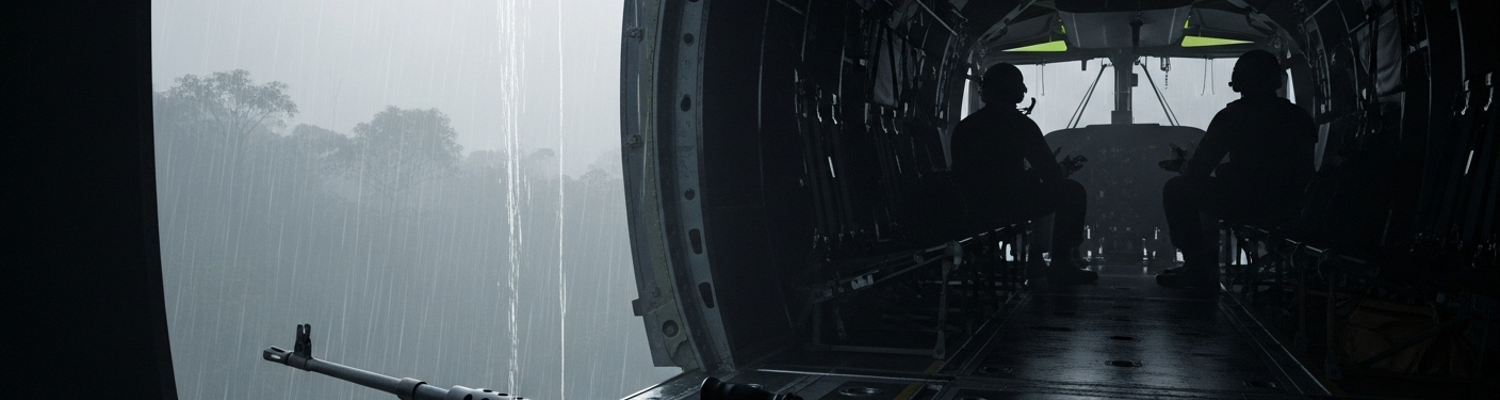

A Desperate Assignment
Intelligence summaries from II Field Force, Vietnam, showed a threefold increase in enemy strength within the Dog's Head region of Tay Ninh province. It was August 1969. The 271st and 272nd Viet Cong Regiments, reinforced by Main Force North Vietnamese Army elements, were maneuvering with an operational freedom that threatened any allied unit smaller than a brigade. The window for tactical action was closing. Any formation sent into that zone faced a high probability of being decisively engaged and annihilated.
This was the context for the mission order that reached the 1st Military Police Battalion.
Operational logs (Record Group 472, NARA) indicate the assignment was a product of necessity, not tactical suitability. The primary air-mobile assets of the 1st Cavalry Division and 25th Infantry Division were committed to a screening operation along the Cambodian border. No line infantry companies were available for a rapid-reaction mission. Command at II Field Force selected Company A, 1st MP Battalion. The choice was influenced by a note in the unit’s readiness report mentioning a week of ad-hoc air assault training. The battalion's primary function was rear-area security and law enforcement. Their organic M113 armored personnel carriers were useless in the dense jungle. A forty-man platoon would be inserted as light infantry, carrying standard M16 rifles and two M60 machine guns, a level of firepower well below that of a standard infantry platoon.
The mission was simple on paper.
Their objective was to secure a remote landing zone, designated LZ Sandpiper, in Binh Long Province. The LZ was a small clearing in the triple-canopy jungle, barely fifty meters across. The ongoing monsoon had turned the ground to mud. Pervasive haze limited visibility to less than one hundred meters. The plan called for a single lift of four UH-1 Huey slicks to insert the MP platoon. They were to establish a perimeter and hold the LZ for no more than twenty minutes.
This entire endeavor was for the extraction of a single, eight-man reconnaissance team. The patrol, identified as Spotted Owl, was a Montagnard Civilian Irregular Defense Group (CIDG) unit under 5th Special Forces Group control. For six days, they had tracked the NVA 7th Division, providing intelligence that confirmed the division was repositioning to assault a major Army of the Republic of Vietnam (ARVN) supply depot. Their last coherent radio message, sent from a PRC-77 with a failing battery, reported their position as compromised. They were being hunted. The intelligence from this one CIDG patrol was deemed significant enough to justify the unorthodox use of a military police unit to secure their extraction. The mission was a gamble on speed, a bet that the MPs could land and hold just long enough for the extraction helicopters to retrieve Team Spotted Owl before NVA forces could react.
Atmospherics and Ambiguity
The operational environment was defined by water. Meteorological logs for August 1969 confirm a severe monsoon season. For radio operators, the oppressive humidity was a constant enemy. The primary ground communication device, the AN/PRC-77 man-portable radio, was highly susceptible to moisture. Water vapor infiltrated battery compartments, corroding the terminals of the BA-4386/U batteries and degrading power. The super-saturated air itself acted as a barrier. High humidity and dense water droplets scattered and absorbed VHF radio waves in a process known as signal attenuation. Transmission range and clarity were significantly reduced. Every attempt at long-range communication was a fight against a wall of static.
This atmospheric degradation was the catalyst for the first failure.
Logs from the 1st Cavalry Division’s aviation assets show the flight of four UH-1 Hueys, callsign Lancer Lead, in difficult contact with a Forward Air Controller. The FAC, callsign Covey 2-5, was orbiting in an O-2 Skymaster, struggling to see the ground through rain and mist. His transmissions were broken and distorted. At 14:22 hours, minutes from landing, Covey 2-5 broadcast an adjustment. The transmission was garbled. Lancer Lead's radio operator logged only fragments of the message: sounds indicating a negative on Sandpiper, a mention of ground fire, and instructions to shift the LZ. The most vital part, the revised coordinates, was lost in a burst of noise. The only intelligible words were a reference to kilo and seven.
The ambiguity forced a decision. The Lancer flight lead could abort the mission, dooming the CIDG patrol. He could circle and attempt to re-establish communication, exposing his unarmored helicopters to the reported ground fire. Or he could interpret the fragments and proceed. With fuel state a concern and the fate of Team Spotted Owl paramount, he chose the third option. The pilot interpreted the fragments as a modification to the last two digits of the easting and northing coordinates for LZ Sandpiper, a common field-expedient method for minor adjustments.
The original landing zone was a relatively dry clearing at Military Grid Reference System coordinate XT 158 472. The lead pilot, believing he was following the FAC’s instructions, directed his flight to a new landing zone at XT 157 477. This was a deviation of just a few hundred meters. Inside the helicopters, the crew chiefs relayed the new coordinates to the door gunners. The forty military policemen in the back felt the shift in flight and the beginning of the descent, unaware of the navigational error that was delivering them into a tactically indefensible position.
Fracture at the Landing Zone
The tactical confusion began the moment the helicopters touched down. The forty military policemen of Company A had been briefed on the terrain of LZ Sandpiper at grid coordinate XT 158 472. Their platoon leader, a first lieutenant, had memorized the positions of a creek bend and a large rock formation as reference points. When his UH-1 settled into the mud of the alternate LZ at XT 157 477, the terrain matched nothing on his map. The clearing was a shallow bowl, its edges offering a height advantage to any concealed observer. The creek was gone. The rock formation was absent. The lieutenant made a decision based on a fatal assumption. He trusted the pilots' navigation over his own map. Believing he was on the correct LZ and that the intelligence imagery had been wrong, he began issuing orders to establish a 360-degree perimeter based on the physical ground they occupied.
This created an immediate break in the chain of command.
The platoon sergeant, a combat veteran on his second tour, landed in a separate aircraft on the opposite side of the clearing. He also recognized instantly that the terrain was wrong. His interpretation was different. He believed the Lancer flight had been forced down short of the true LZ. His experience suggested that when a landing zone was hot, pilots put troops down on the first available spot. He concluded their objective, the real LZ Sandpiper, must lie a short distance through the jungle. While the lieutenant organized a defense of the incorrect position, the platoon sergeant, cut off from radio contact by the noise of the departing helicopters, made a field decision. He gathered the men from the two nearest Huey sticks, primarily 3rd Squad and attachments from the weapons squad. He used his own map and compass to orient them. He was certain a short push to the east would bring them to the correct location.
The platoon was now divided. The platoon sergeant led approximately one-third of the force, including one of the platoon’s two M60 machine guns, off the landing zone and into the jungle. They were not on patrol. They were attempting to correct a navigational error, convinced the platoon leader would follow. This movement was undertaken without the lieutenant’s knowledge. The remaining two-thirds of the MP force, under the platoon leader’s command, were spread thin, attempting to secure a perimeter that was too large for their numbers. They dug into the mud at XT 157 477, awaiting an extraction signal for a CIDG team located near an entirely different set of coordinates.
Command and control elements orbiting overhead operated with their own misinterpretations. The Lancer flight lead correctly reported his insertion point as XT 157 477. The command helicopter, however, was still vectoring the dedicated extraction helicopters for Team Spotted Owl toward the original LZ Sandpiper at XT 158 472. They now had two friendly elements marked on their maps, hundreds of meters apart. The MP lieutenant’s attempts to raise the command ship on his PRC-77 were lost to static and the signal-blocking terrain. The result was a compounding failure. The main MP element was isolated and defending the wrong ground. A rogue security element was moving blind through the jungle. The extraction birds were circling a fourth location, waiting for a signal that would never come. NVA listening posts, having initially reported ground fire near the original LZ, now picked up the noise of the landing and the movement of the separated MP squad. They began directing hunter-killer teams toward both American positions.
Contact in an Unmapped World
The platoon sergeant’s detached element moved east from the incorrect landing zone at a tactical crawl. The terrain between XT 157 477 and their perceived objective was a dense maze of bamboo and thick jungle, which period topographic maps failed to detail. The humidity and mud slowed the M60 gunner, the 23-pound weapon catching on vines with every step. After pushing approximately 400 meters, a journey of nearly twenty minutes, the point man broke through a wall of vegetation. He was not looking at the expected clearing of LZ Sandpiper. He was on the edge of a small, unrecorded hamlet of about a dozen wood and thatch structures, a settlement of Montagnard woodcutters.
It was a place that existed outside the war’s operational maps.
The encounter was a collision of separate worlds, mediated by fear. After-action interviews with the surviving MPs (File AAR-BN1-COA-69-34) show a consistent state of high alert. When the point man raised his hand, the men behind him sank to one knee, weapons oriented outward. Villagers, startled by the sudden appearance of armed soldiers, emerged from their huts. Post-incident analysis suggests they were likely related to the very same Montagnard CIDG groups the US forces were attempting to support. In the murky, gray light, they were simply figures moving in the open. Some carried long-bladed rons, agricultural tools for clearing brush, which bore a passing resemblance to weapons in the poor visibility. The platoon sergeant, peering through the foliage, saw a group of unknown persons in dark clothing, some appearing to be armed, positioned between him and his objective.
The situation disintegrated in seconds. The historical record cannot definitively assign blame for the first shot. A shout in an unfamiliar language. A sudden movement. The result was an instantaneous, reflexive volley of fire from the military police. The M60 machine gun, set up in a hasty support position, opened up on the largest group of villagers. Its 7.62x51mm NATO rounds ripped through the thin walls of the bamboo huts. M16 fire from the rest of the squad added to the storm of metal that swept through the hamlet. For the disoriented MPs, this was the firefight they had been anticipating with an NVA force. For the villagers, it was an inexplicable assault. The sustained burst of automatic weapons fire was also a beacon, providing a precise location to the NVA hunter-killer teams now closing in on the hamlet from the north and east.
The Collapse of an Alliance
This single act of battlefield misidentification shattered a decade of careful alliance-building. The Montagnard tribes, while historically wary of all outside forces, had formed a functional and often loyal partnership with US Special Forces. They provided unparalleled intelligence on enemy movements through their intimate knowledge of the terrain.
News of the massacre would have spread through the intricate network of villages within days.
It effectively severed this bond of trust. The CIDG program in Binh Long province was rendered inert overnight. Partisan teams that had previously provided a crucial early-warning screen went silent, either out of fear or out of a newfound hatred for their former allies. This left a massive intelligence void. American and ARVN units operating in the area were suddenly blind, forced to rely on slower and less reliable reconnaissance methods at the exact moment the NVA 7th Division was maneuvering for a major provincial offensive. The strategic cost of the lost intelligence network far outweighed the tactical loss of a single platoon.
The cascading effects paralyzed the American command structure. The intense firefight at the hamlet was a beacon of sound. The Forward Air Controller, Covey 2-5, still trying to locate the MPs, immediately vectored his O-2 Skymaster toward the noise. Through a gap in the clouds, he witnessed muzzle flashes from a tree line firing into burning huts and returned fire from the area of the village itself. His report to the command helicopter described a troops-in-contact situation at a third set of coordinates, adding another layer of fatal confusion. At that moment, a flight of two AH-1 Cobra gunships, callsign Snakebite 7, arrived on station. Their pilots reported a full ordnance load of 2.75-inch rockets and 7.62mm miniguns. They requested a target from the overwhelmed FAC. The mission to extract the eight-man Spotted Owl team was a complete failure. The team was compromised and would be overrun. Their intelligence was lost. The separated MP platoon was now being actively hunted by NVA forces converging on two locations, while a flight of attack helicopters circled overhead, preparing to unleash their firepower based on a disastrously flawed understanding of the situation on the ground.