
To planners in Washington and Richmond, Arkansas was a problem of geography. Its position west of the Mississippi River made it a strategic anchor, securing the western flank of any army operating along the great river. Control meant dominion over the Arkansas, White, and St. Francis rivers, which were vital arteries for moving men and materiel in a region with almost no railroads and few reliable roads. The state’s agricultural output was significant, and its mines produced lead and saltpeter, essential for ammunition. For the Confederacy, Arkansas was the gateway to Missouri, a recruiting ground, and a buffer protecting Texas and Louisiana. Major General Earl Van Dorn’s entire 1862 campaign, culminating at Pea Ridge, was predicated on a plan to seize St. Louis, a strategy that hinged on using Arkansas as a launching point. For the Union, neutralizing Arkansas was a core tenet of the Anaconda Plan to split the Confederacy. Leaving the state in Confederate hands would allow armies to threaten the flank and rear of any Union advance down the Mississippi.
The strategic value of Arkansas was matched by the sheer ferocity of the conflict there. This was not a war of grand maneuvers. It was a chaotic, decentralized, and deeply personal fight. Following the Union victory at Pea Ridge in March 1862, conventional Confederate power in northern Arkansas was broken. In response, Confederate General Thomas C. Hindman issued General Orders Number 17, a directive that called for citizens to form irregular bands to attack Union forces. This order officially sanctioned a guerrilla war that plunged the state into a cycle of raids, ambushes, and retaliatory violence. The land became a patchwork of warring factions: Federal garrisons, Confederate partisans, pro-Union Arkansas units like the First Arkansas Cavalry (US), independent jayhawkers, and bushwhackers loyal to no one. The Battle of Prairie Grove in December 1862, a strategic Union victory, was a bloodbath that left the dead of both sides on the field for days. Feral pigs roamed the battlefield, a grim indicator of the breakdown of order. This relentless, low-grade warfare destroyed what little infrastructure existed and shattered the agricultural economy.
This pervasive violence triggered a massive humanitarian crisis. The state’s pre-war population, including over 110,000 enslaved people, was uprooted. Civilians fled the anarchy, becoming refugees in their own land. When Major General Samuel R. Curtis’s army reached Helena on the Mississippi River in July 1862, over 2,000 escaped slaves accompanied him. Helena quickly became the most significant refugee center in the state, its population swelling with thousands of freedpeople seeking protection. The army, unprepared for this influx, housed them in makeshift tents, abandoned buildings, and crowded, unsanitary camps. Disease was rampant. Food was scarce. Confederate cavalry often raided these camps to murder or re-enslave the inhabitants. By 1864, the U.S. government was issuing as many rations to destitute civilian refugees as it was to its own soldiers in the region, a stark measure of the complete societal collapse. This flood of displaced, starving, and vulnerable people presented Union commanders with a catastrophic civil affairs challenge for which they had no doctrine, no resources, and no clear authority.
Archival records of the Union’s Adjutant & Inspector General’s Office (NARA Record Group 94) are filled with the dry, bureaucratic language of war. Special Order No. 81, issued on March 31, 1862, was no different. It was a document born of immediate necessity, a direct response to the situation in northwest Arkansas following the Battle of Pea Ridge three weeks prior. With Major General Earl Van Dorn’s Confederate Army of the West broken and Union forces under Brigadier General Samuel R. Curtis consolidating their hold, the conventional phase was over. What remained was the complex problem of occupation. Special Order No. 81 was a tool for this new phase. Such orders were the mechanism by which army headquarters transmitted instructions to subordinate units for missions outside standard routines. A close review of operational logs indicates this particular order was brief, allocating a single detachment of the Provost Guard to a town that was little more than a name on a map to planners at Curtis's headquarters. The order specified a timeline and a destination, but its operational language was critically ambiguous.
Captain Elias Vance and his Provost Guard detachment were not a frontline combat unit. Provost Guards were the army’s internal police, tasked with maintaining discipline, suppressing looting, and managing prisoners. They were infantrymen detailed for this duty, carrying their standard-issue muskets, but their primary function was order, not assault. Vance’s detachment, likely a single company, was pulled from its routine duties and given the Harmony Creek assignment. Their march into the rugged terrain of the Boston Mountains would have been a high-stress operation. The landscape itself was an opponent. With General Hindman’s recent directives encouraging guerrilla warfare, every wooded hollow and ridge-line trail was a potential ambush site. The Provost Guard, trained to police soldiers, was now being deployed into a countryside where the distinction between civilian and combatant was dissolving.
Harmony Creek was representative of dozens of small communities shattered by the passage of armies and the subsequent explosion of irregular violence. After the Confederate withdrawal from northern Arkansas, Fayetteville had been burned. Towns and farmsteads across Benton and Washington counties were left devastated, their resources stripped by both armies and by roving bands of bushwhackers. When Vance’s provosts arrived, they would have found a ghost town. They saw burned-out homes, abandoned fields, and a small, terrified population of non-combatants, mostly women, children, and old men, hiding in the shells of their former lives and facing starvation. The material resources of the town, from livestock to stockpiled grain, were gone. This was the environment into which Captain Vance was to project Union authority.
The core of Vance’s mission was contained in a deeply ambiguous phrase. He was to secure the populace and resources. The Second Confiscation Act, passed later in 1862, would give Union officers clearer authority to seize Confederate property, but in March, the legal framework was ill-defined. For Vance, the orders presented an immediate contradiction for which he had no formal guidance. Did securing the populace mean protecting them from guerrillas and providing humanitarian aid from his own limited stores? Or did it mean pacifying them, enforcing loyalty oaths, and arresting suspected sympathizers? Likewise, did securing the resources mean guarding what little food the civilians had left, or did it mean confiscating those resources for the use of the Union Army? Each interpretation carried significant risk. A gentle approach could allow a pro-Confederate population to continue supporting the insurgency. A hardline policy would alienate everyone, likely driving more men into the bushwhacker ranks. Captain Vance, standing in the wreckage of Harmony Creek, possessed no established doctrine for this type of mission. He was forced to interpret his orders on the ground.
The smoke had cleared days before Captain Vance’s Provost Guard arrived, but the smell of ruin remained. A review of operational logs from units in the area reveals the fight at Harmony Creek was never a planned engagement. It was a vicious, running skirmish that erupted when a Union cavalry patrol stumbled upon a company of partisan rangers using the town for shelter. The fight was a thing of minutes, a chaotic explosion of carbine fire that tore through the settlement’s main street. The town’s grist mill, its economic heart, was a blackened skeleton of timbers, its millstone cracked and useless. The general store had been shot to pieces, its front porch a splintered wreck.
Vance’s men found a community not just broken, but hollowed out. The handful of civilians who emerged from hiding were a spectral remnant. Archival evidence from similar incidents shows this was a common pattern; the non-combatants who remained were mostly women, children, and elderly men. They were gaunt, their faces etched with terror and suspicion toward the blue uniforms. Their homes were gone, their livestock driven off, and their food stores were empty. Smokehouse doors hung open on empty spaces. The partisans had taken what they could carry, and the Union patrol, foraging, had taken the rest. The town well, a critical source of water, was fouled with the carcass of a pig, signaling a deeper crisis.
The immediate problem was disease. With no source of clean water, the population was consuming creek water downstream from the dead livestock and filth. Dysentery was not a future threat; it was already present, weakening a population devastated by malnutrition. Post-action medical reports from Vance’s detachment would later show a sharp increase in sickness among his own men, simply from exposure to the environment. This biological threat was matched by the looming specter of civil unrest. The starving civilians, seeing the Provost Guard’s supply wagons, represented a potential mob. A single act of desperation could trigger a riot that Vance’s small company, numbering fewer than sixty men, would be hard-pressed to control without a massacre. His mission was to secure the populace and its resources, but the skirmish had ensured there were no resources left, only a starving, diseased, and hostile population on the edge of anarchy.
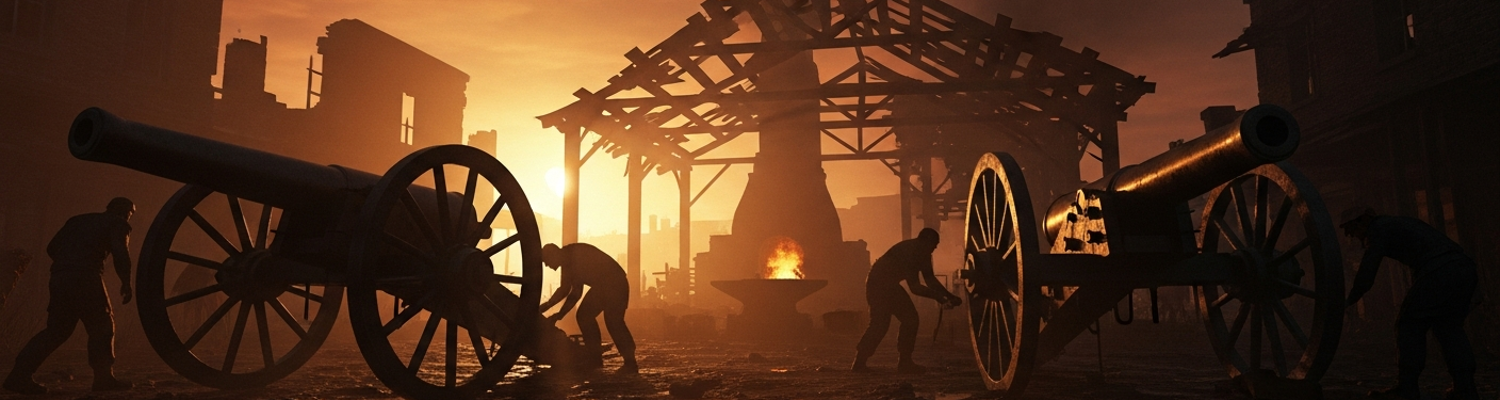
The operational environment at Harmony Creek dictated a solution no regulation manual could provide. Captain Vance’s small detachment was tasked with stabilizing a humanitarian crisis and projecting authority, yet they were outnumbered by the desperate civilians. A review of operational logs shows that any offensive action against partisan bands in the hills was impossible; his force was barely adequate for sentry duty. The primary threat was not a conventional attack, but a riot over his limited supply wagons. He needed a method of crowd control, a psychological deterrent. The answer lay rusting in the mud behind the ruins of the town’s blacksmith shop.
Two Confederate 6-pounder field guns.
They were obsolete junk.
By 1862, the Model 1841 6-pounder cannon was thoroughly outclassed by the 12-pounder Napoleon and rifled artillery. These two guns were in even worse shape. An after-action report details that one piece had a heavily damaged trunnion, one of the two axles that allowed the barrel to pivot for elevation, making it impossible to aim. The wooden carriage of the second gun was splintered. Standard orders dictated that Vance should have disabled the cannons permanently. Instead, he made an unsanctioned command decision to repurpose them. Lacking any combat engineers, he brokered a dangerous pact with the town’s remaining blacksmiths, men whose allegiances were suspect. In exchange for shares of his detachment’s own limited rations, the smiths brought their tools and expertise to bear, working alongside a few of Vance’s men with mechanical backgrounds. This was not a repair job. It was a radical battlefield modification.
The goal was to engineer terror. The team did not restore the cannons; they transformed them into static, area-denial weapons explicitly for crowd control. The true innovation was the ammunition, created from the debris of Harmony Creek itself. Lacking any standard-issue 6-pound canister shot, the men and blacksmiths fabricated improvised charges. Into simple canvas bags, they packed a lethal collection of civilian scrap metal, a hellish mixture known historically as langrage. They gathered bent nails from burned-out floorboards, shattered fragments of cast-iron stoves, broken heads from farming implements, and chopped sections of chain scavenged from the destroyed grist mill. Each bag was a crude, devastating anti-personnel munition. This turned the obsolete cannons into enormous shotguns.
Their placement was purely psychological, designed for urban control. One gun was hauled to the mouth of the main street, its barrel aimed directly down the center of the road to cover the Union supply wagons. The other was positioned to overlook the small plaza where the civilian population congregated. They were not sited to engage potential partisan threats in the surrounding hills but were aimed squarely at the populace Vance was charged to protect. The blacksmiths helped chain and bolt the damaged carriages into fixed positions, their barrels locked at a low elevation, ensuring any discharge would sweep the ground with a wide, lethal pattern of metal shards. It was a brutal and explicit message. An unarmed mob charging the position would not be met with a volley of musketry they might survive. They would be walking into a wall of flying iron. The weapons were never fired. Their silent, menacing presence was enough to prevent a single civilian disturbance.
The decision was forced by the discovery of a wrecked Union supply wagon a mile from Harmony Creek. Partisan activity in the region was constant, and a small quartermaster train had been ambushed. Vance’s men, drawn to the site by lingering smoke, found two mules dead in their harnesses and a wagon with a broken axle. Its contents were partially intact. They salvaged three barrels of salt pork and twelve wooden crates of army hardtack. This was found property, a windfall of resources that technically belonged to the Union Army’s Subsistence Department and was subject to strict accounting.
Back in Harmony Creek, the sight of this salvaged food acted as a catalyst on the starving civilians. Their desperation was a tangible threat. Vance made a rapid, controversial calculation. Standard military doctrine was clear: all recovered government property was to be secured and turned over to the army quartermaster. Distributing army rations to civilians, particularly in hostile territory, was forbidden without explicit orders from a departmental commander, something Vance did not have. He weighed the near certainty of a court-martial for misappropriating government property against the immediate probability of a civilian riot. He chose to defy regulations. He ordered the salvaged barrels and crates opened, establishing a single, heavily guarded distribution point. Each civilian received a fractional ration: three biscuits of hardtack and a chunk of salt pork.
This choice was followed by another, more serious, breach of military protocol. The food addressed starvation, but a sanitation crisis was driving disease through the settlement. With the town well fouled, civilians were drinking contaminated creek water, and dysentery was spreading. Vance’s own surgeon reported a sharp increase in sickness among the provosts from exposure to the unsanitary conditions. The detachment’s medical panniers, leather-reinforced wooden chests, were a finite and irreplaceable field asset, containing the only supplies Vance had to keep his own men healthy. These kits held standard army remedies: quinine for fevers, laudanum and opium pills for pain and dysentery, and rolls of clean bandages.
This was not salvaged property.
This was his unit’s lifeblood.
In a move that went far beyond the distribution of surplus food, Vance authorized his surgeon to use their own medical stores to treat the sickest civilians. It was a gamble. Every dose of quinine given to a feverish child was one less dose available for a soldier with malaria. Every bandage used on a non-combatant was one less for a man wounded in a future skirmish. This decision directly violated the fundamental military principle of preserving the army’s own fighting strength. The Articles of War were explicit about the unlawful disposition of military stores. Vance was consciously sacrificing his unit’s long-term operational readiness to manage the immediate civilian health crisis, betting that preventing a full-blown epidemic in the town was the only way to prevent his own detachment from being wiped out by disease.
Captain Elias Vance had knowingly committed acts that could end his military career. A close review of the 1806 Articles of War, the legal framework governing all Union soldiers, reveals the personal risk he undertook. Article 39 was explicit, stating that any soldier who sold or willfully, or through neglect, wasted the ammunition, arms, or accoutrements committed to his care would be punished by court-martial. A separate article applied the same standard to the misappropriation of provisions. Vance had violated both, first by distributing salvaged army rations and then by dispensing his unit’s own medical supplies to non-combatants.
These were not minor infractions. The proceedings of a general court-martial were a formal and unforgiving affair. He would have faced a panel of his fellow officers, answering for the charge of unlawful disposition of government property. The defense that he was fulfilling the spirit of his ambiguous order to secure the populace would have held little weight against the literal text of military law. The potential punishments were severe: public reprimand, suspension of pay, or, most likely, being cashiered, a formal, humiliating dismissal from the service. By giving away his detachment’s medical supplies, he had crossed a line. He had willfully degraded his own unit’s combat readiness, gambling his men’s future health against the immediate crisis. This was a choice made with the full understanding that his next battle could be in a military courtroom.
His primary defense was rooted in the immediate threat of a biological collapse. The single fouled well at Harmony Creek had forced the entire population, civilians and now his own soldiers, to rely on contaminated creek water. Vance’s surgeon’s log would have shown a sharp increase in cases of dysentery and other enteric diseases within his detachment just days after their arrival. The sickness was a more immediate enemy than any partisan band. An epidemic would not just weaken his command; it would render it inert. A company of soldiers incapacitated by disease could be overrun with ease.
Vance’s rationale, when examined through a tactical lens, was one of preemptive self-preservation. Authorizing his surgeon to treat the civilian population with the detachment’s own limited medical supplies was not an act of simple charity. It was a calculated sanitary measure. By attempting to contain the outbreak among the non-combatants, he was creating a buffer zone to protect his own men from the rampant pathogens in their shared environment. He was trading a finite resource, quinine and opium pills, for a tactical advantage: slowing the spread of a disease that threatened to destroy his command from within. His justification was that a healthy civilian population was a prerequisite for maintaining his own force’s operational integrity.
This logic extended to his decision to prevent widespread civil unrest. The arrival of salvaged food transformed the desperate civilian population from a passive problem into an immediate threat. Vance’s Provost Guard numbered fewer than sixty men, while the civilians numbered in the hundreds. He could follow regulations and defend the army’s property, which would almost certainly require his men to fire upon a mob of starving, unarmed women, children, and old men. The result would be a massacre, a complete strategic failure that would turn every fence-sitter in the county into a sworn enemy of the Union. His second option was to break regulations.
By distributing the food, Vance was using rations as a non-lethal crowd control tool. It was a tactical decision to de-escalate a situation spiraling toward a bloody confrontation. The act instantly quelled the immediate threat of a riot, re-establishing a fragile sense of order. His rationale was that the loss of a few barrels of salt pork and hardtack was an acceptable price to pay to avoid slaughtering the very people he was ordered to secure. He was mitigating a larger, strategic danger, creating a permanent insurgency fueled by an atrocity, by accepting a smaller, personal risk. Vance’s actions were not those of a humanitarian, but of a pragmatist who understood that in the chaotic environment of Civil War Arkansas, adherence to protocol could lead to mission failure more surely than any enemy action.
The immediate impact of Captain Vance’s combined strategy on the populace of Harmony Creek was one of engineered stability. It was achieved through a balance of psychological terror and calculated mercy. The two improvised cannons, loaded with langrage and positioned to command the settlement’s chokepoints, were never fired. Their silent presence was a constant reminder of the lethal force the Provost Guard could bring to bear, neutralizing the threat of a food riot. This overt threat was then softened by the unauthorized distribution of salvaged army rations and the use of the detachment’s own medical supplies to treat the civilian sick. The result was a population that was subdued yet dependent; held in place by fear, but kept alive by a pragmatic charity that also served as a form of sanitary self-preservation for the Union detachment.
Vance’s actions were an isolated case of what would later be termed civil-military operations, a doctrinal field that was nonexistent for a line officer in 1862. The Union command structure in the West had no formal policy for pacification or humanitarian aid, leaving individual commanders to improvise. Most responses were punitive or extractive, focused on punishing Confederate sympathizers and foraging for supplies. Vance’s methods, combining hard-power deterrence with soft-power incentives, represented a sophisticated, ground-level innovation that was never codified or adopted on a larger scale. The potential long-term implication was the creation of a viable blueprint for pacifying hostile territory, one that acknowledged the population itself as the center of gravity. Instead, it remained a footnote. The Union Army would continue to struggle with the challenges of occupation and refugee crises for the remainder of the war, relying on ad-hoc solutions and the creation of contraband camps to manage the humanitarian disasters its own operations often helped create.