
The Political Imperative
In the summer of 1950, the Korean peninsula was a collapsing front. The North Korean People’s Army, the NKPA, had smashed through the Republic of Korea Army and the first American formations sent to intervene. Their 135,000 men and 150 T-34 tanks were a steel fist. By September, United Nations forces were backed into a 140-mile defensive perimeter around the port of Pusan, a last desperate foothold. The NKPA massed for a final, annihilating assault.
The strategic situation demanded a counter-stroke. General Douglas MacArthur, Supreme Commander for the Allied Powers, dismissed any notion of a simple breakout from the Pusan Perimeter. His focus was 150 miles northwest, on the port of Inchon.
He saw it as the only path to a war-ending victory.
Archival evidence from the earliest days of the conflict shows MacArthur was unyielding. He demanded a deep amphibious envelopment. A landing at Inchon, the port serving the captured capital of Seoul, would sever the primary supply arteries of the NKPA divisions surrounding Pusan. It would trap the bulk of the North Korean army. The political pressure from Washington for a dramatic reversal of fortune was intense. MacArthur’s plan, Operation Chromite, promised exactly that. It was an audacious concept, born of his personal belief in his own strategic intuition.
This insistence opened deep fissures within the command structure. The Joint Chiefs of Staff, along with the Navy’s most experienced amphibious warfare officers, registered near-unanimous opposition. A review of planning documents (NARA Record Group 338) reveals their preference for a less hazardous landing further south at Kunsan. That location offered more favorable terrain and approaches. They saw Inchon as a gamble with catastrophic potential. MacArthur’s authority and political standing, however, allowed him to bulldoze all professional dissent.
The core of the Navy’s objections lay with the terrifying hydrographic profile of the target area. Naval intelligence reports presented a grim catalog of dangers. First were the tides. Inchon possessed one of the most extreme tidal ranges on the planet, with a differential exceeding 30 feet. This natural phenomenon severely restricted any amphibious assault. Landing craft could only navigate the approaches and reach the city’s seawalls during a few short hours on a handful of days each month. An invasion force arriving at any other time would find itself stranded on enormous, glutinous mudflats extending for miles. The mud was impassable to men and vehicles. A mis-timed landing would leave the assault waves completely exposed to enemy fire for up to twelve hours, unable to advance or retreat.
The only path for the invasion fleet was the Flying Fish Channel. This waterway was long, exceptionally narrow, and twisted through a maze of islands and mud banks. A perfect natural chokepoint. A few well-placed naval mines or a single scuttled ship could block the channel entirely, trapping the assault fleet under the guns of North Korean shore batteries. The channel was so restrictive that large vessels would have to navigate it in a single file line, making them easy targets. The risk of the entire invasion force being systematically destroyed before the first Marine landed was exceptionally high. These were not minor obstacles. In the collective view of naval planners, they were absolute disqualifiers. The directive from MacArthur’s headquarters remained unchanged.
The Minefield Disconnect
A review of operational planning documents for Operation Chromite reveals a dangerous disconnect between the Army and Navy on the question of naval mines. General MacArthur’s intelligence chief in Tokyo, Major General Charles A. Willoughby, was insistent. His G-2 intelligence summaries consistently downplayed the threat, asserting the North Koreans lacked the technical capacity to deploy mines effectively. This assessment drove the operational assumptions.
The Navy did not share this view. Naval planners, with institutional knowledge of mine warfare's devastating potential, feared the North Koreans could use even crudely laid, Soviet-supplied mines to block the narrow Flying Fish Channel. The acrimony grew as naval intelligence officers pointed to the ease with which small civilian vessels, junks and sampans, could be used for clandestine minelaying under the cover of darkness. This fundamental disagreement created a command climate where the mine threat was simultaneously a catastrophic risk and a negligible factor.
The Navy’s fears were realized just days before the scheduled September 15th landing.
As reconnaissance elements probed the approaches to Inchon, they began spotting the tell-tale signs of moored contact mines. Soviet-made naval mines had been shipped to North Korea, and Soviet experts had provided technical instruction. The North Koreans had begun a belated but determined effort to mine the approaches, using any vessel they could find, including wooden barges fitted with simple rails. While much of their initial mining effort was focused on other ports like Kunsan, the fields at Inchon still presented a lethal obstacle. Destroyers accompanying the invasion force identified some of these moored mines visually at low tide, destroying them with gunfire. This confirmed the presence of a minefield but did not reveal its extent. The muddy waters offered excellent concealment, and the possibility of magnetically triggered influence mines laid among the contact types complicated any clearance plan.
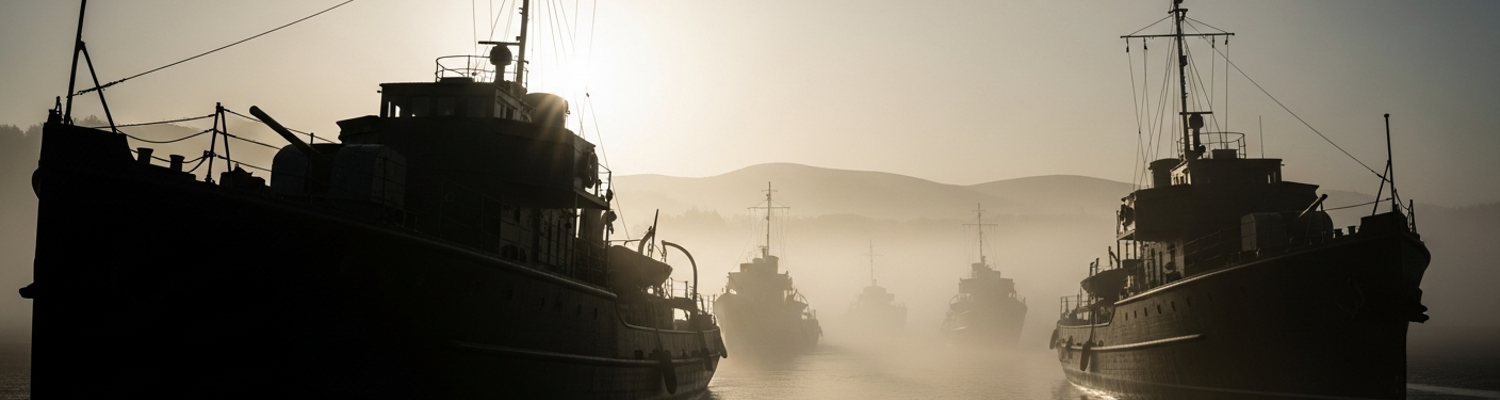
This discovery triggered a frantic race against time. The invasion date of September 15th was a hard deadline, dictated by Inchon’s extreme tidal range. Postponement was not an option. This left an impossibly compressed schedule for minesweeping, which had to be conducted under the direct fire of North Korean artillery on the island of Wolmi-do. The preliminary bombardment and clearance began on September 13th. The minesweeping flotilla had just two days to clear a safe channel for the main amphibious force of over 260 vessels. The task fell to a small group of U.S. and allied minesweepers. They had to sweep the precise channel the invasion fleet would use, knowing a single missed mine could derail the entire operation.
The Sweepers of Task Force 90.5
The responsibility for clearing a path fell to a small, hastily assembled group of American and allied minesweepers attached to Task Force 90. A review of operational logs shows this force was a shadow of the massive mine warfare flotillas of World War II, a direct consequence of postwar demobilization. The group consisted of a handful of older steel-hulled Admirable-class fleet minesweepers (AMs) and several newer, but largely untested, wooden-hulled auxiliary motor minesweepers (AMSs). These vessels were slow and mechanically vulnerable.
Their assignment was one of the most dangerous of the war. Clear the Flying Fish Channel in two days. The invasion was locked for September 15th. The sweepers began their work on September 13th under direct enemy observation. The success of Operation Chromite rested on these few ships clearing a 500-yard-wide lane through an unknown minefield.
They proceeded directly into the enemy’s kill box.
A close examination of the operational plan reveals the technical difficulty. The sweepers had to navigate the twisting channel where tidal currents could reach nearly seven knots. This powerful rush of water put enormous strain on the minesweeping gear. The ships towed long steel cables, paravanes, designed to snag the mooring lines of submerged contact mines and sever them. This allowed the mine to surface for destruction by gunfire. In the violent currents, these cables were difficult to control. The risk of a mine being dragged into the hull of a sweeper or its escort was constant. The entire operation was conducted under the barrels of North Korean 76mm artillery emplaced on Wolmi-do, which commanded the channel entrance. The slow-moving sweepers, constrained to a predictable path, made for perfect targets.
They relied entirely on their destroyer escorts to suppress this fire.
This protection came at a cost. While Willoughby’s intelligence section had dismissed the mine threat, naval reconnaissance had already confirmed the presence of Soviet-supplied mines. As Task Force 90.5 began its approach on September 13th, escorting destroyers identified the horns of moored contact mines sitting on the mudflats, exposed by the low tide. Destroyers like the USS Mansfield, DeHaven, and Lyman K. Swenson began destroying these mines with their main guns while dueling with the shore batteries on Wolmi-do. During this exchange, North Korean gunners found their range. The USS Mansfield was struck. The USS Lyman K. Swenson took a direct hit that killed Lieutenant (junior grade) David H. Swenson and wounded several others. These were the first casualties of the Inchon operation, a direct result of pushing vulnerable minesweepers through a fortified channel.
Disjointed Skies
The skies over Inchon were a symbol of American military might. Task Force 77, a fast carrier force, brought an overwhelming level of air power. Its carriers, including the USS Valley Forge (CV-45) and the USS Philippine Sea (CV-47), launched hundreds of sorties. The workhorses were propeller-driven F4U Corsairs and AD Skyraiders. They could carry heavy loads of bombs, rockets, and napalm, loiter over targets, and absorb punishment. They were joined by jet-powered F9F Panthers, used primarily for flak suppression. A review of operational logs shows these aircraft were indispensable in the days leading up to the landing, systematically bombing Wolmi-do’s coastal defense batteries and interdicting roads to prevent North Korean reinforcements from reaching Inchon. Between July and November 1950, Air Group 5 on the Valley Forge alone flew over 5,000 combat sorties, delivering more than 2,000 tons of ordnance.
This impressive display of force was crippled by an inability for the services to effectively communicate. The problem was doctrinal. The U.S. Marine Corps operated on a system of organic air support where Marine pilots and ground troops trained as an integrated team. By contrast, the newly independent U.S. Air Force viewed close air support as an extension of artillery, a mission secondary to strategic bombing. These competing philosophies resulted in completely different systems for requesting and directing air strikes. The Navy, controlling the carrier aircraft of Task Force 77, had its own ship-based Combat Information Center. The Marines on the ground had their own Forward Air Controllers (FACs) embedded with infantry battalions. The Army’s 7th Infantry Division used Air Force FACs.
A Marine unit under fire could not simply radio a Navy Corsair circling overhead for help. The request had to travel up the Marine chain of command, be relayed to the Joint Operations Center on Admiral Struble’s flagship, be processed for the Navy, and then sent down to the pilots. By then, the original target may have moved or the opportunity lost. Archival analyses of Korean War air operations reveal rampant technical incompatibilities. Different services used different radio frequencies and communication protocols. Direct pilot-to-soldier talk was impossible. This friction meant that while the sky was full of friendly planes, the men on the ground often felt isolated. The lack of interoperability was a direct consequence of postwar budget cuts that had curtailed joint training exercises, allowing the services to drift into their own operational silos.
Pilots from Task Force 77 often returned to their carriers with full payloads because they could not get timely and positive identification of a target from ground controllers. Other times, ordnance was dropped on suspected enemy locations or empty rice paddies based on imperfect information. Wasted sorties. The confusion created the constant danger of friendly fire. While the Inchon operation itself was a success, the persistent communication failures in air support were a grim foreshadowing of the command-and-control problems that would plague United Nations forces throughout the war.
The Legacy on Hill 282
After-action reports from the Korean War reveal a persistent and dangerous legacy of inter-service friction that extended far beyond the success at Inchon. The tensions between air and surface commands, rooted in conflicting doctrines, created systemic operational dysfunction. The U.S. Marine Corps, reliant on its own airpower, operated a seamless system. Ground commanders could communicate directly with pilots. The U.S. Air Force, established in 1947, prioritized strategic bombing and viewed close air support as a lower-priority mission controlled centrally. This philosophical divide manifested in incompatible radio equipment, conflicting targeting procedures, and a convoluted request process.
Bureaucracy and ego were enemies as lethal as any North Korean unit.
The high-level disagreements between MacArthur’s Tokyo headquarters and the Joint Chiefs in Washington set a tone of adversarial service relationships that cascaded down the chain of command. Senior leaders like Lieutenant General Edward Almond, the X Corps commander, harbored deep frustrations with what he perceived as the Air Force’s inadequate support system. He lobbied for specialized ground-attack aircraft, a concept the Air Force resisted. This was a clash of institutional pride. The Air Force and Army actively competed for intelligence assets, each running its own interrogation teams in Korea rather than pooling resources. The lessons of joint operations learned in World War II were not carried over, forcing commanders in the field to rediscover them under fire.
The most immediate and tragic consequence was the constant threat of friendly fire. The chaos of the battlefield, amplified by incompatible communication systems, created an environment where misidentification was frequent and deadly. The most harrowing example occurred on September 23, 1950, just after the breakout from the Pusan Perimeter. Elements of the British 27th Commonwealth Brigade, specifically the 1st Battalion, Argyll and Sutherland Highlanders, had captured Hill 282 near Songju. Pinned down by intense counter-attacks from North Korean forces on the adjacent Hill 388, the British called for an air strike.
The response came from three U.S. Air Force P-51 Mustangs.
A fatal breakdown in communication and procedure followed. The British forces displayed their white recognition panels on Hill 282. The North Koreans on Hill 388 did the same. Unable to establish radio contact with any friendly ground controllers to verify the target, the American pilots circled. In a catastrophic decision, they unleashed napalm and .50 caliber machine gun fire directly onto the Argylls' position. The hilltop was instantly transformed into an inferno of jellied gasoline.
The attack lasted only two minutes. It killed or wounded approximately 60 men, including the battalion’s second-in-command, Major Kenneth Muir. In the immediate aftermath, with the position still burning, survivors had to mount a desperate counter-attack to reclaim the crest from advancing North Korean troops.