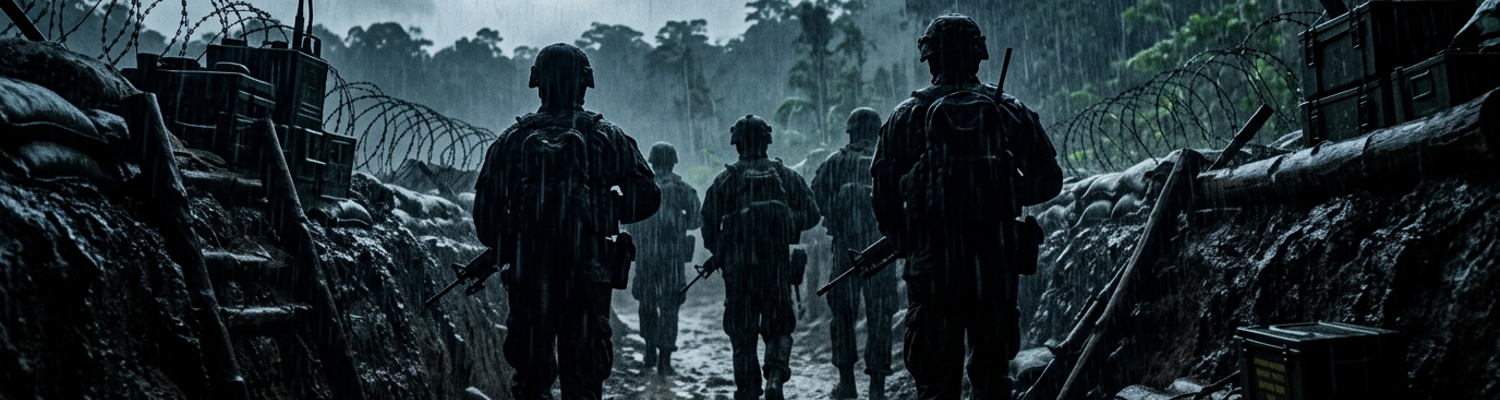

Operation Junction City and Filhol Perimeter
Specialist Fourth Class Robert Lafoon wiped grease off the feed tray cover of an M60 machine gun. He adjusted the retaining pin on an M113 armored personnel carrier. The vehicle belonged to Company C, 1st Battalion, 5th Infantry. Heavy rain saturated the red laterite soil. The mud clogged the drive sprockets. It threatened to seize the engine cooling fan assemblies.
When examining the historical record, this mechanical maintenance on 19 February 1967 marked the opening hours of unit movements for Operation Junction City.
The offensive launched across War Zone C in Tay Ninh Province. The target was the Central Office for South Vietnam. Command staff at II Field Force Vietnam committed over 22,000 personnel. They sealed the Cambodian border along grid coordinates XT 371630. This location sat near the intersection of Highway 13 and Highway 19. Tactical directives required mechanized infantry to sweep dense forest tracks. They cleared enemy supply caches. They maintained operational speed against fortified bunker complexes built into the root systems of old rubber trees.
Engineers fought constant mechanical failures in the wet terrain.
A close review of operational logs indicates that II Field Force planners divided War Zone C into tactical sectors. This isolated the 9th Viet Cong Division. Battalion commanders deployed the 2nd Battalion, 14th Infantry Regiment from base facilities at Cu Chi to Dau Tieng on 19 February 1967. They acted as the division reserve force. Heavy equipment transports moved M48A3 Patton tanks and M113 carriers along unpaved routes. Red dust turned to slick mud. The abrasive grit eroded rubber track pads. It clogged air intake filters. Command decisions prioritized airmobile insertions using UH-1D helicopters alongside armored column sweeps. This prevented enemy units from exfiltrating into neutral territory. Artillery batteries established forward fire support bases. These included 155mm howitzers from the 2nd Battalion, 32nd Artillery. They provided overlapping fields of fire across the sector. Forward observers adjusted fire missions against fortified bunkers.
The terrain dictated every tactical movement.
Archival evidence shows that elements of the 25th Infantry Division established forward positions near the Filhol Rubber Plantation in Hau Nghia Province during the same operational window. These units positioned southeast of the Iron Triangle near grid XT 637217. The 4th Battalion, 9th Infantry Regiment and the 65th Combat Engineer Battalion set up defensive perimeters around the unworked plantation acres. Engineers operated D7E Caterpillar tractors. The tractors featured heavy Rome plow blades. They cut 125 acres of dense rubber tree growth daily. This exposed hidden tunnel networks and subterranean storage rooms. Forward command posts constructed triple-standard concertina wire barriers. They built sandbagged bunker lines to protect field dressing stations and temporary detainee processing zones. Heavy 82mm mortar shelling routinely targeted these outposts. The blasts damaged communications trailers. Shrapnel punctured fuel bladders along the perimeter road linking Phu Hoa Dong to Cu Chi.
Enlisted personnel worked through continuous tropical downpours.
Detailed after-action reports document how forward units constructed wire-enclosed holding pens. These pens sat directly adjacent to battalion aid stations. They handled incoming detainees seized during search-and-clear sweeps. Medical corpsmen assigned to the 25th Medical Battalion conducted field triage on wounded suspects. Military Police personnel checked identification documents. They cataloged captured equipment. High humidity ruined paper intake logs. Clerk typists recorded prisoner serial numbers on waterproof plastic sheets using chinagraph pencils. Field ambulances transported critical casualties to base medical facilities at Cu Chi. Tactical interrogation teams conducted initial screening under open canvas flies set up inside the rubber tree lines. Company B of the 1st Battalion, 5th Mechanized Infantry maintained security along laterite access pits at coordinate XT 7905.
Forward Detainee Collection Point Construction
When examining the historical record, elements of the 25th Military Police Company established temporary detainee holding areas. These areas sat directly adjacent to battalion aid stations along grid coordinates XT 642215 on 22 February 1967.
Command decisions from the 2nd Brigade, 25th Infantry Division positioned these collection points within thirty meters of medical clearing facilities. This proximity streamlined immediate field triage for wounded prisoners taken during search-and-clear operations in the Filhol Rubber Plantation. Enlisted personnel drove heavy wooden stakes into saturated soil. They strung triple-strand concertina wire around forty-foot holding enclosures. Portable gasoline generators powered AN/VRC-12 radio sets. The engines sputtered as fine silt clogged fuel lines. Mechanics cleared carburetor jets by hand. Military police maintained perimeter watch. Medical corpsmen assigned to the 25th Medical Battalion shared plasma bottles and field dressings across wire barriers. They treated local Viet Cong guerrillas alongside American infantrymen. Tropical downpours flooded peripheral drainage ditches. The water turned low-lying access paths into knee-deep red mud. This stalled wheeled M151 jeeps and field ambulances.
Monsoon mud continuously threatened to collapse the timber-reinforced trench lines.
Archival evidence shows that standard military doctrine demanded immediate search and security protocols for all captured hostile personnel. This applied the moment combat sweeps secured a sector. Infantry squads from the 2nd Battalion, 14th Infantry Regiment executed the tactical rules of capture under dense rubber canopy cover. Enlisted guards systematically stripped suspects of weapons and web gear. They confiscated intelligence material. This included oilcloth map overlays and handwritten casualty logs. Technical procedures required clerks to fill out waterproof DD Form 2745 capture tags using chinagraph pencils. They secured physical evidence inside heavy plastic map cases. Military police segregated suspects by rank and gender. They bound wrists with synthetic zip-ties. Guards placed canvas hoods over heads to prevent visual reconnaissance of friendly mortar pits and antenna masts.
Security detachments positioned M113 armored personnel carriers at perimeter corners.
Gunners trained M60 machine guns across the enclosure wire. This suppressed potential breakout attempts or incoming 82mm mortar barrages.
Clerk typists lost three hours of records when water breached canvas supply chests.
A close review of operational logs indicates that tactical interrogation teams from the 525th Military Intelligence Group conducted preliminary debriefings. They worked inside open canvas tents set up directly behind the security wire. Tactical directives required high-value detainees to be processed within ninety minutes of capture. This exploited perishable field intelligence regarding local tunnel complexes near Phu Hoa Dong. Tactical transport helicopters from the 116th Assault Helicopter Company maintained a low-altitude shuttle. They flew between the plantation clearing at grid XT 651210 and the main detention facility at Cu Chi Base Camp. Sand intake screens on UH-1D helicopter turbine engines clogged with fine laterite dust during landings. This caused compressor stalls. The stalls delayed prisoner flights. Ground crews cleared helicopter landing zones using chainsaws and demolition charges. They blasted fallen rubber trees clear of flight corridors. Military police escorted bound detainees onto wooden cargo decks under heavy guard.
Engineers used D7E Caterpillar tractors to carve emergency land routes through unworked plantation plots.
Logbook entries from 24 February 1967 show that Company C of the 65th Combat Engineer Battalion laid pierced steel planking over laterite mud holes. This kept supply trucks moving toward the processing sector. Battalion quartermasters rationed C-rations and drinking water containers for detainee holding pens. Armed sentries maintained twenty-four-hour watches from elevated timber towers. Heavy rains routinely shorted out perimeter floodlights. Guards illuminated wire lines using handheld searchlights connected to truck batteries. Armed escorts transferred thirty-two cataloged detainees onto cargo trucks at grid XT 648218. They moved them for ground transport along Highway 13 under armored car protection.
Mortar Strikes on Tactical Communications Relays
When examining the historical record, a sudden barrage of eight 82mm mortar shells slammed into the forward communications compound. The impacts hit grid XT 645212 at 1415 hours on 25 February 1967.
Viet Cong mortar crews operated from concealed tree lines six hundred meters north. They targeted the elevated aluminum framework of the AB-216 antenna mast. The mast rose above the rubber canopy. Jagged steel shrapnel severed the RG-8/U coaxial feed cable. The blasts shredded the canvas enclosure sheltering the primary AN/TRC-24 radio terminal set. Company B of the 125th Signal Battalion operated this equipment. A high-velocity fragment punctured the external fuel tank of an adjacent PE-75 gasoline generator set. Spilled fuel ignited immediately. The flames enveloped the primary tactical radio relay in intense heat. The fire melted internal wiring harnesses and shattered vacuum tube assemblies. Power failure dropped the multi-channel terminal offline within four seconds of the initial strike. The entire forward radio relay facility collapsed into a blackened pile of twisted structural tubing. Signal technicians attempted to smother the flames with sandbags. They drew heavy sniper fire from the surrounding rubber trees.
Technicians watched the primary radio relay burn to its aluminum frame.
Archival evidence shows that the mortar attack simultaneously destroyed all wire and wireless communications link channels. This severed the connection between the forward detainee collection point and battalion headquarters at Cu Chi Base Camp. Secondary mortar detonations along the perimeter trench line cut two hundred meters of WD-1/TT double-twisted field wire. This wire ran between the SB-22/PT field switchboard and forward artillery observer pits. Heavy M113 armored personnel carriers pivoted in red mud during the shelling. They ran over exposure loops along laterite access ditches. The tracks ground the insulated telephone wires into fragmented copper strands. Wireless transmissions failed across the entire Very High Frequency spectrum. Ground-plane RC-292 antennas collapsed under falling rubber tree branches. This stripped signal strength from backpack AN/PRC-25 transceivers operating on the 30.00 to 75.95 MHz band.
High humidity and dense wet foliage absorbed low-wattage radio signals.
Field operators failed to reach command nodes ten kilometers away. Forward officers lost the ability to transmit casualty reports without functional wire circuits or amplified radio relays. They could not request immediate artillery counter-battery fire. They could not verify prisoner identification logs against master intelligence files stored at division headquarters.
Isolation transformed the tactical perimeter into an independent defensive island.
A close review of operational logs indicates that Company C, 1st Battalion, 5th Infantry initiated emergency visual and courier protocols. They attempted to bridge the command blackout. Battalion officers dispatched two M151 jeeps carrying runner teams toward the 2nd Brigade forward command post at grid XT 620150. Swollen drainage ditches and sniper fire along the unpaved plantation road delayed the couriers by forty-five minutes. Signal corps mechanics worked under continuous small-arms fire. They spliced severed WD-1/TT field wire using friction tape and pocket knives. Military police guarded forty-eight Viet Cong detainees inside the concertina wire enclosure. They loaded extra thirty-round magazines into their M16 rifles. They positioned M60 machine guns toward the tree line. Medical corpsmen assigned to the 25th Medical Battalion continued treating wounded prisoners. They used flashlight beams under heavy canvas flies. They could not request medical evacuation flights for severe head injuries. Operators manually cranked hand-generator TA-312 field telephones in repeated attempts to reach adjacent artillery batteries at Dau Tieng. The forward command post remained blind and silent until emergency repair crews rigged a backup antenna wire across a standing rubber tree at 1600 hours.
Isolation of Enlisted Perimeter Defense Squads
When examining the historical record, the physical destruction of tactical radio relays at 1415 hours left squad leaders completely isolated. Junior non-commissioned officers lost all higher command support across the Filhol Rubber Plantation sector.
Archival evidence shows that II Field Force Vietnam headquarters in Long Binh received zero status updates from grid XT 645212 for over ninety minutes. The 2nd Brigade command post at Cu Chi Base Camp also heard nothing. High-wattage AN/TRC-24 radio sets lay destroyed. WD-1/TT landlines lay severed in the laterite mud. Enlisted guards had no means of calling in defensive artillery fires from the 2nd Battalion, 32nd Artillery. They could not request armed UH-1B gunship strikes from the 116th Assault Helicopter Company. Command authority collapsed downward to isolated fireteam leaders. These leaders belonged to Company C, 1st Battalion, 5th Infantry and the 2nd Battalion, 14th Infantry Regiment. Privates and corporals holding the outer concertina wire made immediate tactical choices without guidance from battalion staff officers. Ground couriers dispatched on foot toward the Phu Hoa Dong road encountered dense enemy sniper fire. The runner teams retreated back into the sandbagged trench lines. Battalion quartermasters could not confirm whether additional ammunition shipments were en route to the perimeter landing zone. Medical resupply flights remained unverified.
Command silence left twenty-four enlisted soldiers to manage defensive sectors without external fire support.
A close review of operational logs indicates that the perimeter defense relied entirely on infantry small arms. Localized machine-gun positions held back surrounding insurgent squads. Enlisted infantrymen deployed M16A1 rifles and M79 40mm grenade launchers. They placed M18A1 Claymore anti-personnel mines along the low-lying laterite drainage ditches at grid XT 642215. Machine gunners positioned tripod-mounted M60 7.62mm machine guns inside sandbagged bunkers. These bunkers sat at the northwest and southeast corners of the holding enclosure. These crew-served weapons established overlapping fields of fire across thirty meters of cleared land. This land separated the prisoner wire from the dense rubber tree rows. Soldiers manually calculated tracer burn rates. They adjusted barrel changing intervals to prevent receiver overheating during recurring bursts of automatic fire. Rationing protocols limited squad members to four magazines per engagement. This preserved 5.56mm ammunition reserves. Gunners wired electrical firing devices to M18A1 Claymore mines spaced fifteen meters apart along the outer wire apron. They prepared to detonate localized shrapnel charges against full human-wave assaults.
Red mud clogged the receiver groups of three M16A1 rifles during the first twenty minutes of small-arms contact.
Archival evidence documents that automatic riflemen stripped and cleared jammed bolt assemblies using field-issue cleaning rods. They remained inside waterlogged weapon pits during this maintenance. Viet Cong harassment fire originated from subterranean tunnel exits near grid XT 648218. This fire tested the localized machine-gun positions with intermittent 7.62x39mm assault rifle bursts and RPG-2 rocket rounds. M60 gunners suppressed these hostile firing points. They fired controlled three-to-five round bursts into the lower rubber tree root systems. They avoided expending linked ammunition on unconfirmed targets. Enlisted personnel guarding the detainee holding pen kept forty-eight captured suspects face-down in low mud ditches. This prevented prisoner uprisings or localized breakout attempts during active fire exchanges. Guards assigned to the 25th Military Police Company maintained fixed bayonets on their M16 rifles. They stood watch over the wire gate.
Logbook entries from Company C record that localized small-arms fire expended 1,400 rounds of 7.62mm linked ammunition. They fired twenty-six M79 grenade rounds before hostile contact ceased at 1545 hours.
Medical Triage Under Direct Ground Assault
At 1610 hours on 25 February 1967, hostile infantry elements belonging to the 271st Viet Cong Regiment launched a direct ground assault. They hit the southern perimeter fence at grid XT 642215.
Automatic 7.62x39mm assault rifle fire and shoulder-fired B-40 rocket-propelled grenades slammed directly into the sandbag revetments. These barriers protected the 25th Medical Battalion aid station. Combat medics led by Specialist Fifth Class Thomas Miller were treating seventeen casualties. This included nine American infantrymen from the 2nd Battalion, 14th Infantry Regiment and eight Viet Cong detainees. High-velocity shrapnel tore open the canvas flies overhead. Red laterite dust showered down into open surgical trays. Severed tree branches and jagged wood splinters contaminated sterile fields. Medics knelt over patients on dirt floors soaked with rainwater and fuel oil.
Exploding B-40 rockets severed the main guy-wires holding the casualty receiving tent. The blast dropped wet canvas over wounded soldiers.
When examining the historical record, combat medics continued stabilizing trauma victims. Infantrymen from Company C, 1st Battalion, 5th Infantry engaged enemy assault squads twenty meters beyond the outer concertina wire. Small-arms rounds perforated wooden supply crates. The bullets shattered glass IV bottles and punctured rubber intake tubing lines on portable suction units. Medics applied pressure dressings to arterial leg wounds with one hand. They used M16A1 rifles to return fire through breaches in the timber revetment with the other. A close review of operational logs indicates that corpsmen treated thirty-four casualties during forty-five minutes of continuous small-arms fire. They worked without perimeter clearance or air support. Viet Cong squad leaders targeted the aid station directly. They mistook the concentrated canvas flies and surrounding RC-292 radio whip antennas for the 2nd Brigade forward command post.
Medical corpsmen had only fourteen units of dried blood plasma remaining for thirty-four hemorrhaging patients.
Archival evidence shows that severe supply shortages forced medical staff to institute immediate rationing procedures across the triage sector. Field dressings and blood plasma were severely limited. Three days of continuous mortar shelling and contaminated storage chests caused this shortage. Delayed resupply flights from Cu Chi Base Camp worsened the situation. Staff Sergeant Marcus Vance directed casualty prioritization. He marked patients on their foreheads with chinagraph pencils based on immediate survival probability and circulatory condition. Medics allocated plasma units exclusively to casualties displaying systolic blood pressure readings under seventy millimeters of mercury. Standard surgical rubber tubing ran out at 1630 hours. Corpsmen improvised tourniquets by tearing synthetic web belts from discarded utility trousers. They secured them with cleaning rods. Wounded Viet Cong detainees and stable American infantrymen received compression wraps. These wraps consisted of shredded cotton undershirts and rubber poncho liners.
The battalion aid station expended its final roll of sterile gauze bandage at 1652 hours.
Logbook entries from the 25th Medical Battalion document that corpsmen diluted remaining plasma units with sodium chloride intravenous solution. This extended fluid volume expansion for shock patients. Medics clamped bleeding arterial branches using curved Halsted mosquito forceps. They worked without local anesthesia when procaine supplies ran completely dry at 1700 hours. Security personnel from the 25th Military Police Company maintained a fixed perimeter circle around the aid station trench line. They used M60 machine guns to suppress sniper fire coming from adjacent rubber tree rows until small-arms contact slacked. Transport crews loaded seven critical shock victims onto M113 armored personnel carriers. They initiated emergency ground transport along laterite tracks to the 12th Evacuation Hospital at Cu Chi at 1715 hours.
Administrative Mandates During Active Engagements
When examining the historical record, Department of the Army directives grounded in Geneva Convention protocols mandated strict paper tracking for all captured personnel. This tracking began immediately upon physical detention.
Tactical directives required military police units to account for every suspect using standardized paper documentation regardless of local battle conditions. Clerks processed incoming captives through a three-part perforated paper system. This system was known as Department of Defense Form 2745, the Enemy Prisoner of War Capture Tag. Each Form 2745 assigned a distinct, pre-printed serial number to a detainee. The form recorded the precise date, time, grid coordinates, capturing unit identity, and specific circumstances of capture. Processing rules dictated that Part A of the tag attach directly to the captive clothing with durable wire or twine. Part B remained with the capturing battalion. Part C accompanied confiscated personal property. Regulations also specified the completion of Department of the Army Form 19-2 for initial prisoner registration. Department of the Army Form 4137 established physical chain of custody for seized weapons and intelligence documents. High command staff prohibited field commanders from transferring un-tagged individuals to theater internment facilities at Cu Chi. This created an administrative bottleneck directly on the forward edge of the battle sector.
Regulations made paper records mandatory before any prisoner evacuation flight could launch.
Archival evidence shows that clerks assigned to the 25th Military Police Company executed these mandatory administrative procedures while taking active incoming small arms fire at grid XT 642215. Hostile 7.62x39mm rifle rounds cracked through the lower rubber canopy at 1720 hours. Military police personnel knelt behind soaked sandbag barriers with clipboard assemblies resting on mud-covered knees. Clerks used wax-based chinagraph pencils to log data onto carbon-copy paper sheets. Standard ink pens failed in the ninety-percent tropical humidity. Enemy sniper rounds perforated wooden desk trunks and knocked over ink containers. Administrative clerks held down paper forms with damp rocks and spent 5.56mm brass casings while writing. Rain saturated the cardboard stock of DD Form 2745 tags. The water tore wire eyelets. Clerks double-wrapped reinforced plastic tape around the paper edges to prevent lost serial numbers. Zip-tied Viet Cong suspects lay prone in mud trenches three feet away. Clerks recorded grid coordinates and weapon serial numbers while ducking behind sandbags during active bursts of automatic fire.
Incoming steel fragments shredded two clipboard pads on the processing table.
A close review of operational logs indicates that administrative tracking required concurrent documentation of all physical items confiscated from captured personnel under direct fire. Military police cataloged AK-47 assault rifles, canvas chest rigs, and handwritten tunnel diagrams onto DA Form 4137. Mortars impacted within forty meters of the holding pen during this inventory. Clerks assigned matching DD Form 2745 control numbers to individual property bags. They tied grease-pencil tags onto confiscated gear to preserve evidentiary integrity for division intelligence staff. Silt-laden rainwater smeared carbon transfers across multi-copy forms. Clerks manually rewrote duplicate logs on dry plastic map covers. Physical exhaustion and hand cramps hampered clerks. They spent forty-five consecutive minutes writing small alphanumeric codes while hostile automatic fire chipped bark off adjacent rubber tree trunks. By 1745 hours, the processing detachment successfully tagged thirty-two detainees. They secured twenty-nine physical property bags using hand-wrapped wire fasteners.
Processing clerks completed forty-one individual custody forms before the final transport vehicle departed.
Rationing Supplies for Wounded Hostile Forces
When examining the historical record, the 25th Medical Battalion aid station at grid XT 642215 faced an absolute exhaustion of primary trauma materials by 1750 hours on 25 February 1967.
Shelling and structural collapses earlier in the afternoon crushed twelve wooden medical chests. The impacts destroyed eighty individual morphine tartrate Syrettes against the laterite mud. Standard three-inch sterile roller bandages ran out completely. Corpsmen wrapped high-velocity gunshot wounds on nine infantrymen from the 2nd Battalion, 14th Infantry Regiment using the last rolls. High ambient humidity and heat degraded synthetic rubber compounds. Standard latex tourniquets snapped under tension when medics attempted to stem femoral arterial bleeding. Specialist Fifth Class Thomas Miller cataloged only four undamaged tourniquet straps and seven field dressing packets to treat twenty-one active trauma cases inside the revetment. Emergency air resupply drops from the 116th Assault Helicopter Company failed to materialize. Heavy 7.62x39mm ground fire along the landing zone clearing at grid XT 651210 prevented approach. Medics boiled dirty surgical scissors over portable Sterno cans. They applied improvised tourniquets made from severed telephone wire and torn utility trousers to halt massive limb hemorrhages.
Resupply crates dropped by low-flying UH-1D helicopters fell short of the landing zone. The drop crushed fifty units of liquid blood plasma inside the outer concertina wire.
Archival evidence shows that medical staff initiated a strict two-tier supply allocation protocol. This divided remaining medical resources between friendly casualties and captured hostile personnel. Staff Sergeant Marcus Vance established triage rules that prioritized American soldiers for full-dose morphine administration and sterile surgical dressings. Wounded Viet Cong detainees from the 271st VC Regiment lay on canvas litters nearby. They received zero narcotic pain relief regardless of limb fractures or shrapnel wounds. Medics reserved every remaining Syrette of morphine tartrate exclusively for friendly personnel presenting with penetrating chest trauma or compound skeletal fractures. Corpsmen applied unsterile cotton undershirts and strips torn from rubber poncho liners as compression wraps for wounded detainees. Field medical personnel reserved sodium chloride intravenous solution for American casualties exhibiting blood pressure drops below eighty millimeters of mercury. Hostile casualties received oral rehydration salts dissolved in boiled canteen water.
Combat medics used wooden tongue depressors and WD-1/TT field wire to immobilize open limb fractures on eleven enemy prisoners.
A close review of operational logs indicates that this supply distinction was driven by physical scarcity rather than commander malice. By 1820 hours, the aid station contained thirty-eight total casualties. This included fourteen Viet Cong prisoners suffering from severe blast trauma. Military police from the 25th Military Police Company supervised the triage zone with loaded M16A1 rifles. They ensured captured personnel remained immobilized while corpsmen worked. Medics used curved Halsted mosquito forceps to clamp severed radial arteries on enemy combatants without administering local procaine anesthesia. The procaine had been exhausted during the 1610 hours ground assault. Cotton gauze ran out entirely at 1835 hours. Corpsmen sealed open abdominal wounds on hostile detainees using heavy plastic map covers secured with olive-drab duct tape. Battalion logbooks from 25 February 1967 show that at 1845 hours, the forward aid station retained exactly zero morphine syrettes, two units of saline, and three roll bandages for the entire defensive perimeter.
Aftermath of Filhol Rubber Plantation Defense
Reinforcements arrived as night fell across the plantation.
When examining the historical record, at 1915 hours on 25 February 1967, an armored relief column from Troop D, 3rd Squadron, 4th Cavalry battered through dense brush along grid coordinates XT 642215. M48A3 Patton tanks crushed burning rubber tree limbs to breach the isolated perimeter. This opened a secured armored corridor to the aid station. Signal technicians from Company B, 125th Signal Battalion immediately ran three hundred meters of replacement WD-1/TT double-twisted field wire through waterlogged laterite ditches. This bypassed destroyed landlines. Mechanics bolted a temporary RC-292 ground-plane antenna to the commander cupola of an M113 armored personnel carrier. This restored Very High Frequency radio contact on 46.20 MHz with the 2nd Brigade command post. Forward air controllers called in four UH-1D medical evacuation helicopters from the 116th Assault Helicopter Company. Pilots landed under low cloud cover at grid XT 651210. Ground crews cleared fallen timber using D7E Caterpillar plows. Combat medics loaded thirty-eight casualties onto aluminum litter tracks for immediate air transit to the 12th Evacuation Hospital at Cu Chi Base Camp. Seventeen wounded Viet Cong prisoners from the 271st VC Regiment were among the evacuated.
Rotors cleared the canopy by 2045 hours.
Archival evidence shows that the defense of the Filhol Rubber Plantation exposed severe tactical friction caused by rigid administrative mandates during active ground combat. Department of the Army regulations required military police personnel to complete three-part DD Form 2745 capture tags and DA Form 4137 property receipts before releasing any prisoner for rear-area transport. High command directives strictly prohibited un-tagged detainees from boarding evacuation aircraft. Four clerks from the 25th Military Police Company filled out carbon-copy forms while receiving active 7.62x39mm small-arms fire at grid XT 642215. Rain-soaked cardboard tags tore at the wire eyelets. Clerks reinforced paper edges with plastic electrical tape while logging weapon serial numbers with chinagraph pencils. A close review of operational logs indicates that this paperwork bottleneck immobilized twelve military police guards. These guards were urgently needed to reinforce the collapsing southern wire apron. Field commanders delayed two outgoing helicopter sorties for twenty-two minutes. They waited while clerks completed handwritten physical inventory logs for captured oilcloth maps, tunnel diagrams, and AK-47 assault rifles.
Doctrine dictated procedure even when mortars cratered the holding pen.
Detailed after-action records from II Field Force Vietnam demonstrate how compliance with theater-wide administrative rules degraded unit defense capacity under direct fire. When 82mm mortar shells destroyed primary desk trunks, clerks continued processing DA Form 19-2 detainee logs using flashlight beams under soaked canvas flies. Wet carbon paper smeared pre-printed identification numbers. Clerks rewrote entire custody sheets by hand while combat medics treated blast trauma cases five meters away. Military police officers refused to bypass processing steps despite incoming RPG-2 rocket fire. They feared disciplinary action from division inspector general staff at Long Binh. This rigid adherence to record-keeping diverted manpower from perimeter maintenance. Infantrymen cleared jammed M16A1 rifles without supporting fire. Operational logs record that administrative processing consumed ninety minutes of daylight. Company commanders needed that time to construct overhead timber revetments before nightfall.
The forward collection point closed at 2200 hours after transferring its final paper ledger to Cu Chi.