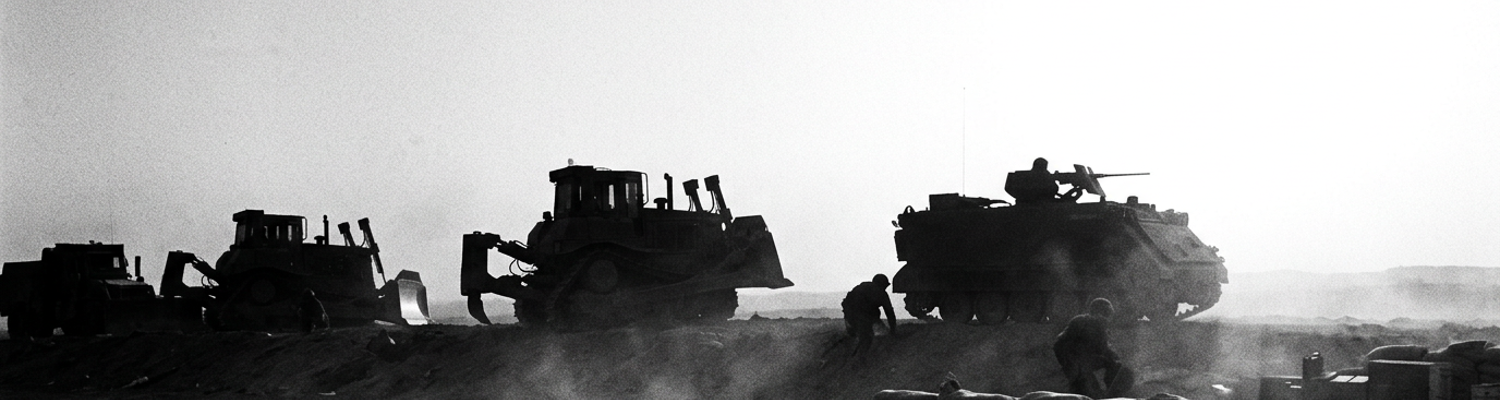

Initial Breach at Coordinates 30 44 43 N 46 25 40 E
Inside the transfer case of a lead M9 Armored Combat Earthmover, the planetary spur gears stripped their teeth. Scorching hydraulic fluid sprayed across the lower transmission housing. Line pressure collapsed from three thousand pounds per square inch to zero. The forty-ton tracked vehicle shuddered to a halt. Its front blade dropped dead into the chalky sand at coordinates 30 44 43 N, 46 25 40 E. Archival evidence shows that this sudden mechanical breakdown stalled the northern security screen at 1615 hours on 10 March 1991. Trailing five-ton trucks fanned out through uncleared access lanes. Elements of the 37th Engineer Battalion and attached explosive ordnance disposal personnel secured the fifty-square-kilometer complex.
No enemy resistance materialized.
Radio traffic confirmed that isolated Iraqi support personnel had abandoned their posts hours earlier. They left miles of concertina wire and unmanned security berms. Weapons pits sat open to incoming American reconnaissance platoons. Forward scouts dismounted into the rising heat. They scanned distant revetments with binoculars. Recovery crews worked frantically to clear the disabled vehicle from the main supply route. The M9 Armored Combat Earthmover required a heavy recovery vehicle for extraction. A specialized M88 Hercules recovery tank arrived from the battalion rear echelon. Mechanics attached heavy steel tow cables to the front lifting eyes of the disabled earthmover.
They dragged the forty-ton machine off the primary dirt road.
A close review of operational logs indicates that the initial entry into the Khamisiyah Ammunition Storage Facility proceeded without standard chemical reconnaissance. The lead elements of the 37th Engineer Battalion operated under standard conventional warfare protocols. Platoon leaders directed their squads to establish a defensive perimeter along the northern boundary. Soldiers dug shallow fighting positions in the loose limestone soil. They oriented their M249 squad automatic weapons toward the open desert. The battalion command post established radio communications with the brigade headquarters.
They reported the facility secured at 1730 hours.
Munitions Inventory and the Scale of the Depot
When examining the historical record of the initial perimeter sweep, the physical footprint of the depot overwhelmed operational planning. Engineers cataloged approximately one hundred storage bunkers and open revetments. These structures contained thousands of tons of conventional munitions left by retreating Iraqi forces. Patrols documented endless rows of 122-millimeter high-explosive artillery shells. They found 152-millimeter projectiles and 240-millimeter heavy rocket assemblies. Crated cluster munitions baked under the southern Iraqi sun.
The depot held enough explosive material to supply an entire army corps.
Inside the fifty-meter-wide earthen revetments, wooden crates of Soviet-pattern fragmentation shells sat stacked four tiers high on decaying pallets. Hardened concrete bunkers featured heavy steel blast doors. Many of these doors were scorched by earlier coalition aerial strikes. The strikes had cracked reinforced roof slabs. Interior corridors filled with choking masonry dust. Sweeps revealed unguided air-to-ground rockets and sea mines converted for land defense. Hundreds of pallets of standard mortar rounds filled the remaining space. Demolition units lacked organic heavy transport assets to haul this ordnance away.
Planned detonations in place became the primary means of depot destruction.
Archival evidence shows that explosive ordnance disposal technicians conducted rapid visual inspections of the munitions caches. They walked down the long rows of stacked wooden crates. They recorded the lot numbers and manufacturing codes stenciled on the exterior packaging. The sheer volume of ordnance required a systematic approach to demolition planning. Platoon leaders assigned specific bunker clusters to individual engineer squads. Each squad received responsibility for calculating the required explosive yields to neutralize their assigned targets. The battalion logistics officer transmitted an urgent request for additional demolition supplies to the corps rear area.
The request specified a need for ten thousand pounds of Composition C-4.
Arabic Stencils and Chemical Detection Failures
A close review of operational logs indicates that chemical detection sweeps failed to identify hazards. Obscured warehouse markings and a lack of translation support for Arabic munition stencils caused this failure. Survey teams deployed with handheld Chemical Agent Monitors and paper-based M256A1 detector tickets. They ran hasty vapor sweeps around bunker thresholds instead of deep inside unventilated storage corridors. The M256A1 kits relied on glass ampoules filled with eel enzyme reagents. Soldiers crushed the ampoules and observed the paper test spots for colorimetric changes.
Thick deposits of desert soot and blast debris heavily obscured warehouse markings.
This grime hid technical warnings on the wooden shipping boxes. The engineer units operated without Arabic translation support or attached military linguists. Frontline teams did not have Arabic-language ordnance identification guidebooks. Soldiers could not translate the white-stenciled Arabic scripts painted onto the olive-drab rocket cases. Ammunition specialists misread symbols indicating nerve agent warheads as standard smoke or illumination markers. The casing dimensions matched standard Soviet-designed Sakr-45 and BM-21 122-millimeter rocket bodies. S-shaped bunkers housing chemical-tipped rockets were treated identically to adjacent stores of conventional ordnance.
Technicians cleared structures based on these visual assumptions.
They certified the contents as standard high explosives for bulk disposal. Demolition checklists received final signatures without a single entry for chemical weapons. The handheld Chemical Agent Monitors utilized ion-mobility spectrometry. This technology frequently produced false positive readings in environments heavily contaminated by diesel exhaust and burning oil. Operators routinely disregarded low-level alarms as equipment malfunctions. They recalibrated the sensors and continued their sweeps. The lack of continuous atmospheric sampling arrays left the demolition teams blind to the presence of sub-lethal vapor plumes.
Defense Intelligence Agency Bulletins and Signal Degradation
Archival evidence shows that as early as late February 1991, the Defense Intelligence Agency circulated classified target folders. These documents identified the ammunition storage facility southwest of Nasiriyah as an active chemical depot. Specific DIA warning bulletins identified bunker clusters at Khamisiyah as probable staging points for non-conventional ordnance. The reports cited prior intelligence on Iraqi chemical handling units operating within the sector. These assessments never filtered down from United States Central Command headquarters in Riyadh to tactical field echelons.
Third Army forward command posts received fragmented electronic summaries.
These summaries stripped out site-specific chemical designations. XVIII Airborne Corps intelligence officers remained entirely unaware of the warning tags. Combat engineers assigned to the 37th Engineer Battalion and explosive ordnance disposal technicians from the 60th Ordnance Detachment moved into the target zone without ever receiving an updated target folder. Operational briefings at brigade level continued to describe Khamisiyah as an ordinary ammunition supply point. Information bottlenecks at theater headquarters trapped classified hazard data on static mainframe terminals hundreds of miles to the south.
A close review of operational logs indicates that frontline engineer companies encountered severe signal degradation across their combat net radio architectures.
Tactical units relied on AN/PRC-119 single-channel ground and airborne radio systems. Their line-of-sight frequencies struggled over vast desert distances plagued by atmospheric heat distortion. Mobile Subscriber Equipment nodes could not maintain continuous digital packet routing between moving tactical command posts and static perimeter guards. Dispatches detailing revised Iraqi chemical storage patterns vanished into transmission backlogs. Technical updates generated by military intelligence analysts warned that Iraqi forces routinely intermingled chemical warheads with standard high-explosive munitions inside open earthen revetments.
Engineer units never received these updates.
Composition C4 Deficits and Improvised Ring Mains
Supply lines running north from logistics bases at Rafha collapsed under the speed of the XVIII Airborne Corps advance. This left the 37th Engineer Battalion with acute deficits of standard demolition stores. Field requisitions demanded thousands of pounds of high explosives. Ammunition supply points delivered only a fractional allotment of standard M112 C-4 blocks. Each 1.25-pound block of Composition C-4 was meant to shatter thick steel casings. The explosive compound consisted of ninety-one percent RDX and nine percent non-explosive plasticizer.
Faced with bare pallets inside the battalion supply area, squad leaders rationed the remaining explosive bricks.
They divided the inventory across more than thirty sprawling bunker complexes and fifty open earthen revetments. Soldiers chopped individual blocks into quarter-pound chunks using combat knives. They stretched their diminishing inventory across tens of thousands of Iraqi shells. Combat engineers reduced doctrine-specified charge weights by over sixty percent. They pressed thin slivers of RDX-based compound onto the nose fuzes of stacked 122-millimeter rockets. This deficit in basic firing assemblies forced demolition teams to spend hours stringing complex ring mains.
They used commercial detonating cord to chain distant munitions pits together.
Working through midday temperatures exceeding ninety-five degrees Fahrenheit, engineer squads unspooled miles of commercial fifty-grain PETN cord across the limestone desert. They attempted to link revet