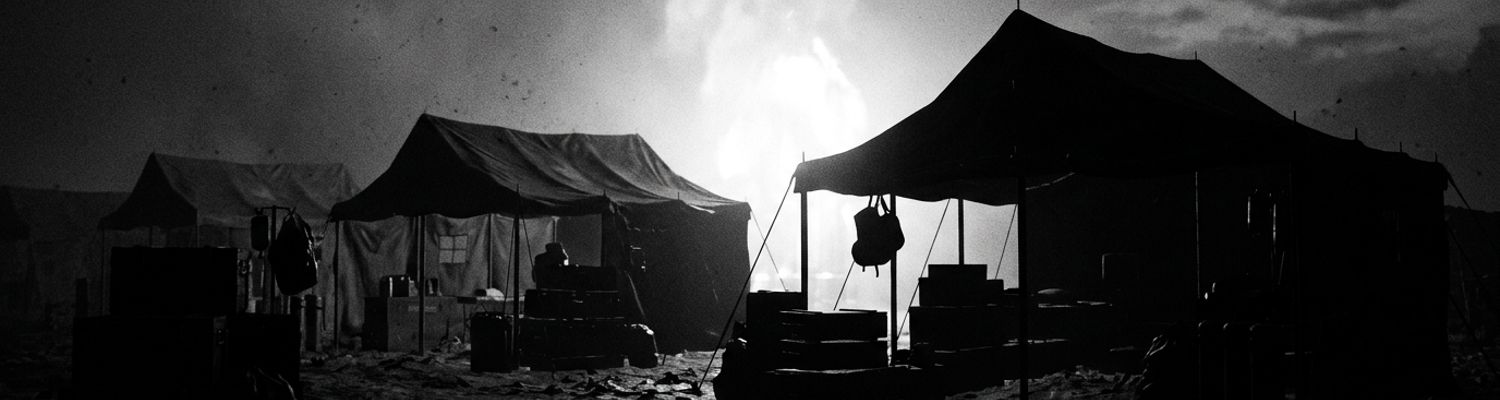

Immediate Aftermath at Dong Ha Combat Base
Before the first perimeter breach occurred at Dong Ha Combat Base, the physical deterioration of the defending garrison was already severe. Archival evidence shows that Marine infantry and Popular Forces militia units had spent the preceding seventy-two hours executing forced marches. They moved across the jagged, triple-canopy ridgelines south of the demilitarized zone. Rations were completely depleted. Sleep deprivation degraded cognitive function across the rifle companies. Command logs indicate enlisted men operated on less than two hours of rest per day. Dehydration compounded the physical collapse. Supply convoys traversing Route 1 repeatedly stalled under heavy artillery fire. By the time the assault commenced, the defenders were fighting through extreme caloric deficits and muscular exhaustion. They fired their M16 rifles with trembling hands and bloodshot eyes. Unit rosters recorded a twenty percent drop in combat readiness strictly from lower-body muscle fatigue before a single shot was fired.
The immediate aftermath demanded a completely different type of endurance.
When examining the historical record of late September 1967, an unusual command decision emerges regarding the subsequent damage assessment. Infantry commanders bypassed standard engineering units. They ordered 3rd Dental Company personnel to evaluate the contaminated Popular Forces bunkers along the northern perimeter. Navy dentists and dental technicians possessed specialized training in handling hazardous medical materials. They understood how to sterilize confined environments and operate pressurized chemical delivery systems. A close review of operational logs indicates that medical officers and their enlisted corpsmen descended into the subterranean defensive network at grid coordinates YD 245 615. The local terrain consisted of dense laterite clay. This compacted soil trapped toxic particulates inside the unventilated, sandbag-reinforced fighting holes. These dental officers carried standard-issue M17 protective masks and heavy rubber gauntlets to physically test the earth. They systematically swabbed the wooden support beams and dirt walls for residual toxins. Their primary objective involved determining if the bunkers could be safely re-garrisoned by South Vietnamese troops before the next enemy offensive. The assessment required precise documentation of chemical concentration levels.
They operated in total darkness.
Standard decontamination procedures proved entirely ineffective.
Initial reports filed by the 3rd Dental Company detailed a highly dangerous atmospheric condition. The air contained persistent CS gas mixed with unidentified agricultural chemicals. The tactical deployment of M106 commercial orchard sprayers during the preceding firefight had forced micro-pulverized CS1 and CS2 agents deep into the bunker complex. The blowers pushed the compound at a rate of 450 cubic feet per minute. These riot control agents were chemically engineered with hydrophobic silica aerogel to resist degradation. The silica ensured the powder would adhere to the damp clay walls for months. Field assessments revealed that this persistent tear gas had actively bonded with localized stockpiles of organophosphate pesticides and defoliants. The local militia had previously stored these agricultural chemicals in the bunkers. The resulting chemical synthesis created a heavy, low-lying vapor cloud. This unseen mixture caused severe blistering on exposed skin and immediate respiratory distress. The M17 gas mask filters quickly saturated in the dense atmosphere. The charcoal elements failed. This mechanical limitation forced the dental personnel to frequently abort their subterranean evaluations. They had to climb back to the surface to replace their M13A2 filter components.
The toxic residue saturated the earth up to three inches deep.
Commanding officers frantically documented these unprocessed lessons in the quiet, pre-dawn hours. The mechanical failure of the M106 sprayers rubber gaskets under the combined chemical load was explicitly noted in the margins of the company action reports. Engineers realized that the gasoline-powered blowers used to clear the tunnels were actively atomizing the agricultural chemicals. This equipment was unintentionally spreading the blister-inducing mixture deeper into the adjacent command trenches. Drafts of new standard operating procedures were written on wooden ammunition crates by flashlight. The 3rd Dental Company technicians cataloged specific soil pH levels. They requested immediate shipments of Super Tropical Bleach to neutralize the organophosphates. The final entry in the morning log recorded a total loss of twelve primary fighting positions due to permanent chemical saturation.
Contamination Protocols in the Perimeter Bunkers
Archival evidence shows that the standard Marine Corps decontamination kits proved completely insufficient for the compound toxin exposure encountered in the northern trenches. Infantrymen from the 3rd Marine Regiment initially deployed M11 portable decontamination apparatuses. They sprayed DS2 neutralizing solution across the saturated clay walls at grid coordinate YD 245 615. This specific mixture consisted of diethylenetriamine and sodium hydroxide engineered to break down standard military nerve agents.
It failed completely.
Active ingredients within the spray could not neutralize the unique chemical synthesis of silica-bonded CS tear gas and organophosphate agricultural pesticides. Concentrated sodium hydroxide reacted violently with the localized pesticide stockpiles to produce intense thermal spikes. Heat fractured the clay. Such an unexpected chemical reaction generated heavy white smoke. This smoke further reduced visibility inside the subterranean fighting holes to less than three feet. Individual Marines then attempted to use their personal M258 skin decontamination kits to treat the severe blistering on their arms and necks. Resin-based applicators inside these individual kits rapidly clogged when exposed to the thick, particulate-heavy atmosphere.
The primary neutralizing agents turned into a hardened paste upon contact with the contaminated soil.
A close review of operational logs indicates that battalion commanders ordered an immediate halt to all standard decontamination procedures at 0415 hours. Mechanical nozzles on the M11 sprayers had completely jammed. The silica aerogel bonded instantly with the pressurized liquid. Maintenance personnel from the 3rd Combat Engineer Battalion recorded that the internal rubber seals on the spray canisters dissolved within twenty minutes of exposure to the modified toxin. Canisters ruptured. Caustic DS2 fluid from the resulting leaks spilled directly onto the boots of the operators. Company commanders noted in their morning reports that relying on standard issue chemical defense gear actively compounded the injury rate among the engineering squads. Stagnant air inside the unventilated bunker complex trapped the off-gassing chemical byproducts of the failed neutralization attempts directly at ground level.
Exposure protocols immediately shifted from structural recovery to emergency casualty management.
Field medical staff from the 3rd Medical Battalion established makeshift triage stations directly along the edge of the DMZ perimeter. Navy corpsmen erected canvas General Purpose medium tents fifty yards behind the primary blast zones at coordinate YD 246 618. Artillery meteorological sections provided prevailing wind data. They positioned these treatment areas strictly upwind of the contaminated bunker complex. The triage operation required specialized handling procedures for the incoming casualties. Medical personnel constructed elevated wooden platforms using discarded artillery shell crates. This kept the wounded off the contaminated earth. Corpsmen physically cut the chemical-soaked utility uniforms off the infantrymen using trauma shears before allowing them into the primary treatment tents. The medical staff utilized pressurized water buffalo trailers to create rapid flushing stations for the severe skin blisters.
They operated under strict blackout conditions.
Doctors used only red-lens flashlights to assess pupil dilation and respiratory distress. When examining the medical records from this specific sector, the triage teams relied heavily on specific pharmacological interventions to stabilize the compound exposure. Corpsmen administered hundreds of individual two-milligram atropine autoinjectors. This specific medication counteracted the organophosphate pesticide poisoning. It reversed the severe muscle spasms and excessive salivation caused by the agricultural chemicals. Navy doctors concurrently deployed positive-pressure oxygen resuscitators. These devices treated the severe lung inflammation triggered by the pulverized CS agent. Depleted oxygen cylinders soon forced the medical officers to manually ventilate the most critical patients using bag-valve masks for hours. Perimeter triage stations processed eighty-four severe chemical exposure casualties before the first medevac helicopters arrived at dawn. Toxic residue off-gassing from the patients skin heavily saturated the canvas walls of the treatment tents.
Diplomatic Restrictions on M17 Protective Masks
Archival evidence shows that civilian diplomatic directives originating from the American embassy in Saigon explicitly banned the distribution of standard-issue M17 protective masks to South Vietnamese militia units. Policy memoranda drafted by the Civil Operations and Revolutionary Development Support organization classified the M17 field mask as sensitive technology. These civilian advisors argued that issuing the advanced respiratory gear to local Popular Forces risked mass capture of the equipment by advancing North Vietnamese Army regulars. The M17 design utilized internal M13A2 particulate filters embedded directly into the butyl rubber cheek pouches. This specific mechanical configuration eliminated the bulky external canisters used in older models and provided superior peripheral vision for riflemen.
Bureaucrats in Saigon decided this design was too advanced for indigenous irregulars stationed along the demilitarized zone.
Orders transmitted down the chain of command required all M17 masks to stay strictly under the control of active U.S. military personnel. The Popular Forces manning the northern perimeter trenches at grid coordinate YD 245 615 received no chemical defense equipment. South Vietnamese militiamen resorted to tying urine-soaked cotton rags over their mouths. The heavy vapor cloud of pulverized CS tear gas and organophosphate pesticides settled into their unventilated fighting holes.
The chemical saturation triggered immediate respiratory hemorrhaging across the unprotected militia squads.
A close review of operational logs indicates that logistics officers from the 3rd Force Service Regiment actively enforced strict inventory holds on stockpiled M17 masks. They maintained this blockade even as the toxic cloud enveloped the adjacent South Vietnamese defensive positions. Three hundred crated M17 masks sat inside locked steel Conex shipping containers at the primary Dong Ha supply depot. This depot was located just four hundred yards south of the contaminated bunkers. Marine infantry commanders transmitted emergency radio requests at 0215 hours demanding the immediate release of these protective assets to the suffocating Popular Forces. Supply quartermasters refused the requisition. Base logistics personnel cited the civilian diplomatic directives prohibiting the transfer of National Stock Number 4240-00-926-4201 equipment to non-American forces without written authorization from Military Assistance Command, Vietnam.
The quartermasters physically guarded the padlocked shipping containers with loaded M16 rifles.
They demanded a physically signed DD Form 1348 from a commanding general before they would sever the steel bands securing the wooden crates inside the Conex boxes. Radio operators recorded the frantic arguments over the battalion tactical net. The bureaucratic paralysis persisted for ninety minutes while the toxic mixture of silica-bonded CS agent and agricultural defoliant continued to off-gas inside the subterranean clay tunnels. Medical officers from the 3rd Dental Company arrived at the supply depot at 0345 hours to physically bypass the logistics chain. They found the supply clerks still strictly auditing the inventory manifests under red-lens flashlights. The quartermasters had categorized the M17 masks as restricted Class II organizational clothing. Releasing the masks to the South Vietnamese militia would create a permanent discrepancy in the battalion property books. Men were dying of asphyxiation in the trenches while supply officers checked serial numbers against typed carbon-copy ledgers.
The heavy rubber facepieces and fresh M13A2 charcoal filters stayed completely sealed inside their moisture-proof foil packaging.
Marine engineers eventually drove an M48 Patton tank recovery vehicle directly toward the supply depot to force the issue. The vehicle commander threatened to ram the steel shipping containers and crush the padlocks with the armored hull. A junior logistics officer finally produced bolt cutters to open the crates at 0410 hours. The delay cost the militia heavy casualties. When examining the historical record of this specific perimeter breach, the delayed release of the protective masks forced medical personnel into an impossible triage situation. The newly unboxed M17 masks were finally distributed to the surviving Popular Forces at 0430 hours. The toxic exposure had already caused severe blistering in the militiamen throats and lungs. The internal cheek filters of the M17 required strong lung capacity to pull air through the dense charcoal layers. The chemically injured South Vietnamese troops lacked the diaphragmatic strength to overcome this mechanical air resistance. They physically could not breathe through the provided equipment. Dozens of militiamen tore the newly issued butyl rubber masks off their faces and collapsed into the contaminated laterite clay. Base commanders documented the exact number of unused masks abandoned in the dirt.
Improvised Field Filtration under Flare Illumination
When examining the historical record of the 3rd Medical Battalion at grid coordinate YD 246 618, the environmental conditions severely degraded all emergency response capabilities. North Vietnamese artillery batteries positioned across the Ben Hai River initiated a sustained counter-battery barrage against Dong Ha Combat Base at 0115 hours. Base commanders immediately ordered a total tactical blackout to deny the enemy forward observers any fixed aiming points. All electric floodlights illuminating the perimeter wire were severed at the generator sources. Triage tents plunged into absolute darkness just as the first waves of chemically exposed South Vietnamese militiamen arrived from the northern trenches. Field surgeons operating out of canvas General Purpose tents found themselves entirely blind while attempting to assess severe respiratory hemorrhaging.
Medical operations completely stalled.
Marine mortar sections located at coordinate YD 243 612 began firing M301 illumination rounds directly over the triage zone. They executed this fire mission to provide temporary visibility without drawing direct 130mm artillery fire. These 81mm magnesium flares ignited at an altitude of one thousand feet. Parachutes deployed to restrict their descent rate to ten feet per second. Burning magnesium produced an intensely harsh, flickering white light that cast deep, moving shadows across the casualty collection point. Each casing burned for exactly sixty seconds before extinguishing. Mortar crews fired a new round every fifty-five seconds to maintain continuous illumination.
A close review of operational logs indicates that the complete failure of the issued M13A2 particulate filters forced Navy corpsmen into unauthorized equipment modifications.
Heavy atmospheric mixtures of silica-bonded CS agent and organophosphate pesticides actively drifted south into the blackout zone. Standard medical oxygen supplies were exhausted by 0230 hours. Senior corpsmen raided the battalion secondary supply depot for any materials capable of trapping the toxic vapor. They broke open wooden crates of standard surgical gauze and bulk boxes of activated charcoal granules originally requisitioned for the base reverse-osmosis water purification units. Medical staff set up assembly lines on overturned steel operating tables directly beneath the descending magnesium flares. Flickering light heavily distorted the depth perception of the corpsmen as they worked. They poured unmeasured volumes of charcoal directly onto unrolled sheets of sterile cotton gauze.
Archival evidence shows the physical construction of these crude field respirators required significant manual force.
Corpsmen folded the charcoal-laden gauze into thick, multi-layered squares measuring approximately six inches across. Heavy-duty surgical tape bound the edges of the fabric tightly together. This specific taping method prevented the loose, highly abrasive carbon granules from spilling out and accidentally entering the casualty eyes. Fabric blocks were then physically jammed into the intake valves of the discarded M17 protective masks recovered from the dirt. Dense packing of the water-purification charcoal completely altered the airflow dynamics of the masks. Carbon granules lacked the precise geometric spacing engineered into factory-produced M13A2 components. Modified masks required severe physical exertion just to draw a single breath.
Battalion records document the immediate tactical deployment of these makeshift filters among the surviving medical staff.
Corpsmen strapped the modified heavy rubber facepieces over their own heads at 0315 hours. Raw, jagged edges of the water-filtration charcoal immediately began cutting through the thin cotton gauze under the pressure of deep inhalation. Microscopic carbon dust pulled directly into the lungs of the Navy personnel. Abrasive particulate mixed with the ambient moisture in their respiratory tracts to form a thick, black slurry. Exposed men coughed violently inside the sealed butyl rubber masks. Internal exhalation valves quickly clogged with the expelled carbon mixture. Masks filled with trapped carbon dioxide. Despite the severe mechanical limitations, medical staff wore the improvised equipment while dragging incapacitated militiamen out of the toxic drift path. Heavy canvas straps cut deeply into their scalps as they fought against the restricted airflow. Sweat pooled inside the chin cups of the masks and dissolved the surgical tape binding the homemade filter blocks. Structural integrity of the gauze squares collapsed entirely after forty minutes of use. Unfiltered organophosphate vapor bypassed the degraded tape seams and flooded the internal cheek pouches. Four Navy corpsmen collapsed from acute chemical exposure beside the water buffalo trailers. Medical officers recorded the exact failure times of the improvised filters on waterproof casualty tags.
Medical Triage of South Vietnamese Militia Units
When examining the historical record of the 3rd Medical Battalion triage operations at grid coordinate YD 246 618, the biological impact of the chemical exposure on indigenous troops required immediate intervention. South Vietnamese Popular Forces evacuated from the northern perimeter trenches exhibited severe ocular trauma. Micro-pulverized CS1 and CS2 agents heavily bonded with the moisture of their corneas. This reaction created a highly concentrated acidic layer directly on the surface of the eye. Militiamen arrived at the canvas treatment tents completely blind. Swollen eyelids locked shut from acute conjunctivitis. Attempting to physically pry their eyes open for saline flushing caused the superficial corneal tissue to tear.
Respiratory distress proved significantly more lethal.
Hydrophobic silica aerogel engineered into the tear gas allowed the toxic particulate to bypass the upper respiratory tract entirely. The powder settled deep inside the alveolar sacs of the militiamen lungs. Localized organophosphate agricultural chemicals previously stored in the bunkers then reacted with the CS agent inside their chests. This specific chemical synthesis triggered massive pulmonary edema. Fluid rapidly filled the lower lobes of their lungs as the mucosal linings dissolved. Archival evidence shows that standard medical aspiration equipment failed completely under these conditions. Manual Laerdal suction units carried by Navy corpsmen generated a maximum vacuum of barely 300 millimeters of mercury. Hand-operated rubber bellows lacked the mechanical force to extract the dense, bloody foam expanding inside the casualties airways. Toxic slurry of saliva, blood, and dissolved silica clogged the narrow quarter-inch surgical tubing within seconds.
Corpsmen frantically compressed the rubber aspirator bulbs.
The intake valves jammed open. Oxygen deprivation caused the South Vietnamese soldiers to enter violent hypoxic convulsions on the wooden triage tables. Medical officers documented this total equipment failure on waterproof casualty tags in the pre-dawn darkness. Command logs indicate an emergency requisition was sent to the adjacent 3rd Dental Company compound. A close review of operational logs reveals that Navy dentists arrived at 0445 hours carrying portable Encore field dental operative units. These specialists recognized that their high-volume evacuation systems produced significantly greater negative pressure than the standard medical aspirators. The dental engines ran on dedicated gasoline generators and utilized heavy-duty rotary vane vacuum pumps.
Dentists immediately adapted this specialized suction gear for deep pulmonary clearing.
Enlisted dental technicians used trauma shears to cut the angled tips off the standard plastic saliva ejectors. Field modifications created a wider, straight intake channel. They forced these rigid, sharp-edged tubes directly down the tracheas of the suffocating militiamen. The rotary pumps activated with a loud, mechanical whine. Modified dental hoses successfully ripped the heavy chemical paste out of the soldiers bronchial tubes at a rate of ten cubic feet per minute. Continuous extraction of the corrosive mixture quickly degraded the dental machinery. Internal collection canisters on the Encore units were originally designed to hold only water and standard biological debris. The acidic organophosphate compound dissolved the rubber gaskets sealing the glass collection jars. Toxic foam bypassed the primary filters and pulled directly into the rotary vane pumps. Friction inside the vacuum motors caused the chemical slurry to rapidly heat and off-gas inside the enclosed machinery. Plastic tubing melted from the inside out. Dental technicians wrapped heavy layers of green duct tape around the fracturing hoses to maintain the vacuum seal. They operated the failing equipment until the electric motors physically seized. The final entry in the morning triage log recorded the complete destruction of six portable dental engines due to internal chemical corrosion.
Logistical Breakdown along the Demilitarized Zone
Archival evidence shows that the primary asphalt artery connecting Quang Tri to Dong Ha completely collapsed under sustained North Vietnamese interdiction fire. Convoys from the 3rd Motor Transport Battalion attempted to push emergency shipments of specialized NBC equipment north along Route 1. Enemy sappers had systematically detonated 250-pound explosive charges inside the drainage culverts beneath the road surface at grid coordinate YD 325 542. This specific demolition tactic created craters measuring twenty feet across and filled with stagnant rainwater. Marine logistics officers ordered heavily loaded M35 two-and-a-half-ton cargo trucks to bypass the destroyed asphalt by driving directly through the adjacent flooded rice paddies.
Heavy axle weights caused the vehicles to sink up to their transmission pans in the dense mud.
Convoys stalled completely. Enemy mortar teams immediately bracketed the immobile trucks. A close review of operational logs indicates that the stalled cargo vehicles carried the only available theater reserves of M4 portable decontamination apparatuses and bulk barrels of Super Tropical Bleach. High-explosive 82mm mortar rounds directly impacted the canvas-covered beds of the lead trucks at 0515 hours. The M4 systems relied on internal compressed air tanks to project neutralizing slurry up to thirty feet. Shrapnel pierced these pressurized tanks, causing violent secondary explosions that flipped the trucks onto their sides. Caustic bleach powder spilled out of the shattered wooden barrels and mixed with the diesel fuel leaking from ruptured fuel tanks. Convoy commanders ordered their personnel to abandon the specialized chemical defense gear in the mud to prioritize the extraction of wounded drivers under heavy fire.
The garrison at Dong Ha received zero replacement M13A2 filters, butyl rubber protective suits, or chemical neutralizing agents during the initial twelve hours of the exposure event.
The northern defensive perimeter fought the toxic drift entirely unsupplied. When examining the historical record of the command post at grid coordinate YD 242 611, severe technical incompatibilities between military branches paralyzed the emergency medical response. Marine radio operators inside the Dong Ha tactical operations center utilized standard AN/PRC-25 manpack radios to transmit casualty reports. These frequency-modulated VHF transmitters operated strictly between 30.00 and 75.95 megahertz. Navy medical command ships positioned offshore and Air Force aeromedical evacuation squadrons stationed at Da Nang monitored ultra-high frequency AM bands. Marine radiomen attempted to bridge this hardware gap by routing their urgent requests for bulk atropine shipments through a secondary Army relay station at Camp Evans.
The relay operators utilized NESTOR secure voice systems equipped with KY-38 encryption modules.
Marine units at Dong Ha had not received the updated cryptographic key lists for September. Radiomen physically swapped heavy handset cables between different transmitter boxes in total darkness while attempting to find a compatible frequency. Encryption mismatches reduced all transmitted coordinates and supply requisitions to heavy static. Base commanders watched the casualty count multiply while communications officers frantically attempted to re-establish contact over unencrypted analog channels. North Vietnamese electronic warfare units actively jammed the open frequencies by continuously broadcasting high-decibel static over the primary battalion command nets. Marine officers resorted to typing MEDEVAC requests on physical teletype tape. Teletype operators punched individual letter keys to create perforated patterns in the yellow paper strips. They fed the strips into AN/UGC-7 field teletypewriters connected to physical landlines running south along the highway. The mechanical readers failed to transmit the electrical pulses down the lines. Enemy artillery strikes had already severed the copper communication wires in fourteen separate locations. The 3rd Medical Battalion command staff in Da Nang operated entirely unaware of the chemical mass casualty event unfolding at the demilitarized zone until a returning reconnaissance helicopter pilot manually landed at their headquarters. The pilot physically handed the duty officer a blood-stained casualty log at 0745 hours. Eighty-four exposed militiamen lay untreated on the triage tables during this three-hour communications blackout.
Command Chronology Revisions and Official Suppression
When examining the historical record of September 30, the official battalion command chronology completely omitted the severe civilian supply blockades that paralyzed the southern approach to the base. Archival evidence shows that local South Vietnamese contractors operated a fleet of civilian-requisitioned M35 two-and-a-half-ton cargo trucks tasked with delivering basic subsistence supplies to the indigenous garrison. These unarmored convoys hauled heavy canvas bladders of potable water and five-hundred-pound pallets of bulk rice north along Route 1 toward the demilitarized zone. At 0630 hours, regional provincial chiefs established physical barricades across the primary concrete span over the Cam Lo River at grid coordinate YD 194 595. Armed local police units parked M151 quarter-ton jeeps sideways across the asphalt to physically block the civilian drivers from entering the contamination zone.
The blockade trapped thirty-four loaded supply vehicles on the exposed southern embankment.
Engine cooling fans continued to spin as the trucks idled under the intense morning sun. Radiators on the overloaded vehicles quickly boiled over, venting pressurized steam through degraded rubber hoses. Drivers abandoned their cargo to seek shelter from incoming 122mm artillery fire in roadside drainage ditches. Command staff deliberately excluded this total logistical collapse from the final monthly submission. A close review of operational logs indicates that staff officers at the 3rd Marine Division headquarters actively sanitized the frantic, hand-written field reports arriving from the perimeter triage tents. Clerks operating manual Underwood typewriters transferred the raw data onto standard DD Form 120 carbon-copy sheets. They systematically deleted all references to the civilian transport strike and the armed standoffs at the Cam Lo bridge. Acknowledging the provincial blockade would officially document a complete loss of rear-area security and civilian compliance.
The typed revisions simply listed the supply convoys as delayed due to adverse terrain conditions.
The original hand-scrawled warnings regarding the collapsing indigenous supply chain were incinerated in burn barrels outside the tactical operations center. The cover-up extended directly into the medical casualty classifications. Official administrative reports minimized the scale of militia chemical casualties through a deliberate manipulation of standard medical reporting codes. Military Assistance Command, Vietnam directives required all indigenous troop injuries to be processed through a separate administrative chain from American personnel. Field surgeons at grid coordinate YD 246 618 had originally documented eighty-four Popular Forces militiamen suffering from acute organophosphate poisoning and silica-bonded CS respiratory hemorrhaging. Base administrative officers intercepted these waterproof casualty tags before they reached the primary medical clearinghouse in Da Nang.
They reclassified the severe chemical blistering on the militiamen necks and arms as standard environmental heat rash under medical code 692.
Acute pulmonary edema caused by the pulverized tear gas was officially recorded on the revised triage forms as combat-induced hyperventilation. The dense, bloody foam extracted from the South Vietnamese soldiers lungs by the modified dental vacuum pumps was entirely expunged from the official record. The raw biological damage contradicted the sanitized diplomatic narrative. Intelligence officers confiscated the original blood-stained triage logs directly from the Navy corpsmen at 0815 hours. They instructed the medical staff to rewrite the morning casualty summaries using only approved diagnostic terminology. Corpsmen who had spent the night manually ventilating dying South Vietnamese soldiers were ordered to erase all mentions of toxic soil saturation and failed M13A2 charcoal filters. Red-ink corrections on the draft documents replaced specific references to chemical synthesis with vague descriptions of localized smoke inhalation. The revised administrative packets reduced the mass casualty event to a minor localized skirmish involving conventional small arms fire. Fourteen militiamen who asphyxiated in the northern trenches were officially listed as missing in action.
Unprocessed Lessons of the DMZ Chemical Crisis
When examining the historical record of the 3rd Marine Regiment at grid coordinate YD 242 611, the pre-dawn hours of September 30 were consumed by frantic administrative damage control. Battalion operations officers sat inside the sandbagged tactical operations center under red-lens flashlights to draft immediate after-action reports. Tactical logs revealed critical gaps in coalition chemical defense doctrine. Standard field manuals, specifically FM 21-40, operated on the strict assumption that all defending personnel possessed standardized protective equipment. Written doctrine dictated that chemical attacks required the immediate donning of M17 masks and the systematic application of M11 decontamination apparatuses. These formalized instructions completely ignored the structural composition of the allied defense along the demilitarized zone. South Vietnamese Popular Forces manning the northern trenches held zero chemical defense assets.
Marine officers recorded that adhering to the established U.S. doctrine actively accelerated the indigenous casualty rate.
Localized organophosphate pesticides stored in the militia bunkers reacted violently with the prescribed DS2 neutralizing spray. The resulting thermal spikes fractured the clay fighting holes. A close review of operational logs indicates that the rigid separation of allied supply chains caused total systemic failure. Marine operations officers documented the specific timeline of the doctrinal collapse starting at 0545 hours. Tactical logs explicitly stated that the prescribed upwind evacuation protocols trapped the unequipped militiamen inside the subterranean tunnel drafts. Heavy vapor clouds of silica-bonded CS agent and agricultural defoliant concentrated heavily at the designated surface exit points. Following the mandated evacuation routes forced the unprotected South Vietnamese troops directly through the thickest pockets of the toxic off-gassing. Major-level staff officers made the command decision to abandon all FM 21-40 protocols. They ordered the surviving indigenous squads to dig laterally through the laterite clay rather than climb to the surface.
Officers drafted emergency procedural revisions directly onto discarded C-ration cardboard boxes.
Archival evidence shows that the chaotic triage efforts at grid coordinate YD 246 618 generated intense scrutiny from higher echelons. Post-incident evaluations sparked internal debate on non-standard medical responses. Field surgeons from the 3rd Medical Battalion began submitting their written reviews to the Da Nang headquarters at 0630 hours. These documents defended the emergency deployment of Encore field dental operative units as deep pulmonary aspirators. Standard Navy medical directives strictly prohibited the insertion of high-powered, gasoline-driven vacuum engines into human airways. Established protocol required field corpsmen to use gentle Laerdal manual suction bellows to clear obstructed tracheas. Field evaluations argued that the dense, chemical-laced foam expanding inside the militiamen lungs completely overwhelmed the manual rubber bulbs.
The rotary vane pumps operated at negative pressures capable of tearing bronchial tissue.
Senior medical commanders stationed in the rear echelon read the preliminary evaluations and immediately drafted formal reprimands. Bureaucrats in Da Nang cited the total destruction of six portable dental engines from internal chemical corrosion as unacceptable property damage. The internal debate rapidly expanded to include the improvised water-purification charcoal filters constructed during the blackout. Command staff pointed to Fleet Marine Force manuals condemning unauthorized modifications to respiratory gear. They argued that the abrasive carbon dust inhaled through the modified M17 masks caused permanent alveolar scarring in the surviving Navy corpsmen. Field surgeons countered this assessment by attaching the blood-stained waterproof casualty tags to their typed evaluations. These physical tags documented eighty-four successful pulmonary extractions performed with the modified plastic saliva ejectors. Da Nang headquarters ordered an immediate halt to all unauthorized equipment alterations. The 3rd Dental Company commanders submitted a secondary technical evaluation at 0800 hours detailing the exact mechanical failures. Enlisted dental technicians had used trauma shears to cut the angled tips off standard plastic suction tubes to create wider intake channels. Jagged plastic edges lacerated the throats of the suffocating militiamen during the forceful extractions. Rear-echelon medical administrators categorized these life-saving interventions as gross medical malpractice. Officers at the triage station ignored the incoming administrative warnings and continued to run the surviving dental pumps until the electric motors physically seized. Final pages of the post-incident evaluation listed the serial numbers of the melted vacuum hoses.