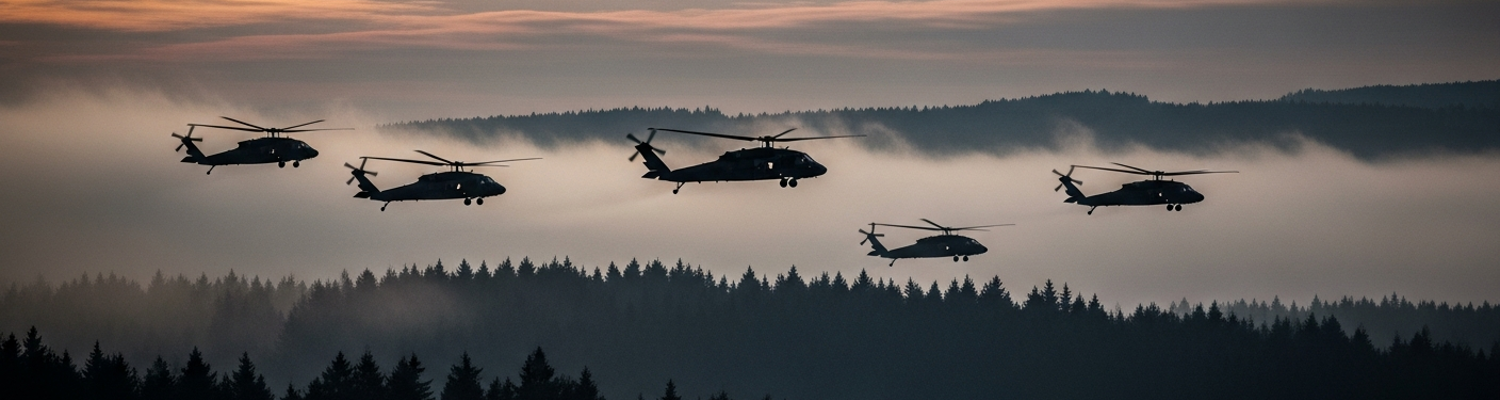

The final tally was absolute. One hundred seventeen helicopters crossed the Inner German Border. Their target: a hardened Warsaw Pact command-and-control node near Meiningen. Nineteen returned to NATO lines. Losses were concentrated in the main assault waves composed of UH-60 Black Hawks from the 2nd Battalion, 502nd Infantry Regiment. These formations were savaged by a dense, layered air defense network they had not been briefed on. Wreckage analysis and the few coherent radio transmissions painted a picture of total destruction. AH-64 Apache attack helicopters from the division’s aviation brigade, tasked with suppressing enemy air defenses, were systematically eliminated. The operation, designed as a swift decapitation strike lasting no more than six hours, devolved into a scattered fight for survival within forty minutes of entering hostile airspace. The infantry-laden Black Hawks, deprived of their Apache escorts, became helpless targets. The mission to destroy the Soviet 8th Guards Army’s forward command post failed. Not a single soldier from the main assault body reached the objective area. They were annihilated en route, their helicopters falling across a fifty-kilometer stretch of forested terrain.
Initial assessments at V Corps headquarters were a frantic exercise in piecing together a failure from disconnected fragments of information. A review of operational logs (V Corps AAR 84-11, Annex B) indicates a sequence of breakdowns, beginning with intelligence. Pre-mission briefs had drastically underestimated the mobility and sophistication of Soviet air defense assets. The unexpected presence of multiple ZSU-23-4 Shilka batteries and newly deployed 2K22 Tunguska systems, which were not supposed to be operating so far forward, proved decisive. These systems were paired with an exceptionally effective electronic warfare screen generated by dedicated Soviet EW battalions. This electronic assault blinded the American force at a critical moment. The AN/ALQ-144 infrared jammers mounted on the US helicopters were designed to confuse older heat-seeking missiles like the SA-7. They proved almost entirely ineffective against the newer generation of Soviet MANPADS, likely the SA-16 or SA-18, whose seekers could better discriminate between the jammer’s pulsing infrared signal and a helicopter’s actual engine exhaust. HAVE QUICK frequency-hopping radios, meant to ensure secure communications, were overwhelmed by broad-spectrum barrage jamming, severing the link between the air mission commander and the individual flight leads. This breakdown in communication prevented any coordinated response or organized withdrawal, leaving each helicopter crew isolated.
The strategic impact of the mission’s collapse was immediate. The 101st Airborne was NATO’s premier air assault division, a theater-level asset intended for high-tempo operations to strike deep and disrupt enemy command. Its virtual removal from the Central Army Group’s (CENTAG) order of battle in the first hours of a wider conflict created a massive operational void. The failure to neutralize the 8th Guards Army’s command node allowed the Soviets to execute their offensive through the Fulda Gap with near-perfect coordination. Soviet armored columns, which should have been disorganized and reacting to a threat in their rear, instead pushed forward against the thinly screened lines of the 11th Armored Cavalry Regiment. The loss of the 101st’s combat power meant that a key component of CENTAG’s plan for a forward defense was gone. There was no longer a credible force that could be rapidly inserted to blunt the tip of the Soviet spearhead. This forced the premature commitment of VII Corps’ reserve elements, specifically the 1st Armored Division, not as a decisive counter-attack force, but as a stop-gap measure to plug the gaping hole left by the failed air assault.
A review of V Corps G-2 intelligence sections reveals an assessment of enemy capabilities that was fundamentally disconnected from the disposition of Soviet forces. The pre-mission intelligence package provided to the 101st Airborne’s planners was built on an optimistic interpretation of satellite imagery (IMINT) and a misreading of signals intelligence (SIGINT). Analysts, relying on doctrinal templates from the mid-1970s, expected Soviet air defense assets to be deployed in a predictable, layered, and relatively static manner. The prevailing assumption was that mobile systems would be tied directly to the divisions they were assigned to protect, creating identifiable concentrations of threat. There was a working theory that the most advanced systems would be held back to protect army-level headquarters, far from the forward line of troops. This created a mental model of a porous border defense that could be penetrated at selected points, followed by a relatively undefended flight to the target area. The intelligence failed to account for a major shift in Soviet doctrine toward integrated, mobile, and offensively-minded air defense.
The most damaging underestimation concerned the density and readiness of two specific platforms: the ZSU-23-4 Shilka and the SA-8 Gecko. Planners expected to encounter Shilkas, but they were plotted in limited numbers, primarily defending fixed locations like bridges. The reality was that Soviet Motor Rifle Regiments had pushed their organic Shilka batteries far forward, using them as ambush predators along likely helicopter ingress routes. The vehicle’s RPK-2 Tobol radar was more than capable of acquiring the large radar cross-section of a UH-60 Black Hawk against ground clutter. Its four 23mm cannons could fire a combined 3,400 rounds per minute, creating an impassable wall of steel for any low-altitude aircraft. Even more devastating was the complete failure to identify the forward deployment of multiple batteries of the 9K33 Osa, known to NATO as the SA-8 Gecko. Intelligence had placed the bulk of these systems much further east. The SA-8’s design, which integrated all systems onto a single amphibious 6x6 wheeled vehicle, gave it unprecedented mobility. A Soviet SA-8 crew could halt, erect their launchers, acquire a target, fire two missiles, and be moving again in under five minutes. This capability made them functionally immune to the AH-64 Apache’s suppression tactics, which relied on locating and destroying static radar emitters. The Apaches were hunting ghosts, while the Geckos, operating with lethal autonomy, engaged and destroyed the American attack helicopters.
These intelligence errors converged on the target zone assessment. The mission objective, the 8th Guards Army’s hardened command post near Meiningen, was located in the Thuringian Forest. The flight planners for the 101st viewed this terrain as advantageous, offering terrain masking that would shield the helicopter formations from long-range enemy radar. The ingress corridors were specifically routed through deep valleys and behind low ridges to minimize exposure time. What the intelligence assessment failed to recognize was that this same terrain offered perfect concealment for the mobile Soviet air defense network. Instead of providing cover for the attacking force, the terrain channeled the helicopters into pre-sighted kill zones. The valleys became shooting galleries. The low ridges hid not just the American helicopters from Soviet radar, but also the ZSU-23-4s and SA-8s from the helicopter crews. The operational plan was predicated on the Apaches clearing a ten-kilometer-wide safe corridor for the main assault wave. Because the Soviet defenses were not static but mobile and distributed throughout the area, no such corridor could be created. The Black Hawks of the 2nd Battalion, 502nd Infantry, flew directly into a layered defense-in-depth, with engagement envelopes for different systems overlapping completely.
Operational logs indicate the precise moment the mission became unsalvageable. At 04:32 Zulu, the lead command-and-control (C2) UH-60A Black Hawk, callsign Eagle 6, crested a low ridgeline approximately 35 kilometers inside East German airspace. This aircraft, serial number 82-23714, was a flying command post carrying the air mission commander, Colonel James Macleod, and his five-man tactical staff. Its specialized communications suite included a KY-58 secure voice unit and a high-frequency radio array designed to act as the sole airborne relay between the low-flying assault force and the 101st Division’s Main Command Post. As it cleared the ridge, its AN/APR-39 radar warning receiver was already saturated with threat signals. Concealed less than two kilometers away was a Soviet 9K33 Osa mobile air defense system. The system’s crew, belonging to the air defense battalion of the 39th Guards Motor Rifle Division, had been tracking the formation’s noise signature. The SA-8’s 1S51M3 LAND ROLL engagement radar illuminated Eagle 6 for less than fifteen seconds before achieving a lock. The crew launched a single 9M33M2 missile. The Black Hawk’s AN/ALQ-144 jammer was useless against the semi-active radar homing of the missile. The pilot had no time to break or deploy chaff. The warhead detonated just aft of the main rotor mast, severing the tail boom and transmission housing. The main fuselage, carrying the command element, pitched forward and disintegrated upon impact.
The brain of the operation was gone.
The destruction of Eagle 6 was the instantaneous decapitation of the entire assault. The aircraft functioned as the central nervous system for the 117-helicopter formation. Its equipment served as a tactical gateway, receiving encrypted burst transmissions from the flight leads via short-range SINCGARS radios and rebroadcasting them over a powerful link to the division headquarters back in West Germany. When the helicopter was destroyed, that link vanished. On the tactical plot boards at the 101st Main CP, the primary icon representing the air mission commander and the entire assault wave blinked out. All subordinate icons, data-fed through the C2 ship, disappeared with it. For the division commander, the mission had gone completely dark. There were no more updates, no status reports, and no way to issue new orders. The chain of command, designed to allow senior leaders to direct a complex battle from a distance, had been shattered by a single missile strike. The assault force was now on its own.
Silence descended on the network.
This command paralysis was compounded by an electronic warfare environment of overwhelming intensity. Even before the downing of Eagle 6, Soviet specialized EW battalions had begun a coordinated electronic assault. Post-action analysis of recovered cockpit voice recorders reveals a battlespace saturated with broad-spectrum barrage jamming. This brute-force electronic noise flooded the UHF and VHF frequency bands, severely degrading the effectiveness of the American HAVE QUICK II frequency-hopping radios. While the radios were designed to jump between frequencies to evade jamming, the sheer power of the Soviet effort raised the noise floor to a point where intelligible voice communication became impossible. The airwaves became a wall of static. Pilots’ radar warning receivers, meant to identify and prioritize specific threats, were rendered useless by the cacophony of signals from dozens of different Soviet radar systems operating in the area. This electronic fog of war effectively isolated each flight element. The loss of the C2 helicopter was the final, physical blow, but the mission’s command structure had already been crippled by an enemy they could not see.
The decapitation of the assault wave’s command element triggered an immediate breakdown in unit cohesion. A review of the few surviving cockpit voice and data recorders shows that in the seconds following the destruction of Eagle 6, the airwaves fell into a confused mess of overlapping, desperate calls between individual flight leads. With no higher authority to issue a recall, the subordinate company commanders of the 2nd Battalion, 502nd Infantry, were left to interpret the last known orders in isolation. The two lead companies, Alpha and Bravo, flying in a staggered formation, reacted in fundamentally different ways. The flight lead for Alpha Company, assessing the sudden spike in anti-aircraft fire as an indicator that they were nearing the objective, ordered his ten UH-60s to descend further into their valley ingress route, accelerating to push through the resistance. In contrast, the commander of Bravo Company, correctly interpreting the loss of all command chatter as a failure, attempted to execute a 180-degree turn to withdraw.
Every independent decision was a mistake.
This divergence in movement shattered what was left of the formation’s integrity. Alpha Company’s descent took them directly into a pre-sighted kill box, where at least two ZSU-23-4 Shilka batteries opened fire. The combined rate of fire from these vehicles, exceeding 6,000 rounds per minute, created a curtain of 23mm shells that tore through the Black Hawk airframes. Wreckage analysis later confirmed that none of Alpha company’s helicopters survived for more than ninety seconds after making this decision. Bravo Company’s attempted withdrawal proved just as lethal. Their turn took them out of the relative shelter of their valley and exposed their full broadside profiles to a different threat. A roving SA-8 Gecko, the same type of system that had downed Eagle 6, acquired the lead elements of the turning formation and fired two missiles in quick succession, destroying two helicopters instantly. The remaining Bravo Company pilots scattered, breaking formation entirely and fleeing as individual aircraft.
The planned air corridor had ceased to exist. It was now a fifty-kilometer-deep free-fire zone. This foreclosed any possibility of rescue or reinforcement. Standard procedure would call for the dispatch of MEDEVAC helicopters to retrieve wounded personnel, but sending unarmed UH-60s marked with a red cross into this environment would have been suicide. The Soviet air defense network was not static; it was a fluid and active hunter-killer system. The mobility of the SA-8 and Tunguska platforms meant that even if a corridor had been temporarily cleared, it could be re-occupied within minutes. Any attempt to send a quick reaction force or resupply mission would have met the same fate as the initial wave. For the crews and infantrymen in the few surviving and scattered helicopters, this was a grim realization. Archival flight recorder data from one of the last destroyed Black Hawks captures a pilot stating flatly that the air corridor was a graveyard and that no help was coming.
There would be no rescue.
This left the handful of surviving Black Hawks from the trailing companies in a state of prolonged exposure to an enemy that was now fully alerted and actively hunting them. For approximately twenty-two minutes, these isolated helicopters were stalked across the Thuringian Forest. Their AN/APR-39 radar warning receivers were perpetually screaming, saturated with signals from dozens of acquisition and tracking radars. Pilots were forced into continuous, violent evasive maneuvers, jinking and diving to break radar locks, all while trying to find a safe route west. The intense psychological pressure was compounded by the ineffectiveness of their countermeasures. The AN/ALQ-144 jammers, designed to defeat older heat-seeking missiles, proved useless against the sophisticated seekers of the SA-16 and SA-18 MANPADS that Soviet infantry had deployed throughout the woods. The final radio transmissions logged by a NATO signals intelligence post were a disjointed series of calls indicating visual acquisition of shoulder-fired missiles, followed by silence. One by one, the remaining helicopters were picked off.
The mission's logistics annex reveals that the entire operational tempo was predicated on the successful deployment of multiple Forward Arming and Refueling Points (FARPs). These were designed to be rapidly established by CH-47 Chinook helicopters in supposedly secured clearings. The plan called for the first wave of AH-1 Cobra attack helicopters, after expending their initial munitions and fuel, to cycle back to these FARPs for a hot refuel and re-arm. The breakdown of the air corridor rendered this plan obsolete within minutes. The Cobras assigned to the deep escort role, flying alongside the Black Hawks, found themselves in a high-threat environment that demanded constant, high-G evasive maneuvers. An AH-1 Cobra’s General Electric T53-L-703 turbine engine burns approximately 110 gallons of JP-8 fuel per hour at cruising speed. Performance data shows this consumption can easily double during sustained nap-of-the-earth flight and aggressive combat maneuvering. Pilots were forced to keep their engines at maximum continuous power. The low-fuel warning lights, indicating less than twenty minutes of remaining flight time, began illuminating across the cockpits of the escort flight far earlier than any worst-case scenario had predicted. With the FARPs now inaccessible through a wall of enemy fire, pilots faced a choice between attempting to fight their way back to the border on fumes or continuing the mission until their engines flamed out. Many of the Cobras were lost not to enemy fire, but when their engines starved of fuel at low altitude, giving the crews no chance to autorotate to a safe landing.
For the infantrymen who survived the initial crashes, the logistical failure was far more immediate.
The psychological disintegration of the surviving ground troops from the 2nd Battalion, 502nd Infantry, was swift. Scattered in platoon- and squad-sized elements across dozens of square kilometers of the Thuringian Forest, they were isolated, disoriented, and hunted. Initial training took over for some; wreckage analysis from several crash sites shows evidence of hastily established perimeters and organized casualty collection points. This discipline eroded quickly. The constant sound of Soviet Mi-24 Hind helicopters and Su-25 Frogfoot ground-attack jets operating with impunity in the airspace above them served as an auditory reminder of their abandonment. Post-conflict analysis of Warsaw Pact records indicates that elements of the 39th Guards Motor Rifle Division were tasked with systematically sweeping the forest, not to take prisoners, but to annihilate all resistance. For the American soldiers hiding below, the forest that was supposed to offer cover became a cage. The lack of communication, their SINCGARS radios now useless slabs of plastic, created an information vacuum that was filled with paranoia. Accounts from the few repatriated prisoners of war describe a rapid breakdown in the chain of command, with junior enlisted soldiers refusing the orders of unfamiliar officers from other platoons. Small groups simply wandered off into the woods in a desperate, individual search for a way out.
Hope for rescue had evaporated.
This acute psychological stress, combined with the physical exhaustion of evasion, led to the final stage of morale collapse. Widespread combat fatigue manifested as a complete inability to function. Soldiers would simply sit down, unresponsive to commands or the immediate dangers around them. A more desperate phenomenon was documented through debriefings of the handful of soldiers who were eventually captured and repatriated years after the conflict. A close examination of these records reveals multiple instances of self-inflicted wounds. These were not acts of cowardice, but the outcome of a mind and body pushed beyond all conceivable limits. After days of being hunted, with ammunition gone and the wounded dying from lack of medical care, some soldiers saw capture as the only alternative to death. A single, deliberate shot to the foot or lower leg was seen as a way to force that outcome. Warsaw Pact patrol logs corroborate these findings, noting the discovery of multiple American soldiers incapacitated by non-lethal, self-inflicted gunshot wounds, their M16A2 rifles lying beside them.