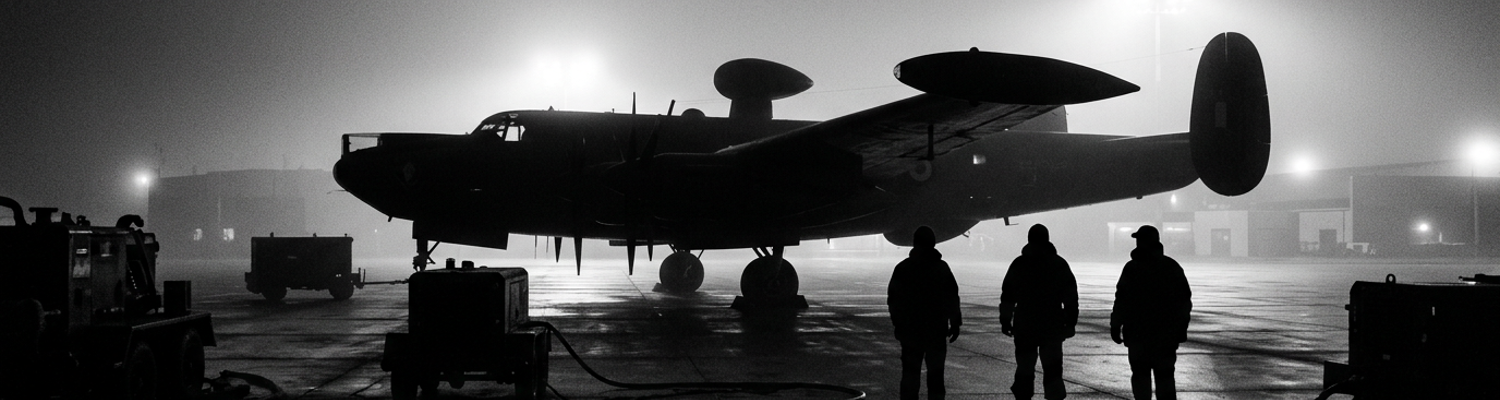

PostCrisis Airborne Radar System Overhauls
On 2 September 1961, mechanics at Wright-Patterson Air Force Base pulled charred Hazeltine APA-56 indicator scopes from wooden transport crates. The units smelled of melted copper and burnt chemical phosphor. General Bernard Schriever of Air Force Systems Command ordered a complete teardown of the damaged lower radomes. The era of fixed-frequency airborne surveillance ended on these concrete hangar floors.
A close review of maintenance reports from that month reveals total electrical failure across the modified EC-121 radar consoles.
The 552nd Airborne Early Warning and Control Wing had installed field-spliced variable capacitors and unshielded coaxial cables at Wiesbaden Air Base. These components melted completely during encounters with Soviet R-118 broadband noise generators over West Germany. Engineers cataloged severe heat damage inflicted on the internal circuit boards. The rigid 2.8 gigahertz S-band transmission architecture caused the signal saturation experienced over the Fulda Gap.
The Pentagon issued an emergency directive to accelerate the development of frequency-agile radar networks.
Technicians stripped the obsolete single-channel 5J26 magnetrons from the primary supply chain. Defense contractors began designing airborne systems around high-power klystron amplifiers and traveling-wave tubes. These new components allowed radar operators to rapidly shift pulse repetition frequencies across a wide electromagnetic spectrum. Airborne early warning platforms could now electronically hop away from the concentrated output of ground-based jamming arrays. Engineers required a hardware architecture capable of detecting hostile interference and shifting its operating megahertz within microseconds without operator input.
The complete collapse of communication nodes over the Helmstedt corridor directly informed the baseline architecture of the E-3 Sentry AWACS.
Soviet electronic warfare battalions had easily flooded the unencrypted UHF voice channels used by the Warning Stars during the height of the Berlin crisis. Analog automated data relays transmitting coordinate telemetry to the 496th Fighter Interceptor Squadron at Hahn Air Base broke down into randomized alphanumeric static. Ground controllers lost tactical visibility over the buffer zone because the EC-121s lacked secure transmission protocols. American pilots flying F-102 Delta Daggers at supersonic speeds through thick cloud cover near the Hesse-Thuringia border flew blind. The Department of Defense mandated that all future airborne command platforms incorporate encrypted digital networks. Systems engineers at Boeing integrated these exact cryptographic requirements into the primary blueprints of the Airborne Warning and Control System program. They studied the specific telemetry degradation logged by the 552nd flight engineers and mapped out a completely new digital infrastructure.
They replaced the vulnerable analog relays with secure Time Division Multiple Access data links.
When examining the historical record, the transition to the E-3 Sentry eliminated the exact hardware vulnerabilities exposed during the European patrols. The new Tactical Digital Information Link (designated Link 11) utilized advanced frequency multiplexing and continuous cryptographic key cycling to shield air-to-ground telemetry from hostile interference. The Boeing design team discarded the transparent acetate plotting boards and heavy grease pencils. They routed the secure data link feeds directly into an onboard IBM 4PI CC-1 central computer system. This heavy mainframe weighed over a ton. It required a dedicated liquid cooling network to prevent the type of thermal overloads that plagued the pressurized cabins of the Constellations. The computer processed the encrypted radar returns and transmitted accurate vectoring coordinates to ground-based interceptor squadrons in precise digital bursts. The rotating Westinghouse AN/APY-1 radar dome mounted above the E-3 fuselage incorporated the frequency-hopping klystron technology first conceptualized after the EC-121 failures. Each pulse transmitted by the AWACS utilized a different frequency phase to completely bypass ground-based directional jamming arrays.
The Heinz Felfe Espionage Compromise
The mechanical failures of August 1961 originated from a severe intelligence breach months earlier.
On 6 November 1961, Federal Criminal Police Office agents entered the Bundesnachrichtendienst headquarters in Pullach, Bavaria. They arrested Heinz Felfe. A close review of declassified interrogation files reveals the exact mechanics of this security breach. Felfe served as the head of Department IIIF. This specific division was directly responsible for Soviet counter-intelligence. Felfe operated as a highly placed KGB mole for over a decade. His handlers stationed at the KGB compound in Karlshorst directed him to systematically catalog the internal organizational charts of West German intelligence.
Felfe possessed unrestricted access to the central registry vaults containing classified NATO defense protocols.
The arrest of Felfe revealed total infiltration of West German intelligence. BND President Reinhard Gehlen learned his primary counter-espionage director had compromised every major western intelligence operation running into East Germany. Investigators searching Felfe's office discovered miniature Minox cameras and false passport templates. They found specialized cipher pads designed to encrypt intelligence summaries. Highly classified internal security reviews sat openly on his desk. The Federal Criminal Police Office spent seventy-two hours securing the immediate perimeter to prevent Felfe from signaling his capture to his handlers.
The KGB already possessed the true identities of ninety-four active field agents.
Archival evidence shows Felfe utilized a complex network of dead drops across Vienna and Salzburg to transfer thousands of photographed documents to Moscow. He bypassed standard BND security checkpoints by hiding microfilm canisters inside hollowed-out shaving cream cans and modified cigarette cases. During his tenure, Felfe actively manipulated BND recruitment processes to reject legitimate Soviet defectors while hiring additional KGB assets. He assigned known Soviet double agents to monitor the primary communication trunks linking the West German Ministry of Defense to the United States European Command. This specific administrative sabotage denied the Fourth Allied Tactical Air Force any early warning regarding the rapid buildup of Soviet electronic warfare units near the inner German border. Western intelligence agencies operated under the false assumption that their internal communications infrastructure functioned without compromise.
Felfe provided Moscow with comprehensive data on NATO radar routing networks and vectoring frequencies.
He specifically targeted the technical manuals governing the deployment of the 552nd Airborne Early Warning and Control Wing. The stolen microfilms contained the exact UHF frequency bands (ranging from 225.0 to 399.9 megahertz) assigned to the EC-121 Warning Star fleets. Soviet intelligence analysts in Moscow translated the classified NATO Air Defence Ground Environment routing schematics. These documents detailed the automated data link protocols connecting the high-altitude radar planes to ground-based interceptor squadrons stationed at Hahn Air Base and Ramstein Air Base. Felfe delivered the daily changing cryptographic keys and the specific brevity codes used by flight engineers to coordinate radar sweeps over the Fulda Gap. The technical specifications of the AN/APS-20 primary search radars were acquired directly by Soviet intelligence. KGB technicians analyzed the precise power output limitations of the EC-121 internal generators. They mapped the exact time delays between a radar contact registering on the aircraft plotting board and the transmission of that data to ground controllers.
Soviet signal battalions tuned their ground-based jamming arrays to the exact megahertz.
Soviet electronic warfare operators did not need to scan the electromagnetic spectrum to locate the American radar planes. They knew the exact coordinate waypoints and operational altitudes for every scheduled flight path in the West German Air Defense Identification Zone. Felfe's espionage allowed the Warsaw Pact to pre-position high-gain directional antennas along the Helmstedt corridor. The ground stations simply waited for the EC-121s to enter their designated surveillance tracks before activating the targeted broadband noise jammers. Radar operators inside the American aircraft faced a concentrated output of electromagnetic interference calibrated to exploit the specific hardware vulnerabilities outlined in the stolen blueprints.
EC121 Radar Console Limitations
The 552nd Airborne Early Warning and Control Wing relied on vulnerable fixed-frequency radar consoles. These units lacked any electronic counter-countermeasure capabilities.
Inside the dimly lit aft compartment of the Warning Star, five radar operators sat before Hazeltine APA-56 indicator scopes. These heavy metal display units depended on single-channel 5J26 magnetrons locked to a rigid 2.8 gigahertz S-band transmission frequency. The hardware architecture offered zero frequency-hopping functionality. If a hostile transmission matched that exact electromagnetic signature, the operator could not manually switch the receiver to an alternate channel. Technicians attempting to modify the internal circuit boards mid flight found the tuning coils physically soldered in place by the manufacturer. The 552nd deployed to the European theater with equipment designed exclusively for uncontested airspace.
Maintenance crews treated the fixed-frequency design as a non-issue until the active jamming commenced.
A close review of operational logs indicates the systemic breakdown started at the signal processor level due to these strict hardware limitations. The primary AN/APS-20 search radar utilized a massive rotating antenna designed to bounce low-frequency pulses off ground targets deep inside East Germany. Because the transmission frequency operated on a completely static band, Soviet electronic warfare battalions easily recorded the specific pulse repetition intervals during routine NATO training flights weeks before the crisis escalated. Ground commanders at the 552nd headquarters failed to authorize the installation of variable-frequency oscillators. Operators in the sky over West Germany stared at glass cathode-ray tubes that offered no physical dials or switches to filter out hostile noise.
Every screen in the aft compartment displayed thick strobe lines that obscured the entire geographic overlay.
Compromised signal nodes allowed Soviet jammers to blind AN/APS-20 and AN/APS-45 radar systems during active patrols. The earlier espionage breaches handed the KGB the exact telemetry nodes used by the EC-121s to relay automated radar returns to ground stations. Soviet troops positioned truck-mounted R-118 broadband noise generators directly beneath the known patrol routes near the Fulda Gap. These jammers flooded the exact fixed frequencies of the Warning Star radar receivers and the specific UHF channels used for air-to-ground data links. Search scopes connected to the AN/APS-20 bloomed into solid white circles of static within seconds of the aircraft crossing the 10th meridian east.
High-altitude AN/APS-45 height-finding radars mounted in the upper dorsal fins suffered identical signal saturation.
Excessive wattage from the Soviet ground transmitters overpowered the tiny receiver diodes inside the airborne consoles. Hydraulic nod-angle mechanics within the AN/APS-45 jammed as the processing unit attempted to calculate false altitude readings generated by the noise barrage. Radar technicians physically unbolted the aluminum chassis covers to replace shattered glass vacuum tubes. Continuous voltage spikes surging through the compromised signal nodes cracked the replacement tubes immediately upon installation. Analog computers aboard the aircraft failed to separate the incoming ground-control intercept coordinates from the overwhelming wash of hostile static. Interceptor squadrons waiting on the tarmac at Hahn Air Base received corrupted data packets consisting entirely of randomized alphanumeric characters.
This loss of specific relay nodes severed the tactical link between the airborne early warning platform and the regional air defense grid.
Signal Degradation in Western European Airspace
13 August 1961. 0214 Zulu. Coordinates 52 degrees 13 minutes North, 10 degrees 53 minutes East.
High-altitude EC-121 Warning Star command patrols experienced widespread signal loss over Western Europe. The modified Lockheed Constellations initiated their standard surveillance tracks at an altitude of 20,000 feet along the West German Air Defense Identification Zone. The primary AN/APS-20 search radars were designed to project a 250-mile forward scan deep into East German airspace to monitor Warsaw Pact troop movements. Archival evidence shows that mechanical degradation began within fourteen minutes of the aircraft establishing their figure eight holding patterns near the Helmstedt corridor. The massive lower radomes housed complex waveguide networks that relied entirely on unshielded coaxial cabling. Thermal stress inside the pressurized cabin aft equipment bays warped the copper connectors linking the antenna array to the primary signal processors.
The vacuum tubes powering the main transmitter arrays began to fluctuate wildly in their voltage output.
Equipment failures compounded rapidly across the deployed fleet. The AN/APS-45 height-finding antennas suffered severe azimuth sweep malfunctions as the hydraulic rotation motors seized. Flight engineers attempted to bypass the primary power distribution panels to keep the systems energized. Ambient high-altitude atmospheric conditions stressed the aircraft internal environmental cooling systems. The heavy magnetrons overheated. Operators physically struck the metal casings of the display consoles with their hands to force jammed mechanical relays back into alignment. The basic analog filters governing the receiver channels burned out completely under the sustained electrical load.
They lost all telemetry from the forward interceptor squadrons stationed at Hahn Air Base.
Ground-based P-14 VHF radars operated at power levels specifically calibrated to overwhelm NATO receivers. Soviet electronic warfare battalions at military bases in Wunsdorf activated a series of broadband noise jammers. The hostile jamming signals flooded the specific UHF communication bands assigned to the Warning Stars. Airborne early warning systems of the era completely lacked frequency-hopping capabilities. The EC-121 analog signal processors could not isolate the hostile interference from friendly transmission traffic. Command elements at the Fourth Allied Tactical Air Force headquarters in Ramstein ordered the aircrews to increase their transmission power to burn through the jamming blanket.
This specific command decision caused the EC-121 internal alternators to draw excessive electrical current from the main buses.
Circuit breakers popped simultaneously across the flight engineer main control panel.
Soviet electronic warfare units mapped the exact patrol routes of the EC-121s by tracking their predictable emission signatures. Once a Warning Star entered a holding pattern over the Fulda Gap, East German-based jammers focused high-gain directional antennas directly at the aircraft flight path. The AN/APS-20 radar receivers suffered cascaded diode failures due to the sustained high-voltage input from the focused jamming signals. Technicians worked in the dimly lit radar compartments. They lacked sufficient spare vacuum tubes to replace the shattered components on the fly. The four Wright R-3350 Duplex-Cyclone radial engines struggled to generate enough electrical output to sustain both basic flight operations and the over-driven radar suites.
Radar operators resorted to using grease pencils on transparent plotting boards because the automated data link systems failed to process any incoming radar returns.
Emergency Field Engineering by USAF Technicians
A close review of maintenance logs from 15 August 1961 details unauthorized hardware teardowns initiated by ground crews at Wiesbaden Air Base.
Technicians assigned to the 552nd Airborne Early Warning and Control Wing dragged the melted Hazeltine APA-56 indicator scopes out of the returning Lockheed Constellations. They hauled them onto the concrete hangar floors. Air Force mechanics lacked the authorized replacement modules required to repair the cascaded diode failures caused by Soviet jamming arrays. Maintenance commanders ordered their teams to execute unscheduled hardware modifications directly on the EC-121 radar consoles to restore basic tracking functionality. Radar technicians stripped the aluminum chassis covers off the primary signal processors using manual aviation snips. They ignored standard procurement channels. Crews worked in unventilated maintenance bays through the night. They used standard-issue soldering irons to melt away the factory-sealed tuning coils.
Flight engineers assigned to the 552nd AEW recognized the rigid 2.8 gigahertz S-band transmission architecture guaranteed continuous signal saturation during their patrols over the Helmstedt corridor.
They needed a physical workaround to force the system off its locked frequency. Ground crews unbolted the heavy primary power distribution panels from the aircraft bulkheads and transported them into the avionics shops. Master Sergeant William Vance authorized his team to cannibalize spare AN/ARC-27 communication radios for raw copper wiring.
Archival evidence shows the subsequent modifications attempted to bypass compromised fixed-frequency signal nodes using improvisational wiring and filter bypasses. The factory-installed analog filters governing the receiver channels burned out completely under the sustained electrical load of the Soviet R-118 broadband noise generators. Technicians drilled holes directly through the exterior metal casings of the AN/APS-20 radar receivers to run exterior coaxial cables. They spliced these heavy black cables into the primary power distribution panels. This entirely circumvented the damaged signal nodes that normally processed incoming telemetry.
To break the fixed-frequency lock, mechanics wired crude variable capacitors scavenged from ground-based interceptor radios directly into the 5J26 magnetron circuits.
This physical hack allowed the airborne radar operators to manually shift the receiver frequencies by a few megahertz to dodge the highest intensity jamming bands. The improvisational wiring completely lacked electromagnetic shielding. Flight line mechanics wrapped the exposed solder joints in standard electrical tape to prevent arcing against the vibrating fuselage walls. They secured the loose copper wiring bundles to the metal ceiling ribs of the aircraft using heavy canvas straps. Maintenance officers falsified the weight and balance logs to clear the aircraft for flight.
The modified receiver units weighed fourteen pounds more than the original factory specifications.
These crude filter bypasses required operators to physically hold exposed wires against grounding plates during high-altitude operations. The 552nd AEW technicians reinstalled the altered consoles into the aft compartments of the Warning Stars just hours before the next scheduled rotation over the Fulda Gap. Because the bypassed signal nodes no longer regulated the incoming voltage, the raw radar returns spiked the electrical current feeding the glass cathode-ray tubes. The improvised variable capacitors successfully shifted the listening frequency away from the exact megahertz targeted by the East German jamming stations. Radar scopes temporarily cleared of the solid white static.
The unscheduled modifications bypassed the automated data link protocols connecting the aircraft to the Fourth Allied Tactical Air Force headquarters in Ramstein.
Operators stared at raw unfiltered radar blips while manually writing coordinate data onto transparent plotting boards with grease pencils. Flight engineers stood behind the radar technicians with heavy leather gloves to physically disconnect the power cables if the scavenged capacitors began to smoke. The unshielded coaxial splices melted through their electrical tape within forty-five minutes of takeoff.
Radar Interface Failures Under Electronic Attack
The unauthorized field modifications initiated at Wiesbaden Air Base immediately degraded the visual output of the Hazeltine APA-56 indicator scopes.
Flight engineers bypassed the factory signal nodes to install scavenged variable capacitors. This stripped away the primary voltage regulators in the process. They manually shifted the S-band receivers by three megahertz to dodge the known jamming frequencies. When the EC-121 Warning Stars returned to their holding patterns over the Fulda Gap on 16 August 1961, Soviet electronic warfare battalions detected the shifted transmission signatures within twelve minutes. Ground-based R-118 broadband noise generators recalibrated their directional antennas to track the new megahertz range. Unshielded coaxial cables spliced into the aircraft primary power distribution panels channeled the concentrated electromagnetic interference directly into the avionics bays.
Raw unregulated voltage surged through the modified wiring harnesses and struck the glass cathode-ray tubes of the radar consoles.
This sudden electrical spike superheated the internal electron guns operating at 15,000 volts. The smell of burning insulation filled the pressurized cabin. The resulting thermal overload ignited the chemical phosphor coating on the display screens.
Archival evidence shows this specific hardware interaction created a blinding visual phenomenon recorded by maintenance crews as severe scope glare. Radar technicians stared into solid walls of bright green luminescence that completely eradicated the geographic map overlays. Electron beam deflection coils housed inside the monitors fell out of magnetic alignment. Mechanical interface instability worsened as the relays controlling the azimuth sweep began to stutter under the fluctuating electrical current. Heavy aluminum chassis boxes vibrated violently against the floorboards. Rotating AN/APS-20 antennas in the lower radome continued to send raw telemetry data up to the aft compartment. The altered consoles could no longer translate the timing pulses.
Operators attempted to manually adjust the gain dials to filter out the intense light. Heat expansion snapped the physical knobs completely off their metal shafts.
Technicians resorted to draping heavy wool blankets over their heads and consoles to block out the ambient cabin lighting.
This visual degradation directly caused massive target loss during active intercept operations along the inner German border. The 552nd Airborne Early Warning and Control Wing carried standing orders to vector F-102 Delta Daggers from the 496th Fighter Interceptor Squadron toward any Warsaw Pact aircraft crossing the buffer zone. These emergency vectoring missions required precise telemetry data to guide the fighters through the congested airspace. Airborne radar operators lacked the clear display returns required to calculate airspeed, heading, and altitude for the incoming bogeys. Severe scope glare obscured the faint radar blips representing both the friendly interceptors and the hostile MiG-19 formations.
Flight engineers tried to read the raw data directly off the oscillating cathode-ray tubes.
Interface jitter displaced the target returns by up to fourteen miles on the transparent plotting boards. Ground controllers at Ramstein Air Base requested immediate vectoring coordinates over the UHF radio channels to guide the F-102s into firing positions. The EC-121 crews transmitted entirely randomized grid locations over the unencrypted voice frequencies. Degraded airborne control capabilities forced the American interceptor pilots to rely entirely on their own short-range Hughes MG-10 fire control systems. These nose-mounted radars offered a highly restricted field of view. F-102 pilots flying at Mach 1.2 through thick cloud cover over the Helmstedt corridor flew completely blind. American operators inside the EC-121 could not differentiate between ground clutter, weather formations, and actual aircraft on their flooded screens.
Soviet jamming arrays intensified their output to exploit the lack of frequency-hopping technology in the modified Warning Stars.
Heavy grease pencils used by the radar technicians tore directly through the acetate plotting maps as they frantically tried to track the erratic strobe lines. Physical communication links between the airborne early warning platform and the fighter squadrons collapsed entirely at 0422 Zulu. Squadron commanders ordered their pilots to break off pursuit patterns and land at Hahn Air Base with less than six minutes of reserve fuel remaining in their internal tanks.
Maintenance crews at Rhein-Main Air Base later cataloged seventy-three blown receiver modules on a single returning aircraft.