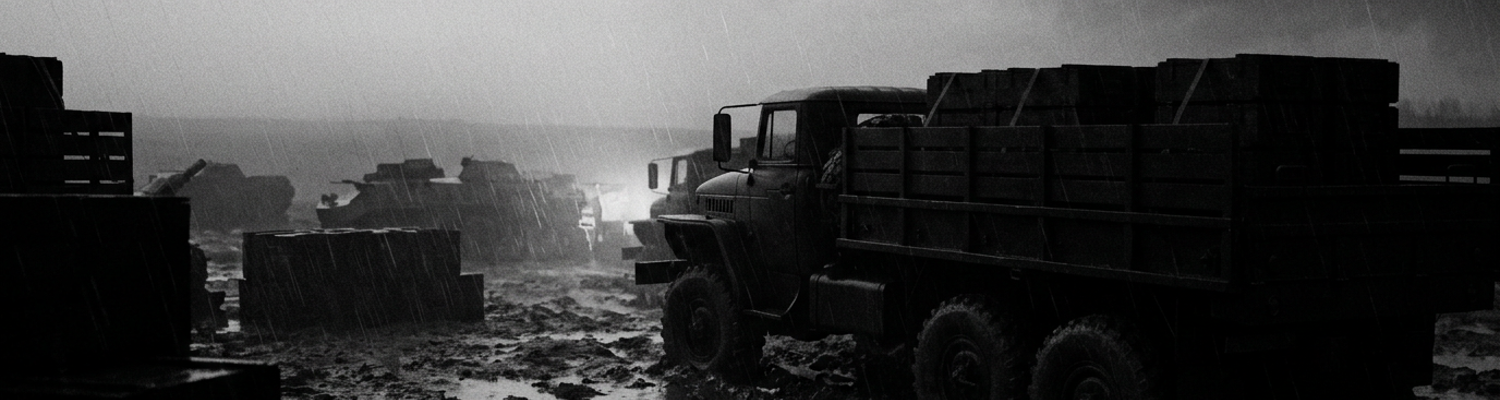

JUSMAPG Planning and Unrealistic Operational Deadlines
At 0430 hours on June 15, 1948, Corporal Yiannis Makris of the Hellenic Army 74th Engineer Battalion lay flat in the damp dirt of a forward supply depot near Kastoria. His position was marked at 40°31'N 21°16'E. He wiped grit from the grease zerk on the forward transfer case of a Studebaker US6 two-and-a-half-ton cargo truck. The brass fitting was heavily scored. Makris connected the nozzle of a manual pneumatic grease gun to the valve. He pumped heavy lubricant into the housing until it seeped out of the planetary gear seams. Three pounds of grease per vehicle was the sole mechanical barrier preventing the axles from shattering on the steep gradients of the Pindus mountain range.
A completely inadequate defense against the coming terrain.
In June 1948, the Joint United States Military Advisory and Planning Group enforced a rigid thirty-day operational deadline for Operation Coronis. Major General James Van Fleet and his American advisory staff drafted a schedule requiring the Hellenic Army to encircle and destroy the Democratic Army of Greece within the Grammos massif by mid-July. They issued these orders from a heavily guarded headquarters in Athens (NARA Record Group 338). The plan demanded the synchronized movement of 70,000 soldiers from the A and B Corps across a combat zone featuring an average elevation of 2,500 meters. Staff officers plotted daily advance quotas on flat topographic maps. They calculated that infantry units would cover up to eight kilometers of vertical terrain every twenty-four hours. These projections ignored the physical limitations of the transport network. Planners failed to account for the caloric burn rate of the transport mules. They missed the rapid degradation of truck differentials on the rocky inclines of Mount Smolikas.
The math dictated a requirement of four hundred tons of daily supplies.
The primary access road through Konitsa could only support one-tenth of that volume.
A close review of operational logs indicates that Hellenic Army leadership was pressured into this precipitous mountain offensive despite receiving severe weather forecasts from their own meteorological units. Lieutenant General Thrasyvoulos Tsakalotos commanded the A Corps. He submitted field reports warning that the offensive window was too narrow and the terrain too unstable. JUSMAPG advisors dismissed these concerns. They threatened to freeze incoming shipments of Truman Doctrine military aid if the Greek general staff delayed the attack. Hellenic Air Force weather stations based in Ioannina tracked a series of unseasonal low-pressure frontal systems moving east across the Ionian Sea. The instruments predicted heavy thunderstorms capable of generating flash floods throughout the Epirus region. This atmospheric disturbance was scheduled to hit during the exact weeks Van Fleet had designated for the rapid armored thrust.
Precipitation data from June 18 recorded an immediate drop in barometric pressure across the staging areas.
The offensive launched directly into the predicted storm cells. Torrential rain saturated the limestone and clay soil of the Grammos foothills. The water instantly transformed the narrow dirt supply lines into deep mud channels. Forward momentum ceased entirely within forty-eight hours. Heavy M8 Greyhound armored cars sank to their chassis bellies. Their smooth tires spun uselessly in the sludge. Pack mules carrying mortar baseplates lost their footing on the washed-out trails. Dozens of animals slid off the sheer drops into the Sarandaporos river gorge. By June 21, the 74th Engineer Battalion abandoned road expansion efforts entirely. They redirected all personnel to the manual extraction of twenty-two immobilized Studebaker trucks trapped along a three-kilometer stretch of the Nestorio pass.
Alpine Trail Collapse and Pack Animal Losses
Archival evidence shows that a low-pressure system stalled directly over the Pindus range on June 23. It dumped seventy-two millimeters of rain in a four-hour window. The primary supply artery for the Hellenic Army 9th Mountain Division consisted of a meter-wide path cut into the limestone schist of the Aetomilitsa-Kiafa route. This path angled upward at forty-five degrees. Torrential summer downpours washed out steep alpine pack trails across Mount Grammos. Rainwater cascaded off the upper ridges and gathered in natural granite chutes. It accelerated to destructive speeds before slamming into the man-made dirt paths. The kinetic energy of the runoff stripped away the topsoil. Slick bedrock was exposed beneath. Greek engineering units from the 74th Battalion had previously reinforced the outward-facing edges of the trail with untreated pine logs and iron rebar driven into the dirt. The floodwaters eroded the sediment holding these anchors. Hundreds of meters of reinforced trail sheared off the mountain face. The debris plummeted into the Sarandaporos gorge. Supply columns moving toward Hill 1532 suddenly found their designated routes replaced by sheer vertical drops.
The entire forward advance halted at an elevation of 1,800 meters.
Infantry units attempted to bypass the missing trail sections. They encountered knee-deep slurry. The unseasonal storm cells continued to regenerate throughout the final week of June. They dropped an additional forty millimeters of precipitation daily. The clay-heavy soil of the Grammos massif absorbed the water until it reached total saturation. Whole sections of the mountainside began to slide under their own weight. Operational logs from the A Corps indicate that secondary routes near the Epano Arena peak dissolved into liquid mud channels. Soldiers tried to lay woven branch fascines across the worst gaps. The rushing water swept these temporary bridges into the ravines below. Quartermaster units trapped behind the collapses watched their food supplies rot in the damp air.
The overland transport network ceased to function.
When examining the historical record, the cost of this infrastructural failure was paid primarily in livestock. The Hellenic Army relied entirely on Cypriot and American-imported mules to move heavy equipment. Handlers equipped the animals with rigid Phillips pack saddles designed for carrying artillery. Over four hundred supply mules drowned or fell along washed-out mountain routes during the last week of June. Soldiers from the 103rd Pack Transport Company led animals along the disintegrating paths. The mules carried up to ninety kilograms of cargo. They hauled disassembled 75mm Pack Howitzer M1 barrels. They transported wooden crates of 81mm mortar shells and canvas sacks of dry rations. The high center of gravity created by these specific loads made the animals exceptionally unstable on the wet stone. As the trail edges crumbled under their hooves, the mules lost their footing. They slid backward down the steep inclines. Handlers held the lead ropes. The falling weight violently jerked them toward the cliffs.
Most soldiers dropped the canvas leads to save themselves.
Dozens of animals plummeted hundreds of feet down the limestone faces. The blunt force trauma shattered their spines. It scattered live artillery ammunition across the lower slopes. Other mules survived the initial falls only to land in the swollen tributaries of the Aliakmon river. The thick canvas cinches securing the heavy artillery parts pinned the animals underwater. They drowned in the fast-moving rapids. Quartermaster reports filed on July 2 (Document ID 44-A-192) documented exactly 412 missing pack animals within the 9th Division sector alone. Veterinary officers recorded that an additional eighty mules sustained compound leg fractures from slipping into hidden rock fissures covered by the mud. Greek commanders ordered these injured animals shot on site to clear the narrow passes. The carcasses were pushed over the edge into the brush.
By July 4, the 103rd Pack Transport Company possessed only eighteen functional pack animals.
Motor Transport Stagnation and Lowland Mud
Archival evidence shows that the Hellenic Army supply blueprint relied exclusively on heavy American-manufactured cargo trucks to cross the Epirus lowlands. The 104th Motor Transport Company operated a fleet of GMC CCKW and Studebaker US6 two-and-a-half-ton vehicles. These machines weighed over ten thousand pounds unloaded. Planners routed this heavy convoy through the Nestorio basin near 40°24'N 21°03'E. The unpaved transit corridor ran parallel with the Aliakmon river. Following the unseasonal June downpours, the alluvial deposits of the Aliakmon floodplain possessed high plasticity. Rainwater saturated the topsoil. The route turned into a continuous trench of viscous muck. The heavy transport vehicles became completely immobilized in this deep lowland mud. Drivers engaged the front-wheel-drive transfer cases and dropped their unsynchronized transmissions into first gear. The standard-issue non-directional tread tires packed with wet clay within three revolutions. They lost all traction. Truck axles sank beneath the surface level of the sludge. The heavy differential housings dragged against the buried bedrock. This friction anchored the vehicles in place. Mechanics attempted to use the front-mounted Gar Wood power take-off winches to pull the trucks free. The steel cables snapped under the extreme tension. Recoiling wire rope shattered the safety glass of the truck cabs. Cooling systems failed as engines ran at maximum revolutions per minute without generating forward airflow. Radiators boiled over. They expelled superheated coolant into the rain.
Recovery crews found fifty-eight trucks permanently entombed in the mud along a seven-kilometer stretch of the basin.
A close review of operational logs indicates that this mechanical paralysis immediately severed the supply chain for the frontline infantry. Ground transport failures cut off forward movement of food and technical support to the 8th and 9th Mountain Divisions. These units held blocking positions on the upper Grammos ridges at elevations exceeding two thousand meters. The battalions required sixty tons of daily provisions to maintain combat effectiveness. The immobilized Studebakers down in the valley held thousands of wooden crates containing British-manufactured 25-pounder artillery shells. Pallets of dry cell batteries required to power SCR-300 backpack radios sat under canvas tarpaulins. Infantrymen exhausted their ammunition reserves repelling Democratic Army counterattacks. Without power for their communication sets, forward observers could not call for artillery support. Armorer units attached to the forward battalions lacked the necessary spare parts to repair jammed M1 Garand rifles. Extractor springs and firing pins remained boxed in the valley. Field medical tents ran out of morphine syrettes and sterile bandages. Quartermasters at the Nestorio staging area watched rainwater seep into canvas sacks of flour and sugar. The dampness activated the yeast. Expanding dough caused the sacks to split open in the cargo beds of the stranded trucks. Cases of canned corned beef sank into the mud alongside the vehicle chassis.
Frontline soldiers were reduced to a caloric intake of four hundred calories per day.
Hellenic Army command officers at A Corps headquarters issued direct orders to bypass the motorized bottleneck using human labor. Lieutenant General Thrasyvoulos Tsakalotos drafted rear-echelon cooks, radio operators, and mechanics into ad-hoc carrying parties. The conscripted laborers strapped thirty-kilogram wooden crates of 75mm Pack Howitzer ammunition to their backs using canvas webbing. Entire platoons waded into the Nestorio mud basin on foot. The slurry sucked the leather combat boots off their feet. Men abandoned their footwear entirely. Freezing, debris-filled sludge coated their saturated wool socks during the march. Soldiers suffered from severe trench foot after standing in the cold water for consecutive days. Medical officers amputated gangrenous toes with unsterilized field knives. The fifteen-kilometer trek from the disabled truck convoys to the base of the mountain trails took fourteen hours to complete. Exhausted carrying parties frequently dumped heavy technical equipment into the ravines to lighten their loads. Small arms ammunition received priority over food. Combat engineers from the 74th Battalion requested replacement pneumatic drills, blasting caps, and lubricating oil to clear rockfalls on the upper slopes. The carrying parties left those specific crates sitting in the flooded beds of the abandoned GMC trucks. Rainwater filled the open wooden boxes. The pooling water corroded the sensitive detonators and ruined the mechanical replacement parts.
The 74th Engineer Battalion recorded zero deliveries of explosive ordnance between June 28 and July 5.
Frontline Ordnance Depletion and Artillery Failure
Archival evidence shows that by July 12, 1948, the 21st Field Artillery Regiment positioned at 40°20'N 20°52'E completely exhausted its stockpile of M48 High Explosive shells. Gun crews operating M1 75mm Pack Howitzers on the exposed limestone ridges of Mount Kiafa spent the morning executing continuous suppression missions against Democratic Army bunkers. The barrels reached temperatures exceeding two hundred degrees Fahrenheit. Loaders shoved the last eighteen-pound brass casings into the breeches. They slammed the sliding wedge blocks shut. Gunners yanked the braided cotton lanyards. The final volley of point-detonating fuzed projectiles sailed across the Sarandaporos gorge. The recoil cylinders absorbed the rearward force. Mechanics wiped the hot steel. Gunners reached for the next wooden crate. They found only splintered pine boards. Frontline Hellenic Army artillery batteries ran completely out of high-explosive ordnance at the exact moment the 9th Mountain Division initiated its primary infantry assault on Hill 1532. Firing pins clicked against empty chambers. Battery commanders ordered their men to stack the spent brass in the dirt. Soldiers scraped dried mud from the empty primer pockets using their fingernails.
The entire artillery line across the northern Grammos sector ceased firing at 1400 hours.
A close review of operational logs indicates that this sudden silence triggered an immediate tactical reversal across the combat zone. Democratic Army spotters recognized the cessation of incoming fragmentation patterns and initiated a coordinated counter-offensive. Communist infantry swarmed out of deep subterranean trench networks dug into the reverse slopes of the Epano Arena peak. They charged directly up the alpine scrub fields toward the Hellenic Army positions. The attackers utilized the natural granite outcroppings for cover while closing the distance. They carried captured German MG42 machine guns and Soviet-supplied PPSh-41 submachine guns. Greek forward observers desperately cranked the hand generators on their SCR-300 radios. They transmitted urgent requests for protective box barrages. Artillery officers at the battery command posts listened to these coordinates through static-filled headsets. They could do nothing. They recorded the grid references in their logbooks. Gunners stared at the empty dirt pits.
The 21st Field Artillery Regiment recorded a complete loss of three forward gun emplacements by nightfall.
The geographical disconnect between the valley floors and the alpine ridges finalized the disaster. Quartermasters calculated a minimum requirement of two hundred 75mm shells per hour to sustain a creeping barrage. Those specific munitions sat twenty kilometers away in the flooded cargo beds of immobilized Studebaker US6 trucks trapped in the Nestorio mud. The axle-deep sludge locked the transport vehicles in place and prevented any forward momentum. Human carrying parties failed to cross the washed-out trails with the heavy wooden crates. Conscripted cooks abandoned the ninety-pound ammunition loads in the ravines. The rigid canvas straps severed the skin on their collarbones. Pack mules capable of hauling the heavy artillery components had already drowned weeks prior. Supply disruptions prevented ammunition replenishment during highly active offensive phases. This left the forward infantry entirely exposed on the rocky inclines. Greek artillerymen resorted to packing their howitzer breeches with white phosphorus smoke shells. They fired these low-yield projectiles directly into the advancing formations at point-blank range. Burning magnesium scattered across the wet limestone. The chemical fires provided no kinetic stopping power.
Communist machine gunners advanced straight through the white smoke.
When examining the historical record, the specific mechanics of the supply failure reveal a complete breakdown in the chain of command. Division commanders sitting in dry tents in Ioannina issued repeated orders for the 21st Field Artillery Regiment to resume firing. Couriers ran physical paper messages up the mountainside. The notes demanded continuous artillery support for the crumbling infantry lines. Artillery officers wrote their replies on the backs of the original orders using grease pencils. They detailed the exact zero-count of their high-explosive inventory. Staff officers at the rear echelon refused to accept these inventory reports. They accused the frontline battery commanders of hoarding munitions. Generals threatened to court-martial the artillery captains for insubordination.
Quartermaster clerks in Athens continued to log the stranded artillery shells as active frontline inventory.
Tactical Air Neutralization and Illumination Breakdown
Archival evidence shows that by July 14, 1948, the Hellenic Air Force 335th Bomber Squadron ceased all offensive operations over the Grammos massif. Ground crews at the Sedes Air Base near Thessaloniki prepped Supermarine Spitfire Mk IX fighters for close air support missions. Mechanics loaded 250-pound general-purpose bombs onto the underwing racks. They topped off the fuselage tanks with 100-octane aviation fuel. Pilots received coordinates to strike Democratic Army strongholds positioned near 40°23'N 20°47'E. The flight path required navigating the Pindus range at altitudes exceeding eight thousand feet. A severe low-pressure system descended over the operational zone right as the squadrons reached the target area. Dense nimbostratus clouds dropped the visibility ceiling to zero. Claustrophobic fog enveloped the jagged limestone peaks. The atmospheric moisture condensed on the armored glass of the Spitfire canopies. Pilots lost all visual reference to the horizon.
Rolls-Royce Merlin engines roared blindly through the dense clouds.
A close review of flight logs indicates that thirty-two consecutive sorties were aborted between July 15 and July 18. Hellenic Army infantry units on the ground activated M18 colored smoke grenades to mark their forward lines. The thick fog completely absorbed the yellow and red chemical smoke. Airborne pilots stared at their altimeters while banking sharply to avoid colliding with unseen granite walls. Radio compasses proved useless in the highly magnetized iron-ore deposits of the mountain range. Without visual confirmation of the target zones, squadron leaders ordered their pilots to jettison their payloads blindly into the Sarandaporos gorge to reduce landing weight. Ground controllers at the A Corps headquarters listened to the radio chatter as the fighters turned back toward the coast. The infantry holding the line on Hill 1532 received zero aerial suppression against the communist mortar pits. Democratic Army engineers used this uninterrupted window to reinforce their bunker roofs with thick pine logs.
The tactical air support network ceased to exist.
When examining the historical record, the absence of daytime air cover forced the Hellenic Army to rely on nighttime artillery strikes. The 21st Field Artillery Regiment attempted to coordinate fire missions against Democratic Army bunkers dug deeply into the reverse slopes of the Epano Arena peak. Forward observers could not see the enemy muzzle flashes in the pitch-black conditions. Battery commanders ordered the deployment of Mk 24 parachute flares to expose the communist trench lines. Loaders shoved the modified 75mm illumination rounds into the howitzer breeches. The projectiles detonated at an altitude of one thousand feet above the valley floor. Magnesium candles ignited upon deployment. They burned at three thousand degrees Fahrenheit.
Each flare produced one million candlepower of raw white light.
The technical application of these illumination devices completely failed in the atmospheric conditions of the Grammos range. The claustrophobic fog banked heavily inside the mountain passes. As the magnesium flares drifted downward on their silk parachutes, the intense light hit the dense layer of suspended water droplets. The fog intercepted the raw light. The suspended water droplets reflected the blinding white glare directly back into the retinas of the Hellenic Army forward observers. Greek soldiers lost their night vision instantly. Pupils contracted under the intense glare. The dug-in communist positions remained entirely concealed beneath the cloud deck. Deep shadows cast by the jagged limestone outcroppings shifted wildly as the parachutes swayed in the alpine crosswinds. Democratic Army machine gunners utilized these moving shadows to reposition their heavy weapons without detection. They fired directly into the illuminated Greek observation posts. Hellenic artillery crews continued to launch flares into the overcast sky at a rate of four per minute. The burning magnesium casings eventually hit the wet dirt. They sputtered out in the mud.
Psychological Fatigue and Localized Unit Collapse
A close review of operational logs indicates that by July 19, 1948, the 73rd Infantry Brigade of the Hellenic Army 15th Mountain Division ceased to function as a cohesive military formation. A stationary low-pressure system trapped dense nimbostratus clouds against the upper limestone ridges of Mount Kiafa at 40°21'N 20°46'E. Visibility dropped to less than three meters for six consecutive days. Infantrymen lost all spatial awareness within this opaque white environment. The highly magnetized iron-ore deposits beneath the topsoil rendered standard-issue magnetic compasses completely useless. Needles spun erratically inside their brass housings. Squads attempting to cross the 2,100-meter elevation walked in tight circles until they collapsed from exhaustion. The continuous downpour saturated the soldiers heavy wool uniforms. Wet fabric clung to their skin. It accelerated body heat loss in the near-freezing alpine winds. Men shivered violently in waterlogged foxholes. Soldiers pressed their bodies against the cold bedrock to escape the biting drafts. Water seeped into their leather combat boots. The constant dampness caused the epidermal layers of their feet to slough off in large sheets. Severe hypothermia, physical degradation, and complete sensory deprivation triggered acute psychological trauma across the entire brigade.
Medical officers recorded that frontline infantrymen went one hundred and forty hours without entering a rapid eye movement sleep cycle.
Archival evidence shows that this extended environmental disorientation systematically dismantled the mental stability of the conscripted soldiers. The Hellenic Army supply chain failure restricted these men to a daily intake of four hundred calories. Starving brains began to misinterpret auditory stimuli in the dense fog. Democratic Army artillery units positioned on the reverse slopes fired 82mm mortar rounds blindly into the cloud cover. The high-explosive shells detonated against the unseen granite outcroppings. Concussive waves echoed unpredictably through the narrow mountain passes. Greek soldiers could not visually track the incoming fire. The men heard the whistling descent of the mortar fins multiplying from every direction at once. The constant acoustic barrage fractured their nerves. Visual hallucinations plagued the sentries. Exhausted riflemen fired their remaining .30 caliber ammunition at shifting shadows in the mist. Spotters reported seeing communist infantrymen charging through the clouds. Morning patrols found only shattered pine branches riddled with friendly bullets. Men dropped their weapons and pressed their palms aggressively over their ears. Some screamed uncontrollably into the fog. Field medics lacked the necessary pharmacological sedatives to treat the mass hysteria. Doctors tied the most erratic soldiers to pine trees using canvas rifle slings to prevent them from wandering off the sheer cliffs.
Dozens of restrained men strangled themselves attempting to break free from the wet webbing.
When examining the historical record, this psychological degradation directly precipitated the localized structural collapse of multiple combat units. The 3rd Battalion of the 73rd Brigade received direct orders from A Corps headquarters to execute a flanking maneuver against communist bunkers on Hill 1430 at 0500 hours on July 22. Platoon commanders blew their brass whistles to signal the advance. The enlisted men sat completely motionless in the mud. Non-commissioned officers drew their M1911 sidearms. They racked the slides and chambered .45 caliber rounds. Sergeants threatened to shoot anyone who refused to stand. The conscripts ignored the officers entirely. Soldiers stared blankly at the pooling rainwater in their trenches. Dozens of infantrymen began systematically dismantling their M1 Garand rifles. Men tossed the heavy wooden stocks and steel receivers into the deep ravines. The swelling of the untreated wood in the damp air had already jammed the operating rods. These weapons were dead weight. Company captains attempted to relay the mutiny back to division command using SCR-300 backpack radios. The internal dry cell batteries had ruptured from the freezing temperatures. Acid leaked into the wiring harnesses. The communication grid was dead. Command structures dissolved by midday. Officers descended the mountain trails alone. They left their leaderless squads curled in fetal positions among the wet rocks.
Military police units at the Nestorio base camp arrested fourteen deserting lieutenants before nightfall.