
The battlefield had no front line. Viet Cong and North Vietnamese Army units defied conventional intelligence, moving with near-total freedom through the triple-canopy jungle. They could be anywhere. For American ground forces, this created a persistent state of dread, where any rice paddy could conceal a prepared ambush. Locating and fixing this enemy for a decisive engagement was nearly impossible. They were fighting a phantom.
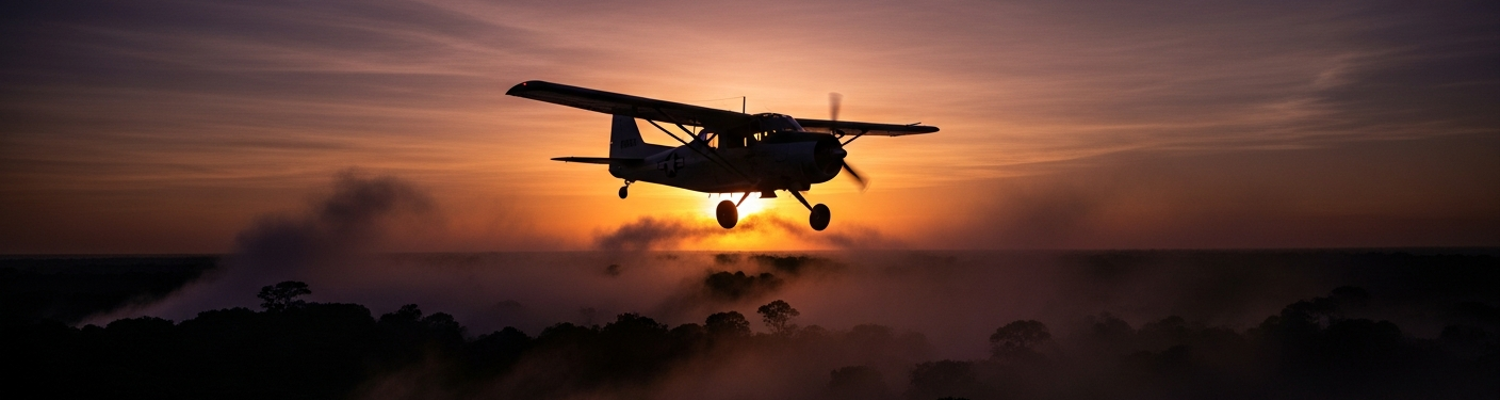
The answer was the Forward Air Controller. The FAC flew the Cessna O-1 Bird Dog. It was an aircraft from another era. Derived from a 1949 civilian design, the single-engine plane was slow and entirely unarmored. Its fuel tanks were not self-sealing. The pilot's only real sensor was his own eyesight. Flying just above the treetops at speeds below 100 miles per hour, the FAC’s mission was visual reconnaissance. Pilots from units like the 21st Tactical Air Support Squadron spent hours scanning the green canopy for subtle signs of enemy activity: an unusual trail, freshly disturbed vegetation, the faintest wisp of smoke from a concealed cook fire, or the V-shaped wake of a sampan in a delta canal. A review of operational logs from the period (NARA Record Group 342) shows these were methodical flights demanding intense concentration. The pilot navigated by map and visual landmark over terrain that offered few distinct features. The Bird Dog’s exceptional rear and side visibility, a product of its high-wing design, was its only technical advantage. This was the analog process of finding a needle in a ten-thousand-square-mile haystack, all while presenting a slow, predictable target for anyone on the ground with a rifle.
Once a target was found, the FAC’s role transitioned from observer to director of an air strike. The mission was to guide fast-moving jet fighter-bombers, F-100 Super Sabres or F-4 Phantoms, onto unseen enemy positions below. The speed differential was a major challenge; the Bird Dog loitered at 90 mph while jets screamed in at over 400 mph. The FAC pilot would first establish radio contact with the inbound fighters, providing a detailed verbal description of the target’s location relative to a prominent landmark. Then came the most dangerous part of the mission. The marking run. The O-1 would dive low to fire a 2.75-inch white phosphorus rocket, a Mk 4 FFAR known as “Willy Pete,” to create a plume of white smoke precisely on the enemy position. This run deliberately exposed the aircraft to concentrated ground fire from small arms and heavy 12.7mm DShK machine guns. Enemy gunners knew that shooting down the FAC could disrupt the entire air strike. Once the smoke was on the ground, the FAC would climb away, directing the fighter pilot’s eyes onto the mark and clearing him to drop ordnance of napalm or high-explosive bombs. The FAC remained overhead to assess the damage and, if necessary, call for another strike on a new marking rocket.
1967 saw a massive escalation in air-ground operations. The launch of Operation Junction City in February placed an enormous demand on FAC assets. It was the largest single US operation of the war. Its objective was to locate and destroy Viet Cong headquarters inside War Zone C, a known enemy sanctuary northwest of Saigon. The “hammer and anvil” strategy depended entirely on the ability of air power to fix and destroy enemy units flushed out by ground forces. FACs were the essential link, flying in support of the 1st and 25th Infantry Divisions and the 173rd Airborne Brigade. The increasing sophistication of enemy concealment tactics, with forces dispersing into smaller, fortified positions, meant that only the low-and-slow perspective of the O-1 pilot could reliably identify targets for the 575 aircraft sorties flown on the first day of the operation alone. This surge in operational tempo, driven by the increase in US ground troops and their search-and-destroy missions, solidified the FAC’s central role in nearly every combat action. The year saw the number of USAF FACs in Vietnam climb toward its peak of 668 the following year, a direct response to the lesson that in the jungles and highlands, air power was blind without the eyes of the Bird Dog.
The operational doctrine for visual reconnaissance and the physical constraints of the O-1 Bird Dog forced its pilots into a dangerous flight profile, often just hundreds of feet above the jungle canopy. To have any chance of spotting the subtle signs of enemy presence, FACs had to fly low enough to peer through gaps in the foliage, maintaining speeds barely above the aircraft’s stall point. This tree-top level existence was a fundamental disconnect from any sanitized training manual. The airframe was not intended for prolonged, high-stress maneuvering in the turbulent, super-heated air rising from the jungle. Pilots spent hours navigating not by advanced instruments, but by visually tracing rivers and ridgelines that all began to look the same. The dense, humid atmosphere, especially during the monsoon season, frequently created fog and low cloud ceilings that compressed this flight envelope even further. Flight became a constant negotiation between the treetops below and the cloud deck above.
Survival was measured in feet and seconds.
This low-altitude requirement made the Bird Dog catastrophically vulnerable to ground fire. The aircraft possessed no armor plating for the pilot or critical flight systems. A single, well-aimed rifle-caliber round could sever a control cable, puncture an oil line, or disable the single Continental O-470 engine, forcing a crash landing in enemy territory. Viet Cong and NVA forces were well aware that the FAC was the lynchpin for coordinating air strikes and made shooting them down a priority. Archival evidence shows they became adept at setting up “flak traps” with small arms and Soviet-made 12.7mm DShK heavy machine guns along likely flight paths. The slow speed and predictability of a FAC on a marking run made the O-1 a straightforward target. During the war, a total of 469 O-1 Bird Dogs were lost to all causes, with a high percentage attributable to ground fire. Some pilots for clandestine units like the Ravens calculated that nearly 90% of their aircraft had been hit by ground fire at some point. The enemy knew that by firing on the FAC, they might give away their position, but the potential reward of disrupting a major bombing attack was often deemed worth the risk.
Even without the threat of being shot down, visual target acquisition was a monumental challenge. The triple-canopy jungle of regions like the A Shau Valley or War Zone C presented a uniform, unbroken sea of green that masterfully concealed enemy activity. From the air, a fully developed NVA base camp could be rendered nearly invisible. FAC pilots were trained to look for incredibly subtle indicators: the faintest wisp of smoke from a carefully placed cook fire, unusual bends in trails that suggested hidden entrances to bunkers, or freshly disturbed vegetation. In the Mekong Delta, it might be the V-shaped wake of a sampan that seemed to disappear into a mangrove for no reason. Visibility was often reduced to less than ten meters in many areas. This intense, hours-long visual search, conducted while simultaneously flying the aircraft, navigating by map, and managing three different radio systems, placed an immense physical strain on the pilots.
The operational relationship between a Forward Air Controller and the 1st Infantry Division ground units he supported was one of intimate dependency. A review of operational logs from 1967 shows pilots from the 21st TASS were often assigned to a specific battalion’s area of operations for weeks at a time, learning the terrain and the voices of the company commanders below. This direct coordination for target acquisition was the system’s core strength. The FAC pilot maintained multiple radio links: a VHF-FM channel to speak directly with the ground commander and a separate UHF channel for the inbound fighter-bombers. While circling over the jungle northwest of Saigon during operations like Junction City or Billings, the pilot acted as the ground unit’s airborne eyes. A company from the 1st Battalion, 28th Infantry, pinned down and unable to see past the dense undergrowth, could provide a direction and an estimated distance to a machine gun bunker. The FAC, flying low, would then systematically scan that sector, using the infantry’s tracer rounds as a guide to pinpoint the exact enemy fighting position.
The system was built for speed.
A close air support request was not a distant, bureaucratic process; it was a shout for help from the men in the firefight. When a platoon from the 1st Infantry Division made contact, the request for air power was immediate. The platoon leader or his radio telephone operator (RTO), carrying the 25-pound AN/PRC-25 radio, would transmit an urgent call on the company net. That company commander, if a FAC was already on station, could talk to the pilot directly. This eliminated layers of command and shortened the response time from hours to minutes. Archival evidence from actions like Operation Billings in June 1967 details how this direct line from the infantry to the FAC was the deciding factor in repelling enemy assaults. During the battle for LZ X-Ray on June 17, elements of the 1st and 3rd Brigades were heavily engaged by the VC 271st Regiment. Records show that artillery and gunship support were requested and delivered quickly, but it was the tactical air strikes, coordinated by FACs, that were noted as forcing the enemy to begin to withdraw.
The immediate impact of these strikes was absolute. For a 1st Infantry Division rifleman hugging the earth as enemy fire tore through the bamboo, the sequence was unmistakable. First came the high-pitched whine of the FAC’s O-1 diving to mark the target. Then, the roar of approaching F-100 Super Sabres or F-4 Phantoms. The effect of their ordnance was overwhelming. The delivery of 500-pound bombs sent shockwaves through the ground, collapsing bunkers. Napalm canisters tumbled end over end, igniting with a deep whoosh that consumed enemy positions in a torrent of fire. A successful air strike, guided with precision by the FAC, would abruptly silence the machine guns and RPGs that had pinned the infantry in place. Post-action reports from Operation Billings and other 1967 engagements consistently note that ground units were able to maneuver and evacuate their wounded only after air strikes had broken the enemy’s assault. In many recorded instances, the VC broke contact entirely only after devastating air attacks made their positions untenable.
Crammed into the O-1 Bird Dog, the military combat photographer occupied one of the most unique and perilous perches in the war. Cameramen from units like the 600th Photo Squadron, activated in February 1966 to document all USAF operations, flew these missions with the specific task of capturing the air war for intelligence and historical record. The photographer’s space was the cramped rear seat or, in some modified aircraft, a position with the door removed entirely, offering an unobstructed but exposed field of view. Burdened with multiple cameras, typically rugged Nikon F or Leica M series bodies, the photographer had to contend with the vibrations of the single-engine plane, the G-forces of a marking run dive, and the constant threat of ground fire. Their vantage point was unparalleled, providing a comprehensive, top-down perspective impossible to gain from the ground or a fast-moving jet. From this seat, the photographer witnessed the entire anatomy of a close air support mission.
This was a job of fractions of seconds.
The photographer’s primary function was to document the execution of the air strike itself, a process that provided critical data for Bomb Damage Assessment (BDA). As the FAC pilot commenced his dive to fire a Willy Pete marking rocket, the photographer would begin shooting, capturing the rocket’s impact in relation to the target. This sequence was vital; the images provided undeniable proof of where the mark landed. This was immediately followed by the arrival of the fighter-bombers. The photographer had to anticipate the attack run of the F-4 Phantom or F-100 Super Sabre, capturing the moment the aircraft released its payload and the subsequent impact on the ground. The visual evidence of a string of 500-pound bombs walking across a treeline or the blossoming fireball of a napalm canister engulfing a bunker complex was more than a historical record; it was a technical evaluation of the strike’s effectiveness. These images, rushed to processing labs at major bases like Da Nang or Tan Son Nhut, allowed intelligence officers to determine if a target had been destroyed or if a follow-up mission was required.
From their position circling above the fight, photographers captured scenes of violence and relief that were often invisible to the ground troops themselves. Their lenses documented the aftermath of a successful strike: shattered bunkers, burning supply caches, and secondary explosions indicating destroyed enemy ammunition. Just as importantly, they captured the human element. A photographer’s sequence might show a pinned-down infantry platoon beginning to maneuver only after a napalm strike silenced a machine gun nest. The images provided visual proof linking the air war to the ground war, showing MEDEVAC helicopters landing in clearings secured by air power or infantry units advancing across ground that had been a kill zone only minutes before. This visual evidence became an unfiltered testament to the mechanics of this new type of warfare.
The first point of care for a wounded soldier was the casualty collection point (CCP). This was not a facility but a designated, and often exposed, patch of ground at a fire support base or hastily secured landing zone. During operations in 1967, such as the 1st Infantry Division’s movements in War Zone C, the CCP was typically a few yards from the command post bunker, marked by ponchos laid on mud. Here, under the threat of incoming mortar and rocket fire, platoon medics and company corpsmen triaged the wounded. There were no sterile conditions. Medics worked in suffocating heat, kneeling in blood-soaked soil, using the light of flares at night. The environment itself was a hostile force, with torrential monsoon rains turning landing zones into quagmires that impeded the movement of stretcher-bearers. The air was thick with insects, and every open wound was immediately subject to contamination. This initial collection point was the nexus of chaos, where unceasing enemy fire met the first actions of life-saving care.
The first touch of care was on blood-soaked earth.
Initial assessment and stabilization were a race against time. The 10 weeks of advanced medical training a combat medic received focused on this situation, teaching them to categorize casualties and apply immediate interventions. A medic assigned to an infantry platoon, carrying an M16 rifle in addition to his aid bag, would move through the incoming wounded, making rapid decisions. A sucking chest wound from an AK-47 round was sealed with the plastic wrapper from a field dressing. A catastrophic bleed from a limb lost to a booby trap was met with a tourniquet, often a web belt twisted tight with a bayonet, and massive pressure dressings. Morphine syrettes were administered to control pain and shock. The medic’s job was not to heal but to keep a man alive long enough for the next stage of evacuation. For every casualty, the medic’s actions were a calculation of what could be done with the few items in his bag against the severity of the wounds inflicted by automatic weapons, grenades, and mortars.
The ability to provide care was directly tied to the severe constraints on medical supplies and surgical capabilities at forward locations. A Battalion Aid Station, the next echelon of care, was rarely more than a tent with a few cots and, if the unit was fortunate, a physician. While these stations were responsible for stocking and distributing all medical supplies for the battalion, they were frequently beset by shortages of the most needed items, particularly whole blood for transfusions. A captured Viet Cong dispensary during Operation Mastiff in early 1967 was found to be stocked with American-made commercial products like penicillin that were in high demand at nearby U.S. aid stations. The primary function of the Battalion Aid Station was not complex surgery; it was incapable of handling major abdominal, thoracic, or neurological trauma. Its mission was to perform damage control, stop the bleeding, secure an airway, and get the casualty packaged for helicopter evacuation. The entire system was built around the expectation that a wounded soldier would be moved by a “Dustoff” helicopter from the point of injury to a fully equipped surgical hospital within 35 minutes, a process that effectively bypassed the limited capabilities of the forward aid stations.
The entire American strategy for saving wounded soldiers in 1967 hinged completely on the Bell UH-1 “Huey” helicopter. In a country with few passable roads and where enemy forces could control the terrain between a firefight and a friendly base, ground ambulance was not an option. The system was built around the radio call “Dustoff,” which sent a dedicated medevac helicopter speeding toward a landing zone (LZ) that was often little more than a bomb crater or a small clearing cut from the jungle with explosives. Units like the 57th Medical Detachment, the first such unit to deploy to Vietnam, existed for this single purpose. The doctrine was to bypass lower-level aid stations and move a casualty directly from the battlefield to a surgical hospital, a system that dramatically increased survival rates if it worked.
This absolute dependence on helicopter evacuation created a critical vulnerability. The arrival of a Dustoff helicopter was a predictable event, and enemy forces became adept at waiting for the slow-moving Huey to begin its final approach before opening fire from concealed positions. The red crosses painted on the aircraft offered no protection; they were targets. Pilots and crew chiefs from units like the 498th Medical Company regularly flew into these “hot” LZs, knowing the landing was a planned ambush. The UH-1 itself was susceptible, with its hydraulic lines, engine, and flight controls exposed to rifle-caliber fire. A single hit could disable the aircraft on the ground. Beyond enemy action, the weather was an equally formidable adversary. During the monsoon season, torrential rains and low cloud ceilings could ground all air traffic for days, including medevac flights. A close examination of after-action reports from the period reveals numerous instances where wounded troops were forced to wait, their chances of survival diminishing with each passing hour that the helicopters were unable to fly.
Even when the weather was clear and enemy fire was manageable, the system was frequently overwhelmed by a simple scarcity of resources. During major operations in 1967 like Junction City, the number of casualties could quickly exceed the number of available Dustoff helicopters. A single helicopter was often forced to make a “milk run,” flying from one hot LZ to the next, collecting wounded from multiple units before heading to the hospital. This practice, born of necessity, extended the critical time between injury and surgical care for every man on board. It forced agonizing choices upon commanders and pilots: which unit’s wounded were most critical? Did they retrieve the men from the unit still in heavy contact, or the soldiers from a quieter sector who had been waiting longer? This shortage meant that the “golden hour” was often a theoretical ideal rather than a practical standard. A wounded soldier’s survival depended not just on the skill of the medic who first treated him, but on the brutal arithmetic of how many other men were wounded that day and where his unit fell on the priority list for a limited number of aircraft.
The institutional framework for employing a Forward Air Controller in 1967 was fundamentally broken by the physical environment of Southeast Asia. Training doctrine, developed over the clear terrain of the United States, envisioned a battlefield with discernible landmarks. Vietnam offered none of this. It presented a near-uniform triple-canopy jungle that concealed everything, broken only by a bewildering network of rivers and ridgelines that all looked the same from 1,500 feet. The heat and humidity degraded the performance of the O-1 Bird Dog’s Continental O-470 engine, reducing its already marginal power. During the monsoon seasons, a constantly low cloud deck compressed the pilot’s entire world into the few hundred feet between the treetops and the bottom of the clouds, a space filled with violent, tropical turbulence. The doctrinal methods of visual reconnaissance were designed for a different world.
Established military doctrine in the 1960s was still largely oriented toward a conventional conflict in Europe, with clear delineations between friendly and enemy territory. The war in Vietnam shattered this model. The enemy was everywhere and nowhere. The FAC, envisioned as a support element, was thrust into the role of primary target acquisition because ground troops were often blinded by the vegetation just feet in front of them. The close air support system became an ad-hoc, highly compressed loop of communication between a pinned-down infantryman, the FAC orbiting overhead, and the inbound jet fighters. This process bypassed entire layers of traditional command and control, a necessary improvisation born from desperation. The unarmored, slow-moving O-1 was being used as a front-line weapon system in a high-threat environment, a role for which it was never intended. Enemy forces knew the FAC was the lynchpin and prioritized shooting him down, creating flak traps that made the predictable marking run a near-suicidal act.
The lessons learned in the skies over Vietnam fundamentally reshaped American air-ground operations. The mismatch between the O-1’s capabilities and its mission drove the development of the first purpose-built FAC aircraft, the North American OV-10 Bronco. First flown in July 1967, the twin-turboprop Bronco was faster, better armored, and possessed superior ordnance and loiter capabilities, a direct answer to the O-1’s deadly shortcomings. Doctrinally, the experience of 1967 solidified the concept of the airborne FAC as the on-scene commander of an air strike, an extension of the ground commander’s will. This principle became the bedrock for the modern Joint Terminal Attack Controller (JTAC) program, which places a qualified airpower expert on the ground with infantry units. The raw, often chaotic procedures refined by FACs in Vietnam, managing multiple radios, visually deconflicting aircraft, and guiding weapons in extreme danger-close situations, were codified and standardized, forming the direct lineage of how the United States military integrates air power with ground maneuver today.