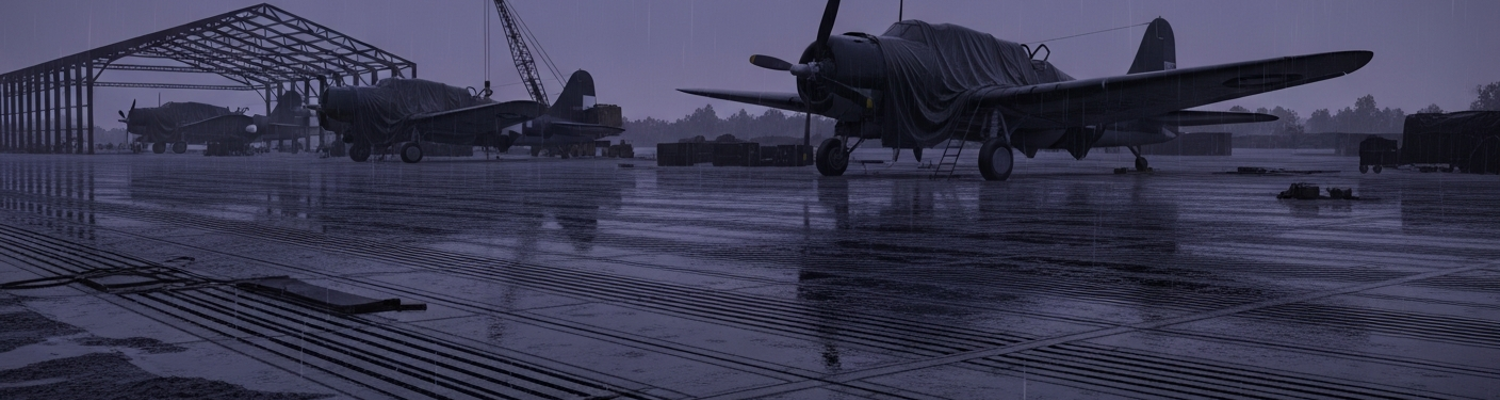

The Dual Threat at Mangaldan
The American advance into the Philippines in 1945 forced Engineer Aviation Battalions into an environment of punishing extremes. Following the Lingayen Gulf landings of January 1945, units such as the 8th Fighter Control Squadron were tasked with establishing critical airfields. At sites like Mangaldan on Luzon, they faced a landscape defined by monsoon rains that turned volcanic soil into a thick morass capable of swallowing construction equipment. This was followed by periods of oppressive, humid heat that pushed men and machines to their breaking points.
It was in these conditions that self-contained construction units, typically numbering around 800 men, were ordered to carve operational airfields from the ravaged landscape. The ground they inherited was not simply difficult terrain. It was seeded with the lethal remnants of the fighting that had just passed. Before a single perforated steel plank could be laid for a runway or a foundation dug for a barracks, the ground had to be cleared of a deadly, indiscriminate harvest of unexploded ordnance (UXO).
An examination of operational logs from the Pacific theater reveals that clearing captured airfields was a dual-pronged problem, involving both Allied and Japanese munitions. Fields like Mangaldan, and later Moret Field in Zamboanga on Mindanao, were littered with the products of failed detonation. American ordnance, often dropped from high altitude, had a significant dud rate. Post-war studies indicated that over 12 percent of U.S. bombs failed to explode due to reasons ranging from damaged tail fins causing the bomb to tumble, to simple mechanical failures of the fuze. This meant Engineer Aviation Battalions like the 1892nd were tasked with locating and removing their own side’s hazardous materials alongside those of the enemy.
At Moret Field, historical footage from July 1945 (NARA Record Group 111-ADC-4652) shows graders and Filipino laborers building airstrips amidst the wreckage of Japanese aircraft, a visual of the overlapping dangers. The process was painstaking. It required methodical sweeps of areas designated for runways, hardstands, and supply dumps. Each signal from a primitive SCR-625 metal detector or a probe striking a solid object required a halt in all nearby work, turning the rapid pace of airfield construction into a stuttering, nerve-wracking process.
The specific challenges posed by different types of UXO were extensive. Japanese ordnance presented a notorious set of problems. Many of their bombs, from the 15kg Type 92 high-explosive bomb to larger variants, were filled with picric acid, known to the Japanese as Shimose powder. While a powerful explosive, picric acid had a dangerous characteristic. Over time, or when in contact with metal casings, it could form highly unstable and shock-sensitive picrate crystals. A bomb that had been inert for weeks could become exquisitely sensitive to the slightest disturbance, a lethal trap for any bomb disposal team. Allied ordnance, while generally more stable, had its own issues. A 500lb general-purpose bomb that had failed to detonate on impact could have a damaged or partially armed fuze, its internal mechanisms left in a precarious state. White phosphorus rounds, if unearthed, could reignite on contact with the air. Retreating Japanese forces were also known to booby-trap their own duds, adding another layer of complexity and danger for the disposal teams who had to assume every item was designed to kill them.
This pervasive threat of unexploded ordnance directly dictated the operational tempo of the air war in the Philippines. A single suspected UXO near a runway could halt all flight operations, grounding fighter groups like the 35th and 58th at Mangaldan or the bombers of the 312th Bombardment Group. These delays created bottlenecks in the supply chain of men, munitions, and materiel flowing to the front lines. The psychological toll on personnel was substantial. Men in bomb disposal units faced extraordinary stress, while pilots and ground crews lived with the knowledge that the ground beneath their feet could erupt at any moment. The work of the Engineer Aviation Battalions was therefore an essential act of combat logistics, as vital to the success of the island-hopping campaign as the air superiority missions themselves. The speed at which they could locate, identify, and neutralize these buried threats directly translated into the speed at which Allied air power could be brought to bear on the enemy.
EOD Equipment and Field Expedients
A review of operational logs from the Pacific theater shows a severe disconnect between the intended outfitting of Explosive Ordnance Disposal (EOD) units and the gear they actually carried into the field. The vast distances and strained supply lines of the island-hopping campaign meant that specialized EOD equipment was a low priority against the unending demand for ammunition, fuel, and rations. While formal training established protocols for a range of tools, many units arrived at locations like Luzon or Zamboanga with little more than standard engineer toolkits.
Critical items were frequently unavailable.
Non-sparking brass wrenches, essential for safely manipulating fuzes without creating an ignition source, were a rarity. Technicians resorted to common steel tools, acutely aware that a single slip or friction spark could detonate the ordnance they were attempting to render safe. Protective equipment was even more scarce. The heavy, layered bomb suits of later conflicts were nonexistent. Protection, if any, often consisted of a standard M1 steel helmet and flak jacket, offering negligible defense against the blast and fragmentation of a high-explosive bomb. Portable X-ray systems to inspect the internal state of a fuze were exceptionally rare, forcing teams to rely on stethoscopes to listen for the ticking of a clockwork mechanism or to make a tactile, blind assessment based on experience alone.
This lack of specialized gear forced a near-total reliance on improvised methods. Archival evidence shows that units became masters of innovation born from necessity. Lacking remote-handling equipment, teams fashioned grappling hooks from rebar and attached them to long lengths of rope or cable. This allowed them to drag bombs away from critical infrastructure like runways or fuel dumps before attempting to disarm them. It was a crude but effective way to gain distance. For particularly stubborn ordnance, or items deemed too hazardous to approach, some units developed a technique of firing at the fuze from a safe distance with a high-powered rifle. A more complex and perilous procedure was the steam-out method, sometimes known as the "K-Method," reserved for bombs filled with TNT. This involved technicians carefully drilling a hole into the bomb’s casing and feeding in a hose that pumped high-pressure steam, melting the explosive filler until it could be washed out. The process was fraught with danger. A miscalculation in drilling could hit the fuze, and if the bomb was filled with picric acid instead of TNT, the heat could form hyper-sensitive crystals and cause a catastrophic detonation.
The formal EOD training, first established at the Naval Gun Factory in Washington, D.C., and later at the American University campus, took place in a controlled, academic environment. Technicians learned from pristine diagrams, cutaway models, and intact examples of German and Japanese ordnance on clean tables. They memorized the intricate schematics of electrical fuzes and the precise steps for neutralization under ideal conditions. The battlefields of the Pacific presented a violent contrast to this structured learning. A technician trained on a perfect schematic of a Japanese tail fuze was now confronted with a mud-caked, rusted, and bent device on a bomb half-buried in a swamp. The impact of its fall could have damaged the internal clockwork or armed an anti-handling feature, a possibility the training diagrams could never fully capture. Retreating Japanese forces added another layer of lethality, frequently booby-trapping their own dud-fired bombs. The most important skill for an EOD technician was not the rote memorization of procedures learned stateside, but the ability to assess a unique and hostile situation and improvise a solution under the immense pressure of getting an airfield back into the fight.
The Collapse of the Marine Air Supply Chain
Operational logs from Marine Aircraft Groups operating in the Philippines during 1945 reveal a logistical system stretched to its breaking point. For units like MAG-12 and MAG-32, tasked with providing close air support for Army divisions on Luzon and later Mindanao, the primary obstacle was often the immense Pacific Ocean itself. The 7,000-mile supply line from the United States was fragile, overburdened, and subject to a complex and often inefficient priority system.
Ships arrived at hastily constructed ports like those in the Lingayen Gulf or at Zamboanga, but the specific materiel needed to sustain high-tempo air operations was frequently missing. This created a systemic bottleneck where entire air groups, positioned to support major ground offensives, were hamstrung by a simple lack of supplies that were either sitting in a depot on the US West Coast, assigned to a lower shipping priority, or lost in the vast administrative machinery of the war.
The most acute deficiency was in aircraft spare parts. This shortage directly impacted the combat availability of the F4U Corsair. Ground crews for squadrons under MAG-12 and MAG-14 on Leyte and Samar became masters of cannibalization. The powerful but complex Pratt & Whitney R-2800 Double Wasp engine was a maintenance nightmare in the primitive, humid conditions of the Philippines. Items with a short operational life, such as spark plugs, magnetos, and tires, were in perpetual short supply. The lack of these seemingly minor components could ground an otherwise perfectly functional fighter. It was common for a squadron to have only a third of its assigned aircraft flyable at any given time. Maintenance crews would strip parts from one damaged airframe to get another into the air, creating a fleet of "hangar queens" that served as unofficial spare parts depots. This practice, while keeping some aircraft operational, steadily degraded the overall strength of the air group, turning flight-line maintenance into a zero-sum game.
Supply failures extended disastrously into munitions. Crates of 500-pound bombs were plentiful, but the nose and tail fuzes required to arm them were not. This created the absurd situation of airfields piled high with inert ordnance while planned strikes were cancelled or drastically scaled back. A similar crisis affected the 5-inch High Velocity Aircraft Rocket (HVAR), a devastatingly effective weapon against Japanese fortifications and armor. Marine Corsair pilots were trained extensively in their use, but squadrons in the Philippines often found their stores empty. An examination of after-action reports shows that mission loadouts were frequently dictated by whatever ordnance was available, not what was tactically optimal. This directly impacted the support provided to Army units on the ground, who had come to depend on the precision firepower of Marine aviation. The same fractured supply chain that failed to deliver rocket fuzes also failed to deliver specialized EOD equipment, creating a vicious cycle where UXO-contaminated airfields could not be cleared quickly, thus delaying the arrival of aircraft that, even if they did land, lacked the proper ordnance to be effective.
Operational tempo was governed more by the arrival of a supply ship than by enemy action. For groups like MAGSZAM (Marine Aircraft Group, Zamboanga), operational readiness was a daily calculation based on fuel levels, parts availability, and ordnance stores. Command decisions revolved around conservation. Pilots were instructed to avoid maneuvers that put undue stress on engines, not for safety, but because a blown cylinder could not be replaced. Sorties were planned around the number of fuzes on hand, not the number of available aircraft. The strategic objectives of the larger campaign, which relied on overwhelming air power to isolate and destroy Japanese garrisons, were consistently undermined by the mundane, grinding failure to get the right equipment to the right place at the right time.
VMSB-341 and Operational Improvisation
Marine Scout Bombing Squadron 341 (VMSB-341), the "Torrid Turtles," had an operational history in the Philippines defined by a persistent battle against its own supply chain. Deployed to support U.S. Army ground operations on Luzon and later Mindanao in 1945, the squadron found that the 7,000-mile logistical tether to the United States was a more immediate and debilitating foe than the Japanese forces they were tasked to engage. Arriving at hastily constructed airfields like Mangaldan and later Moret Field in Zamboanga, the unit was confronted with the systemic failure of the sprawling wartime bureaucracy to deliver the specific equipment needed to prosecute the air war. This disconnect between strategic intent and logistical execution placed extreme limitations on VMSB-341, forcing a near-total reliance on improvisation.
The squadron’s reliance on field-expedient solutions for aircraft maintenance was constant. The unit’s Douglas SBD-5 Dauntless dive bombers, while famously rugged, were not immune to the punishing tropical environment and the strain of combat operations. Ground crews for VMSB-341 became experts in cannibalization, a practice born of necessity due to a chronic shortage of high-turnover spare parts. The Wright R-1820 Cyclone engines demanded frequent replacement of spark plugs and magnetos that were simply not available in sufficient quantities. Tires, shredded by primitive runways made of steel matting or crushed coral, were another critical point of failure. Archival records indicate it was common for maintenance crews to strip functional parts, hydraulics, landing gear assemblies, instruments, from one damaged SBD to make another airframe flyable. This created a flight line populated by "hangar queens," airframes that served as unofficial and ever-dwindling spare parts lockers. This zero-sum game of maintenance steadily reduced the squadron’s overall combat power, regardless of pilot availability.
This was a war fought on maintenance logs.
The correlation between these supply failures and reduced sortie rates is undeniable. An air squadron’s combat effectiveness is measured by its ability to put armed aircraft over a target. For VMSB-341, this capability was often crippled not by enemy anti-aircraft fire, but by a missing crate of AN-M103 tail fuzes or a lack of engine gaskets. After-action reports from Marine Air Groups in the Philippines repeatedly show planned strikes being cancelled or their size drastically reduced because the available bombs could not be armed. The squadron might have a dozen flyable SBDs ready on the hardstand, but if the fuzes for their 500-pound bombs had been offloaded at a different port or were sitting in a depot with a lower shipping priority, those aircraft were useless for their primary mission. This forced pilots to fly missions with whatever ordnance happened to be available, not what was tactically required for the target, directly impacting the quality of close air support provided to Army units on the ground. The operational tempo of VMSB-341 was therefore governed by the arrival of a supply ship, not by tactical demand.
Improvisation became standard operating procedure. The most acute shortages were often in the smallest components. Without the correct nose and tail fuze assemblies, a 500-pound general-purpose bomb was just dead weight. Faced with piles of inert bombs and urgent requests for air support from embattled Army units, ordnance crews from VMSB-341 and its parent group, MAG-24, were forced to innovate. This involved modifying available fuzes meant for other types of ordnance to fit the bombs they had on hand, a technically complex and hazardous undertaking. Such field modifications required manually altering arming vanes and timing mechanisms, often with rudimentary tools, turning every bomb-loading operation into a dangerous experiment.
Documenting the Unseen War
Archival photography from the Pacific theater reveals a narrative often at odds with the intended story of heroic progress. The U.S. Army Signal Corps deployed hundreds of combat cameramen across the Pacific, including units like the 161st Signal Photographic Company, which served on Leyte and Luzon. Their official purpose was to document military activities for use in newspapers, magazines, and films back home. Civilian correspondents from magazines like LIFE and Yank were embedded with frontline units, with photographers like W. Eugene Smith and Ralph Morse capturing some of the war’s most recognizable images aboard aircraft carriers and during amphibious landings.
They produced iconic shots of combat. Their lenses also captured a more persistent, unglamorous struggle. An examination of the full contact sheets and uncurated photo collections (housed at the National Archives) shows a different war. There are countless frames dedicated to the mundane: ground crews wrestling with engines in the mud, soldiers hauling supply crates through torrential rain, and bulldozers sinking in the muck of a half-constructed airfield. These images, less dramatic than an exploding kamikaze, were not the ones that typically made headlines. They documented the true friction of the campaign, where the environment and the tyranny of distance were constant adversaries.
The photographic record provides visual proof of the equipment shortages that plagued ground crews and ordnance teams. At rear-area airfields across the Philippines, the struggle to keep aircraft flying was relentless. Images show flight lines where mechanics are stripping parts from one F4U Corsair or SBD Dauntless to get another operational, a practice known as cannibalization that created entire boneyards of "hangar queens." The problem was a systemic failure to get the right parts to the right place at the right time across a 7,000-mile supply line. Operational logs confirm what the photos suggest: a chronic lack of basic, high-turnover components like spark plugs, magnetos, and tires for the maintenance-heavy Pratt & Whitney R-2800 engines. The same supply paralysis crippled Explosive Ordnance Disposal teams. EOD personnel, tasked with clearing captured airfields of Japanese bombs and American duds, often worked without specialized non-sparking toolkits, relying instead on standard steel wrenches that could create a fatal spark. Protective equipment was virtually nonexistent, and remote-handling gear was a rarity, forcing teams to use improvised methods like dragging bombs with ropes and hooks.
Imagery and after-action reports from airfields on Leyte and Luzon reveal the direct cost of these logistical failures on air operations. Photographers documented fields piled high with bombs that could not be used because the specific nose and tail fuzes required to arm them were missing, lost somewhere in the vast, paper-driven bureaucracy of the supply system. A squadron might have a dozen flyable aircraft, but without armed ordnance, they were useless for supporting ground troops. Mission reports from Marine Air Groups frequently note that strike packages were cancelled or sortie loads were determined not by tactical need, but by whatever munitions and fuzes happened to be available. The result was a significant degradation of air support for Army units engaged in heavy fighting. The visual evidence, when paired with unit records, shows an air campaign often throttled not by the enemy, but by its own internal logistics.
The Psychological Cost of Logistics
Medical and operational records from the Pacific theater indicate that the psychological toll on ground personnel was a significant, if underreported, aspect of the air war. For the men of the Engineer Aviation Battalions and their attached Explosive Ordnance Disposal teams, the enemy was not an opposing soldier but the ground itself, along with the unrelenting pressure of their duties. The condition known then as "combat fatigue" or "combat exhaustion" was not limited to frontline infantry. It manifested in men who never fired a shot in anger but were subjected to prolonged periods of high stress, deprivation, and visceral danger.
EOD technicians, working on captured airfields like Moret Field or Mangaldan, lived in a state of extreme hypervigilance. Each signal from a mine detector, each scrape of a shovel on a hard object, triggered a physiological fight-or-flight response. Repeating this process dozens of times a day, for months on end, led to a specific form of psychological erosion. Medical reports from the era describe symptoms among rear-echelon troops that included severe anxiety, tremors, amnesia, and an acute sensitivity to sharp noises. All were classic indicators of combat exhaustion.
This was not a war of dramatic dogfights.
The daily existence for ground support personnel in the Philippines was one of grueling, repetitive, and unglamorous labor. The work of an aviation engineer, mechanic, or ordnance handler lacked the perceived glory of combat roles, yet it was carried out under the constant threat of sudden, violent death. A typical day involved heavy manual labor in oppressive tropical heat and humidity, wrestling with steel matting for runways, hauling fuel drums, or performing complex engine maintenance in primitive, open-air conditions. This work was frequently interrupted by the discovery of unexploded ordnance, forcing a complete halt and creating a climate of perpetual tension. The men were acutely aware that a moment of carelessness, a dropped tool on a bomb casing, a bulldozer blade digging too deep, could result in catastrophe for them and their comrades. This combination of monotonous, physically draining work and the ever-present, indiscriminate threat of UXO created a unique and corrosive form of stress, far removed from the public perception of the war effort.
Morale was a direct casualty of this environment. The constant, low-level fear of unexploded ordnance was compounded by the frustrations born from a failing supply chain. A close analysis of unit logs from Marine Air Groups in the Philippines shows that it was common for airfields to be stocked with vast quantities of bombs but no fuzes to arm them, or to have a flight line of grounded F4U Corsairs for want of basic spare parts like tires or magnetos. For the ground crews and ordnance teams working relentlessly to get aircraft in the air, this systemic failure was profoundly demoralizing. It created a sense of futility, where their hazardous and exhausting work was rendered meaningless by bureaucratic inefficiency thousands of miles away. This feeling was magnified when requests for close air support from embattled Army units had to be denied not due to enemy action, but because of a missing crate of components. The psychological impact was severe, fostering a cynical environment where the primary adversary often seemed to be their own logistics system. The U.S. military recognized that every soldier had a breaking point, and for many ground personnel in the Pacific, that point was brought closer not just by the bombs buried in the dirt, but by the knowledge that their ability to fight the war was being crippled from within.