
A review of operational logs from the American VIII Corps in early December 1944 reveals a military force conditioned by a specific set of doctrinal assumptions. The logistical theory underpinning the American advance was codified in texts like Field Manual 100-10, Administration. It presupposed a war fought over a robust, modern road network. Planners built their models on the experience in France, where the "Red Ball Express" could push enormous quantities of materiel forward to divisions advancing at speed. This system was entirely dependent on high-capacity, paved road surfaces and predictable weather. American communications doctrine, detailed in FM 24-5, Signal Communication, operated on a similar premise. It relied heavily on the rapid laying of telephone wire, specifically the robust quarter-ton spiral-four cables, to connect command posts. For mobile units, the doctrine called for the use of short-range FM radios like the SCR-300 backpack unit and the vehicular SCR-508. The entire communications architecture was built for an environment where signal battalions could work unimpeded, laying physical lines behind a fast-moving front. It assumed clear lines of sight for radio transmissions and that vehicle-mounted relay stations could be positioned on high ground with ease. In the dense, rugged terrain of the Schnee Eifel, these assumptions disintegrated. The limited road network, composed of narrow, winding tracks, immediately became choked with traffic. Ice and mud made roads impassable, severing supply chains. Telephone wire laid by signal companies of the 2nd, 28th, and 106th Infantry Divisions was constantly cut by artillery, tank treads, or simply buried under snow, isolating units completely. The forest canopy and steep, rolling hills absorbed radio waves, rendering company-to-battalion communication intermittent at best and often impossible.
The gap between field manual theory and the physical conditions of the Ardennes winter was profound. The US Army’s official guidance on cold-weather operations was academic, written by staff officers who had never fought in sub-zero temperatures under artillery fire. A soldier’s primary defense against the cold was the M-1943 field uniform, a layered system that was effective when dry. Most troops, however, were still issued older M-1941 jackets or simple wool overcoats which, once wet, offered almost no insulation. The standard-issue leather service boot was a catastrophic failure. It was not waterproof, and the constant exposure to snow, mud, and freezing water led to thousands of cases of trench foot, incapacitating soldiers as effectively as any weapon. Archival evidence shows that mechanical systems failed at an alarming rate. Standard gun oil and vehicle lubricants thickened into sludge, causing the actions of Browning Automatic Rifles and M1 Garands to seize. Starting a Sherman tank or a 2.5-ton truck required herculean efforts, as batteries lost up to 50% of their cranking power in the cold. Antifreeze was a critically scarce commodity, forcing crews to run their vehicle engines for hours at a time to prevent the blocks from cracking, consuming precious fuel. While manuals offered textbook solutions, like keeping weapons clean and storing batteries in warm places, they provided no context for executing these tasks in a shallow foxhole, with numb fingers, while shells were landing a hundred meters away. The simple act of digging that foxhole in the frozen, rock-hard earth could take an entire squad hours of punishing labor.
This specific unpreparedness for winter combat was a symptom of a much larger institutional miscalculation. The American command structure, from Eisenhower’s SHAEF down to the divisional level, had embraced the belief that the German Army was effectively broken. The Ardennes sector was designated a quiet zone. It became a proving ground for green units fresh from the United States, like the 99th and 106th Infantry Divisions, and a rest area for combat-weary formations like the 28th Infantry Division, which had been savaged in the Hürtgen Forest. The 106th, for example, was deployed with its 27,000 inexperienced soldiers holding a 27-mile front, a line density that violated every principle of defensive doctrine. Intelligence assessments systematically downplayed German capabilities. Reports of significant Panzer and Volksgrenadier formations assembling opposite the VIII Corps front were received, yet they were interpreted by 12th Army Group intelligence as evidence of a small-scale, localized counterattack at best, or a defensive realignment. The focus of the entire Allied command was offensive, aimed north of the Ardennes toward the Roer River dams. The strategic reserve, including potent armored divisions like the 7th and 10th, was positioned to exploit that planned offensive, not to counter a German assault in the south. The German attack on December 16th did not just strike unprepared divisions; it struck an unprepared command philosophy.
The German offensive’s immediate success was a logistical decapitation. A close review of operational logs shows the armored spearhead of Kampfgruppe Peiper of the 1st SS Panzer Division functioning as a scalpel, intentionally severing the supply arteries that sustained the American VIII Corps. On December 17th, Peiper, already behind schedule and burning fuel at a high rate, deviated from his assigned route specifically to seize a US Army fuel depot in Büllingen. His tanks rolled into the depot area with near-empty fuel cells and, using captured American troops as labor, refueled directly from the vast stores intended for the American front. This single act deprived forward units of thousands of gallons of gasoline. The speed of the German advance through the Losheim Gap and across routes thought impassable created widespread panic in the rear echelon. Supply convoys moving west from the major depots at Spa and Liège were ambushed or forced to jettison their cargo and flee. The entire Red Ball Express-style system, predicated on secure road networks, broke down in hours.
This collapse at the strategic level translated almost instantly into critical shortages at the foxhole level. Armored infantry units and tank battalions found themselves immobilized not by enemy action, but by empty fuel tanks. A Sherman tank without gasoline became a fixed steel pillbox, its offensive power entirely negated. A review of unit records from the 7th and 10th Armored Divisions reveals combat commands unable to maneuver against German penetrations due to a complete lack of fuel. The effect on artillery was just as severe. Batteries of 105mm M2A1 howitzers, the backbone of divisional fire support, were quickly starved of shells. Brigade and division-level artillery commanders issued strict fire-discipline orders, reducing shell allocations to as few as ten rounds per gun and permitting fire only on observed, massed enemy formations. This rationing of firepower had a direct and deadly consequence for the infantry of the 28th and 106th Infantry Divisions, who were left to face Panzer and Volksgrenadier assaults without the overwhelming artillery support that had become a central tenet of American combined arms doctrine.
With roads cut and surrounded units like the 101st Airborne Division at Bastogne facing annihilation, the US Army turned to its only remaining option: large-scale, ad-hoc airborne resupply. Beginning on December 23rd, once a brief break in the severe winter weather allowed for flight, the IX Troop Carrier Command initiated a massive airlift. Flying unarmored C-47 Skytrain transport aircraft, often without fighter escort and at low altitudes, pilots faced intense German flak from the units ringing the besieged town. Over five days, hundreds of sorties were flown, dropping more than 1,000 tons of supplies into the Bastogne perimeter. The drops were a desperate measure. Bundles containing ammunition, K-rations, medical supplies, and gasoline were pushed out on parachutes. The most urgent need was for artillery ammunition, particularly 105mm shells, which were difficult to package for air-dropping. The success rate for these drops was estimated at over 90 percent, a testament to the pathfinder teams on the ground who used radar beacons to guide the transports. Some drops inevitably went astray, delivering their precious cargo directly into German hands. Gliders were also used to bring in surgical teams and larger equipment. This aerial lifeline was just enough to allow the defenders of Bastogne to hold out until ground-based relief forces could break the encirclement.
A close examination of vehicle maintenance logs from December 1944 (NARA Record Group 407) reveals a failure point rooted in basic chemistry. The standard lubricants and oils issued to American units were rated for temperate climates. In the sub-zero temperatures of the Ardennes, these fluids underwent a fatal transformation. Standard-issue gun oil, intended to keep the actions of M1 Garands and Browning Automatic Rifles cycling, thickened into a viscous sludge. This caused bolts to seize and operating rods to jam, turning semi-automatic weapons into single-shot clubs in the middle of a firefight. The problem was magnified inside the engine blocks and transmissions of the Army's mechanized fleet. The heavy-grade oil in a Sherman tank's crankcase could congeal to the consistency of molasses, making it nearly impossible for the starter motor to turn the engine over. Antifreeze was a scarce commodity, often prioritized for medical and command vehicles. This left the crews of tanks, trucks, and half-tracks with a devastating choice: risk a cracked engine block from frozen coolant, or leave the engines running around the clock. Most chose the latter. This decision burned through astronomical quantities of gasoline, consuming fuel not for tactical movement but simply to prevent mechanical self-destruction.
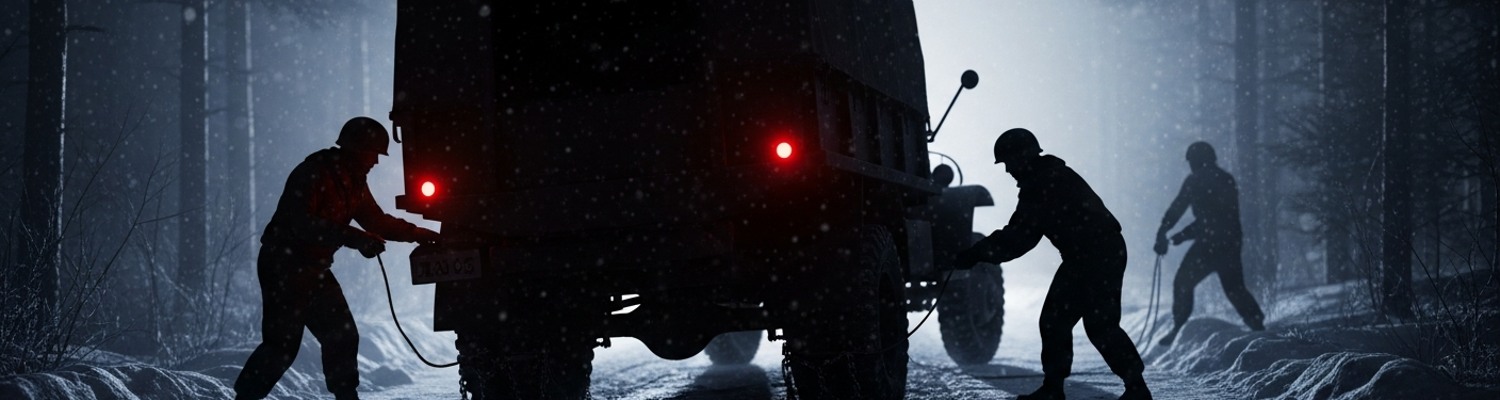
This widespread mechanical paralysis was not just a supply issue; it was a systemic failure in winterization protocols. Field manuals offered scant practical guidance for preparing vehicles to operate in extreme cold. Archival evidence shows an almost complete absence of the specialized equipment needed to counter the effects of the plunging temperatures. There were no engine block heaters to keep oil fluid, no insulating wraps to protect batteries from the cold that robbed them of up to 50 percent of their cranking power. The desperate, ad-hoc solutions employed by GIs were often dangerous and ineffective. Maintenance crews used blowtorches to heat frozen oil pans, a practice that risked igniting fuel vapors and destroying the vehicle. Starting a 2.5-ton truck often required linking several vehicles together with slave cables to pool enough battery power for a single start attempt. The operational logs of Combat Command B of the 10th Armored Division, as it raced toward Bastogne, show that its combat effectiveness was degraded not by enemy contact, but by the sheer number of vehicles that could not be started after a frigid overnight halt.
The fundamental design of the US Army's transport fleet proved wholly inadequate for the terrain and weather. The entire logistical network, from the massive depots in Liège to the forward supply dumps, depended on the GMC CCKW 2.5-ton truck. This 6x6 vehicle was a masterpiece of mass production designed for the highways of France, not the ice-choked forest tracks of the Schnee Eifel. Its standard military-tread tires offered little to no traction on ice or in deep snow. A review of First Army engineering reports from the period highlights a near-total lack of essential snow-clearing equipment. There were not enough snowplows or road graders to keep even the main supply routes open. Tire chains, the most basic tool for ice driving, were in critically short supply. The consequences were immediate and paralyzing. A single stalled or jack-knifed truck on a narrow, winding road could halt an entire convoy for hours, creating a miles-long target for German artillery. The absence of sufficient numbers of specialized, fully-tracked transport vehicles like the M29 Weasel meant there was often no way to get supplies off the impassable roads and to the frontline foxholes. This forced infantrymen to become beasts of burden, man-hauling every crate of ammunition and canister of water up frozen, exposed hillsides because the world's most mechanized army had been defeated by a few inches of snow.
An analysis of after-action reports from Signal Corps units attached to VIII Corps reveals a failure of radio communications, driven by a triad of environmental, procedural, and enemy-inflicted pressures. The primary point of failure was rooted in the basic chemistry of the power sources for frontline radios like the SCR-300 'walkie-talkie' and the smaller SCR-536 'handie-talkie.' These units relied on zinc-carbon dry cell batteries, principally the BA-70 and BA-80 models. The electrochemical reaction that generates power in these batteries slows dramatically in sub-zero temperatures. A battery pack like the BA-70, rated for 20-25 hours of operation in temperate conditions, could be rendered useless in as little as three or four hours. This extreme reduction in battery life meant that units which expected to have communications for a full day were often silenced shortly after dawn. GIs attempted to mitigate this by keeping spare batteries inside their field jackets, using body heat to keep them viable, but this was an impractical solution for a soldier in a foxhole under artillery fire. The supply of these batteries, already a high-priority item, could not keep pace with the accelerated consumption rate, effectively turning a 35-pound SCR-300 backpack radio into dead weight.
This chemical failure was compounded by the chaos of constant unit displacement. For the infantry companies of the 28th and 106th Infantry Divisions, which bore the initial shock of the German assault, command posts were forced into a series of rapid, disorganized retreats. Each move required signalmen to tear down and re-establish their antennas, a difficult task in the frozen, rock-hard ground and snow-laden forests. The dense woods and steep, rolling hills severely attenuated the signals of the low-power FM radios, making line-of-sight communication almost impossible to achieve. The rapid retreats wrecked the integrity of the Signal Operation Instructions (SOI), the schedule of frequency changes designed to maintain security. A battalion command post, forced to move, might miss a scheduled frequency change. Its subordinate companies, with their short-lived batteries, would then be unable to find the new command net frequency, leaving them completely isolated. This procedural breakdown, layered on top of the physical limitations of the hardware, meant that entire regiments, such as the 422nd and 423rd of the 106th Division, were left to fight and ultimately surrender with almost no functional communication with higher headquarters.
The final, decisive element in this communications collapse was a sophisticated German electronic warfare effort. A review of both American and German military records shows that the Wehrmacht deployed specialized radio intercept and jamming units, known as Funkstörkompanien, with their attacking formations. These units were highly proficient at tactical signals intelligence. They would identify the primary command and fire-control frequencies used by American units and target them with powerful jamming transmitters. The inexperienced radio operators of the 106th Infantry Division found their networks completely overwhelmed by these broadcasts, which often manifested as a piercing squeal or grinding static that made voice communication impossible. While more veteran operators, such as those in the 9th Armored Division, were sometimes able to copy messages through the jamming, it severely slowed the pace of command. The Germans also practiced a form of signal deception, intercepting American transmissions and then rebroadcasting them to create confusion or lure units into ambushes. This combination of jamming and deception proved particularly devastating to the American command structure around St. Vith, where commanders were left effectively blind and unable to coordinate a coherent defense.
Intelligence summaries from the autumn of 1944 reveal an Allied command structure gripped by a powerful confirmation bias. Data indicating a massive German buildup opposite the Ardennes was not absent; it was misinterpreted. At General Omar Bradley’s 12th Army Group headquarters, the prevailing belief was that the German Army was shattered and incapable of a large-scale offensive. This mindset conditioned the analysis of all incoming information. Reports from the 849th Signal Intelligence Service detailing the movement of armored divisions behind the front, intercepts identifying the new Sixth Panzer Army, and accounts from prisoners of war were consistently viewed through a lens of defensive preparation. The intelligence G-2 for the First Army, Colonel Benjamin "Monk" Dickson, was one of a few officers who correctly assessed the enemy’s capability and intent to strike the VIII Corps sector, but his warnings were largely dismissed by higher echelons. These accurate predictions were seen as outlier assessments that contradicted the accepted strategic picture. The consensus at SHAEF and 12th Army Group was that any German troop movement was either a realignment to counter planned Allied attacks north of the Ardennes or, at most, preparation for a small spoiling attack. The 28th and 106th Infantry Divisions received no specific warning of an imminent, theater-level offensive, leaving them psychologically and tactically unprepared for the assault on December 16th.
When the German artillery barrage opened at 0530, it initiated a breakdown in the American command and control cycle. The initial reports that trickled into regimental and divisional command posts were fragmentary and chaotic, describing intense shelling and localized infantry probes. At VIII Corps headquarters in Bastogne, the initial picture was one of uncoordinated enemy activity. For hours, corps commander General Troy Middleton and his staff could not grasp the scale of the offensive. The physical distance between headquarters and the front, compounded by the immediate severing of communication lines, created an information vacuum. It took until mid-morning for it to become clear to commanders like Major General Alan Jones of the 106th Division that they faced a full-scale armored assault, and even longer for this reality to be accepted at the corps and army level. This chronological lag between event and decision was fatal. The critical window to authorize a tactical withdrawal of the 422nd and 423rd Infantry Regiments, dangerously exposed in the Schnee Eifel salient, slammed shut. By the time the orders were finally issued, German spearheads were already closing the trap behind them.
Command reverted to the 19th century. The first casualty of the opening German artillery barrage was the intricate web of telephone wires that connected the front lines to battalion and regimental command posts. Signal Corps linemen had painstakingly laid thousands of miles of W-110-B assault wire, a simple twisted-pair copper-and-steel cable. This thin wire was laid directly on the frozen ground or loosely strung between trees, making it exceptionally vulnerable. The massive weight of German artillery fire shredded these lines in minutes, isolating nearly every forward observation post and rifle company. Signalmen sent out to find and repair the breaks under continuous shelling faced a suicidal mission. A review of the 28th Infantry Division’s records shows that in the vital road junction of Marnach, the defending battalion was completely cut off from its regiment within two hours of the attack’s start. This collapse of physical infrastructure forced a desperate reliance on messengers. Jeep drivers and runners on foot became the sole means of transmitting orders and intelligence between command posts. These men had to navigate a battlespace that was rapidly disintegrating, running a gauntlet of artillery, infiltrated German patrols, and roads clogged with burning or retreating vehicles. An order issued from a divisional headquarters was based on a tactical picture that was already hopelessly obsolete by the time it reached a frontline company commander.
The German offensive inflicted thousands of shrapnel and bullet wounds, but it was the combination of record-low temperatures and systemic unpreparedness that generated a secondary mass casualty event. A review of VIII Corps medical records (from late 1944 into early 1945) shows a spike in non-battle injuries, primarily trench foot, frostbite, and hypothermia. The number of American soldiers incapacitated by exposure to the cold during the winter of 1944-45 is estimated to be as high as 71,000 across the European theater. This was the direct result of a logistical and doctrinal failure to provide front-line troops with the proper equipment to survive one of the coldest European winters in recorded history. The standard-issue leather service boot and wool socks, when subjected to the constant wet and freezing conditions of a foxhole, became a liability, trapping moisture and accelerating tissue damage. The resulting epidemic of trench foot, a condition where flesh dies from prolonged exposure to cold and wet, non-freezing temperatures, was immense. It was a tactical disaster, removing tens of thousands of riflemen from the line as effectively as enemy action.
This wave of cold injuries crashed into a medical support system that was already reeling. Battalion aid stations and clearing companies, the first links in the chain of evacuation, were completely overwhelmed. These small, mobile units were designed to stabilize battlefield trauma cases, not to manage a flood of non-battle injuries that required specialized, long-term care. A facility like the 77th Evacuation Hospital, with a normal capacity for 750 patients, found itself handling twice that number during the battle. The sheer volume of casualties created surgical backlogs that sometimes exceeded 300 patients. Compounding the crisis, the rapid German advance overran or forced the hasty evacuation of several key medical installations. The few remaining medics set up makeshift aid stations in any available structure, working with rapidly dwindling supplies under constant artillery fire. The cold itself became an enemy inside the hospitals; blood plasma froze solid in its containers, and morphine syrettes failed to function, complicating every procedure.
The primary instrument of casualty movement, the Dodge WC-54 3/4-ton ambulance, proved mechanically unfit for the terrain and weather. These vehicles, designed for the road networks of France, were equipped with standard military-tread tires that offered almost no traction on the ice-choked forest tracks. The resulting paralysis was absolute. A single ambulance, sliding off a narrow, winding road or becoming bogged down in deep snow, could halt an entire evacuation convoy for hours, creating a static, vulnerable target for German artillery. With tire chains in short supply, ambulance drivers were often left with no choice but to abandon their vehicles. This forced a primitive regression in medical transport. Medics and walking wounded had to man-haul litter cases for miles through deep snow and freezing temperatures, a physically punishing task that exponentially increased the time between injury and surgical intervention. Some enterprising medics fashioned crude sleds to more easily drag the wounded over the snow, but for many casualties lying unattended in the open, a delay of even 30 minutes in the arctic conditions could be fatal.
The evacuation system was also under direct and constant fire. The speed of the German advance meant that medical facilities, which doctrine placed in supposedly safe rear areas, were suddenly on the front line or behind enemy lines. A devastating blow came on December 19, when a German armored column overran the main clearing station of the 101st Airborne Division, capturing the 326th Airborne Medical Company near Bastogne. This single action resulted in the capture of 11 officers and 119 enlisted medical personnel, gutting the division’s organic medical capability just as casualties began to peak. Ambulance drivers faced a gauntlet on every trip. The thin sheet-metal construction of the WC-54 offered no protection from shrapnel or small arms fire, and though the vehicles were marked with large red crosses, they were frequently targeted. The American medical system was unprepared for the sheer volume and specific nature of cold-weather injuries. Medical personnel trained to treat trauma from bullets and shrapnel had little to no experience managing the long-term, specialized care required for thousands of frostbite and trench foot cases. These casualties, who were combat-ineffective but required extensive resources, flooded an evacuation system already choked with the wounded. For the thousands of wounded and freezing men in the Ardennes, the gap between the medical care they needed and what the system could provide was often the difference between life and death.