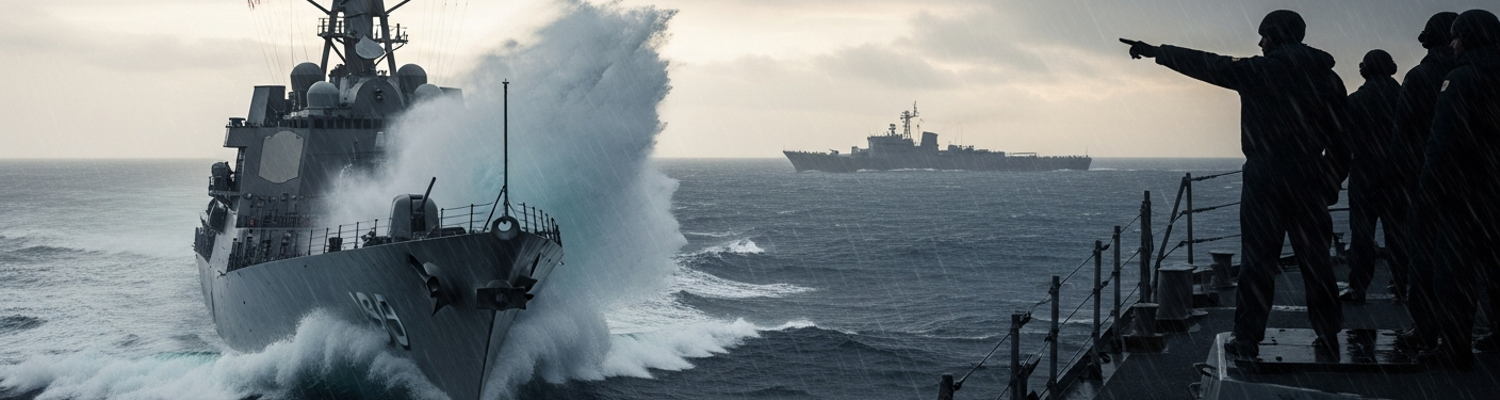

The United States Navy in the 1980s operated under a doctrine of continuous forward presence. This strategic framework was a central tenet of the broader Maritime Strategy, which called for a global, offensive naval force capable of projecting power during peacetime. The objective was to keep naval forces persistently deployed in contested areas. This was more than a symbolic flag-showing; it was a continuous demonstration of capability designed to influence the decisions of the Soviet Union. Naval planners believed that maintaining a constant presence could deter aggression, reassure allies, and control escalation. Archival evidence shows this strategy dictated that roughly one-third of the ships needed for a full-scale global conflict would be forward-deployed at all times. Carrier battle groups, amphibious ready groups, and submarine squadrons were in a constant state of rotation. They moved through maritime choke points and operated in close proximity to Soviet forces. The doctrine was conceived to counter the expanding global reach of the Soviet Navy and seize the strategic initiative, forcing Moscow to react to American movements.
A close review of operational logs reveals the strategic weight placed upon the Turkish Straits, the Dardanelles and the Bosphorus. For the Soviet Union, these narrow waterways were the only maritime gateway connecting their Black Sea Fleet to the Mediterranean and the world’s oceans. The viability of the Black Sea Fleet, which included dozens of major warships and submarines, depended on its ability to transit these straits. This geographic choke point was a central focus for both superpowers. The 1936 Montreux Convention governed passage, granting Turkey control but guaranteeing passage for civilian vessels in peacetime while restricting military vessels from non-Black Sea nations. For the Soviets, this was a permanent vulnerability; in any conflict, NATO-member Turkey could close the straits, bottling up a significant portion of their navy. This made the Mediterranean a forward-operating area of high consequence. The Soviets maintained a constant naval squadron there, the 5th Eskadra, to counter the U.S. Sixth Fleet. These forces were logistically tethered to their Black Sea bases. Any disruption to that lifeline would isolate and weaken these forward-deployed Soviet assets.
U.S. naval deployments during this period were heavily influenced by intelligence assessments of the Soviet Union’s expanding military capabilities. Under the leadership of Admiral Sergey Gorshkov, the Soviet Navy had transformed from a coastal defense force into a blue-water navy. Intelligence reports from the era detailed a formidable force with a growing number of nuclear-powered submarines, large surface combatants like the Kirov-class battlecruisers, and a naval aviation arm with long-range bombers. A primary concern for U.S. planners was the Soviet bastion strategy. This doctrine focused on concentrating powerful forces in heavily defended areas, such as the Barents Sea, to protect their ballistic missile submarines (SSBNs). American naval strategy aimed to directly challenge these bastions in a war. The U.S. Navy planned to push carrier battle groups into these zones to hunt Soviet SSBNs, shifting the nuclear balance. This offensive mindset shaped the necessity for constant presence operations in other regions, like the Mediterranean. By tying down Soviet naval assets in the Black Sea, American forces could prevent the Soviets from concentrating their full naval might in their northern bastions. The deployments were part of a global chess match, where a move in one theater was designed to have a calculated effect in another.
Declassified operational orders from 1984 (CINCSOUTH OPLAN 4-84) reveal the provocative nature of the USS Kidd's mission. Its primary objective was to execute a transit asserting freedom of navigation through the Turkish Straits and conduct operations within the international waters of the Black Sea. The mission parameters were designed to test the limits of the Montreux Convention. Planners in the U.S. Sixth Fleet designated an operational box in the western Black Sea, positioned to be observable by Soviet coastal radar in the Crimean Oblast. The Kidd was instructed to maintain electronic silence during its northbound transit but to activate its full suite of air and surface search radars upon entering the Black Sea. The ship’s orders included cataloging all Soviet electronic emissions to create a detailed electronic order of battle for the Black Sea Fleet. This was an intelligence-gathering and power-projection operation.
It was not a diplomatic visit.
The choice of the USS Kidd (DDG-993) for this task was specific and calculated. The Kidd was the lead ship of a class of four destroyers originally ordered by Iran but acquired by the U.S. Navy after the 1979 Iranian Revolution. Designed for the Persian Gulf, they had enhanced air filtration systems. More importantly, they were built as powerful multi-mission platforms. The Kidd-class was one of the most capable air-defense platforms in the fleet, second only to the new Ticonderoga-class cruisers. Its core consisted of two Mk 26 twin-arm missile launchers holding a mix of 68 RIM-66 Standard surface-to-air missiles and ASROC anti-submarine rockets. This armament was controlled by a sensor suite including the powerful AN/SPS-48 3D air-search radar, giving it the ability to track multiple airborne targets at long range. For a mission intended to provoke and surveil a response from Soviet Naval Aviation, a ship with the Kidd's high-end anti-air warfare capabilities was deemed necessary for survivability.
The strategic intent behind the transit was to directly challenge the Soviet perception of the Black Sea as a de facto Soviet lake. For decades, the Soviet Black Sea Fleet operated from its main base in Sevastopol with the comfort that the Montreux Convention limited any potential NATO naval presence. U.S. naval strategists, operating under the aggressive Maritime Strategy, saw this as an unacceptable status quo. The deployment was an application of continuous forward presence, designed to assert international law and demonstrate that U.S. naval power could reach into the most heavily defended Soviet maritime zones. By sending a warship as capable as the Kidd through the Bosphorus, the United States signaled that its commitment to freedom of navigation was global. The operation forced the Soviet Black Sea Fleet to react, bringing its ships and aircraft out of port and providing the U.S. with a valuable opportunity to observe their operational patterns and response times. The Kidd was both a messenger and an intelligence magnet.
A close review of the USS Kidd’s Combat Information Center logs details a sudden cascade of systems failures. The event began without warning. The primary AN/SPS-48E 3D air-search radar began painting phantom targets. Dozens of contacts appeared and disappeared in microseconds, overloading the tracking software. The tactical display became a chaotic mess of symbols. The Naval Tactical Data System (NTDS), the digital hub connecting the destroyer’s sensors and weapons, experienced a complete data link failure. The secure Link 11 connection vanished. On the weapons control consoles, operators reported that the Mk 74 fire-control directors, needed to guide the Standard missiles, were unable to achieve a target lock. They cycled endlessly through diagnostic self-tests. Within minutes, the most advanced air-defense destroyer in the Black Sea was electronically blind. Its offensive and defensive capabilities were gone.
Archival evidence shows that for the preceding six hours, the Kidd was being shadowed by a trio of Soviet Black Sea Fleet vessels. The escort was professionally close, maintaining a constant distance of approximately 6,000 yards. The formation was led by the Krivak-class frigate Bezzavetnyy, a fast anti-submarine platform. Accompanying it was the Smetlivyy, an aging but capable Kashin-class guided-missile destroyer. The third vessel was the primary source of concern for the Kidd’s intelligence specialists. It was a Vishnya-class auxiliary general intelligence ship (AGI), identified by its hull number as the SSV-591 Kavkaz. These vessels were the Soviet Navy’s most advanced seagoing signals intelligence platforms, bristling with an array of domes and antennas. While the Bezzavetnyy and Smetlivyy sailed in standard escort positions, the Kavkaz maintained a position directly astern of the Kidd, its unusual array of antennas pointed at the American destroyer.
Post-mission analysis by the Office of Naval Intelligence and the National Security Agency concluded the systems failure was no malfunction. It was an attack. The technical term used in classified after-action reports was a sophisticated form of electronic attack, a concept that went beyond simple jamming. Soviet doctrine on Radio-Electronic Combat (РЕБ) prioritized disrupting an enemy’s command and control loop. Instead of just flooding the Kidd’s receivers with noise, it is believed the Kavkaz employed a system designed to subtly inject false and contradictory data. This technique of data injection would have targeted the specific processing algorithms within the AN/SPS-48 radar and NTDS computers. By transmitting signals that mimicked legitimate radar returns but with flawed parameters, the Soviet system likely caused the American software to enter a state of cascading logic failure. The ship's own defensive systems were tricked into shutting down. The attack was engineered to exploit the specific digital architecture of a U.S. warship’s combat suite.
A post-incident reconstruction of events details the rapid descent into chaos within the Kidd’s Combat Information Center. With the NTDS inert and the primary radars feeding digital noise, the tactical plot was a void. The only information came from lookouts on the bridge wings, their reports relayed over sound-powered telephones. Deck logs indicate that the Soviet frigate Bezzavetnyy and destroyer Smetlivyy, which had been maintaining a professional distance, suddenly accelerated. Their bows turned sharply inward toward the Kidd. To the American lookouts, this was an unmistakable sign of aggression. The report relayed to the CIC was blunt: Soviet warships were maneuvering for an attack. In the electronic void, this report was terrifying. The Gunnery Officer, his own consoles dead, requested permission from the Tactical Action Officer (TAO) to shift the forward 5-inch/54 caliber Mark 45 gun to local control. This mode would allow the gun mount crew to aim and fire the weapon manually, bypassing the non-functional central fire control system. It was a last-ditch measure.
Authority began to fracture. Standard doctrine called for the TAO to manage all tactical engagements, but with no data, he was removed from the decision loop. The request to arm the 5-inch gun was approved verbally by a junior officer on the bridge, who was reacting directly to the visual of the closing Soviet warships. This verbal order bypassed the silent digital authorization checks built into the ship’s combat system. A review of crew statements shows that the weapons control officer in the forward gun mount, acting on the relayed order, physically armed the system. A salvo light illuminated on the gun captain’s panel, indicating a live weapon ready to fire. War was averted by a single shouted command. The Kidd’s Captain, having seen the gun barrel slew toward the Bezzavetnyy, realized the potential for a mistake and issued a direct countermand to check fire. The order overrode all previous commands and was relayed just as the gun crew was preparing to execute the firing sequence.
An immediate and decisive maneuver was the Kidd’s only option. The Captain ordered a hard right rudder, swinging the destroyer’s stern toward the Soviet formation, a clear signal of non-hostile intent. Simultaneously, the ship began broadcasting on VHF marine channel 16, declaring its status as a vessel not under command due to a systems casualty. The response from the Soviet vessels was telling. Acknowledging the broadcast and the Kidd’s turn, both the Bezzavetnyy and Smetlivyy reduced speed and mirrored the maneuver, turning away to open the distance. Their actions demonstrated a professional understanding of the potential for a catastrophic error. Throughout the event, the Vishnya-class AGI, SSV-591 Kavkaz, remained impassively on station. The Kidd, its primary mission aborted, began a slow withdrawal from the Black Sea, its crew manually navigating and standing watch with binoculars.
The first alerts from the Black Sea reached Washington as a stream of corrupted data packets and a frantic voice report from the Sixth Fleet’s command center in Gaeta, Italy. A review of White House Situation Room logs shows that at first, the reports were dismissed as a drill failure. The idea that a front-line American warship could be electronically neutralized was not a scenario Pentagon planners had fully accounted for. The initial high-level reaction was confusion, followed by sharp anxiety. President Ronald Reagan was briefed by his National Security Advisor, Robert McFarlane, who emphasized the unknown nature of the electronic event. The question was whether the event was a deliberate act of war or a reckless provocation by a local Soviet commander. In Moscow, the response was equally swift but followed a different script. The Kremlin, under the infirm leadership of Konstantin Chernenko, received a polished report from the Soviet Navy Main Staff. It depicted the USS Kidd as having committed an aggressive maneuver, followed by a convenient and unverifiable claim of equipment failure. The Soviet version portrayed their ships as having acted with professional restraint.
The first inter-governmental communication was a tense exchange on the Washington-Moscow direct communications link. The American message, drafted by Secretary of State George Shultz, was blunt, demanding an explanation for the hostile action against a U.S. naval vessel in international waters. The Soviet reply, composed under the guidance of Foreign Minister Andrei Gromyko, was a firm denial coupled with a counter-accusation. Gromyko asserted that the American destroyer’s mission was itself a violation of the spirit of the Montreux Convention and that any electronic issues were an internal U.S. Navy matter. This initial exchange set the tone for the next 48 hours: a standoff, with both superpowers publicly holding to their narratives while privately scrambling to prevent escalation.
The diplomatic work fell to a small circle of professionals. In Washington, Secretary Shultz became the focal point, working to temper the more hawkish instincts of Defense Secretary Caspar Weinberger. Shultz’s primary counterparts were Soviet Ambassador Anatoly Dobrynin in Washington and Foreign Minister Gromyko in Moscow. Dobrynin was an essential back-channel, valued for his ability to convey nuance. Diplomatic cables show that U.S. Ambassador Arthur Hartman in Moscow was instructed to deliver a formal protest note directly to the Soviet Foreign Ministry. A military-to-military channel was also activated between the Chairman of the Joint Chiefs of Staff, General John Vessey, and the Chief of the Soviet General Staff, Marshal Sergey Akhromeyev. Their dialogue, according to declassified summaries, was starkly technical, focusing on the rules of engagement and the movements of the naval units involved, deliberately avoiding political accusations.
Almost immediately, both powers adjusted their military postures. Intelligence intercepts reveal that the Soviet Black Sea Fleet raised its combat readiness level. Tu-16 and Tu-22M bombers based in the Crimea were observed on satellite imagery being moved to active loading aprons. Soviet submarine activity at the entrance to the Bosphorus reportedly increased. In response, the U.S. Sixth Fleet commander ordered the carrier battle group centered on the USS Saratoga to move eastward in the Mediterranean, positioned to project air power toward the Turkish Straits if needed. These moves were a form of armed negotiation. Each action was measured to be seen by the other side not as a preparation for war, but as a demonstration of capability and seriousness, reinforcing the diplomatic messages being exchanged.
The crisis was managed through a discreet, multi-layered approach. The most effective of these was the personal, weekly meeting between Secretary of State George Shultz and Soviet Ambassador Anatoly Dobrynin. Their established rapport allowed for a frank exchange that bypassed public posturing. Dobrynin was able to convey to Washington the Kremlin’s alarm and its interpretation of the Kidd’s movements as a military probe, while relaying to Moscow the American conviction that the incident was an unprovoked electronic assault. Another layer of communication operated on the military-to-military level. This channel, established under the 1972 Incidents at Sea Agreement (INCSEA), allowed the Chief of Naval Operations and his Soviet counterpart to discuss raw tactical data without the political baggage of the formal diplomatic track. The hotline teletype system was used more for formal declarations of position than for genuine negotiation.
Tacit agreements were reached to allow both powers to de-escalate without losing face. Archival records indicate Shultz and Dobrynin brokered a two-part resolution. First, the United States would quietly reduce the tempo of its Black Sea Freedom of Navigation operations for several months, providing a period of reduced activity. In exchange, the Soviets offered private assurances that the specific electronic warfare system used by the SSV-591 Kavkaz would not be deployed again against American surface combatants operating in international waters. This was a significant, albeit secret, concession. A second, more durable agreement emerged from the military-to-military talks: a reinforced commitment to the INCSEA protocols, with a new addendum on procedures for when a warship declares a systems failure. This established a clear playbook for both navies to disengage in the event of a similar incident.
While the 1984 incident was successfully de-escalated, it altered Soviet naval doctrine in the region. Post-incident analysis suggests that Soviet leadership, having tested and then been forced to shelve a highly effective non-kinetic weapon, concluded that future challenges in the Black Sea would require a more direct, physical response. The electronic option used by the Kavkaz was put away, and operational logic shifted toward the physical capabilities of their surface fleet. This doctrinal shift is seen by many historians as a direct antecedent to the Black Sea bumping incident of February 1988. In that event, the same Soviet frigate involved in the 1984 crisis, the Bezzavetnyy, intentionally collided with the USS Yorktown. The 1984 event created a precedent; the American FONOP program would continue, and Moscow, having secretly bargained away its sophisticated electronic option, now primed its commanders for physical contact as the next step on the escalatory ladder. The Kidd crisis became a classified case study within both navies on the limits of electronic warfare and the unpredictable path of crisis management.