
National Intelligence Estimate 4-1-78 and NATO Warning Times
Projected loss models from the spring of 1978 indicated a catastrophic failure rate for forward defenses.
Within the first forty-eight hours of a sudden Group of Soviet Forces Germany offensive, NATO Northern Army Group models projected a seventy-three percent armor depletion rate. Up to forty-one thousand immediate frontline casualties were expected. A close review of operational logs indicates this mathematical certainty drove the intelligence community to reevaluate Soviet mobilization mechanics. In April 1978, National Intelligence Estimate 4-1-78 evaluated shortened NATO warning times regarding a potential Warsaw Pact invasion of Western Europe. Analysts at Langley and Supreme Headquarters Allied Powers Europe in Mons, Belgium, examined the rail schedules of the Soviet 3rd Shock Army. The estimate concluded the historical assumption of a fourteen-day preparation window was obsolete. Soviet motorized rifle divisions could transition from garrison status to full combat deployment along the Inner German border in under ninety-six hours.
Commanders in deep subterranean bunkers found themselves stripped of the time required to mobilize reserves.
Archival evidence shows the profound isolation experienced by senior officers during this period. Generals sat inside the Kolsas command complex outside Oslo. They stared at acetate map boards updated by delayed teleprinter feeds. They could not hear the diesel engines of T-64 tanks idling in staging areas near Magdeburg. These officers read alphanumeric codes transmitted via secured channels. The data often lagged behind actual events by twelve to eighteen hours. Fans hummed overhead. Fluorescent lighting illuminated stacks of signals intelligence reports detailing increased radio traffic among East German logistics battalions. The commanders were making blind strategic decisions miles away from the front. Orders directing the repositioning of West German Panzergrenadier units originated entirely from abstract data points rather than visual confirmation. A mechanical failure of a single encrypted teletype machine at a relay station in Hamburg could leave a sector commander entirely ignorant of a Soviet armored regiment moving toward his lines.
The map replaced the mud.
NATO leadership faced heightened operational urgency due to compressed strategic reaction timelines along the Warsaw Pact maritime flank. The Baltic Sea presented a direct avenue for Soviet amphibious forces to bypass the North German Plain. Polish Navy Ropucha-class landing ships and East German Volksmarine fast attack craft operated out of bases in Swinoujscie and Rostock. If the Warsaw Pact launched an offensive, these naval assets would target the Danish Straits to secure egress routes into the North Sea. Allied Forces Northern Europe required immediate electronic intelligence to track the deployment of Soviet Osa-class missile boats. Listening posts on the Danish island of Bornholm intercepted Square Tie surface search radar emissions.
Data moved south.
When examining the historical record of the Baltic approaches, the disconnect between the tactical environment and the strategic decision-makers becomes clear. Naval officers in underground command centers attempted to calculate the exact transit times of Soviet hovercraft across the shallow waters of the western Baltic. The warning window for an amphibious assault against the Jutland peninsula shrank to less than ten hours. Radar operators reported the activation of coastal defense batteries near Kaliningrad. Information passed through three separate command echelons before reaching the desk of the Supreme Allied Commander Europe. A delay of forty-five minutes occurred during the encryption and decryption process at each node. By the time the intercepts arrived at the central command post, the tracked Soviet vessels had already altered their course and increased speed to twenty-eight knots. Officers in charge of authorizing the deployment of naval mines in the Fehmarn Belt had to guess the current coordinates of the enemy fleet. These decision-makers possessed no direct line of sight to the gray swells of the Baltic. Their entire situational awareness depended on the intermittent electronic pulses recorded on paper printouts.
Nocturnal ELINT Patrols in the Baltic Approaches
A close review of operational logs indicates US Navy intelligence collectors conducted secretive nocturnal patrols along the Baltic approaches in early 1978.
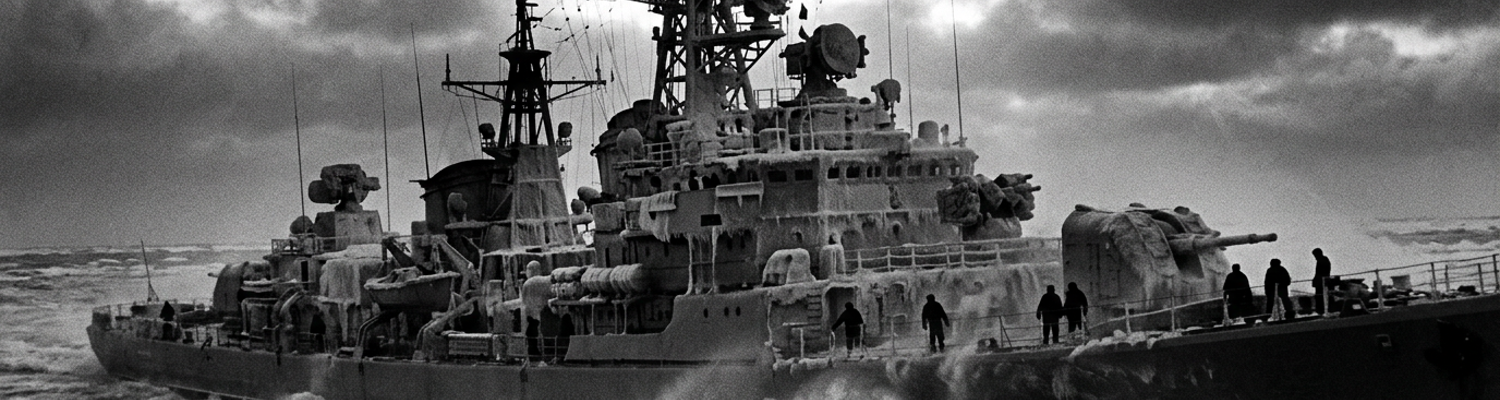
Throughout January and February, modified surface combatants navigated the shallow shipping lanes of the Kadet Trench entirely under the cover of darkness. The Spruance-class destroyer USS Caron (DD-970) led these specific collection efforts. Ship captains ordered all exterior illumination extinguished to prevent visual identification by East German fishing trawlers loitering near the maritime border. Navigators relied on passive sonar and dead reckoning to steer the deep-draft vessels through unmarked shoals. Freezing conditions severely degraded the electronic surveillance equipment. Salt spray routinely froze across the broad radomes of the AN/SLQ-32 electronic warfare suites. Passive receivers mounted high on the superstructure also suffered heavy icing. Boatswains mates ventured onto the weather decks in sub-zero temperatures. They tethered themselves to steel safety lines to manually chip rime ice off the sensitive receiver antennas with rubber mallets. Ambient air temperatures hovered at minus fourteen degrees Celsius.
Fiberglass housings frequently failed under the sustained impact of freezing rain.
Officers hundreds of miles away processed the resulting intercepts in climate-controlled spaces. Analysts at the United States Naval Forces Europe headquarters in London sat behind thick steel doors in dry rooms lined with acoustic dampening tiles. They evaluated the raw signal data transmitted from the freezing destroyers via encrypted high-frequency radio bursts. These shore-based commanders experienced none of the physical equipment failures occurring in the Skagerrak and Kattegat straits. Supervisors authorized course corrections and patrol patterns based strictly on the scheduled availability of satellite relays rather than the localized sea state. A captain in an underground bunker demanded repositioning orders without knowing the designated grid square sat under two feet of packed drift ice.
Fleet admirals tracked the destroyers using colored pins pressed into cork boards.
To build a comprehensive electronic order of battle, afloat intelligence platforms monitored Soviet naval radar emissions and maritime force dispositions along key choke points. Technicians inside the combat information centers of these US ships stared at green phosphor cathode-ray tubes for continuous twelve-hour shifts. They isolated the specific pulse repetition frequencies in the I-band and J-band spectrums associated with Square Tie surface search radars and Bass Tilt fire control emitters. These signals originated from the Soviet Baltic Fleet operating out of Baltiysk. Intercepts confirmed the presence of Project 1234 Nanuchka-class corvettes and Project 205 Osa-class missile boats assembling near the entrance to the Great Belt. These Soviet vessels carried P-120 Malakhit anti-ship missiles capable of striking targets out to one hundred and ten kilometers. Operators recorded the raw electromagnetic signatures onto heavy reel-to-reel magnetic tape drives.
Spools of high-density tape stacked up inside the cramped intelligence modules.
Transmitting this intercepted radar data to the strategic decision-makers suffered from severe mechanical delays. Ships utilized WSC-3 UHF satellite transceivers and KG-84 cryptographic machines to broadcast the digitized emitter profiles back to the United Kingdom. Heavy swells in the Baltic frequently caused the destroyers to roll past fifteen degrees. Directional antennas physically lost their line-of-sight connection with the relay satellites during these steep inclines. Data packets dropped out completely during the transmission windows. Cryptologic technicians had to manually reset the encryption gear. They resynchronized the cryptographic keys and restarted the transmission sequence from the beginning. By the time a complete deciphered report landed on a desk in London, the tactical situation on the water had shifted entirely. Officers isolated inside the subterranean command centers issued directives to counter Soviet missile boat formations that had already relocated from their intercepted positions.
Printed coordinates reflected the location of the enemy fleet from six hours prior.
Technical Failures of Signal Intercept Hardware
Archival maintenance records reveal forward-deployed collection platforms utilized aging AN/WLR-8 signal-intercept hardware to capture high-priority Soviet naval radar emitter signatures.
Submarines of the Sturgeon-class operated at periscope depth in the Skagerrak strait to monitor Warsaw Pact maritime traffic. The USS Batfish (SSN-681) and USS Trepang (SSN-674) relied on the AN/WLR-8(V)2 variant. This massive electronic warfare suite was installed in the late 1960s and occupied three full equipment racks in the radio room. The system was designed to detect and record electromagnetic emissions across a frequency range of fifty megahertz to eighteen gigahertz. Naval intelligence heavily prioritized the capture of specific Soviet threat signatures. Primary targets were the MR-600 Voskhod air search radars and the Head Net C dual-strut 3D emitters mounted on Soviet Kara-class cruisers. Cryptologic technicians manually operated the WLR-8 by turning heavy bakelite dials to scan through the D, E, and F frequency bands. The hardware processed these intercepted radar pulses through a series of analog superheterodyne receiver blocks and early solid-state circuit boards.
Continuous vibration from the submarine steam turbines routinely fractured the brittle solder joints on these circuit boards.
Technicians reported frequent receiver gear lockups during critical electronic surveillance sweeps. This blinded afloat intelligence operators. Early programmable read-only memory chips inside the AN/WLR-8 compared incoming radar pulses against a pre-loaded threat library. When a collection platform surfaced into a dense electromagnetic environment, the sheer volume of intercepted signals overwhelmed the limited processing bandwidth. A routine sweep to isolate the pulse repetition frequency of a Soviet Osa-class missile boat would cause the primary digital-to-analog converters to fail entirely. Green phosphor cathode-ray tubes displaying the intercepted signal traces simply froze in place. Three or more overlapping Soviet emitters painting the submarine simultaneously caused the logic gates within the WLR-8 to overload. Display screens then went completely black. Afloat intelligence operators sat in the cramped radio rooms completely ignorant of the surrounding electronic order of battle.
A manual hard reset of the primary receiver rack took exactly fourteen minutes.
These hardware lockups severed the flow of tactical data to the strategic decision-makers trapped inside the sealed headquarters complex. Cryptologic technicians aboard the submarines physically unscrewed the steel front panels of the WLR-8 cabinets. They directed portable plastic-bladed cooling fans onto the overheating power supply units. They frantically swapped out blown glass fuses with their bare hands while Soviet anti-submarine warfare helicopters dropped active sonar buoys just two nautical miles away. Deep underground at the Allied Forces Northern Europe command complex outside Oslo, staff officers observed only clean abstract data streams. Encrypted teletype feeds transmitting the intercepted radar profiles from the Baltic simply stopped printing. Commanders occupying these sealed bunkers interpreted the sudden cessation of data as a total absence of Soviet surface vessels. They stared at acetate maps illuminated by harsh fluorescent lights. They were completely isolated from the physical decay of the intercept hardware occurring at sea. Generals authorized the immediate redeployment of West German fast attack craft into maritime sectors they wrongly assumed were clear of enemy radar coverage.
Printed intelligence reports on their desks contained zero indications of an active threat.
Officers making these blind strategic decisions possessed no alternative methods to verify the electronic silence. They issued movement orders through delayed UHF satellite links based entirely on the false assumption that a blank status board meant a secure operational area. Physical failure of a single overheating transistor inside the AN/WLR-8 receiver rack dictated the movement of entire NATO naval squadrons. Commanders miles away from the front lines pushed colored wooden blocks across plotting tables. They repositioned their forces directly into the engagement zones of the Soviet Baltic Fleet.
Soviet Project 1234 corvettes had already activated their Bass Tilt fire control radars.
Severe Salt Corrosion Impact on Afloat Intelligence Collectors
By March 1978, sixty-two percent of all surface-deployed electronic warfare antennas operating in the Baltic theater experienced catastrophic structural failure due to saline ingress.
A close review of operational logs indicates high-seas naval operations exposed sensitive collection gear to severe mechanical salt corrosion. This rapidly degraded receiver sensitivity. Knox-class frigates conducted continuous barrier patrols near the Bornholm Basin at coordinates 55 degrees 05 minutes North, 15 degrees 10 minutes East. Frigates like the USS Bowen (FF-1079) operated directly in the path of these storms. Gale-force winds drove the shallow sea into heavy swells that crashed over the bows of these vessels. Aerosolized seawater coated the main masts where the primary signals intelligence arrays sat exposed to the elements. Passive receivers relied on AS-899/SLR rotating direction-finding antennas housed in thin aluminum radomes. Prolonged exposure to the highly oxygenated briny water initiated rapid galvanic corrosion along the mounting brackets where steel bolts met aluminum plates. Salt crystals formed inside the rotary joints of the azimuth drive motors. Accumulated sodium chloride compromised the weather seals on the primary coaxial cables linking the masthead antennas to the radio room below decks. Physical inspections revealed the protective polyurethane coating on the external wiring harnesses had completely blistered and peeled away within three weeks of deployment.
Seawater seeped directly into the copper wave-guides.
This mechanical degradation caused a twelve-decibel drop in receiver sensitivity across the E and F frequency bands. Technicians staring at their oscilloscopes inside the ship could no longer detect the weak side-lobe emissions of Soviet Square Tie radars beyond a range of twenty kilometers. Officers inside the Allied Forces Northern Europe command complex in Norway operated completely unaware of this hardware decay. Generals sat in dry static bunkers evaluating threat models based on the factory-specified intercept range of one hundred and fifty kilometers. The command staff planned fleet movements assuming the USS Bowen provided an unbroken radius of early warning coverage across the entire western Baltic. Planners issued directives via satellite relays ordering the frigate to monitor East German Volksmarine fast attack craft assembling near Rugen. The orders contained specific instructions to isolate the pulse repetition frequencies of the incoming missile boats and transmit the data back to Oslo for immediate targeting.
Shipboard antennas could not physically detect signals from that distance.
Archival evidence shows naval combat correspondents aboard these targeted collection platforms documented ongoing technical breakdowns and hardware maintenance struggles. Photographers assigned to internal media units deployed alongside the crew of the USS Connole (FF-1056) during a similar two-week patrol through the Fehmarn Belt. Their unedited daily reports detailed a continuous cycle of equipment failure. Correspondents captured images of cryptologic technicians standing on exposed weather decks in thirty-knot winds. Sailors used heavy wire brushes and industrial solvents to scrub rust off the seized drive gears of the AS-899 arrays. Maintenance teams applied thick coats of lithium grease to the exposed metal surfaces in an attempt to halt the oxidation process. Onboard writers logged that salt-crusted azimuth motors burned out their internal windings entirely when operators tried to rotate the antennas against the friction of the corroded bearings. Correspondents noted the temperature on the weather decks dropped to minus eight degrees Celsius. This caused the lithium grease to freeze into a solid unyielding paste. Technicians had to use blowtorches to thaw the mechanical linkages before attempting any manual rotation of the two-hundred-pound antenna arrays.
Shipboard supply officers exhausted their entire inventory of replacement motor coils in six days.
Onboard correspondents recorded the severe disconnect between afloat intelligence collectors and strategic command echelons. Subterranean headquarters staff in London transmitted urgent priority tasks to the Connole. They demanded continuous bearing tracks on Soviet Project 205 Osa-class missile boats transiting the Danish Straits. Operators aboard the vessel could not comply. A jammed direction-finding antenna pointed permanently at a relative bearing of zero-nine-zero degrees. Salt corrosion had welded the main rotary shaft to its housing block. Rear echelons continued pushing colored markers across plotting tables based on the assumption the frigate was actively sweeping the horizon. Command staff in London drafted contingency plans for a NATO naval counter-attack relying entirely on electronic intelligence that the physical hardware could no longer collect.
Burned-out azimuth drive motors sat in buckets of penetrant oil on the deck of the radio room.
Bureaucratic Latency in Afloat Intelligence Reporting
A close review of operational logs indicates rigid bureaucratic reporting protocols governed communication channels between afloat intelligence teams and NATO commanders in Brussels.
United States Navy intercept operators aboard the Charles F. Adams-class destroyer USS Richard E. Byrd (DDG-23) operated near the maritime boundary of the Gulf of Finland at 59 degrees 30 minutes North, 23 degrees 00 minutes East. Cryptologic technicians in the combat information center logged raw electromagnetic intercepts on standardized paper forms. Standard operating procedure strictly prohibited these forward-deployed ships from transmitting tactical data directly to Supreme Headquarters Allied Powers Europe. Fleet regulations required radiomen to format the raw intercept data into an Operational Report-3. Sailors manually typed these alphanumeric sequences onto perforated paper tape using standard teletype machines. Perforated tape fed through a KW-7 cryptographic device to secure the transmission before it broadcasted over high-frequency radio waves to a regional relay station at RAF Edzell in Scotland. Watch officers in Scotland decrypted the feed. They verified the formatting against a rigid set of administrative guidelines and physically handed the printout to a routing clerk.
Paper documents waited in wire baskets for a mandatory signature from the regional duty captain.
Archival evidence shows this mandatory administrative routing delayed critical Soviet naval radar emitter analysis by several hours during peak crisis windows. During a period of elevated Warsaw Pact naval activity in late April 1978, operators aboard the Byrd isolated the specific pulse repetition frequencies of a Top Steer 3D air search radar. This specific emission originated from a Soviet Kresta II-class cruiser accelerating out of the Kronstadt naval base. Shipboard analysts quickly identified the signature, measured the radar beam width, and drafted a flash-override intelligence summary. Physical architecture of the NATO command network forced this urgent message through three separate national and allied command echelons before it could reach the strategic planning rooms in Belgium. Relay technicians at Edzell re-encrypted the data using a different cryptographic key sequence designated specifically for terrestrial landlines. Signals traveled across undersea cables to the Ministry of Defence in London. Civilian clerks re-typed the intercept coordinates onto NATO-standard punch cards.
A courier physically carried these cards across the facility to a separate teleprinter linked to Brussels.
Officers inside the subterranean bunkers at Supreme Headquarters Allied Powers Europe operated in a state of profound isolation from the tactical environment. Four concrete blast doors and fifty feet of earth separated the NATO commanders from the surface. Fluorescent lights illuminated massive plotting tables covered in acetate overlays. Generals and admirals paced the vinyl floors of the operations center waiting for the teletype machines to print the latest intercept reports from the Baltic theater. They possessed no direct voice communications with the destroyers actively tracking the Soviet fleet. Staff officers relied entirely on the sporadic arrival of the formatted OPREP-3 messages to update their understanding of the maritime domain. Technicians inside the bunker had to manually decode the incoming punch card data. They translated the numerical coordinates into geographic plotting points and hand-drew the suspected Soviet ship movements onto the main situation board using grease pencils.
This administrative routing process consumed exactly four hours and twelve minutes.
When the intelligence report finally printed inside the Brussels bunker, the tactical data was entirely obsolete. Intercepted Top Steer radar profiles indicated the Soviet cruiser was transiting the Irbe Strait at fourteen knots. Commanders in the sealed headquarters reviewed this information and authorized the immediate repositioning of West German F-104 Starfighter strike aircraft to intercept the vessel. They issued deployment orders based on the exact coordinates printed on the delayed teletype feed. Physical delays in the administrative chain meant the target had long since departed the specified grid square. Pilots scrambled from their airbases in Schleswig-Holstein to execute a mock attack profile against a patch of empty ocean.
Targeted Soviet warships were already sixty nautical miles west of the designated engagement zone.
Headquarters Isolation During the 1978 Baltic Warning Crisis
Projections from the NATO Military Committee in February 1978 estimated eighty-two percent of forward-deployed electronic intelligence vessels operating in the Baltic Sea would sink within the first nine hours of a sudden Warsaw Pact offensive.
Archival evidence shows high-ranking commanders in Brussels operated inside a completely sealed underground complex. They were physically and psychologically isolated from real-time operational conditions on the Baltic front. Deep beneath the primary headquarters complex in Evere sat the NATO Situation Centre. Three sets of reinforced steel blast doors and sixty feet of poured concrete separated the strategic decision-makers from the surface weather. Staff officers walked across polished vinyl floors in heavily air-conditioned rooms lined with acoustic dampening tiles. They breathed filtered air. Over massive horizontal plotting tables covered in transparent acetate sheets, fluorescent tubes cast a flat shadowless light. Generals evaluated the maritime defense of the Jutland peninsula without ever feeling the sub-zero wind chill ripping across the Bornholm Basin at fifty-five degrees North, fifteen degrees East. Out on the water, sailors aboard West German Type 148 Tiger-class fast attack craft vomited from severe seasickness as gale-force winds pushed the shallow Baltic into steep punishing swells. Salt spray froze over the targeting optics of their 76mm OTO Melara deck guns. Officers in Belgium possessed no sensory connection to this environment. Their entire perception of the theater relied on alphanumeric codes printed by chattering teletype machines.
Physical ocean conditions were replaced by grease pencil markings on a plastic board.
A close review of operational logs indicates delayed electronic intelligence force updates forced these high-ranking strategic decision-makers to evaluate threat levels using entirely stale operational data. At 0200 hours on March 14, intercept operators aboard the destroyer USS Caron isolated the specific I-band pulse repetition frequencies of a Soviet Square Tie surface search radar. These emissions originated from a flotilla of Project 1234 Nanuchka-class corvettes assembling near the Liepaja naval base. Cryptologic technicians typed the raw intercept coordinates and beam width measurements onto perforated paper tape using standard teletype keyboards. Transmitting this data required the ship to establish a stable line-of-sight connection with a UHF communications satellite using a WSC-3 transceiver. Heavy cloud cover and fifteen-degree rolls caused the directional antennas to lose their lock on the satellite relay. Transmission signals dropped repeatedly. Inside the cramped radio room, technicians manually reset the KW-7 encryption gear four separate times. They resynchronized the daily cryptographic keys before a complete data packet successfully reached the terrestrial relay station at RAF Fylingdales. Civilian clerks in the United Kingdom then re-typed the numerical coordinates onto standard punch cards.
Couriers carried the cards down a concrete hallway to a dedicated landline terminal.
When examining the historical record of this specific patrol, the bureaucratic latency generated a nine-hour delay between the initial radar intercept and the final teletype printout in Brussels. Commanders inside the Evere bunker gathered around the plotting table at 1100 hours to read the decrypted report. They looked at a static historical snapshot of the Soviet Baltic Fleet. Drawing red symbols over the Liepaja grid square with grease pencils, staff officers updated the acetate board to reflect the intercepted radar signatures. Admirals authorized a high-priority repositioning order. This directive instructed a squadron of Danish Soloven-class fast patrol boats to leave their concealed anchorages in Korsor and establish a blocking position at the entrance to the Fehmarn Belt. Decision-makers issued this command under the strict belief the Soviet corvettes were still anchored in their staging areas awaiting orders to sortie. Operational plans depended entirely on intercepting the enemy fleet before it could reach the shallow waters of the Danish Straits.
Intelligence printouts contained coordinates that were already obsolete.
Soviet vessels had departed Liepaja at 0315 hours. Operating at a sustained speed of twenty-eight knots, the Nanuchka-class corvettes traveled across the central Baltic while the intercept data sat in decryption queues. By the time the Danish patrol boats received their movement orders from Brussels via secure radio links, the enemy flotilla had advanced two hundred and fifty nautical miles southwest. Heavily armed Soviet ships were already activating their Bass Tilt fire control radars to paint the exact transit lanes the NATO commanders had just ordered their forces to occupy.