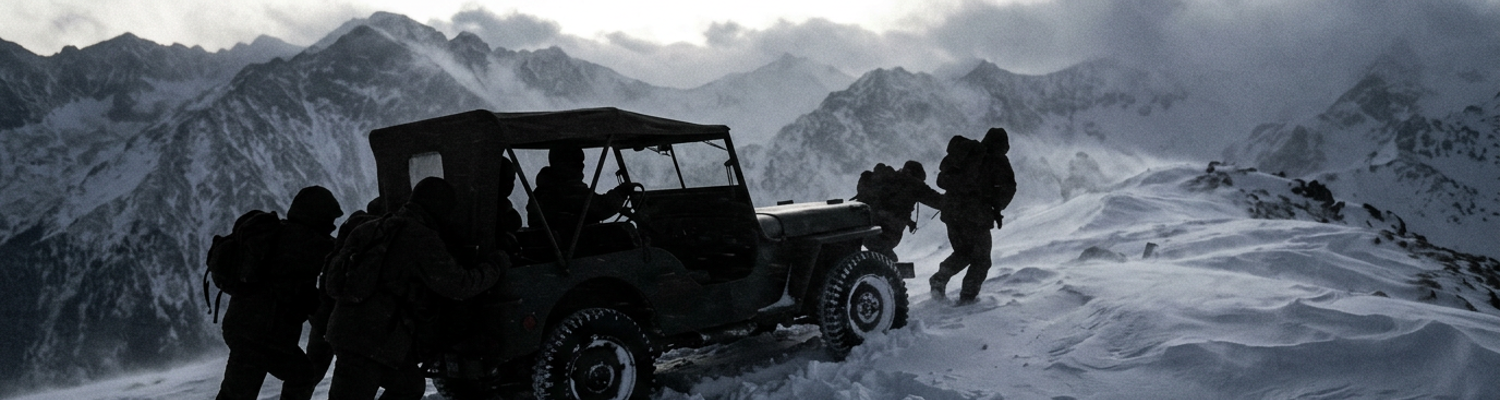

Eighth Army Alpine Sweeps in Nagano Prefecture
Private First Class Arthur Vance knelt in the freezing mud of a ridgeline in the Hida Mountains. He scraped wet soil from the copper grounding wire of his SCR-300 backpack radio. The unit needed a clear transmission vector. Reporting their position back to the regional control center was a strict requirement. Vance turned the frequency dial with numb fingers. Twisting the squelch knob filtered out heavy static. A violent crack echoed above him. A two-ton sheet of shale fractured from the overhang. The rockslide crushed the radio chassis. It severed the antenna array.
The patrol lost all transmission capability with the regional control center.
A close review of operational logs indicates that Eighth Army mountain detachments conducted highly structured sweep operations across Nagano Prefecture between June 1946 and October 1947. Commanders stationed in the Yokohama headquarters directed these patrols from behind mahogany desks. Grid coordinates arrived based on outdated Imperial Japanese Army topographic maps (Series L771, 1932 edition). The officers sat inside an isolated command center. Rapid progress through the Japanese Alps was expected. Detached elements of the 1st Cavalry Division marched through the densely forested Kamikochi valley. Specialized alpine engineering units scaled elevations exceeding nine thousand feet. The physical distance between the front line and the command echelon was only a few hundred miles. Terrain features made radio transmission impossible. High-frequency signals bounced off the granite faces of the Hida Mountains. The transmissions dissipated into static. Headquarters staff made uninformed strategic decisions regarding patrol routes. Real-time feedback from the squads navigating the steep inclines of Mount Hotaka never materialized. Generals reviewed weekly progress reports. These documents were already obsolete by the time couriers delivered them. Exhausted platoons received orders to push further into the Kiso Valley based on these outdated intelligence briefs.
Messages requesting supply drops took three days to reach the supply desk.
These isolated patrols systematically searched the remote terrain for hidden Imperial Japanese Army ordnance. Legal documentation was also a primary target. Retreating Japanese forces had utilized natural limestone caves. Abandoned mining tunnels scattered throughout Nagano Prefecture concealed military assets prior to the formal surrender. American infantrymen used heavy iron pry bars and pickaxes. Breaking open sealed cave entrances hidden behind dense pine thickets required hours of manual labor. Inside the damp caverns, search teams found wooden crates. These boxes contained cosmoline-coated Type 99 Arisaka rifles. Heavy machine gun tripods and disassembled Type 94 mountain guns filled the back of the caves. Unexploded ordnance lay stacked directly on the wet stone floors. This cache included volatile picric acid artillery shells. The search teams also recovered thousands of pages of sensitive legal documentation. Kempeitai field officers had buried conscription ledgers deep in the mountains. Regional unit rosters and execution orders were hidden to prevent the incoming occupation forces from finding them. Engineers cataloged decaying paper files. These records detailed prisoner of war transfers. Local civilian forced labor quotas and strategic fortification blueprints filled the ledgers. Ground-level troops carefully packed these damp documents into waterproof canvas bags (Stock No. 74-B-53). Hauling the heavy satchels down the steep mountain trails fell to the enlisted men.
Officers back in Yokohama filed these recovered ledgers into steel cabinets without ever seeing the caves.
The pressure radiating from the command center forced the mountain detachments to maintain an aggressive search pace. Failing equipment and severe physical exhaustion did not alter the schedule. Commanders demanded daily recovery quotas. Satisfying the administrative goals set by the Supreme Commander for the Allied Powers took priority over troop welfare. Staff officers tracked the progress of the Nagano sweeps using red grease pencils. Large acetate wall maps mounted in climate-controlled briefing rooms displayed the theoretical front line. Planners miles away ignored the mechanical wear on the M-1943 combat boots used by the patrols. Rubber soles degraded rapidly against the sharp igneous rock of the alpine ridges. A single squad operating near the Azusa River spent forty-eight hours digging out a buried cache. Extracting seventy-five millimeter high-explosive artillery shells required boots held together with salvaged copper communication wire. Detachment leaders submitted a written requisition form for replacement footwear. Supply clerks in Yokohama denied the request.
The rejection stemmed from a clerical error regarding the geographic designation code of the unit.
General Headquarters Demilitarization Quotas from Tokyo
Archival evidence shows that the Supreme Commander for the Allied Powers administered the occupation from the climate-controlled offices of the Dai-Ichi Life Insurance Building in central Tokyo. General Headquarters staff operating within this six-story granite structure issued rigid daily demilitarization quotas. Eighth Army detachments stationed hundreds of miles away in the Japanese Alps received these orders via teletype. Officers assigned to the G-3 Operations section calculated ordnance destruction targets. Mechanical adding machines and outdated pre-war industrial surveys provided the baseline data. Typewritten directives mandated the daily recovery of specific military assets. A standard daily quota required a single infantry company to locate four hundred Type 99 Arisaka rifles. Cataloging and destroying two tons of picric acid artillery shells was also mandatory. Planners in Tokyo routed these mandates through regional administrative hubs via secure networks. The directives arrived at the field command tents printed on standard carbon paper. Staff officers in the capital based their mathematical formulas entirely on flat-terrain models. Initial occupation of the Kanto Plain had generated these supply baselines. A linear progression of search grids was assumed. The Tokyo planners expected a standard motorized rifle platoon to clear a ten-square-mile sector every forty-eight hours. Bureaucrats tracked this theoretical progress by moving colored pins across large paper maps pinned to corkboards.
The daily mandate forced the 43rd Engineer Construction Battalion to process three tons of high explosives every twenty-four hours regardless of the physical environment.
Headquarters directives consistently ignored harsh alpine weather conditions. Mountain terrain constraints did not factor into the daily quotas. The Hida Mountains experienced severe meteorological shifts beginning in late October 1946. Atmospheric pressure dropped rapidly across Nagano Prefecture. Heavy snow squalls blanketed the Kamikochi valley in up to four feet of dense powder. Tokyo commanders continued to transmit the same flat-terrain quota requirements. The 27th Infantry Division elements operating at elevations exceeding eight thousand feet received these unchanged orders. The physical geography of Mount Hotaka featured forty-five-degree inclines. Loose shale and slick granite composed these slopes. Bureaucrats sitting at mahogany desks ordered motorized patrols to push Willys MB jeeps (1/4-ton 4x4) up narrow logging trails. Dodge WC-54 ambulances (3/4-ton 4x4) were commanded to traverse paths that had completely washed out during the autumn rains. Freezing temperatures caused the mechanical components of the field equipment to fail. The lubricating oil inside M1 Garand receiver assemblies thickened into a dense paste. Vehicle engine blocks cracked overnight when the mercury dropped below zero degrees Fahrenheit. General Headquarters refused to adjust the daily destruction targets to account for these environmental delays. Staff officers rejected field requests for specialized winter gear.
They denied requisitions for M-1944 shoepacs and heavy canvas parkas.
Cargo trucks received orders to traverse the completely snowbound Nomugi Pass to maintain the strict demilitarization schedule.
A close review of operational logs indicates the total disconnect between the Dai-Ichi building and the alpine squads resulted in severe operational breakdowns. In December 1946, G-3 Operations demanded the immediate excavation of an Imperial Japanese Army ammunition bunker. This site sat near the summit of Mount Yarigatake. The geographic coordinates placed the cache at an elevation of 10,400 feet. A blizzard had buried the entrance beneath six feet of compacted ice. A detachment from the 11th Airborne Division received the order to fulfill the daily quota. Extracting five hundred seventy-five-millimeter anti-aircraft rounds from the frozen cave was the primary objective. Soldiers spent fourteen hours hacking at the ice wall with standard-issue D-handle entrenching tools. Canvas field jackets absorbed the freezing moisture. The squad radio operator attempted to contact the regional command center. Requesting a forty-eight-hour extension due to the zero-visibility whiteout conditions was impossible. Sub-zero exposure completely drained the SCR-300 radio batteries. Infantrymen continued digging in the dark to meet the Tokyo mandate. Manual labor was required to haul the frozen brass casings out of the cavern. The troops stacked the heavy artillery shells directly in the snowdrifts.
They waited for a transport convoy that would not arrive for another three weeks.
US Patrol Relations with Local Japanese Mountain Communities
Archival evidence shows that rigid demilitarization mandates issued by the Supreme Commander for the Allied Powers forced Eighth Army patrols into highly aggressive interactions with local Japanese mountain communities. General Headquarters in Tokyo issued uninformed directives. Total disarmament of the civilian population alongside the seizure of heavy military caches was required. Elements of the 27th Infantry Division operated in the Kiso Valley during January 1947. Blanket search warrants were executed across isolated logging villages like Tsumago and Magome. Infantrymen kicked in the sliding wooden doors of traditional kura storehouses to search for contraband. The orders from the Yokohama command center failed to distinguish between military-grade ordnance and civilian survival tools. Squad leaders followed mandates printed on standard carbon paper. Confiscating single-shot Murata hunting rifles from local trappers became a daily routine. Planners sitting in climate-controlled offices hundreds of miles away demanded daily tallies of seized weapons. Administrative quotas required these numbers. Troops stacked these basic hunting firearms in the village squares. Heavy rubber tires of two-and-a-half-ton cargo trucks crushed the wooden stocks.
The destruction of these civilian rifles left the isolated Nagano settlements entirely unable to cull the local population of aggressive Ussuri brown bears during the winter months.
The administrative pressure to fulfill these daily confiscation quotas generated intense friction between the occupation forces and the village headmen. Squads from the 1st Cavalry Division interrogated local timber cutters. Outdated phrasebooks and physical intimidation tactics were standard procedure. Soldiers pointed the heavy steel barrels of M1 Garand rifles at civilian farmers. Exact coordinates of suspected Kempeitai supply drops were demanded. Severe language barriers frequently resulted in the unnecessary destruction of civilian property. Infantrymen used heavy iron pry bars to rip apart the cedar floorboards of rural Buddhist temples. Faulty intelligence reports generated by bureaucrats in the capital prompted these actions. Officers in the command echelon expected a high yield of hidden Type 99 Arisaka rifles from these village raids. Ground-level troops usually found only hidden reserves of unhusked rice and dried radishes.
Log clerks back at the regional control center recorded these zero-yield village raids as operational failures on their weekly typewritten progress reports.
When examining the historical record, a deep operational paradox emerges regarding how these patrols traversed the surrounding alpine geography. Soldiers relied heavily on local civilians for navigation. Ongoing search operations to arrest former officers and seize hidden war material from those exact same settlements occurred simultaneously. The 43rd Engineer Construction Battalion received orders via teletype to locate a suspected ammunition bunker. The site was buried near the 8,500-foot mark of Mount Norikura. Topographic maps provided by the G-3 Operations section consisted of poorly translated 1932 Imperial land surveys. Accurate elevation contour lines were absent from these documents. Deep snowdrifts completely obscured the narrow logging trails. Detachment commanders had to hire local Matagi winter hunters. Heavily armed squads required these men to guide them through the dense pine forests. Heavily burdened American infantrymen sank to their thighs in the powder. Standard-issue M-1943 combat boots provided no flotation. Local Japanese guides walked easily across the frozen crust. Traditional kanjiki wooden snowshoes made this possible. The march proceeded in complete silence as the engineering squads followed these civilian trackers. Suspicion spread through the ranks regarding the true motives of the charcoal burners leading them up the forty-degree shale inclines. Soldiers constantly feared their hired trackers were actively steering them away from the largest ordnance caches. Protecting former Imperial Army assets was a suspected motive. A local guide eventually led a squad to a concealed limestone cave entrance. Stacked basalt rocks blocked the opening. American troops used D-handle entrenching tools to clear the heavy debris. Inside the damp cavern, the engineers discovered twelve disassembled Type 94 mountain guns. Sixty wooden crates packed with volatile picric acid artillery shells sat nearby.
The civilian guide watched from the tree line as the engineers cataloged the heavy artillery components using a waterproof field ledger.
Courier System Failures Across Snowbound Passes
A close review of operational logs indicates that the physical dispatch network connecting Eighth Army alpine outposts to the Tokyo command center collapsed entirely during the winter of 1946. Radio transmissions failed continuously across the high-altitude terrain of the Hida Mountains. General Headquarters mandated the use of mechanized couriers. Transporting daily intelligence briefs required these drivers. Written requisition forms and geographic survey updates also traveled via this network. Enlisted drivers assigned to the 1st Cavalry Division operated open-cab Willys MB jeeps along the treacherous Nakasendo mountain routes. Locked canvas pouches traveled down to the regional railheads at Nagano City. Severe blizzards hit Nagano Prefecture in early January 1947. Heavy snowdrifts buried the narrow dirt tracks leading out of the Matsumoto relay station under four feet of dense powder. Drivers attempted to force their vehicles through the blockades. Standard-issue steel tire chains wrapped around smooth rubber treads provided little traction. The hardened metal links snapped under the extreme mechanical torque. Exposed drive shafts violently struck hidden granite boulders beneath the snowpack. Heavy impacts shattered the cast-iron differential housings. Brake lines were severed instantly. The damage immediately immobilized the jeeps on the steep inclines.
The frozen dispatch pouches sat inside the disabled vehicles for up to nine days.
Officers stationed inside the climate-controlled Dai-Ichi Life Insurance Building demanded uninterrupted paperwork flow. Mechanical failures happening on the alpine ridges were ignored. Clerks in the G-3 Operations section required physical carbon copies of daily ordnance destruction tallies. Field officers had to sign these documents. Updating large acetate wall maps required this paperwork. Planners reacted to the delayed communications by issuing typewritten orders. Local detachment commanders were commanded to dispatch secondary courier teams on foot. These unequipped runners faced zero-visibility whiteout conditions. Sixty-mile-per-hour crosswinds and sub-zero temperatures battered the men. Hiking twenty miles down into the Kiso Valley was an assignment. The secondary couriers routinely suffered from severe frostbite on their extremities. These injuries were sustained before reaching the nearest functional telegraph station.
Tokyo staff officers marked the delayed units as administratively delinquent on their corkboard tracking charts.
Archival evidence shows that frontline US patrols moved through the snowbound Harinoki Pass with severely depleted supply lines. Real-time headquarters assistance was non-existent. Elements of the 8th Cavalry Regiment received orders via delayed courier. Locating a suspected Imperial Japanese Army munitions dump buried at an elevation of 8,200 feet was the objective. The squad departed their base camp with only three days of standard C-rations. Specialized cold-weather gear was not issued. Heavy snowfall completely erased all topographical landmarks along the forty-five-degree ascent. The patrol radio operator carried a heavy SCR-284 field set on his back. Maintaining contact with the regional command tent was his primary duty. Sub-zero exposure completely drained the dry-cell batteries within six hours. The squad lost all ability to request emergency supply drops. Reporting casualties or confirming exact grid coordinates with the Yokohama planners became impossible. Officers sitting at mahogany desks miles away had no mechanism to track the exhausted men wandering through the blizzard. The infantrymen resorted to dead reckoning using standard magnetic compasses. Magnetic needles malfunctioned constantly near the dense iron ore deposits scattered throughout the mountain range.
Soldiers ate frozen pork fat scraped directly from tin cans using their steel bayonets.
The total lack of command guidance forced the isolated squad leaders to make uninformed tactical decisions while traversing the shifting ice fields. Infantrymen pushed through chest-deep snowdrifts to reach the suspected cache coordinates. Structural support or established medical evacuation routes did not exist. Wooden stocks of confiscated Type 99 Arisaka rifles were burned. The fire was used to melt drinking water in their M1 steel helmets. The patrol eventually located the concealed limestone cave entrance. A frozen waterfall near the summit hid the opening. Heavy iron pry bars and pickaxes were used to chip away the solid ice blockades. Inside the damp cavern, the troops discovered four hundred wooden crates. Volatile seventy-five-millimeter high-explosive anti-aircraft shells filled these boxes. The ordnance lay stacked directly on the wet stone floor.
The infantrymen cataloged the heavy ordnance on a damp paper ledger without any electronic mechanism to report the discovery.
Delayed IMTFE Evidence Processing in Tokyo
A close review of operational logs indicates that severe transport failures across Nagano Prefecture completely stalled the legal processing network. International Military Tribunal for the Far East prosecutors felt this delay immediately. Legal staff operated out of the former Imperial Japanese Army War Ministry building in Ichigaya. A constant flow of seized field documents was required to build cases against Class A defendants. The physical supply chain moving these records out of the Hida Mountains failed continuously between November 1946 and March 1947. Infantrymen from the 27th Infantry Division packed thousands of recovered Kempeitai execution orders and regional unit rosters. Standard M-1936 canvas field bags held these records. Heavy satchels were loaded onto open-cab Willys MB jeeps near the 5,000-foot elevation mark of the Kiso Valley. Frequent axle fractures and frozen differential housings left these vehicles stranded along the Nakasendo mountain routes for days. Damp paper files absorbed moisture from the surrounding snowbanks while awaiting secondary transport. Once the documents finally reached the regional railhead at Matsumoto, they sat on exposed wooden loading docks. Coal shortages paralyzed the Chuo Main Line freight trains. Hauling the evidence down to the Kanto Plain was delayed indefinitely.
The decaying paper ledgers froze solid inside the unheated boxcars.
Archival evidence shows that this transport breakdown directly halted the daily workflow of the prosecution translation division. Hundreds of civilian linguists and military legal officers sat in the climate-controlled offices of the Ichigaya complex. Waiting for the mountain detachments to deliver the raw evidence consumed their shifts. Heavy Underwood standard typewriters and A.B. Dick mimeograph machines were prepped. Duplicating the expected conscription ledgers was the goal. The physical absence of these documents left entire legal teams idle for weeks. Delayed Chuo Main Line trains finally arrived at Shinjuku Station. Quartermaster clerks tossed the stiff, frozen canvas bags onto two-and-a-half-ton cargo trucks. The final drive to the tribunal headquarters commenced. Translators dumped the contents onto long wooden tables. Prolonged exposure to alpine moisture and sub-zero temperatures had fused the pages of the Imperial supply rosters together. Solid blocks of ice and decaying wood pulp sat on the desks. Clerks attempted to separate the fragile sheets using steel letter openers. Soaked paper disintegrated immediately upon contact with the metal blades.
Translators discarded hundreds of pages of unreadable military orders directly into the building incinerators.
When examining the historical record, a severe administrative disconnect existed between the rigid trial docket established in Tokyo and the physical limitations of the alpine sweep operations. Supreme Commander for the Allied Powers administrative staff generated fixed deadlines for the submission of prosecution exhibits. Standard carbon paper was used to print these schedules. Legal teams preparing to prosecute former Imperial generals received the documents. The dates required specific regional fortification blueprints and prisoner of war transfer manifests. Entering these files into the court record by 0800 hours on designated Tuesday mornings was mandatory. Bureaucrats sitting behind mahogany desks expected the 43rd Engineer Construction Battalion to extract these specific files on demand. Pulling them from limestone caves buried under six feet of snow on Mount Norikura was the expectation. Tribunal judges refused to alter the rigid courtroom schedule to accommodate the blizzard conditions covering Nagano Prefecture. Legal officers in Tokyo transmitted urgent requests via secure teletype networks. Immediate delivery of specific ledgers was demanded. The messages arrived at the field command tents days later.
Planners in the capital expected instantaneous extraction of documents from coordinates located at an elevation of 8,500 feet.
The total lack of synchronization between the distant courtroom deadlines and the mountain search operations forced prosecutors to abandon heavily researched trial strategies. Lead attorneys planned to submit recovered Kempeitai field directives. Proving a coordinated system of civilian forced labor required these papers. Infantry squads assigned to locate these specific boxes spent forty-eight hours digging through a collapsed mining tunnel near the Azusa River. Hauling the heavy wooden crates down a forty-five-degree shale incline on their backs was necessary. Physical extraction took four days longer than the Tokyo planners had allocated in their mathematical models. Couriers eventually delivered the dried, translated documents to the Ichigaya courtroom. The presiding judge had already closed the evidentiary submission period for that specific prosecution phase by that time. Defense attorneys immediately lodged procedural objections. Blocking the late submission of the field directives was their legal right. The tribunal sustained the objections. Legal officers filed the newly translated mountain documents into steel storage cabinets (NARA Record Group 338).
The prosecution proceeded with the cross-examination phase using completely circumstantial evidence.