
Operational Isolation and Logistical Crisis
Dense fog covered the A Shau Valley canopy at dawn on April 19, 1968. The cloud layer muffled all mechanical sound across the valley floor (NARA Record Group 338). Inside the cockpits of inbound airmobile assault formations orbiting east of the Annamite Range, flight crews monitored instrument panels in absolute silence. They awaited the signal to break through the overcast.
The calm broke instantly.
Archival evidence shows that the 1st Cavalry Division initiated Operation Delaware to sever Base Area 611. Elements of the 101st Airborne Division and the South Vietnamese 3rd Airborne Task Force supported the assault. Military planners targeted this long-standing North Vietnamese supply sanctuary twenty-five miles west of Hue. The corridor funneled heavy munitions, trucks, and fresh infantry battalions south via Route 548. Major General John J. Tolson committed multiple air cavalry battalions to establish forward bases deep inside the territory. He designated an abandoned French airstrip at A Loui as the operational center of gravity.
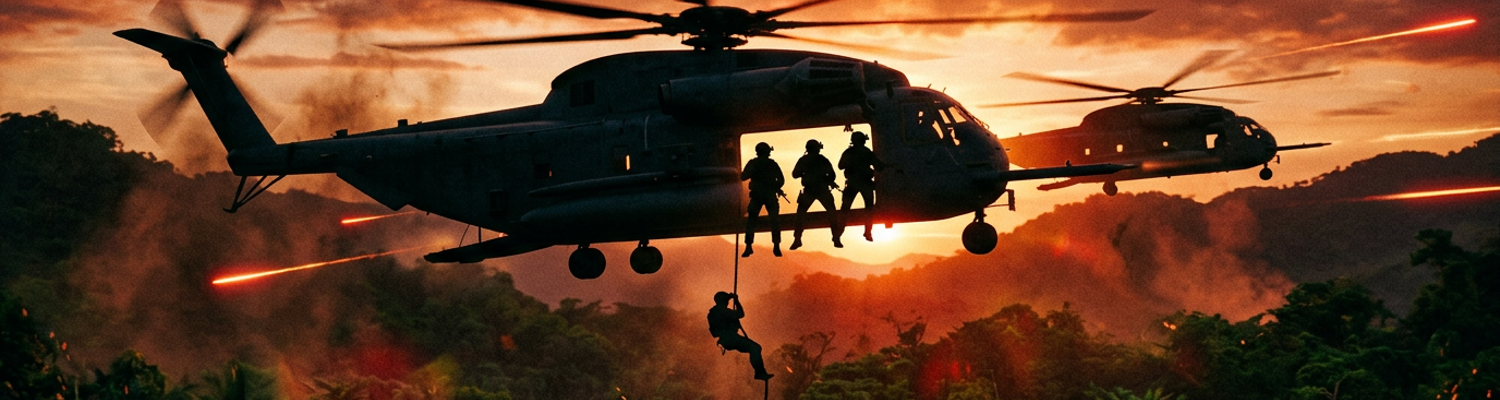
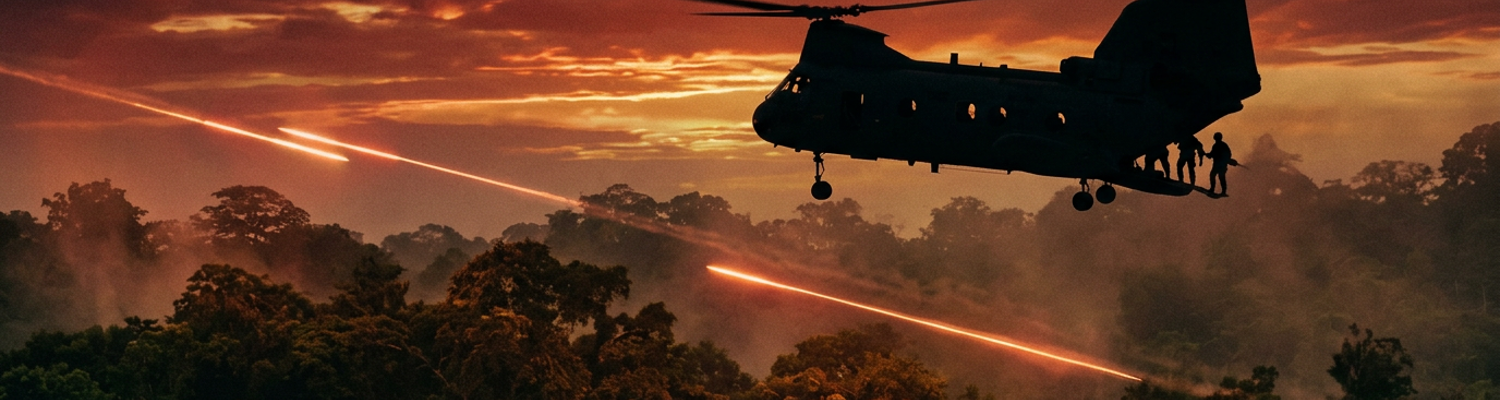
Flight coordinates directed waves of Bell UH-1 Hueys, Boeing CH-47 Chinooks, and Sikorsky CH-54 Skycranes straight into a narrow mountain trench. Jagged 3,000-foot karst ridgelines funneled all approach trajectories into a twenty-eight-mile defile. The cloud ceiling sat at barely two hundred feet. That physical constraint forced aircraft down into pre-registered kill zones.
The division flew directly into an entrenched flak trap.
A close review of operational logs indicates that the North Vietnamese Army had transformed the defile into a concentrated anti-aircraft redoubt. Well-camouflaged positions housed rapid-firing 12.7mm heavy machine guns and twin-barrel 23mm cannons. Radar-directed 37mm anti-aircraft batteries sat dug into sheer limestone cliffs. Heavy automatic fire ripped through aluminum skins within minutes of the initial assault. Flight mechanics suffered immediate hydraulic depressurization. Turbine fires erupted. Rotor drives shattered under kinetic impact.
Ten aircraft went down on the first day alone. Dozens more sustained severe structural damage. Hostile fire destroyed more than twenty helicopters and damaged well over one hundred by the end of the operation. Vertical replenishment collapsed under this attrition rate. Planners exhausted their rotary-wing assets. This forced an abrupt reliance on fixed-wing United States Air Force cargo transports. These aircraft had to deliver supply tonnages into unpaved, fire-swept extraction zones.
Aviation fuel burn rates outpaced delivery schedules within forty-eight hours.
When examining the historical record of the 1st Cavalry units holding defensive perimeters around Landing Zone Tiger, the numbers revealed an impending systemic collapse. Artillery batteries from the 1st Battalion, 30th Artillery burned through high-explosive 105mm projectile stocks during nocturnal counter-battery duels. Enemy 122mm rocket crews fired continuously from the high ground. Infantry platoons rationing 5.56mm magazines clung to shallow fighting scrapes under relentless mortar barrages. Rubberized fuel bladders sat bone-dry on the A Loui strip.
Without aviation fuel, armed reconnaissance gunships could not lift off. They could not suppress the cliff-face batteries firing directly into the defensive sectors. Parachute drops from Fairchild C-123 Providers often drifted off-target into thick jungle ravines controlled by enemy heavy machine gunners. Ground commanders faced absolute isolation. Fixed-wing airlifters had to physically touch down wheels-first directly on the contested red dirt of the valley floor. Ground crews measured the remaining usable length of the battered dirt strip at roughly 1,800 feet.
Physical Constraints of the Assault Strip
Military flight doctrine designated the mountain runway mathematically unfit for heavy transports.
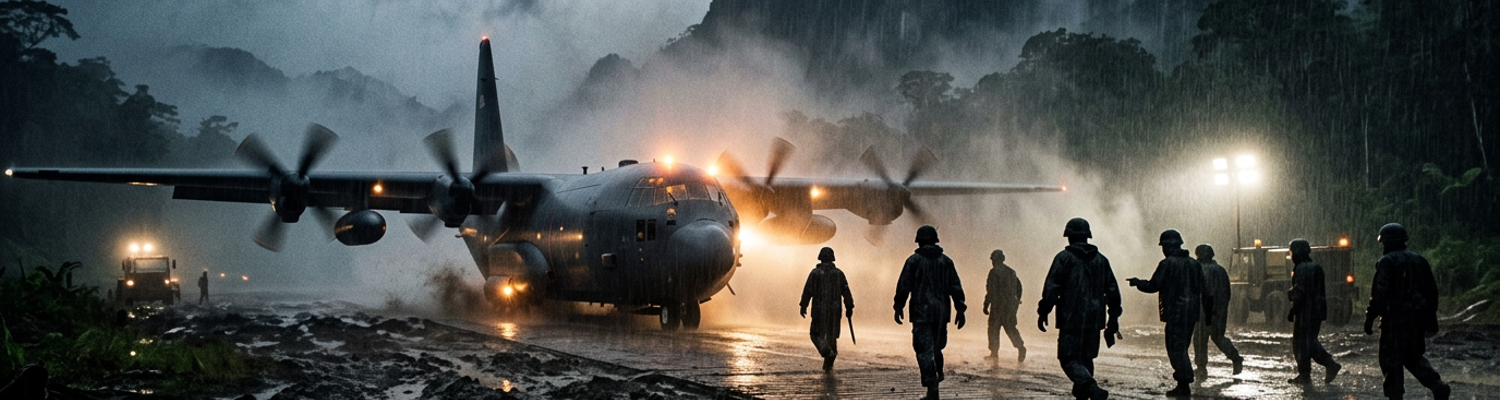
Standard United States Air Force assault landing regulations required a minimum 3,000-foot runway for Lockheed C-130 Hercules operations. Flying an empty forty-ton C-130E into a combat assault strip demanded strict physical tolerances. The aircraft had to dissipate massive kinetic energy upon touchdown. Tactical Air Command design criteria dictated that a combat-loaded Hercules crossing the runway threshold at 105 knots required at least 2,500 feet of clean ground roll under dry conditions. Flight engineers calculated an additional 500-foot safety buffer. This accommodated pilot reaction lag, reverse-thrust spool-up times, and mechanical brake fade under high temperatures.
Four Allison T56-A-7 turboprop engines swinging four-bladed Hamilton Standard propellers generated thousands of pounds of reverse thrust. Aerodynamic deceleration alone could not compensate for an abbreviated rollout distance. Seventh Air Force safety officers at Tan Son Nhut classified any runway under 3,000 feet as an automatic abort zone. They refused operational authorization because anti-skid pneumatic systems could not prevent four-engine transports from overrunning landing thresholds.
Archival evidence shows that the abandoned French airstrip at A Loui measured only 1,800 feet of unpaved clay. Pierced steel planking covered the surface. Combat Control Team airmen from the 8th Aerial Port Squadron discovered an unusable, buckled surface. They surveyed the strip alongside combat engineers from the 8th Engineer Battalion. Runway measurements confirmed the operational surface ran barely sixty feet wide. Bomb craters and drainage ditches bordered the strip immediately on both sides.
Interlocking M8A1 steel planks lay twisted and heavily corroded across the center line. Subgrade settlement had caused severe undulations along the runway profile. Distinct six-inch depressions formed where high-pressure aircraft tires would strike jagged steel edges at over one hundred miles per hour. That layout left incoming transport pilots with twelve hundred feet less landing space than the absolute minimum required by Air Force flight regulations.
The red clay beneath the steel mats offered no structural stability.
A close review of operational logs indicates that persistent monsoon precipitation degraded soil load-bearing capacity. Low-pressure weather systems trapped against the western slopes of the Annamite Range dropped inches of rain daily onto the valley floor. This reduced the California Bearing Ratio of the underlying subgrade from an acceptable rating of twelve down to single digits. Saturated subsoil liquefied beneath repeated mechanical stress.
Heavy earthmovers and fuel trucks rolled across the strip. Hydraulic pressure forced thick slurry upward through the holes in the pierced steel planking. This coated the metal surface with a slick emulsion of red mud and rainwater. Dual nose-gear and tandem main-gear tires lost direct surface friction. Touchdown speeds exceeded ninety knots. Trapped surface water generated severe hydrodynamic lift under the multi-ply aircraft tires. This induced full dynamic hydroplaning. Pneumatic brakes became useless. Nose-wheel steering failed. Rudder authority neutralized against crosswinds channeled through the mountain corridor.
The Assault Decision of the 834th Air Division
Headquarters accepted catastrophic risk to prevent the garrison from falling.
When examining the historical record of Seventh Air Force tactical directives, Brigadier General Burl W. McLaughlin bypassed Department of the Air Force technical landing criteria on May 3, 1968. He commanded the 834th Air Division at Tan Son Nhut Air Base. Standard operating regulations classified any runway shorter than 3,000 feet as off-limits to Lockheed C-130 Hercules operations. Heavy ground fighting around Landing Zone Tiger forced McLaughlin to act. Depleted artillery stockpiles worsened the situation. Staff officers calculated that rotary-wing assets could no longer sustain the 1st Cavalry Division under persistent anti-aircraft fire.
Division dispatchers ordered combat-loaded C-130 transports from the 314th and 463rd Tactical Airlift Wings to begin assault landings at 0800 hours. They directed the aircraft straight onto the 1,800-foot runway at A Loui. Wing safety officers registered formal objections. They warned that landing forty-ton turboprop aircraft on warped pierced steel planking coated in mud violated every peacetime structural specification. McLaughlin formally suspended the required safety margins. He authorized full-stop landings on a strip twelve hundred feet short of established engineering minimums.
Stopping the loaded transports required violent mechanical intervention.
Flight data sheets prepared for inbound flight crews required pilots to force all four Hamilton Standard 54H60 propellers into ground beta reverse pitch within one second of main gear contact. Touching down at an approach speed of ninety-five knots with fifty thousand pounds of cargo pushed the airframes to aerodynamic stall thresholds. Archival evidence shows that flight engineers calculated landing weights down to individual pounds. They demanded flight crews pull engine power levers straight through the flight-idle gate into maximum reverse thrust immediately upon impact.
Four Allison T56-A-7 turboprop engines had to deliver full negative thrust against forward momentum. Flight mechanics monitored turbine temperatures nearing critical limits. Anti-skid pneumatic systems were simultaneously compressed to maximum floorboard pressure. Flight commanders warned aircrews that the perforated M8A1 steel planking would shred tread rubber under sustained friction. Manual pumping of the brakes was forbidden. Multi-disc brake assemblies absorbed kinetic energy at temperatures exceeding twelve hundred degrees Fahrenheit. Brake fires threatened the aircraft while the four-bladed propellers blasted sheets of red mud across the forward windscreens.
A single mechanical slip meant total destruction.
A close review of operational logs indicates that flight crews from the 776th and 779th Tactical Airlift Squadrons signed mission manifests knowing the risks. Aborting or correcting a botched rollout was mechanically impossible. Running off the steel matting meant striking unexploded mortar ordnance. Deep drainage trenches and water-filled artillery craters sat dug directly into both runway shoulders. Asymmetric reverse thrust caused by a stuck propeller actuator would violently pivot the 80,000-pound aircraft sideways. This would induce structural breakup within four seconds.
The terrain beyond the southern threshold offered no recovery zone. The strip terminated abruptly at a steep decline dropping into the Rao Trang riverbed. Pre-sighted North Vietnamese 37mm flak pits lined the riverbank. Flight crews carried zero fuel reserve for holding patterns over the valley. They committed to an unassisted visual descent through mountain cloud breaks. A locked brake cylinder or wet steel hydroplane would send their transport into the southern embankment at sixty knots.
Anti-Aircraft Fire and Tail Number 60-0297
When examining the historical record of tactical airlift sorties on May 3, 1968, Lockheed C-130B Hercules tail number 60-0297 touched down at A Loui. The aircraft carried aviation fuel supplies to relieve the 1st Cavalry Division. Assigned to the 463rd Tactical Airlift Wing operating out of Tan Son Nhut, the four-engine transport carried multi-ply rubber bladders. These bladders contained thousands of gallons of JP-4 aviation kerosene. Loadmasters chained them securely to internal deck cleats.
Fuel reserves across the valley floor had completely evaporated after days of continuous helicopter combat air patrols. Major General John J. Tolson had air cavalry gunships sitting immobile on forward perimeters. They could not run turbine engines or fly protective sorties over isolated landing zones. The C-130 crew descended through dense overcast along the mountain walls of the Rao Trang corridor. They aligned the thirty-eight-ton transport with the narrow red dirt approach.
The aircraft crossed the runway threshold at ninety-five knots. It touched down firmly within the first two hundred feet of unanchored pierced steel planking. Tandem high-pressure tires struck the perforated metal sheets with heavy kinetic impact. Mud and red water geysered through the drainage slots under forty tons of landing weight.
Hamilton Standard propellers snapped into reverse pitch.
Archival evidence shows that concealed North Vietnamese Army 37mm anti-aircraft batteries opened fire on the aircraft during rollout. Entrenched gun crews from the 280th Air Defense Regiment occupied camouflaged revetments. They cut these positions into the jungle tree line barely four hundred meters from the runway center line. These anti-aircraft positions maintained total firing discipline during the transport descent. They deliberately withheld fire to ensure the target could not abort its landing run.
Reverse thrust kicked up clouds of exhaust and clay slurry. Twin-barrel Type 55 and Soviet-supplied M1939 37mm automatic cannons unmasked their positions simultaneously. High-explosive incendiary rounds tore across the clearing at twenty-eight hundred feet per second. Direct broadside salvos hit the transport at point-blank range. The rounds shredded the forward crew cabin. They pierced the left wing root and chewed through the pressurized aluminum skin. The airframe was decelerating past seventy knots. Shrapnel from bursting shells knocked out the number two Allison turboprop. It severed primary electrical harnesses along the upper cockpit bulkhead.
Flak shells blew through the cargo bay.
A close review of operational logs indicates that shell impacts ruptured onboard fuel cargo. Exploding 37mm cannon rounds shredded the rubber bladders. This discharged thousands of gallons of volatile jet fuel across the vibrating metal deck. Atomized fuel vapor ignited within seconds against hot turbine ducting and sparking circuit breakers.
Raging cargo fires burned through the utility hydraulic lines. The blaze destroyed the booster hydraulic assembly mounted along the rear fuselage bulkhead. Loss of hydraulic fluid pressure instantly locked the mechanical flight control linkages. This neutralized elevator travel, rudder pedals, and wing ailerons. Broken mechanical cables dropped into the burning fuel bath. This completely severed physical connection to the empennage. The pilots lost all steering authority and braking control while rolling down the final six hundred feet of slick pierced steel planking. The burning transport slid sideways off the runway threshold at fifty knots. It plunged nose-first into a cratered ditch near the edge of the perimeter wire.
Runway Closure and Palletized Fuel Destruction
When examining the historical record of the 463rd Tactical Airlift Wing, multiple 37mm high-explosive incendiary shells penetrated the cargo compartment floorboards before the transport could decelerate. Loaded across the internal cargo deck were palletized quartermaster 500-gallon rubber fuel bladders. These containers held volatile JP-4 jet propellant filled to absolute capacity. Direct projectile hits ripped through the synthetic rubber casings. This released thousands of gallons of pressurized liquid under high velocity.
Atomized fuel mist flooded the enclosed cargo bay within milliseconds.
Friction sparks along the steel roller conveyors ignited the hydrocarbon vapor. Contact with hot turbine ducting accelerated the combustion. Exploding bladders tore through the cargo hold. The blast blew outward through the crew entry door, the paratroop exits, and the shattered cockpit transparencies. Aluminum structural frames melted at eleven hundred degrees Fahrenheit within ninety seconds. The entire cargo compartment became an uncontrolled furnace. The fire incinerated flight systems and burned away the upper fuselage crown. The center wing box collapsed directly onto the internal cargo bed.
Thick black smoke rose two thousand feet above the valley floor.
Archival evidence shows that the burning four-engine airframe slid to a halt directly across the surveyed centerline of the 1,800-foot landing strip. Tandem main landing gear assemblies fused into the perforated M8A1 steel planking. This left forty tons of smoldering alloy positioned as an impenetrable barricade. Usable runway width measured barely sixty feet from shoulder to shoulder. The collapsed fuselage and scorched wing spars spanned over one hundred and thirty feet from wingtip to wingtip. Both sides of the unpaved clay embankment lay completely obstructed.
Combat engineers from the 8th Engineer Battalion attempted to clear the centerline with an armored Caterpillar D6 bulldozer. That recovery operation collapsed rapidly. Intense radiant heat detonated onboard small-arms ammunition stores. Steel tow cables snapped against the white-hot airframe. Liquid metal welded the ruined transport directly to the underlying pierced steel planking. No heavy transport could maneuver past the obstruction without sliding into the cratered drainage ditches.
The single runway at A Loui was dead.
A close review of operational logs indicates that the physical obstruction instantly closed the assault strip to all fixed-wing traffic. Seventh Air Force tactical controllers at Tan Son Nhut diverted all inbound C-130 and C-123 transport flights. They canceled scheduled drops of fifty thousand gallons of fuel and three hundred tons of 105mm artillery rounds. Forward battalions of the 1st Cavalry Division were trapped in an immediate logistical choke point.
Defensive lines at A Loui and Landing Zone Tiger had no reserve fuel to operate their grounded Bell UH-1 Hueys or Boeing CH-47 Chinooks. Artillery crews from the 1st Battalion, 30th Artillery dropped to emergency limits of fewer than ten rounds per howitzer tube. Enemy 122mm rockets struck the perimeter continuously. Wounded soldiers accumulated inside dirt aid bunkers. Medical evacuation flights were halted by the lack of JP-4 fuel. Seven combat companies holding the perimeter had no operational corridor for mechanical extraction.
North Vietnamese forward observers adjusted mortar fire onto the trapped battalions at twilight.
Eighth Aerial Port Squadron Logistical Triage
Archival evidence shows that combat controllers from the 8th Aerial Port Squadron established field communications while exposed to continuous mortar shelling. They set up an austere Tactical Air Control Party site directly beside the smoldering debris of tail number 60-0297. Airmen unpacked battery-powered AN/PRC-41 UHF and AN/PRC-25 FM transceivers into shallow, sandbag-reinforced trenches. Shrapnel from incoming 82mm and 120mm mortar rounds routinely severed whip antenna elements. Blast fragments sheared off coaxial lead wires and blew sulfurous grit across frequency selector dials.
Radiomen spliced mangled copper cabling by flashlight beneath poncho coverings. Enemy rounds peppered the airstrip revetments every three to five minutes. Power supplies failed as acid leaked from ruptured dry-cell casings. Technicians cannibalized wiring from wrecked ground support jeeps. They rigged direct-current connections to lead-acid vehicle batteries to keep the transmitters powered. Ground crews operated with earpieces jammed beneath steel helmets. They recalibrated squelch controls each time blast overpressures rattled the receiver chassis. Transmitters maintained emergency contact with the Seventh Air Force tactical air control center at Tan Son Nhut. They transmitted exact coordinates for inbound resupply flights despite hot metal fragments puncturing the radio housing units.
Mortar fragments severed five separate dipole lead lines within ninety minutes.
A close review of operational logs indicates that joint air-ground radio teams from the 8th Aerial Port and 1st Cavalry Division routed aerial delivery traffic through severe weather. Stationed in an unroofed sandbag bunker, Air Force controllers synchronized frequencies with the division air liaison officer. They coordinated with flight operations staff from the 228th Assault Support Helicopter Battalion. Saturated monsoonal cloud decks settled down to two hundred feet. This blanketed the sheer karst ridgelines of the Rao Trang defile in blinding grey fog.
Instrument flight rules normally prohibited blind visual approaches through the mountain gorge. The combined radio teams guided approaching Lockheed C-130 Hercules and Fairchild C-123 Provider transports using primitive dead-reckoning vectors over ultra-high-frequency guard channels. Ground operators tracked engine acoustics echoing against the canyon walls. They called out rapid altitude and heading corrections. This kept descending transports from slamming into the granite cliffs bordering Base Area 611. Transport crews broke through the cloud ceiling at three hundred feet above ground level. They leveled out seconds before impact to release palletized loads along pre-coordinated headings.
Zero margin for navigational error existed between the ridgelines.
When examining the historical record of 834th Air Division drop operations, forward ground controllers manually organized drop-zone clearances amid torrential monsoon downpours. Inbound transports dropped cargo bundles by Container Delivery System parachutes directly over the inundated valley floor. Driving rain saturated the drop areas. The storm dumped inches of water per hour and converted the drop clearing into waist-deep clay bogs. This immobilized mechanical recovery vehicles.
Cargo parachutes dragged five-hundred-gallon fuel bladders and four-thousand-pound crates of 105mm artillery shells into flooded bomb craters. Surface currents pulled palletized munitions toward uncleared minefields and perimeter wire. Ground controllers waded into the mud alongside infantry details from the 1st Battalion, 12th Cavalry. They used curved combat rigging knives to slice nylon suspension lines before heavy surface winds could drag pallets into enemy fields of fire. Recovery teams slung steel tow cables onto bogged skids. They muscled cargo containers onto sledges by hand while water blinded the men and fouled pallet extraction gear.
High surface winds dragged multiple pallet bundles across active minefields.
Ground personnel retrieved eighty tons of artillery ammunition and aviation fuel from the mud before midnight. They hauled individual crates through the deluge under direct visual observation from North Vietnamese gun positions.
Parachute-Extraction Failures in Severe Weather
When examining the historical record of 834th Air Division operations after the runway closure on May 3, Seventh Air Force tactical commanders ordered transport wings to abandon conventional landings. They executed Low-Altitude Parachute-Extraction System runs alongside Container Delivery System drops. The burned hull of aircraft 60-0297 blocked the pierced steel planking. Lockheed C-130E transports from the 314th Tactical Airlift Wing converted immediately to low-level cargo release profiles.
LAPES procedures required transport pilots to drop down the mountain axis at one hundred and fifteen knots. They skimmed between five and ten feet above the muddy clay and opened the aft cargo ramp. A cockpit switch deployed a fifteen-foot ring-slot drogue parachute out the back. Snapping taut into the slipstream, the drogue extracted a twenty-eight-foot main parachute. This yanked multi-ton sledges of artillery ammunition and fuel bladders straight out of the aircraft cargo compartment across dual aluminum roller rails. Concurrently, flight crews deployed high-speed Container Delivery System drops from five hundred feet above ground level. They cut release gates to shove strings of four-foot by four-foot A-22 containers fitted with twenty-two-foot G-12E cargo parachutes out the beaver-tail door.
Mountain air currents tore the drop profiles apart.
Archival evidence shows that extreme turbulence and low cloud ceilings in the Rao Trang gorge systematically compromised parachute ballistics. Low-pressure cells banking against the Annamite Range compressed cloud decks down to barely three hundred feet. This concealed the narrow valley approach and forced transport navigators to make blind approach corrections. Vertical downdrafts dropping off the three-thousand-foot granite ridgelines slammed into inbound C-130 airframes during critical extraction runs. This produced sink rates exceeding one thousand feet per minute.
Pilots leveled off over the markers. Erratic thirty-knot crosswinds caught the expanding nylon canopies of the G-12E parachutes the moment cargo containers cleared the ramp. Loads drifted hundreds of yards off their planned trajectory instead of settling onto the cleared perimeter of the airstrip. Artillery shells, 81mm mortar cases, and palletized rations dropped directly into dense, uncleared bamboo saps and ravine systems stretching along the western valley floor. Thick vegetation swallowed the bundles. Four-thousand-pound ammunition platforms hung suspended ten to twenty feet above the ground in tangled canopy branches.
C-130 transports circled out of the gorge through heavy automatic fire while cargo lay trapped outside friendly wire.
A close review of operational logs indicates that recovery parties dispatched to retrieve the misdropped supplies encountered heavy defensive fire from dug-in North Vietnamese infantry. Forward commanders from the 1st Cavalry Division detailed rifle squads from Company A and Company B, 1st Battalion, 12th Cavalry. They exited the defensive perimeter on foot to locate missing munitions crates. Troopers equipped with chainsaws, axes, and tow cables pushed three hundred to six hundred meters into uncleared elephant grass and splintered bamboo.
Camouflaged North Vietnamese Army snipers holding elevated karst hides engaged the working parties with aimed 7.62mm fire. This pinned squads against muddy creek banks. Simultaneously, enemy forward observers from the 325C Division registered 82mm and 120mm mortar rounds directly onto the impact points of the orange cargo parachutes. They used the bright nylon cloth as visual aiming stakes. Shrapnel tore through the retrieval teams as men hacked through bamboo trunks to free suspended pallets. Seventeen infantrymen were killed or wounded attempting to drag a single pallet of 105mm artillery shells back to the defensive trench line. The recovery detachment had to leave dozens of high-explosive cases behind in the jungle under falling night.
Doctrine Reassessment for Austere Tactical Airlift
Archival evidence shows that Operation Delaware concluded on May 17, 1968. The final air cavalry units withdrew eastward from the A Shau Valley. General John J. Tolson had committed his airmobile division to sever the North Vietnamese supply network winding south through Route 548. The operation demonstrated the severe risks of austere strip assault missions under direct observed fire. Dug-in gun crews from the 280th Air Defense Regiment maintained visual dominance over the valley floor from elevated karst ridgelines bordering Base Area 611.
Transport crews descending through low cloud ceilings entered pre-registered flak corridors. Twin-barrel 23mm cannons and 37mm automatic anti-aircraft guns engaged inbound aircraft at point-blank range. Heavy transports crossing the threshold at ninety-five knots could not maneuver away from high-explosive broadsides while decelerating on rollout. The combat loss of tail number 60-0297 proved that relying on large fixed-wing aircraft to resupply contested valley pockets carried severe exposure for the entire force. A single disabled transport shut down the only runway. Ground battalions were isolated in the mud.
The operational gamble had failed.
When examining the historical record of 834th Air Division command directives, Brigadier General Burl W. McLaughlin ordered an immediate overhaul of combat assault landing criteria at Tan Son Nhut Air Base. Technical evaluation teams reviewed the mechanical tolerances of the C-130 Hercules operating on unpaved surfaces. Standard flight regulations mandated a minimum 3,000-foot runway. This provided pilots sufficient rollout distance to dissipate kinetic energy without burning out multi-disc brake assemblies.
The controversial waiver permitting landings on the 1,800-foot strip at A Loui had eliminated those safety margins. Flight crews had zero buffer when slick clay compromised reverse-thrust deceleration on pierced steel planking. The division established a strict 2,500-foot absolute floor for future assault operations. They barred tactical transports from touching down on shortened, unreinforced dirt strips. Staff officers instituted urgent runway clearance protocols. Combat engineering detachments were ordered to pre-rig heavy Caterpillar D6 bulldozers and M578 recovery vehicles with high-tensile steel cables at the runway boundary during every landing window. Ground crews received standing directives to ram burning or immobilized airframes straight off the centerline into perimeter trenches within four minutes of a runway blockage.
Fuel cargo posed an even greater hazard.
A close review of operational logs indicates that data gathered from the A Loui runway disaster fundamentally reshaped Seventh Air Force tactical airlift doctrine regarding forward fuel bladder transport. Ballistic assessments conducted on the wreckage of aircraft 60-0297 revealed that palletized 500-gallon synthetic rubber containers created catastrophic fire hazards inside the cargo compartment. Direct hits from 37mm high-explosive rounds easily pierced the unarmored rubber bladders. This sprayed pressurized JP-4 aviation kerosene across the deck where hot electrical conduits and turbine bleed ducts triggered immediate flash fires.
Temperatures exceeding eleven hundred degrees Fahrenheit melted structural aluminum ribs. The heat burned through the booster hydraulic linkages controlling the rudder and elevators within ninety seconds. Seventh Air Force planners updated tactical transport directives to prohibit internal bulk fuel bladder shipments into forward strips lacking secure perimeters. Future fuel replenishment missions to frontline firebases shifted toward high-speed Container Delivery System drops, low-level cargo extractions, and external helicopter sling loads. This eliminated the presence of pressurized liquid propellants inside landing transport cabins under observed enemy fire. Seventh Air Force combat airlift never attempted an unarmored fuel landing at A Loui again.