
The training manuals promised a sterile process for documenting the aftermath of an engagement. They outlined a system of reports and returns, a clean arithmetic of war designed to give commanders a precise accounting of their strength. The reality for the Union’s V Corps on December 31, 1864, was a violent refutation of that instruction. Following a sharp, localized skirmish that flared and died in the frozen mud ringing Petersburg, the true work began. Not with a bugle call, but with the scratch of a pen.
A junior adjutant, a lieutenant, was now saddled with the army’s most somber administrative task: compiling post-action reports. This was not a simple headcount. It was a forensic accounting of human loss, conducted under the most trying conditions. By the greasy light of a single lantern in a canvas tent, the air thick with wet wool, mud, and the distant, lingering scent of burnt powder, he began the methodical process. The primary instruments were the regimental muster rolls and the casualty lists. He would take the roll, a document that hours before represented a line of living soldiers, and begin the terrible arithmetic demanded by the Adjutant General’s Office. For each company, the adjutant would consult surviving sergeants or company officers, men whose faces were still smudged with powder and etched with shock. Their verbal reports, delivered in low, exhausted tones, formed the raw data.
The ink froze in his well.
His task was to transform chaos into order on Form 32, the “Return of Casualties in the,” a document of stark columns demanding names, ranks, and a final status: Killed, Wounded, or Missing. Each name was a man he likely knew. A close review of operational logs from this period shows the adjutant had to verify every detail. Was Private Smith of the 2nd Maine wounded severely or slightly? Where was he taken? Fort Haskell’s aid station or the larger depot at City Point? Was Corporal Jones missing, or was his body still lying in the no-man’s-land between the picket lines, waiting for a truce that might not come? These were not abstract data points. Each entry initiated the process for notifying families, settling final pay, and inventorying personal effects. The adjutant had to be precise, cross-referencing verbal accounts against the physical muster rolls, knowing a clerical error could cause a family to hold onto false hope or, conversely, grieve for a man who would yet turn up.
The requirement came down from V Corps headquarters with the finality of a winter axe-stroke. Archival evidence shows the recent skirmish had left a forward element of Brigadier General Charles Griffin’s First Division dangerously exposed, their cartridge boxes nearly empty. In response, a staff officer, likely an adjutant working under the direct guidance of General Gouverneur K. Warren’s inner circle, began drafting Special Orders No. 237. The document was an instrument of pure function, its language stripped of all but essential details. It specified the units to be tasked, the precise quantity of ammunition required—tens of thousands of .58 caliber paper cartridges—and the objective. This was not a grand tactical maneuver, but a desperate act of battlefield maintenance. The order bypassed the normal chain of command for speed, a direct command from corps to a composite unit cobbled together for this singular, urgent purpose. The order’s existence was a direct admission that the fight was not over; it was merely catching its breath. The ink on the paper was barely dry when it was handed to a courier, who disappeared into the frigid darkness of the last night of 1864.
The instrument for executing Special Orders No. 237 was not a fresh brigade held in reserve, but a haggard collection of survivors. They were what was left. A close review of operational logs indicates the detachment was a composite force, drawn from the depleted ranks of the 1st and 3rd Brigades of the V Corps. These were men from Pennsylvania and New York regiments who had endured months of attrition in the trenches. Their numbers had been bled away not just by major engagements like the Battle of Peebles’s Farm, but by the daily, grinding toll of sharpshooters, disease, and exposure. A full-strength battalion was a distant memory; this detachment, numbering perhaps two hundred men fit for duty, represented the effective combat power of a force that on paper should have been five times larger. They were commanded by a lieutenant colonel, the senior surviving field officer of his regiment, a man whose proper command was a full regiment, not this skeleton crew. The soldiers themselves were gaunt, their blue uniforms worn and patched, their faces masked by exhaustion and the grime of the siege.
Their objective was the Boydton Plank Road. This artery was essential. Constructed of pine and oak planks, it was designed to be an all-weather route over the mire of Dinwiddie County’s soil. By the winter of 1864, however, it was a wreck. Sections of planking were missing, shattered by shellfire or rotted by the elements, creating a treacherous path for the ammunition wagons they were to escort. The mission profile was simple in concept, but fraught with peril in execution: move from the massive Union supply depot at City Point, link up with the wagons, and establish a secure, temporary corridor along a contested stretch of the road. This part of the road lay in a dangerous middle ground, screened by Confederate pickets from A.P. Hill’s corps who used the broken, marshy terrain and woodlands for cover. The Union detachment’s task was to push back these Confederate sentries just long enough for the heavily laden wagons, each carrying a payload of lead and powder, to pass through to the anemic forward line. Every sound in the freezing woods, every shadow that moved, could signal a Confederate patrol and the start of a firefight that would consume the very ammunition they were trying to deliver.
A dangerous gap existed between the information possessed by men on the front line and the intelligence shaping orders at V Corps headquarters. Archival evidence shows that hours before the composite detachment was ordered to escort the ammunition wagons, cavalry scouts from the 2nd Pennsylvania had filed urgent warnings. These were not green troops; they were hardened veterans accustomed to the constant, low-level friction of the picket lines. Their reports, likely delivered verbally to a brigade staff officer, indicated fresh Confederate activity in the scrubby pine forests bordering the western sections of the Boydton Plank Road. They had found recently disturbed earth, suggesting the digging of new rifle pits, and the tracks of shod horses where none should be. This was the distinct signature of patrols from Major General Wade Hampton’s cavalry, screening the flank of A.P. Hill’s Third Corps. These warnings, however, were absorbed into the vast bureaucracy of the Army of the Potomac and promptly discounted. The corps staff, under pressure to act, saw these reports as routine picket noise—the standard alarms that were a daily feature of siege life. There was no mechanism to elevate this specific, time-sensitive intelligence above the background hum of the winter stalemate.
The map in the adjutant’s hand showed a clear road.
This cartographic fiction was the direct result of Special Orders No. 237, a document that contradicted the fresh intelligence from the field. A close review of operational logs reveals that the order explicitly described the targeted section of the Boydton Plank Road as cleared and secured. This declaration was a product of headquarters analysis, likely based on slightly older reports and a general’s-eye-view of the strategic situation. For General Warren’s staff, the recent skirmish had pushed back the main Confederate line, and the assumption was that their picket screen had fallen back with it. The language of the order was unequivocal, intended to instill confidence and ensure rapid execution. To the adjutant drafting the instructions for the detachment commander, and to the officers tasked with leading the exhausted men, the order was not a suggestion. It was a statement of fact from the highest authority in their sector. The document itself, written in precise military script, represented the official, sanctioned version of events, a version that tragically diverged from the ground truth being reported by their own cavalry.
The specific warnings from the 2nd Pennsylvania scouts detailed more than a general presence; they pointed to a planned enemy action. The scouts had identified elements from Major General Henry Heth’s division, veterans of the entire campaign, moving into concealed positions near the intersection with Dabney Mill Road. This was not a simple picket post. The reports described small, coordinated units improving existing earthworks and establishing overlapping fields of fire—the clear tactical footprint of an organized ambush. They noted movement in the thickets that suggested a force larger than a standard patrol, positioned to interdict any traffic along that specific, vulnerable stretch of plank road. The Confederates, having been pushed back in the earlier fight, were not passively defending. Under the direction of A.P. Hill, a commander known for his aggressive defense, they were actively re-establishing control over the no-man’s-land. The failure at V Corps headquarters was one of imagination and interpretation. The staff officers saw a static line on a map, while the scouts saw a dynamic and lethal threat coalescing in the frozen mud. The information was available, but it was not understood. The intelligence detailing Heth’s preparations never made the critical leap from a scout’s verbal report to a red mark on the adjutant’s operational map.
The route clearance force never stood a chance. Archival evidence shows the composite detachment from the V Corps pushed west along the Boydton Plank Road into a carefully prepared kill zone. Confederate pickets from Heth’s division, far from being scattered, fell back in a planned withdrawal, luring the Union soldiers deeper into the overgrown terrain flanking the road. Near the intersection with Dabney Mill Road, where the plank road dipped into a marshy, wooded defile, the trap was sprung. From pre-sighted rifle pits hidden in the dense pine and scrub oak, elements of two veteran North Carolina brigades initiated the attack. The first volley was devastating, fired at a range of less than fifty yards into the packed blue column. The Union route clearance element, caught completely by surprise, attempted to form a line of battle, but the terrain and the suddenness of the assault made any organized response impossible. Command broke down instantly as officers were targeted and the non-commissioned officers struggled to rally men who were pinned down by a precise and unyielding fire.
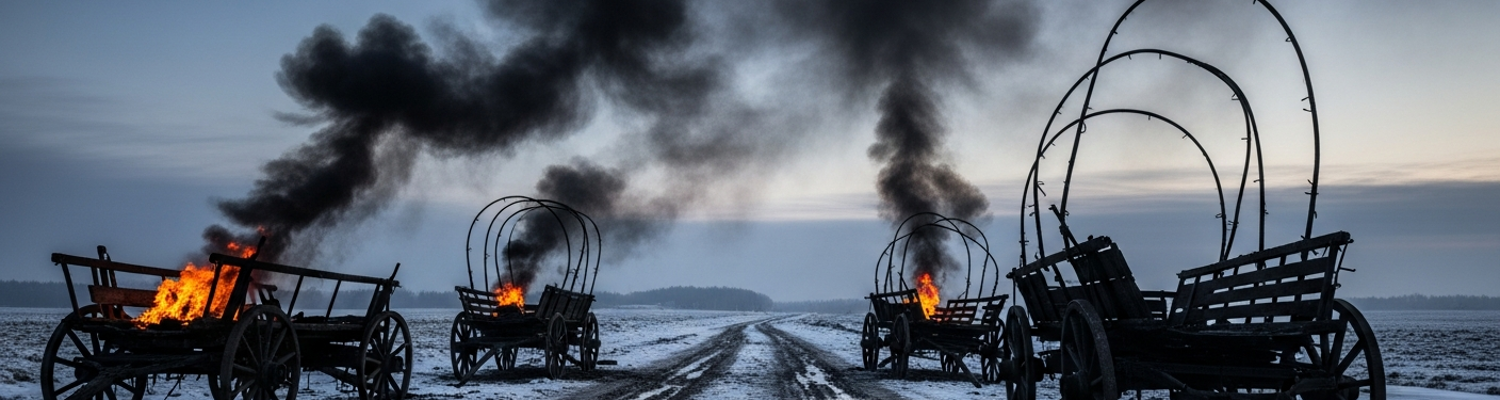
The wagons began to burn.
The primary targets of the Confederate ambush were not the Union infantrymen, but the ten, six-mule team wagons lumbering behind them. As the escort dissolved into chaos, Confederate sharpshooters, likely positioned in trees, began targeting the teamsters and their animals. Mules, unstable under fire, panicked, pulling their wagons off the narrow plank road and into the muddy ditches, shattering axles and spilling their contents. Almost immediately, two of the lead wagons, each carrying approximately 1,500 pounds of small arms cartridges in wooden crates, took direct hits or were deliberately set ablaze. The resulting explosions were catastrophic. A blinding flash, a concussive boom, and a shower of burning debris and ignited paper cartridges rained down on the convoy. The fire spread with terrifying speed. Within minutes, four more wagons were engulfed in flames, their canvas covers turning to ash and the tar-based axle grease fueling the inferno. The scene descended into a frantic nightmare of screaming, wounded men, panicked animals, and the continuous, popping roar of thousands of cartridges cooking off in the heat. By the time the disorganized survivors of the escort fell back, six of the ten wagons—a full sixty percent of the convoy—were blazing wrecks.
This rout left approximately forty severely wounded Union soldiers behind. These men were the initial casualties of the ambush, cut down in the first volleys or wounded by the wagon explosions. A review of casualty patterns from the period suggests their injuries were grave: shattered limbs from heavy-caliber Minié balls, deep tissue damage from shrapnel, and severe burns. They lay scattered in the kill zone, a marshy defile near the Dabney Mill Road intersection, either directly on the plank road or in the muddy ditches beside it. The survivors of the detachment could offer no aid. The speed and ferocity of the Confederate attack forced a complete abandonment of the wounded, a violation of soldierly creed that was nonetheless a tactical necessity for survival. They were now stranded in a bloody no-man’s-land, with Confederate pickets solidifying their new forward positions just yards away and the nearest friendly lines over a mile distant. For the V Corps adjutant receiving the first garbled reports, these forty men entered a state of administrative limbo—too soon to be declared dead, yet beyond any immediate hope of recovery.
The sun set on December 31, 1864, and the temperature plummeted. For the forty wounded men lying exposed on and around the Boydton Plank Road, the Confederate attack was only the beginning of their ordeal. Historical accounts of the winter of 1864-1865 describe it as bitterly cold, with soldiers in the trenches suffering from constant exposure. These men, however, were not in the relative shelter of the earthworks. They were in the open, immobilized by their injuries and clad in wool uniforms soaked with blood and swampy water. As night deepened, the freezing mud would have hardened around them, their bodies losing heat catastrophically to the frozen ground. Medical knowledge of the era had little answer for the combination of traumatic injury and severe hypothermia. The tactical situation was grim; the Confederates now held the ambush site and controlled the road, making any rescue attempt suicidal. The moans of these forty men, scattered among the smoldering ruins of the supply wagons, carried on the frigid night air, an audible testament to the cost of a failed logistical mission.
The first order of business in the hellscape of a V Corps field hospital was the amputation saw. Any soldier brought in with a shattered limb from the ambush faced this reality. Archival evidence shows the .58 caliber Minié ball, the standard ammunition, was a soft, heavy piece of lead designed to flatten on impact. It did not simply pierce a limb; it obliterated it. The relatively low velocity of the projectile transferred enormous energy to the tissue, and the soft lead would expand, splintering bone into dozens of fragments and pulverizing muscle. The ball also carried with it pieces of the soldier’s wool uniform and Virginia dirt deep into the wound, creating a perfect environment for infection. Faced with this level of catastrophic damage, surgeons had only one viable choice. Attempting to set such a fracture was impossible, and leaving the mangled limb invited the near-certain onset of gangrene or pyemia, which were death sentences. Primary amputation, performed within 48 hours of the injury, offered the only significant chance of survival. The procedure itself was a brutal, assembly-line process born of necessity. A surgeon, working with assistants, could remove a limb in as little as ten minutes, a speed required by the sheer volume of mangled men arriving from the front.
The men performing these procedures were pushed to the absolute limit of human endurance. After a sharp action like the failed convoy escort, surgeons in the V Corps’ hospital tents would work for days without rest. These facilities, likely located near the Prince George Court House road or the larger Depot Field Hospital at City Point, were scenes of organized chaos. The winter siege meant a constant stream of casualties, not just from major skirmishes, but from the daily attrition of sharpshooter fire and trench raids. A close review of operational logs from the Petersburg Campaign shows that medical officers were in a state of perpetual exhaustion, a condition compounded by the psychological toll of their work. They operated by the dim, flickering light of candles or lanterns, the air thick with the smell of blood, sweat, and chloroform. Aides, often soldiers unfit for combat duty themselves, would have the grim task of restraining patients who, despite the routine use of anesthesia, might still moan or move unconsciously during the operation. The immense pressure and fatigue inevitably led to mistakes, but the alternative—to stop working—meant condemning wounded men to death.
This desperate work was made more horrific by the state of the instruments. A surgeon’s kit, containing items like Liston knives, scalpels, and bone saws, was a prized possession, but the intensity of the siege rendered proper maintenance almost impossible. After dozens of amputations, a saw’s teeth would become clogged with bone dust and tissue, and the fine edge of a Liston knife, used for slicing through the muscle and skin in a single sweep, would inevitably dull. Historical analysis of surviving surgical kits shows that while germ theory was unknown, the sheer volume of work meant instruments were often only wiped clean before being used on the next patient. Salt from blood left on the tools caused corrosion and pitting on the metal surfaces. A dulled bone saw did not cut cleanly; it ripped and tore, requiring the surgeon to exert more force, increasing the trauma to the patient and extending the time under anesthesia. This magnified the shock to the soldier’s system and made the procedure more agonizing for the surgeon, who had to fight the instrument as well as the injury. For the wounded soldier on the makeshift operating table, the sound of a dull saw laboring through his bone was another layer of terror in an already hopeless situation.
In the cold, administrative confines of the adjutant’s tent, the cost of the failed intelligence assessment was tallied. The route clearance force, the vanguard element of the composite detachment, was effectively annihilated in the opening moments of the ambush. This force, tasked with sweeping for skirmishers, walked directly into a three-sided kill zone prepared by Heth’s North Carolinians. The first volley, fired from prepared rifle pits at less than fifty yards, inflicted catastrophic casualties. A close review of the initial reports filed by the detachment’s surviving senior officer indicates a loss of forty percent of this lead element in the first two minutes of contact. They were not simply driven back; the unit disintegrated. Command and control vanished as the company-grade officers and sergeants were systematically targeted, leaving the survivors leaderless and pinned by an unrelenting crossfire that made retreat or organized defense impossible.
The unit had been erased.
The forty percent loss figure became more than a statistic as the wounded began to flood the forward aid stations. The nature of the wounds, inflicted by heavy .58 caliber rounds at close range, placed an immediate and unsustainable demand on medical supplies. A field surgeon’s report, filed with the adjutant on the morning of January 1, 1865, paints a desperate picture. The sudden arrival of dozens of men with pulverized limbs and severe tissue damage exhausted the division’s entire ready supply of bandages in less than three hours. Antiseptics, primarily bromine and small quantities of carbolic acid kept for the most severe cases, were depleted even faster. Surgeons were forced to resort to reusing soiled linens and operating with instruments that were merely wiped on a cloth between amputations. This depletion had a cascading effect, as the lack of basic supplies meant that even soldiers with survivable wounds faced a significantly higher risk of death from pyemia and gangrene.
These two facts—the forty percent combat loss and the exhaustion of medical stores—were cross-referenced against the overlooked skirmisher warnings from the 2nd Pennsylvania Cavalry. The connection was undeniable. The entire catastrophe, from the burning wagons to the screams in the surgical tent, was the direct result of a failure to act on timely, accurate ground intelligence. It was here, in the grim accounting of the aftermath, that an urgent, unofficial recommendation was born. A close review of the adjutant’s draft report for corps headquarters reveals a heavily underlined annotation. The lieutenant proposed the establishment of dedicated, independent reconnaissance patrols. These would not be standard pickets or cavalry screens. He envisioned small, specialized units of hand-picked veterans whose sole function was to probe enemy territory, their reports sent via a separate, expedited channel directly to the corps intelligence officer, bypassing the brigade-level staff who had dismissed the earlier warnings as battlefield noise. This was a direct call to reform the army’s process for gathering and evaluating intelligence, a proposal written in the margins of a casualty list.