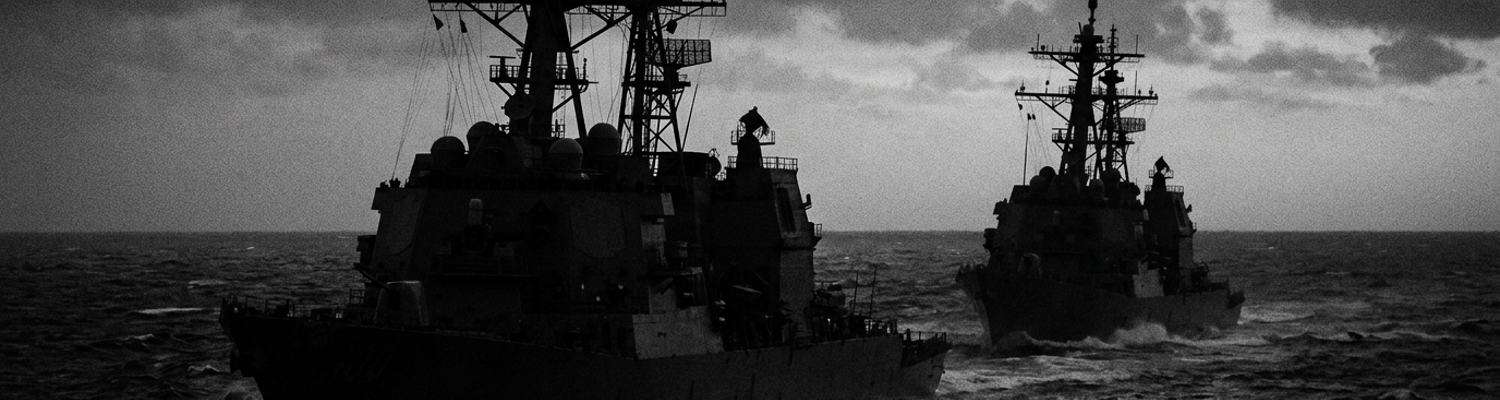

Eastern Mediterranean Naval Tensions in July 1974
Supplying three carrier strike groups with fresh JP-5 aviation fuel and guided ordnance in the constrained waters south of Crete presented a mathematically impossible resupply equation.
Archival evidence shows that by mid-July 1974, the Eastern Mediterranean had transformed into a compressed tactical chokepoint. Following the July 15 coup in Nicosia orchestrated by the Greek military junta, Turkish armed forces initiated Operation Atilla on July 20. Turkish amphibious landing craft departed from the port of Mersin under the cover of darkness. Five destroyers and two submarines escorted the convoy. The Hellenic Navy deployed four Type 209 submarines from the Salamis Naval Base to patrol the Aegean. They specifically targeted the narrow sea lanes between Rhodes and Cyprus. Turkish warships established strict blockade zones north of Kyrenia. These vessels were primarily ex-US Navy Gearing-class destroyers equipped with AN/SPS-40 air search radars. Soviet surface action groups from the 5th Eskadra immediately sortied from their deep-water anchorages near Sollum and Alexandria. Two Kynda-class cruisers armed with nuclear-tipped SS-N-3 Shaddock anti-ship missiles anchored the Soviet flotilla. They positioned their vessels within twenty nautical miles of NATO assets. This ensured direct radar line-of-sight. The airspace saturated with overlapping search radars and continuous VHF radio traffic from three distinct sovereign armed forces operating on high alert.
The electromagnetic spectrum between 34 degrees North and 36 degrees North latitude reached maximum capacity by July 21.
Task Force 60 received direct orders from European Command to reposition south of the Greek island of Crete. The USS America (CV-66), USS Independence (CV-62), and USS Forrestal (CV-59) carrier strike groups established overlapping holding patterns in the deep water trenches of the Hellenic Trough. This positioned them roughly 150 nautical miles southwest of Heraklion. Battle readiness conditions escalated to DEFCON 3 across the entire theater. Flight decks transitioned to continuous cyclic flight operations. Catapult crews launched F-4 Phantom II interceptors from Fighter Squadron 33 and EA-6B Prowler electronic warfare aircraft from Tactical Electronic Warfare Squadron 132 on alternating combat air patrols. Below decks in the magazine spaces, aviation ordnancemen manually loaded AIM-7 Sparrow air-to-air missiles onto alert fighters. They replaced standard blue-banded training rounds with yellow-banded live high-explosive munitions. The America strike group commander mandated strict Emission Control Condition Alpha. This directive silenced all non-essential active radar and communications transmitters. The goal was masking the carrier exact position from Soviet passive sonar arrays and Tupolev Tu-95 Bear reconnaissance aircraft patrolling at thirty thousand feet. Destroyers in the anti-submarine screen relied entirely on passive acoustic tracking and visual signaling via flashing light. Escort vessels secured their active sonar pinging to avoid acoustic detection.
Maintaining this defensive posture drained aviation fuel reserves at a rate of 1.2 million gallons per day across the task force.
A close review of operational logs indicates the sheer volume of overlapping radar signals forced a localized technological adaptation. Electronic warfare technicians aboard the USS Independence applied an unauthorized field modification to the AN/WLR-8 tactical electronic support measures suite to manage the dense signal environment. They adjusted the frequency discrimination filters to automatically reject the repetitive pulse repetition frequencies of older commercial maritime navigation radars operating in the X-band and S-band frequencies. This minor software recalibration intended to clear the cathode-ray display screens for radar operators trying to isolate Turkish and Greek military search radars from the hundreds of civilian merchant vessels transiting the Suez Canal approaches. Technicians completed the manual input sequence using perforated paper tape loaded directly into the ship combat information center mainframes at 0200 hours on July 22. The filtering algorithm immediately suppressed over four hundred civilian radar tracks from the primary tactical picture. Operators in the combat information center logged a massive reduction in background signal noise.
The AN/WLR-8 system operators reported a completely clear display screen exactly twelve minutes after the patch installation.
Electronic Intelligence Operations Aboard USS Mahan
Archival evidence shows that the Farragut-class guided-missile destroyer USS Mahan operated as the primary forward electronic picket ship for Task Force 60. The vessel held a stationing assignment in the Kithira Strait. The exact coordinates were 35 degrees 45 minutes North, 23 degrees 12 minutes East. This maintained a screening position between the carrier strike groups and the contested Aegean waters. A close review of operational logs indicates the crew relied heavily on the AN/WLR-1 electronic surveillance receiver suite to conduct their ELINT collection. This system was an analog superheterodyne receiver designed to intercept and direction-find hostile radar emissions across a wide spectrum ranging from 50 megahertz to 10,750 megahertz. The hardware occupied a small compartment known as the electronic warfare module. This room was located just aft of the combat information center on the 02 level. Multiple 600-pound equipment racks housed the fragile vacuum-tube amplifiers and heavy manual tuning dials. Technicians interfaced with the system through the AS-899/SLR antenna group mounted high on the destroyer mainmast. These antennas captured incoming radio frequency energy and routed it down thick shielded coaxial cables into the processing racks below decks. The equipment generated severe ambient heat during continuous operation.
The primary cooling fans inside the electronic warfare module failed at 1400 hours on July 23.
Damage control personnel rigged temporary canvas ventilation ducts directly from the starboard weather decks. Passive tracking operations aboard the destroyer focused entirely on isolating Soviet surface combatant emitters and Turkish naval search radars from the background electromagnetic clutter. The primary Soviet threats in the sector included Kashin-class destroyers and Kynda-class cruisers emitting MR-310 Head Net C 3D air search radar signals operating in the E-band. Soviet commanders frequently activated their Peel Group fire control radars. These transmitted high-frequency short-pulse signals designed to guide SA-N-1 surface-to-air missiles toward airborne targets. Turkish forces presented a completely different technical profile. Ex-US Navy Gearing-class destroyers operated by Ankara carried AN/SPS-40 long-range air search radars and AN/SPS-10 surface search radars. These systems broadcasted in the UHF and C-band frequencies. Intercept operators on the USS Mahan had to measure the specific pulse repetition frequencies and scan rates of each incoming signal manually. They used analog oscilloscopes with calibrated green grid overlays to visually calculate the microsecond intervals between individual radar pulses. Visual calculations required intense concentration in a room illuminated only by the glow of the display screens.
Operators logged every intercepted azimuth bearing on a backlit transparent plotting board using yellow grease pencils.
The AN/WLR-1 lacked the automated signal sorting and digital memory banks found in the newer AN/WLR-8 systems installed on the aircraft carriers. Every radar contact required direct human verification. An electronic warfare technician wearing a heavy sound-powered headset had to physically rotate a handwheel to tune the receiver through different frequency bands. He listened to the converted audio output of the radar pulses. A Turkish AN/SPS-10 surface search radar produced a steady low-pitched hum in the operator headset. A Soviet Peel Group fire control radar generated a rapid high-pitched mechanical whine. The operators matched these audio signatures and oscilloscope waveforms against a classified reference manual known as the ELINT parameters handbook (NAVAIR Document 11-45A). This binder contained hundreds of pages of known radar profiles. Cross-referencing these parameters took an average of forty-five seconds per signal. The volume of simultaneous emissions in the Kithira Strait frequently exceeded sixty overlapping radar contacts per hour. This caused a backlog in the identification process. Watchstanders fell behind on plotting the exact locations of the foreign naval vessels surrounding their position.
At 0415 hours on July 24, the intercept receivers detected a sudden shift to high-PRF continuous wave emissions.
These signals originated from a Soviet Kynda-class cruiser located 45 nautical miles to the northeast.
Sixth Fleet Airborne Jamming Platform Support
Archival evidence shows that at 0530 hours on July 24, European Command ordered the immediate launch of specialized airborne electronic warfare assets to suppress the Soviet continuous wave emissions. Fleet Air Reconnaissance Squadron Two maintained a detachment of highly modified EA-3B Skywarrior aircraft aboard the USS Independence. Bureau Number 144865 maneuvered onto the carrier starboard waist catapult. The twin-engine jet weighed seventy thousand pounds fully loaded with aviation fuel and electronic countermeasure pods. It required maximum steam pressure from the ship accumulators to achieve safe flight velocity. Two Pratt and Whitney J57-P-10 turbojet engines generated twenty-one thousand pounds of combined thrust. This pushed the heavy airframe off the flight deck and over the Hellenic Trough. The aircraft climbed at a shallow angle toward a designated orbit station at 35 degrees 15 minutes North, 24 degrees 00 minutes East. Inside the unpressurized fuselage, five electronic warfare technicians sat strapped into a windowless converted bomb bay known as the capsule. These operators monitored banks of AN/ALR-40 signal intercept receivers. They manually controlled the AN/ALQ-76 broadband noise jamming pods mounted on the external underwing pylons.
The Skywarrior established a counter-clockwise holding pattern exactly thirty-two nautical miles above the USS Mahan.
A close review of operational logs indicates the primary tactical objective involved synchronizing the EA-3B active jamming capabilities with the passive threat detection screens of the surface fleet below. Carrier strike group commanders intended to use the airborne platform to blind the Soviet Kynda-class cruiser fire control radars without revealing the location of the American destroyers. The Skywarrior operators initiated a barrage jamming sequence at 0545 hours. They directed high-powered radio frequency interference across the E-band and F-band spectrums. This targeted the specific coordinates of the Soviet vessel located forty-five nautical miles to the northeast. Ram-air turbines spun up on the front of the ALQ-76 pods. This generated the necessary electrical voltage to power the internal magnetrons. Jamming transmitters broadcasted a continuous stream of random electronic noise designed to overwhelm the receivers of the hostile surface-to-air missile systems. Down on the ocean surface, the guided-missile destroyers maintained strict Emission Control Condition Alpha. Combat Information Center personnel aboard the Mahan attempted to use the airborne jamming strobe as an active reference line to triangulate the Soviet cruiser exact location.
Watchstanders fed the bearing lines into the ship Naval Tactical Data System using manual keypads.
This integration of airborne electronic countermeasures with surface passive detection triggered an immediate signal collapse across the task force. Broadband noise generated by the Skywarrior underwing pods bled heavily across adjacent frequency channels. This intense electromagnetic spillover directly interacted with the unauthorized software modification installed on the USS Independence AN/WLR-8 electronic support measures suite just forty-eight hours prior. Jury-rigged frequency discrimination filters failed to process the sheer volume of the EA-3B defensive jamming energy. The filters were programmed via perforated paper tape to ignore repetitive civilian S-band signals. Shipboard mainframe computers automatically classified the protective electronic blanket as localized background clutter. The AN/WLR-8 system systematically rejected all incoming data packets associated with the affected frequency bands. This scrubbed the primary tactical displays of both the airborne jammer and the Soviet surface action group.
The combat information center screens went completely blank at 0602 hours.
Electronic warfare operators inside the Skywarrior cramped fuselage continued transmitting their jamming signals blind. They pushed the ALQ-76 pods to maximum output. This drove the internal magnetron temperatures past three hundred degrees Celsius. Liquid dielectric fluid cycled rapidly through the wing-mounted hardware to prevent a thermal overload. Below them, the surface fleet passive detection screens displayed zero hostile contacts in the northeastern quadrant. Intercept operators aboard the USS Mahan frantically rotated their handwheels on the AN/WLR-1 receivers. They tried to manually locate the high-pitched mechanical whine of the Soviet fire control radar through the heavy background static. They heard nothing. The airborne jamming signal bounced off the atmospheric inversion layer over the Kithira Strait. This scattered electronic interference directly into the destroyer mainmast antennas.
Task force commanders lost all telemetry data on the Kynda-class cruiser missile batteries.
Unintended Interference in the Gigahertz Spectrum
At 0608 hours on July 24, the lead electronic warfare evaluator inside the unpressurized capsule of the EA-3B Skywarrior initiated a manual system override. Flight logs from Fleet Air Reconnaissance Squadron Two show the operators realized their AN/ALQ-76 jamming pods were failing to suppress the Soviet MR-310 air search radars. Atmospheric conditions over the Kithira Strait had degraded the radio frequency propagation path. The technician unbuckled from his harness and opened the primary access panel for the jammer power distribution unit mounted on the aft equipment rack. He executed a minor power recalibration on a supporting Sixth Fleet EA-3B Skywarrior by adjusting the voltage bias on the pod traveling-wave tube amplifier. Using a standard flathead screwdriver, the operator rotated the internal potentiometer three degrees clockwise. This physical adjustment bypassed the factory-set thermal safety limiters. It commanded the ram-air turbines on the external underwing pylons to feed an additional four hundred volts of direct current directly into the jamming transmitters.
The modification took exactly forty seconds to complete.
Archival evidence shows the increased electrical load immediately altered the physical behavior of the magnetrons inside the ALQ-76 pods. Pushing the hardware past its designed voltage threshold caused the internal cathode filaments to overheat and warp. The jamming system lost its ability to maintain strict frequency containment. The transmitters began emitting raw unfiltered radio frequency energy across multiple adjacent channels instead of broadcasting a narrow focused beam of electronic noise targeted specifically at the Soviet cruiser fire control frequencies. The pod internal wave-guides failed to filter the excess power. High-voltage arcing within the transmitter chassis stripped away all modulation control from the operator console.
The aircraft became an uncontrolled omnidirectional radiation source.
This mechanical failure triggered an inadvertent flooding of the 2 to 4 gigahertz electromagnetic spectrum across the formation. Operating at an altitude of thirty-two thousand feet, the Skywarrior had an unobstructed line of sight to every vessel in Task Force 60. The 2 to 4 gigahertz range contained the American fleet most essential sensor networks (designated as the S-band under the legacy IEEE classification system). Down on the surface, the USS Mahan absorbed the brunt of the uncontained energy. The destroyer AN/WLR-1 intercept receivers experienced a massive power spike. This physically melted the glass fuses inside the 02-level equipment racks. Technicians in the electronic warfare module documented a sudden smell of burning electrical insulation.
All passive surveillance on the Soviet surface action group ceased entirely.
The interference cascaded rapidly through the carrier strike groups holding station in the Hellenic Trough. A close review of operational logs indicates the USS Independence lost all functionality of its AN/SPN-43 air traffic control radars. These operated directly within the 3.5 gigahertz frequency band. Cathode-ray display screens in the carrier combat direction center filled completely with dense overlapping green lines. Operators could no longer track the F-4 Phantom II interceptors flying combat air patrols. Airborne pilots from Fighter Squadron 33 reported their nose-mounted AN/APQ-120 radars also suffered total signal saturation. The high-powered static washed out the entire 120-nautical-mile radius around the EA-3B holding pattern. Friendly radar operators attempted to shift their systems to alternate pulse repetition frequencies to cut through the noise. The sheer volume of raw energy pouring from the damaged jamming pods overwhelmed every receiver filter in the task force.
Task Force 60 lost track data on eighty-four airborne contacts.
Phantom Seeker Locks Across the Surface Screen
Archival evidence shows that at 0612 hours on July 24, the uncontained radio frequency emissions radiating from the damaged EA-3B Skywarrior descended directly onto the destroyer screen. The USS Mahan and the adjacent Charles F. Adams-class destroyer USS Richard E. Byrd carried an array of shipboard passive threat receivers. The AN/WLR-11 and AN/WLR-1G variants were mounted along their upper superstructures. These AS-899/SLR antenna groups were explicitly calibrated to detect the terminal guidance radars of Soviet anti-ship weapons. The unfiltered direct current leaking from the Skywarrior warped magnetrons struck the Kithira Strait atmospheric inversion layer and scattered downward in condensed energy clusters. Receiver hardware on the surface vessels processed these irregular bursts of gigahertz-band static as distinct structured radar pulses. The incoming wave patterns perfectly matched the pulse repetition frequencies associated with the active radar seekers on Soviet SS-N-3 Shaddock and SS-N-2 Styx surface-to-surface missiles. The electronic characteristics of the scattered interference matched the exact microsecond intervals of a Soviet active seeker head locking onto a large metallic hull.
False anti-ship missile seeker locks instantly registered across the entire surface screen.
A close review of operational logs indicates the automated warning systems aboard the destroyers triggered immediate defensive protocols based on this corrupted telemetry. Klaxons sounded general quarters throughout the USS Mahan at 0614 hours. Watchstanders in the combat information center observed the threat receiver displays lighting up with overlapping red strobe lines. These indicated incoming ordnance from multiple azimuths. The electronic warfare technicians identified the signal parameters as identical to a Shaddock missile entering its final homing phase. They recognized the specific 400-hertz pulse repetition frequency of the active radar. Command officers on the Mahan authorized the rapid arming of the Mk 36 Super Rapid Bloom Offboard Countermeasures chaff dispensers. Gunner mates rushed to the forward Mk 42 five-inch gun mounts to load variable-time fragmentation rounds for point defense.
Deck crews physically yanked the safety pins from the decoy launchers.
Inside the windowless electronic warfare module on the 02 level, the analog AN/WLR-1 receivers began flooding the Combat Information Centers with phantom incoming threat signatures. The hardware lacked any microprocessors capable of filtering the high density of the false telemetry. Heavy 600-pound equipment racks vibrated as the internal traveling-wave tubes struggled to process the heavy influx of data spikes. The raw voltage bypassed the primary attenuation circuits. Oscilloscope screens turned entirely solid green. This blinded the technicians to any actual radar profiles. Technicians wearing sound-powered headsets experienced localized acoustic trauma when the system audio conversion output generated a deafening continuous high-pitched shriek. This specific audio profile mechanically designated a multi-axis saturation strike from high-velocity projectiles.
Operators threw their heavy headsets onto the metal deck plates.
The backlog of false contacts completely paralyzed the tactical plotting teams. Watchstanders attempted to manually log every phantom threat signature on the backlit transparent plotting boards using yellow grease pencils. They wrote backward from behind the glass so officers could read the data from the command tables. The volume of incoming data outpaced their physical ability to write. A radar technician assigned to the primary threat board aboard the USS Independence logged eighty-seven distinct incoming missile locks in a three-minute window. All originated from empty ocean sectors to the northeast. The internal communication networks aboard the destroyers degraded rapidly under the strain of the false threat warnings. Combat Information Center evaluators activated the primary tactical voice circuits to broadcast launch warnings to the carrier strike groups.
They encountered heavy static interference on all ultra-high frequency channels.
The AN/WLR-1 receivers continuously fed this raw intercept data into the ship Naval Tactical Data System mainframes via thick coaxial cables routed through the overhead bulkheads. This data overload forced the primary processing units to dump their memory buffers. The mainframes automatically erased all previously tracked legitimate surface contacts from the system to allocate processing power to the non-existent missile threats.
Paper tape spooled rapidly onto the compartment floor.
Emergency Breakaway Evasion During Underway Replenishment
Archival evidence shows that at 0612 hours on July 24, the USS Mahan was physically tethered to the USS Neosho. The Neosho was an AO-143 designated fleet replenishment oiler. The two vessels steamed on a parallel base course of 090 degrees true at exactly twelve knots through the Kithira Strait. Deck logs confirm the destroyer required sixty-five thousand gallons of Navy Special Fuel Oil to maintain its continuous high-speed screening operations. Operations personnel established a strict separation distance of one hundred and twenty feet between the port side of the Mahan and the starboard side of the oiler. The Mediterranean swells were running at four feet. This required the helmsmen on both ships to make constant micro-adjustments to the rudders to maintain the narrow channel between the hulls. Boatswain mates on the destroyer midships replenishment station secured a heavy three-quarter-inch steel span wire to a forward pelican hook. A seven-inch diameter reinforced rubber fuel hose hung suspended from this wire by metal trolley blocks.
Pumping operations transferred fuel at a rate of three thousand gallons per minute under high pressure.
The tensioned span wire relied on a pneumatic ram tensioner aboard the oiler to compensate for the roll and pitch of the two independent hulls. The Neosho carried a maximum capacity of 180,000 barrels of fuel and operated as the primary supply lifeline for Task Force 60.
A close review of operational logs indicates the false SS-N-3 Shaddock missile seeker locks flooded the Mahan combat information center precisely as the forward fuel tanks reached eighty percent capacity. The bridge repeater consoles flashed red warning strobes indicating an inbound saturation attack from the northeast. The commanding officer immediately ordered an emergency breakaway maneuver to detach from the Neosho. The officer of the deck slammed the general alarm handle forward and triggered six short blasts on the ship whistle. Standard underway replenishment protocols dictated a sequential depressurization of the fuel lines and a controlled retraction of the probe receiver. The automated threat telemetry bypassed these safety procedures entirely. The rig captain on the destroyer deck wearing a yellow hardhat and sound-powered headset signaled the oiler by crossing his arms in front of his chest.
The oiler winch operators failed to release the span wire tension in time.
The helmsman spun the brass wheel thirty-five degrees to the right.
Engine room telegraphs rang up all ahead flank. Throttlemen deep in the engineering spaces spun the main steam valves wide open. Forced draft blowers screamed as they pushed ambient air into the Babcock and Wilcox boilers. High-pressure superheated steam at twelve hundred pounds per square inch flooded into the main drive turbines. The sudden application of eighty thousand shaft horsepower forced the destroyer twin bronze propellers to bite violently into the water. The Mahan began a heavy fifteen-degree list to port as the hull sheared away from the fleet oiler. Up on the weather decks, the rapid divergence of the two ships snapped the unretracted fuel probe directly out of the receiving bell. Brass seating lugs sheared off the receiver assembly and launched across the deck plates at high velocity.
Deck crews scrambled behind steel bulkheads to avoid the whipping cables.
The heavy span wire stretched past its maximum tensile strength of thirty thousand pounds and parted near the oiler ram tensioner assembly. Several hundred feet of broken steel cable and heavy rubber hosing crashed down onto the Mahan port side torpedo tubes. Residual pressure inside the severed line sprayed roughly four hundred gallons of uncombusted marine diesel fuel across the aft anti-submarine rocket launch rails. The Neosho executed a simultaneous hard port rudder order to maximize the distance between the two hulls.
The destroyer accelerated past twenty-eight knots within sixty seconds.
Radar operators on the bridge tracked the distance opening rapidly between the vessels. Damage control teams immediately deployed aqueous film-forming foam across the fuel-soaked decks to prevent accidental ignition. The Mahan completed a 180-degree tactical evasion turn. This pointed its bow directly toward the phantom incoming missile bearings. Fire control technicians activated the Mk 68 gun director to track the nonexistent targets. The ship bow slammed into the incoming swells. Heavy white water washed over the forward five-inch gun mount.
The radar screens remained clogged with solid bands of green interference.
Fleet Replenishment Collision and Fuel Line Severance
Archival evidence shows that the emergency breakaway maneuver initiated at 0614 hours rapidly deteriorated into a worst-case shiphandling scenario. The USS Mahan applied eighty thousand shaft horsepower to its twin bronze propellers to escape the phantom missile locks. This generated massive hydrodynamic pressure in the narrow channel between the destroyer and the USS Neosho. Fluid dynamics principles dictate that two large vessels moving at high speeds in close proximity create a low-pressure vacuum between their hulls. This physical force is known as bank suction. It completely negated the hard right rudder command ordered by the destroyer helmsman. Water displaced by the fleet oiler 38,000-ton bulk trapped the lighter Farragut-class hull. The Mahan port quarter swung violently inward instead of kicking outward toward the open sea. Bridge crew on the Neosho watched as the distance between the vessels collapsed from one hundred and twenty feet to zero in under fourteen seconds. The destroyer port side slammed directly into the oiler starboard midships section at a relative speed of twenty-two knots. The impact occurred specifically near the number four cargo tank. The physical force of the strike buckled fifty feet of half-inch steel hull plating on the oiler.
The collision sheared the primary portside torpedo tube mounts entirely off their deck fittings.
A close review of operational logs indicates this physical impact triggered the catastrophic destruction of the underway replenishment equipment spanning the two ships. Tension on the forward and aft UNREP spanwires exceeded forty-five thousand pounds of force as the hulls ground against each other. The heavy three-quarter-inch steel cables snapped directly off their pneumatic ram tensioners on the oiler deck. Heavy metal trolley blocks shattered into high-velocity shrapnel upon hitting the destroyer steel bulkheads. The complete severance of the heavy fuel oil transfer lines occurred a fraction of a second later. Seven-inch diameter reinforced rubber hoses caught directly between the colliding steel plates of the two ships. Mechanical shearing forces sliced cleanly through the wire-braided outer jackets and the inner synthetic rubber cores. The Neosho main cargo pumps were still operating at full capacity during the exact moment of the impact. Pumping stations on the oiler lacked automatic cutoff switches linked to line tension.
Three thousand gallons of uncombusted Navy Special Fuel Oil pumped directly into the open air every sixty seconds.
Severed hoses sprayed uncontrolled high-pressure streams of fluid across the entire aft section of the USS Mahan. Aviation boatswain mates stationed on the destroyer helicopter flight deck abandoned their posts to avoid the toxic deluge. Thick black marine diesel coated the AS-899/SLR antenna groups mounted on the aft superstructure. This physically blinded the secondary electronic warfare receivers. Down in the engineering spaces, the chief engineer ordered an immediate shutdown of the forced draft blowers. This prevented the ship boilers from sucking atomized fuel into the combustion chambers. Securing the blowers instantly dropped the destroyer available steam pressure. Shaft horsepower plummeted. This caused the Mahan to drag heavily along the oiler reinforced steel rub rails. Sparks generated by the grinding metal hulls showered down into the pooling fuel on the weather decks.
Deck crews deployed aqueous film-forming foam canisters blindly into the dark.
Commanding officers on both vessels executed emergency engine orders to break the physical suction holding the ships together. Reversing its single main propeller, the Neosho backed full astern while the Mahan maintained a slow ahead bell. Separation finally occurred at 35 degrees 44 minutes North, 23 degrees 14 minutes East. Heavy structural damage forced the Farragut-class destroyer to proceed away with a permanent eight-degree list to port. Damage control central reported the complete loss of all portside liferafts and the physical destruction of the aft refueling probe receivers. Watchstanders in the combat information center attempted to re-establish a tactical picture to track the phantom incoming SS-N-3 Shaddock missiles. Analog AN/WLR-1 intercept receivers sat completely unresponsive. Radar repeater screens displayed only the dense green static from the EA-3B Skywarrior uncontained jamming pods.
Destroyer Immobilization and Electronic Warfare Lessons
The catastrophic destruction of the USS Neosho starboard midships fueling rig instantly collapsed the underway replenishment schedule for Task Group 60.2 anti-submarine screen. Archival evidence shows that three specific guided-missile destroyers relied entirely on this single fleet oiler for their daily consumption of Navy Special Fuel Oil. These were the USS Mahan (DLG-11), the USS Richard E. Byrd (DDG-23), and the USS Sampson (DDG-10). High-speed evasion maneuvers executed throughout the morning of July 24 to dodge phantom missile locks had drained their bunker tanks to critical levels. The Byrd and Sampson reported their fuel states at less than twelve percent capacity by 0800 hours. Without the Neosho capable of transferring heavy oil through its severed seven-inch reinforced rubber hoses, the destroyer commanders faced a mathematical certainty of fuel exhaustion. Boiler technicians aboard the Sampson initiated emergency fuel-conservation protocols at 0830 hours. They secured two of the ship four Babcock and Wilcox 1200-psi boilers to stretch their remaining reserves.
The destroyer maximum speed dropped immediately to twelve knots.
A close review of operational logs indicates the situation degraded into complete immobilization by early afternoon. At 1315 hours, the USS Richard E. Byrd lost suction on its primary fuel service pumps while holding station at 35 degrees 40 minutes North, 23 degrees 20 minutes East. Air entered the fuel lines. This caused the forward fire room burners to extinguish. Steam pressure to the main drive turbines plummeted to zero within four minutes. The Byrd went completely dead in the water. It drifted unpowered in the four-foot Mediterranean swells. The USS Mahan suffered a similar mechanical failure at 1410 hours. The USS Sampson burned through its final gallons of heavy oil at 1445 hours. Three frontline screening vessels sat physically paralyzed in the Kithira Strait. They were heavily armed but incapable of generating the high-pressure steam required to turn their bronze propellers or power their primary AN/SPS-40 air search radars.
Emergency diesel generators kicked on automatically to provide baseline electrical voltage to the combat information centers.
This simultaneous loss of the task force forward electronic picket line forced a complete overhaul of Sixth Fleet tactical procedures regarding electromagnetic emissions. Archival evidence shows that investigators from the Naval Security Group arrived at the command headquarters in Naples two weeks later to audit the July 24 incident (Report File 74-A9). Their primary technical finding isolated the fatal intersection between the EA-3B Skywarrior uncontained broadband noise jamming and the passive AN/WLR-1 intercept receivers mounted on the surface ships. European Command issued a classified directive mandating strict time and frequency deconfliction protocols across all Mediterranean carrier strike groups to prevent future spectrum fratricide. Electronic warfare coordinators implemented a new scheduling matrix known as Emission Control Condition Delta. Under this specific protocol, airborne jamming platforms like the EA-6B Prowler and EA-3B Skywarrior were physically locked out from transmitting within the 2 to 4 gigahertz S-band spectrum while surface combatants conducted passive intelligence gathering. Carrier air wings had to establish hard geographic boundaries. This restricted electronic attack aircraft to specific orbit stations at least fifty nautical miles away from any friendly surface vessels operating passive threat receivers.
Technicians installed hardwired voltage limiters on all ALQ-76 jamming pods to physically block operators from manually overriding the thermal safety thresholds with flathead screwdrivers.
A close review of operational logs indicates the post-event overhaul extended directly into the software architecture of the fleet electronic support measures. Naval Sea Systems Command dispatched civilian engineers to the USS Independence to purge the unauthorized paper-tape modifications from the AN/WLR-8 mainframes. They reprogrammed the frequency discrimination filters to process high-density background clutter without automatically dumping the memory buffers. The new algorithms required radar technicians to manually verify any incoming signal that matched the 400-hertz pulse repetition frequency of a Soviet SS-N-3 Shaddock missile before the system could trigger a general quarters alarm. Watchstanders received updated ELINT parameters handbooks containing specific visual waveforms of degraded or scattering jamming signals. This helped operators differentiate between hostile targeting radars and friendly interference.