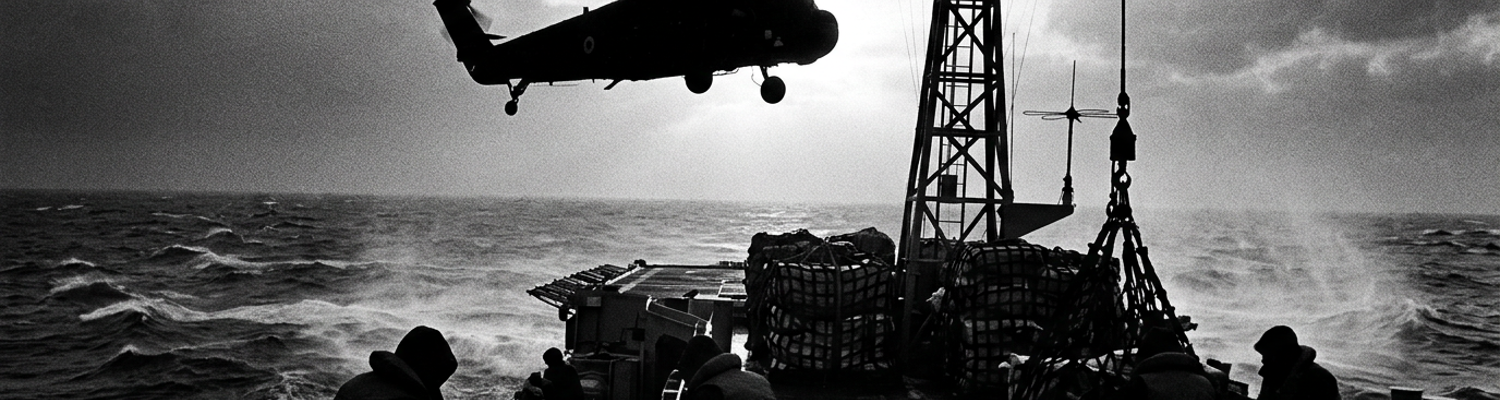

Kaman UH-2A Seasprite Cargo Hook Development
High-pressure MIL-H-5606 hydraulic fluid sprayed across the lower fuselage. The primary release actuator blew its internal seals. Steel locking pawls inside the belly-mounted latch assembly scraped violently against the titanium release cam. A 2,500-pound pallet of 5-inch naval artillery shells dropped three feet. The load jerked the helicopter downward before the manual override caught the pallet. This mechanical failure over the Pacific in late 1963 exposed severe structural limitations. The machine was forced into a role it was never designed to perform.
Not by choice. By direct order.
Archival evidence shows Kaman Aircraft developed early UH-2A Seasprite airframes primarily for utility and search-and-rescue roles. Engineers at Kaman in Bloomfield drafted the HU2K-1 under a 1956 Bureau of Aeronautics specification calling for an all-weather utility helicopter. The primary mission profile required the aircraft to hover over open ocean and pull a downed aviator from the water. A starboard-side hydraulic rescue hoist rated for a maximum of 600 pounds handled this task. General Electric T58-GE-8B turboshaft engines provided 1,250 shaft horsepower. This figure was calculated to lift a crew of three and two passengers. The baseline empty weight stood at 6,100 pounds. Fully fueled with external drop tanks, the gross weight approached 8,600 pounds. Very little margin remained for external freight.
The side-mounted hoist utilized a simple electric winch spooling 100 feet of braided steel cable.
Kaman designers built the landing gear to absorb the shock of hard deck landings. They did not reinforce the belly panels to support centralized downward tension. Naval Air Systems Command issued an urgent directive in early 1963 requiring carrier strike groups to resupply at sea without breaking formation. Planners selected the UH-2A to carry out this new vertical replenishment mission based entirely on its availability on cruiser and destroyer helipads.
The airframe required immediate physical modification to lift heavy cargo.
Technicians at the Naval Air Test Center cut directly through the lower fuselage skin beneath the main transmission housing. They bolted a modified Eastern Rotorcraft suspension frame to the primary load-bearing bulkheads at fuselage station 132. An electromechanical hook rated for a 4,000-pound static load hung from this new hardpoint. Flight crews ran heavy-gauge wiring and auxiliary hydraulic tubing from the main rotor gearbox down through the cabin floor. This powered the pilot-controlled release solenoid. Helicopter Combat Support Squadron One received the first batch of these modified aircraft. Their flight logs from September 1963 detail the grueling pace required to keep a fleet supplied. Pilots flew back-to-back sorties. They ferried everything from frozen rations to Mk 44 torpedoes.
The experimental hook featured a dual-release mechanism.
Either the pilot via a cyclic stick button or a crewman in the cabin using a manual foot pedal could drop the load. The ship-to-ship transfer process demanded absolute precision. The helicopter matched the exact speed and heading of the receiving vessel.
A close review of operational logs indicates the suspension frame bolts began shearing after exactly forty hours of flight time.
Lifting heavy munitions crates and dropping them onto moving ship decks in rapid succession subjected the Kaman airframe to extreme downward torque. Pilots had to hover at fifty feet. They aligned the hook with a pendant attached to the cargo net and rapidly ascended as the supply ship rolled in the ocean swells. The snatch-loading effect sent kinetic shocks directly into the helicopter transmission mounts. Maintenance crews aboard the destroyer tender USS Frontier (AD-25) recorded transverse micro-fractures forming along the aluminum floor joists surrounding the new cargo hook cut-out. The hook primary hydraulic release valve relied on a constant pressure of 1,500 PSI from the utility system. Repeated sudden weight transfers caused that pressure to spike well beyond 3,000 PSI. This led to the blown seals and grinding gears experienced during the initial trials.
Mechanics replaced the standard aluminum hydraulic fittings with heavier stainless steel variants.
They installed a nitrogen-charged accumulator inline with the cargo hook release circuit to absorb the pressure spikes. These field modifications added fifty pounds of weight to the burdened airframe. Testing resumed at coordinates 32 degrees 42 minutes North 117 degrees 11 minutes West. The helicopter lifted 2,000-pound concrete test blocks directly from the aft deck of USS Frontier.
USS Frontier Maintenance Hub and VERTREP Evaluations
Pacific Fleet Command designated the Dixie-class destroyer tender as the primary floating maintenance hub for coastal vertical replenishment trials in November 1963. Operating at coordinates 32 degrees 55 minutes North 118 degrees 33 minutes West off San Clemente Island, the USS Frontier (AD-25) anchored in Sea State 4 conditions. The crew evaluated the experimental Kaman UH-2A Seasprite cargo hook assemblies. Designers never built the baseline helicopter for this specific heavy-lift profile.
Commander Naval Air Forces Pacific demanded a rapid underway assessment of the newly bolted Eastern Rotorcraft suspension frame.
Below the main deck, the Frontier provided a massive floating machine shop. The space was equipped with heavy-duty South Bend lathes and Bridgeport milling machines. On November 4, 1963, flight operations commenced. Helicopter Combat Support Squadron One (HC-1) pilots attempted to lift 1,500-pound pallets of 5-inch naval artillery shells and 500-pound Mk 44 torpedoes from the aft deck of the tender. They delivered them to the USS Morton (DD-948) steaming alongside at twelve knots.
The sheer mechanical stress of snatching dead weight off a pitching deck immediately warped the factory-standard aluminum release cams.
Maintenance crews aboard the destroyer tender performed real-time technical modifications on the experimental cargo hook mechanisms during these underway fleet evaluations. The moment the UH-2A shut down its General Electric T58-GE-8B engines, mechanics rushed onto the flight deck. Teams unbolted the jammed hook assemblies and carried them directly into the hull. Down in the R-1 Division workspaces, shipboard technicians discovered the internal locking pawls were shearing under the dynamic load of a swinging pallet. Kaman originally machined these parts from standard 2024 aluminum. Utilizing the onboard metal shop, machinists fabricated replacement pawls from hardened 4130 chromoly steel. They heat-treated them in the ship high-temperature forge. Exact tolerances dictated the success of the repair. Any deviation beyond 0.005 inches caused the electromechanical release solenoid to bind against the titanium housing.
They finished the first custom steel pawl in exactly three hours.
Reinstalling the modified hardware required flight line personnel to crawl directly under the main transmission housing at fuselage station 132. Heavy swells off the California coast sent saltwater spray constantly washing over the lower fuselage. Corrosive moisture easily penetrated the unsealed wiring harnesses connecting the pilot cyclic stick button to the hook release relay. Electricians aboard the AD-25 stripped the factory wiring out of the airframe entirely to solve the short-circuiting. A heavy-duty rubberized marine-grade wire designed for submarine bulkheads replaced the standard aviation cables. By routing this thicker 10-gauge wire along the upper cabin ceiling, the new circuit completely bypassed the fragile utility hydraulic system sensors. Testing the newly fabricated steel pawl and marine wiring involved sixty consecutive lifts of a 2,000-pound concrete block.
The modified hook held the load without a single uncommanded drop.
The pace of these underway adaptations becomes clear when examining the historical record from late November 1963. Entries from the ship logbook on November 22 detail a complete redesign of the manual override linkage. Kaman engineers originally routed a thin braided steel cable from a foot pedal in the cabin down to the belly hook. After lifting five consecutive loads, deck crews measured up to two inches of stretch in this cable. Such severe slack prevented the manual override from fully disengaging the primary latch. Hull maintenance technicians aboard the Frontier cut a 0.75-inch thick rigid stainless steel push-rod to replace the flexible cable. Using tungsten inert gas welding, they attached a series of steel guide rings directly to the interior cabin floor to keep the rod perfectly aligned. This rigid linkage transferred mechanical force instantly to the belly hook without any loss of tension.
Sub-Zero Blade Icing and Rotorhead Drive-Shaft Fractures
Helicopter Combat Support Squadron One detachments deployed to the Gulf of Alaska in December 1963. Navigational charts at coordinates 57 degrees 46 minutes North 152 degrees 29 minutes West placed the fleet directly in the path of Arctic storm systems. High-latitude resupply runs exposed early UH-2A Seasprite airframes to extreme sub-zero updrafts and severe blade icing. Kaman helicopters operated continuously off the aft deck of the USS Castor (AKS-1) in twenty-knot headwinds. Massive ocean swells generated heavy sea spray across the flight deck. Sub-zero ambient air temperatures froze this moisture instantly upon contact with the aluminum skin of the aircraft. Ice accumulated rapidly on the asymmetrical leading edges of the 44-foot main rotor blades. Factory specifications for these early airframes lacked electrical thermal de-icing boots. Pilots reported a sudden aggressive loss of lift as the ice buildup altered the aerodynamic profile of the airfoil.
Up to forty pounds of solid rime ice bonded directly to the aluminum honeycomb structures within three minutes of flight.
Flight crews attempted to mitigate this accumulation by spraying the blades with pressurized ethylene glycol before launch. The chemical wash provided only three minutes of protection in the harsh maritime environment. Helicopters hovered at fifty feet to hoist 1,200-pound cargo nets from the supply ship. Freezing updrafts funneled vertically through the high-velocity rotor wash. Supercooled water droplets slammed into the spinning blades at 400 revolutions per minute. Asymmetrical shedding followed shortly after the initial buildup. Heavy chunks of ice broke off unevenly from the outer blade tips. This unequal weight distribution threw the entire dynamic system out of balance.
Extreme sub-zero updrafts and blade icing during high-latitude resupply runs caused severe rotorhead drive-shaft fractures across early Seasprite airframes. Violent low-frequency vibrations bypassed the rubberized elastomeric dampers designed to absorb normal flight turbulence. Kinetic shockwaves traveled straight down the titanium rotor mast and into the main transmission housing. Inside the heavily bolted gearbox, the primary drive-shaft connected the twin General Electric T58 turboshafts directly to the planetary gears. Kaman engineers machined this hollow shaft from high-strength 4340 alloy steel. It measured exactly 2.5 inches in diameter and rotated at high RPMs. Asymmetrical blade icing induced massive torsional stress across this mechanical linkage. Shafts twisted violently against their own mounting splines hundreds of times per second.
Micro-fractures formed rapidly along the base of the machined gear teeth.
Maintenance personnel aboard the USS Frontier utilized fluorescent dye penetrant inspections to evaluate the drive-shafts of returning aircraft in January 1964. Technicians applied liquid chemical dye to the steel splines under ultraviolet light in the ship darkened hangar bay. Green fluorescence revealed jagged stress fractures propagating horizontally across the metal grain. Left undetected, the shaft snapped entirely under the dynamic load of a heavy cargo net. A total disconnect between the engines and the rotorhead resulted immediately. Several UH-2A crews experienced uncommanded torque loss while hovering over icy waters. Warning horns blared in the cockpit as rotor RPM decayed. Pilots dumped their suspended cargo directly into the ocean to reduce gross weight. They executed emergency autorotations back onto the pitching decks of the fleet.
Mechanics logged twelve destroyed drive-shafts in a single three-week deployment.
Shipboard machinists lacked the specialized metallurgy equipment to fabricate replacement drive-shafts from scratch. Processing 4340 steel required a specific high-temperature heat treatment and a chemical nitriding process to achieve the necessary surface hardness. Flight line personnel grounded six UH-2A airframes on the USS Castor due to parts shortages. Deck crews stripped intact drive-shafts from helicopters with failed hydraulic systems to keep a single aircraft flying. Remaining fractured shafts were boxed in wooden shipping crates and sent back to the Naval Air Rework Facility in North Island, California. Engineers measured the sheared splines with precision micrometers. They recorded a consistent 0.04-inch deflection in the metal just before the breaking point.
Destroyer Flotilla 3 Signal Errors and Cargo Loss
Commander Destroyer Flotilla 3 ordered strict emissions control during underway replenishment drills off the Southern California coast on December 14, 1963. Radio silence forced the USS Frontier (AD-25) and receiving destroyers to rely entirely on visual flag hoists. At coordinates 32 degrees 48 minutes North 118 degrees 25 minutes West, the USS Richard B. Anderson (DD-786) steamed alongside the tender at fifteen knots. Exactly eighty yards of churning water separated the vessels. Kaman UH-2A Seasprite pilots had to interpret complex signal flags snapping in thirty-knot crosswinds while simultaneously maintaining a fifty-foot hover over a pitching deck. Standard operating procedure required the receiving destroyer to run the Romeo flag up to the dip to indicate preparation. The crew then closed it up to the yardarm to signal deck readiness. The tender crew on the Frontier mistakenly hoisted a yellow and green Prep pennant on the starboard side. They paired it with a localized flotilla indicator flag.
This specific visual command dictated an immediate emergency breakaway for all connected vessels.
The Seasprite aircraft commander fought heavy rotor wash and scanned the mast through rain-streaked plexiglass. He misread the flapping nylon halyards. He interpreted the chaotic sequence as the standard authorization to release the suspended cargo net over the drop zone. His thumb depressed the red cyclic-mounted solenoid switch on the control stick. Heavy-gauge marine wiring routed through the upper cabin ceiling sent exactly twenty-four volts directly down to the Eastern Rotorcraft belly hook. Inside the titanium housing, the electromechanical relay energized. The newly fabricated 4130 chromoly steel locking pawls snapped open instantly under the massive static tension of the load.
Two thousand pounds of suspended freight detached from fuselage station 132 in a fraction of a second.
The sudden reduction in payload weight caused the helicopter to surge violently upward. The pilot dumped collective pitch to avoid a main rotor stall. The premature sling-load jettison resulted in the total loss of highly sensitive radar repair parts required by the operational escorts. Inside the heavy canvas cargo net sat four reinforced wooden crates containing replacement magnetrons, high-voltage pulse amplifiers, and beryllium-copper wave-guide assemblies for the AN/SPS-40 air search radar system. Supply officers aboard the Frontier packed these specific components to repair the primary early warning arrays on three adjacent destroyers in the flotilla. The unsecured load plummeted forty feet. It entirely missed the steel aft flight deck of the Richard B. Anderson by a margin of fifteen feet. It struck the Pacific Ocean surface at high velocity. The impact generated a massive plume of white water. Saltwater violently breached the unsealed wooden crates upon impact. The sheer kinetic force of hitting the ocean surface shattered the fragile glass vacuum tubes and permanently crushed the precisely machined wave-guides.
The entire net sank into 600 fathoms of water within forty-five seconds.
The destruction of these specific electronics severely degraded the combat readiness of the task group. Without the functioning AN/SPS-40 components, the escorts lost the ability to track incoming airborne contacts beyond a twenty-mile radius. Electronic technicians aboard the destroyers lacked any salvageable spares in their localized inventory. They submitted emergency requisition orders via teletype to Naval Station San Diego. The messages demanded priority airlift of replacement hardware. Fleet commanders temporarily grounded the UH-2A vertical replenishment flights for three days to completely rewrite the visual signaling protocols between aviation detachments and surface ships. Supply chain bottlenecks at the mainland depots kept the flotilla operating with blind radar sectors until December 28. The Frontier recorded a loss of 450,000 dollars in aviation and electronic assets during this single botched transfer.
Post-Crisis Structural Retrofits and Communication Reforms
Engineers at Kaman Aircraft in Bloomfield received twenty-four sheared 4340 alloy steel drive-shafts from the Pacific Fleet by late January 1964. Naval Air Systems Command authorized an emergency redesign of the entire transmission linkage connecting the General Electric T58 turboshafts to the main planetary gears. The November 1963 mechanical failures off the California coast and the Gulf of Alaska proved the original elastomeric dampers failed to absorb low-frequency vibrations. Metallurgists abandoned the original 2.5-inch hollow core design. They drafted a reinforced shaft measuring 2.875 inches in diameter. A press-fitted titanium sleeve surrounded the new component. This physical alteration required shipboard mechanics aboard the USS Frontier (AD-25) to expand the primary gearbox housing using tungsten-carbide drill bits. Maintenance personnel had to remove the 44-foot main rotor assembly using overhead block and tackle systems to access the deep transmission mounts. Factory technicians also altered the chemical nitriding process for the mounting splines. This increased the surface hardness rating to Rockwell C55.
The new assembly added nineteen pounds of dead weight directly beneath the main rotorhead.
Commander Naval Air Forces Pacific simultaneously overhauled cold-weather flight parameters to prevent further torsional stress on the airframe. Draftsmen at Naval Air Station North Island entirely rewrote the UH-2A NATOPS manual sections governing Arctic deployments. The harsh maritime environment at coordinates 57 degrees 46 minutes North 152 degrees 29 minutes West demanded these exact operational limits. Supercooled water droplets bonded to the asymmetrical leading edges of the aluminum rotor blades within two minutes of exposure. The updated guidelines strictly prohibited the use of unheated ethylene glycol for pre-flight de-icing. Flight deck crews aboard the USS Castor (AKS-1) received heavy-duty heating carts to apply a viscous Type IV propylene glycol fluid at 140 degrees Fahrenheit just before launch. The new heated chemical wash formed a temporary barrier. It caused the ocean spray to bead and shear off before freezing. Helicopter aircraft commanders received orders restricting any fifty-foot hover over a pitching deck to a maximum duration of ninety seconds when ambient temperatures dropped below 32 degrees Fahrenheit.
Pilots exceeding this time limit triggered a mandatory shutdown.
A full fluorescent dye penetrant inspection of their transmission splines followed immediately.
The response to the December cargo jettison off the USS Richard B. Anderson reveals a total restructuring of fleet communications. Radio silence mandates during emissions control drills previously caused severe misinterpretations of localized flotilla indicator flags. The loss of 450,000 dollars in AN/SPS-40 radar components forced Commander Destroyer Flotilla 3 to ban the yellow and green Prep pennant during all underway replenishment drills. Signal hoist manuals across every active tender crew and destroyer flotilla in the Pacific underwent immediate standardization to prevent further jettison errors. Staff officers at Naval Station San Diego typed out the new communication protocols on triplicate carbon paper. They distributed them via courier to every vessel in the task group. Tactical officers implemented a dedicated VERTREP Alpha flag sequence. This specific visual command required the supply ship to run a solid red square flag up to the yardarm only when the drop zone was completely clear of deck personnel. Helicopter pilots no longer relied solely on flapping nylon halyards in thirty-knot crosswinds to determine load release timing.
Quartermasters on the USS Frontier physically destroyed their outdated signal manuals in the ship lower-deck incinerator.
Naval engineers integrated redundant visual verification steps to secure the deck communication loop. Receiving destroyers had to aim a directional Aldis lamp directly at the hovering Seasprite. The Aldis lamp operator stood on the open bridge wing. He tracked the aircraft through high-powered binoculars. Bridge personnel transmitted a continuous green light beam through the rain-streaked plexiglass of the cockpit to signal final drop authorization. Down on the steel aft deck, a designated Landing Signal Enlisted wearing a high-visibility yellow surcoat took control of the helicopter final descent. The deck crewman positioned himself exactly twenty feet forward of the designated drop zone. He braced his boots against the heavy rotor wash. His hand motions provided a constant unbroken visual reference point independent of the ship roll in Sea State 4 conditions.
The pilot kept the cyclic-mounted release solenoid entirely disabled until he visually confirmed the crossed red flashlight wands directly below his side window.
Obsolescence of Single-Engine Seasprites in Naval Logistics
Evaluators at Naval Air Systems Command analyzed the December 1963 cargo jettison incidents. They determined the single-engine UH-2A was mathematically incapable of safe fleet resupply. The single General Electric T58-GE-8B turboshaft produced exactly 1,250 shaft horsepower at maximum continuous output. This power rating proved entirely insufficient to maintain a fifty-foot hover with a 2,000-pound sling load while fighting thirty-knot crosswinds off the California coast. Mechanics aboard the destroyer tender USS Frontier (AD-25) documented a 15 percent drop in main rotor RPM during sudden torque applications. They also recorded dangerous exhaust gas temperature spikes exceeding 650 degrees Celsius. Desk officers at the Pentagon drafted a technical memorandum on March 14, 1964. It formally classified the Kaman Seasprite as physically inadequate for high-tempo vertical replenishment. The document dictated an immediate shift toward heavy-lift dual-engine platforms capable of surviving an engine failure while carrying suspended munitions over open ocean.
Planners selected the Boeing Vertol CH-46A Sea Knight to replace the Seasprite in the maritime supply chain.
The Sea Knight solved the specific aerodynamic deficits of the Kaman airframe through increased shaft horsepower and dual-rotor lift. Twin T58-GE-8B engines drove a tandem-rotor configuration via a heavy-duty synchronization shaft running the entire length of the upper fuselage. This specific mechanical arrangement completely eliminated the need for a power-draining tail rotor. The Boeing design directed 100 percent of the generated engine torque straight into vertical lift. Flight testing at Naval Air Station Patuxent River at coordinates 38 degrees 17 minutes North 76 degrees 25 minutes West demonstrated the CH-46A lifting 4,000-pound pallets of Mk 44 torpedoes with a 40 percent power reserve. Helicopter Combat Support Squadron One (HC-1) began receiving the 17,000-pound Boeing airframes in July 1964. Pilots transitioned from the cramped Seasprite cockpit to a heavy transport platform. The new aircraft came equipped with a rear loading ramp and an integrated dual-hook suspension frame bolted directly to the primary load-bearing bulkheads at station 210.
The rapid procurement of the CH-46A left dozens of single-engine UH-2A airframes parked on the tarmac at Naval Air Station North Island without a designated fleet role.
The Navy initiated a complete structural conversion of these sidelined cargo helicopters in 1967 to salvage the initial procurement investment. Engineers at Kaman in Bloomfield drafted a retrofit program to install a second T58 turboshaft engine onto the upper transmission deck. Technicians cut away the original fiberglass cowlings and expanded the engine bays. They bolted a new combining gearbox to the titanium rotor mast to synchronize the input from both powerplants. This physical modification resulted in the UH-2C variant. The added horsepower allowed the airframe to carry heavier electronic payloads rather than suspended external freight. Naval planners repurposed these upgraded airframes for the Light Airborne Multi-Purpose System (LAMPS) program to counter the expansion of Soviet submarine patrols. Factory workers stripped out the manual cargo hook overrides, the reinforced belly panels, and the heavy-gauge marine wiring previously installed by the hull technicians aboard the USS Frontier.
The aircraft received the new operational designation of SH-2D.
Machinists bolted a fiberglass radome housing the AN/APS-115 surface search radar directly beneath the chin of the helicopter. They reinforced the starboard side fuselage at station 140 to support a pneumatic launch tube for an ASQ-81 magnetic anomaly detector. Flight crews dropped passive acoustic sonobuoys from newly installed internal cabin racks to track submerged contacts operating in the Pacific transit lanes. Acoustic sensor operators sat in the rear cabin monitoring frequency readouts on a cathode-ray tube display. The former cargo haulers now carried a pair of 500-pound Mk 46 acoustic homing torpedoes on side-mounted pylons. Upgrades continued into the SH-2F variant in 1973. This version featured a reinforced main landing gear to handle hard deck landings on Knox-class frigates in Sea State 5 conditions. The Kaman production line delivered the final converted LAMPS airframe with the torpedo mounting brackets torqued to exactly 120 foot-pounds.