
Task Force 77 Sea of Japan Deployments
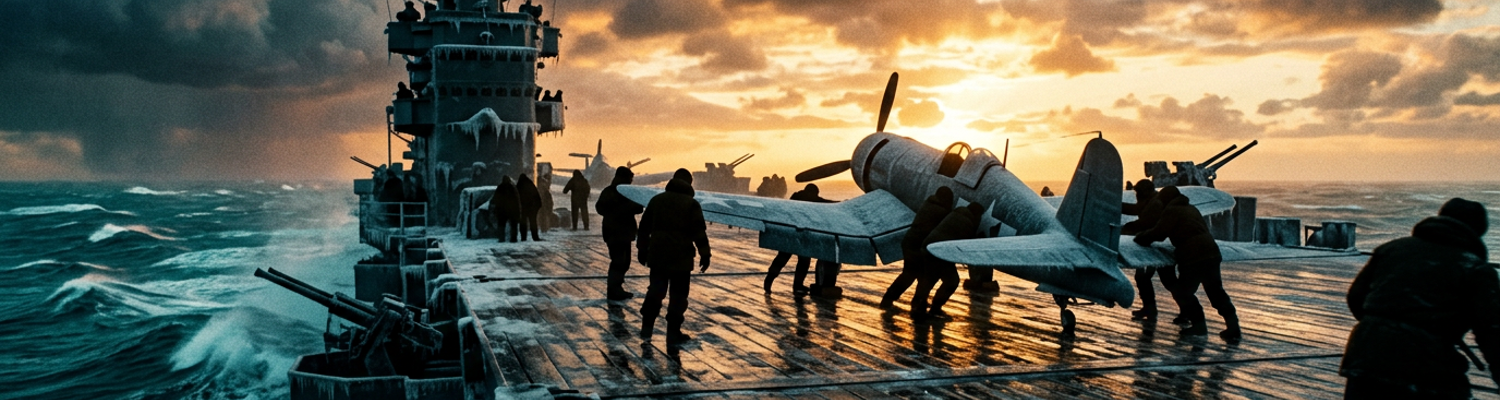
Seawater froze into thick crusts across the forward catapults of attack aircraft carrier USS Bon Homme Richard as the ship operated in freezing gales with Task Force 77 in the Sea of Japan during November 1952. Arctic air masses sweeping down from Manchuria collided with moist marine air over the coast of eastern Korea, producing blinding snow squalls and rough swells that rolled the thirty-thousand-ton carrier through steep troughs. Flight deck crews wore heavy wool and rubber exposure suits that stiffened in the sub-zero chill, forcing sailors to swing heavy wooden mallets against frozen arresting cables and hydraulic fittings to prevent mechanism failure. Mechanics worked barehanded for brief intervals on the wind-scoured flight deck to free jammed safety pins and defrost canopy tracks before pilots climbed into freezing cockpits.
Pilots climbed into their freezing cockpits and launched Carrier Air Group 7 on high-tempo interdiction strikes directly from those icy catapults, targeting fortified Communist rail junctions and coastal artillery around Wonsan and Kowon. Aviators flew low beneath the gray overcast along the eastern rail corridor, hunting for supply trains that moved through deep mountain cuts between the port of Wonsan and the rail hub at Kowon. Communist artillery crews had carved heavy gun emplacements and mortar bunkers directly into the limestone cliffs overlooking the tracks, anchoring their positions behind thick timber and rock blast walls. Shrapnel from these hidden flak batteries regularly punctured aircraft fuel cells and severed hydraulic lines as Navy strike leaders pressed their bombing runs down to treetop level. Bomb fragments and cratered roadbeds disrupted northern logistics for hours at a time, but North Korean repair battalions emerged from tunnels each night to replace shattered ties and lay fresh ballast before daylight.
Ordnancemen aboard Bon Homme Richard altered the bomb fuses on their strike aircraft to disrupt this rapid nighttime rebuilding, installing delayed mechanical timers designed to detonate hours after impact. Flight crews dropped these delayed-action weapons into narrow choke points around the Kowon railway yards, expecting the buried explosives to kill repair workers and keep the rail lines severed around the clock. Heavy mountain snowdrifts absorbed the impact of the falling casings, burying the bombs deep in frozen mud and shale without triggering their internal arming vanes. Ground spotters soon reported that dozens of unexploded five-hundred-pound bombs lay intact along the embankment, giving enemy salvage units an unexpected stockpile of high-grade military explosive right beside their main transportation artery. Communist engineers hauled the duds into covered workshops, removed the tail assemblies, and began converting the American warheads into improvised landmines and heavy coastal defense charges.
Artillerymen positioned these repacked aerial bombs inside concealed revetments ringing the approaches to Wonsan harbor, aiming the heavy charges directly at the coastal shipping lanes used by United Nations blockade vessels. Shore batteries used the scavenged explosives to increase the blast radius of their coastal defense rounds, enabling hidden guns to bracket offshore targets with sudden lethal concussions. Patrol craft and destroyers coordinating with Task Force 77 suddenly faced heavier and more destructive shore fire from previously silenced battery sectors. Communist gunners fired the modified ordnance directly into the low-altitude dive-bombing corridors around the bay, filling the air with dense clouds of secondary fragmentation. Task Force commanders ordered immediate retaliatory strikes against the rearmed gun positions, forcing deck crews to launch continuous sorties through the worsening winter weather.
Flight Deck Limitations and Hydraulic Catapult Wear
Deck crews wrestled heavy Grumman Panther jets, Douglas Skyraiders, and ordnance-laden Vought Corsairs onto the unmodernized straight wooden flight deck of the carrier. High-tempo Cherokee Strikes demanded mixed launches of these heavy aircraft, pushing the legacy hydraulic catapults beyond their designed operational limits. Sub-zero temperatures caused hydraulic fluid to thicken inside the catapult cylinders, slowing the launch pistons and reducing the acceleration needed to push fully loaded strike planes into the air. Launch officers watched anxiously as heavily armed Corsairs sank dangerously close to the freezing waves immediately after leaving the bow. Mechanics rushed below decks between launches to bleed pressurized lines and replace blown seals, struggling to keep the aging machinery functional under the relentless combat schedule.
Maintenance teams fought a losing battle against catastrophic mechanical wear as the intense sortie rate degraded both the catapults and the wooden flight deck. Jet exhaust from the Panthers scorched the timber planking, weakening the structural integrity of the deck and requiring carpenters to constantly replace charred wood. Arresting gear cables snapped under the strain of recovering heavy aircraft in rough seas, whipping across the deck and forcing sailors to dive for cover behind steel bulkheads. Damaged aircraft returning from Wonsan frequently missed the remaining wires, crashing into the nylon barrier nets and creating massive bottlenecks on the forward deck. Flight operations ground to a halt while crash crews dragged the tangled wreckage clear, delaying scheduled launches and leaving airborne strike packages circling with dwindling fuel reserves.
Pilots in circling strike packages burned through their aviation fuel while waiting for the deck to clear, forcing flight leaders to order immediate landings once the barriers were reset. Deck handlers packed the returning aircraft tightly onto the aft deck, leaving virtually no room to maneuver the heavy planes toward the forward catapults for the next mission. Aviation fuel spilled across the frozen planks during these cramped refueling operations, creating severe fire hazards that required damage control teams to stand by with foam hoses. The sheer volume of strike aircraft needed to suppress the fortified coastal guns overwhelmed the physical capacity of the straight-deck layout, forcing deck officers to strike heavily damaged planes below to the hangar bay. Task Force commanders ordered surface gunnery officers to take over the bombardment duties, demanding immediate aerial spotting to guide the naval gunfire.
Reallocation of Specialized Carrier Reconnaissance Assets
Commanders aboard Bon Homme Richard issued a tactical directive that diverted carrier reconnaissance aircraft from Composite Squadron 61 Detachment N away from high-altitude mapping to forward close-support spotting. Pilots of the detachment flew Grumman Panthers equipped with specialized vertical aerial cameras mounted inside elongated nose compartments where twenty-millimeter cannons normally sat. These modifications stripped the jet fighters of all offensive weaponry, leaving the single-seat aircraft completely defenseless against hostile ground fire and interceptors. Carrier flight schedules had previously sent the photo jets into the clear thin air above twenty-five-thousand feet, where wide-angle lenses photographed hundreds of square miles of North Korean terrain to update outdated theater navigation charts. Navy planners discarded those long-range mapping tracks to satisfy the urgent demands of surface gunnery officers aboard cruisers and destroyers who needed real-time bomb damage assessments and firing corrections. Deck crews on Bon Homme Richard fueled the camera jets alongside heavily laden Corsair and Skyraider strike packages, pushing the unarmed reconnaissance pilots into contested coastal airspace without fighter escorts.
Carrier air controllers routed the unarmed photo-reconnaissance aircraft low over frontline choke points to verify strike coordinates and artillery accuracy. Low-altitude passes brought the Panthers down to five hundred feet above frozen railway cuts and river bridges, directly within range of Communist light flak and small-arms fire. Gun crews from North Korean artillery regiments filled the narrow mountain passes with overlapping fields of machine-gun fire and thirty-seven-millimeter antiaircraft bursts whenever the low-flying jets approached. Heavy vibrations and shrapnel hits repeatedly cracked the delicate optical glass in the nose camera bays, ruining rolls of film before pilots could return to the carrier. Cold air rushing through shrapnel holes chilled the internal camera compartments, causing condensation to freeze across lenses and jamming the mechanical shutters that captured ground details. Mechanics on Bon Homme Richard discovered that repeated low-level runs through turbulent valleys warped the wing roots and strained the airframes far beyond normal wear.
Technicians on the hangar deck struggled to keep the damaged photo-reconnaissance Panthers operational as maintenance demands overwhelmed available spare parts. Composite Squadron 61 Detachment N possessed only three assigned aircraft aboard the carrier, meaning that even minor flak damage or hydraulic leaks removed a major portion of the photographic capability of the ship. Turnaround times between missions stretched from two hours to entire days as mechanics patched punctured skin panels and replaced frosted camera assemblies. High fuel consumption during low-altitude runs forced the jets to land with empty reserves, often compelling pilots to make emergency straight-in carrier approaches that disrupted ongoing strike launches. Catapult crews held armed strike aircraft on the flight deck while damaged reconnaissance jets cleared the arresting wires, reducing the overall sortie rate of Carrier Air Group 7 during peak daylight hours.
Staff officers analyzing the daily reconnaissance film realized that exhausting the specialized camera jets over local targets left the wider Korean theater completely unmapped. High-altitude mapping flights over North Korean transportation corridors ceased entirely as the detachment devoted its remaining flight hours to low-level target spotting around Wonsan. Chinese and North Korean logistics officers exploited this lack of high-altitude surveillance by moving fresh infantry divisions and motorized supply convoys through eastern mountain corridors without detection. Train crews pushed hundreds of boxcars through railway hubs north of Kowon during daylight intervals that had previously been monitored by Navy cameras. Communist forces established fortified antiaircraft ambushes and repositioned mobile artillery battalions along the coast, aiming their newly sited weapons directly at the low-altitude flight paths used by the Navy camera jets.
North Korean Flak Traps and Interdiction Losses
Pilots conducting low-altitude spotting runs drew naval aircraft directly into concealed Communist anti-aircraft flak traps stationed along rail valleys where steep canyon walls prevented escape. Spotter jets descended below the winter cloud base to inspect bombed railway cuts and locate hidden coastal batteries, unaware that North Korean gun crews had positioned heavy machine guns and rapid-firing cannons across the canyon floors. Trapped aircraft flew through narrow ravines where overlapping lines of fire swept across their flight paths from both ridgelines at the same time. Aviators had to maintain level flight at five hundred feet to keep target cameras aligned and observe artillery impacts, giving enemy gunners steady firing angles against the unprotected underside of each passing plane. Dense volleys of tracer rounds bracketed the aircraft before flight leaders could warn following divisions or call for suppressive fire from offshore cruisers.
Gunners firing concentrated automatic weapons and heavy artillery shot down strike aircraft and crippled reconnaissance flights over Wonsan as the ambush erupted across the valley. Metal fragments tore through the aluminum wings of Grumman Panther jets, severing hydraulic lines, puncturing fuel cells, and smashing photographic lenses mounted in the nose compartments. Douglas Skyraiders and Vought Corsairs arriving to bomb nearby rail yards flew directly into the same crossfire while attempting to draw fire away from the unarmed reconnaissance planes. Explosive rounds struck radial engine blocks, burning through oil lines and filling cockpits with blinding smoke as strike pilots banked hard toward open water. Damaged aircraft shed debris and trailed thick smoke as they struggled toward the coastline, while planes with shattered flight controls crashed into the granite hillsides. Surviving reconnaissance pilots nursed crippled jets past coastal batteries with depressurized cockpits, failing instruments, and cracked cameras that captured nothing but blurred images of the canyon walls.
Sailors aboard Bon Homme Richard rushed across the frozen flight deck to erect emergency barricades as damaged aircraft approached the carrier with jammed landing gear and shredded control surfaces. Crash crews sprayed foam over burning fuselages as crippled Panthers and Skyraiders slammed into nylon barrier nets, throwing sparks across the wooden deck planking. Several heavily damaged planes ran out of fuel before reaching the ship, forcing pilots to ditch into the frigid waters of the Sea of Japan, where rescue destroyers and utility helicopters hurried to pull shivering airmen from the swells. Technicians inside the hangar bay cannibalized parts from grounded aircraft to repair punctured fuel bladders and shattered canopies, but replacement components ran out as daily damage reports multiplied. Damaged airframes crowded the maintenance areas, leaving mechanics unable to turn around scheduled flights and forcing flight leaders to cancel planned combat sorties.
Flight leaders cancelled the low-altitude spotting runs around Wonsan, ordering pilots on subsequent interdiction sweeps to pull out of bomb runs above three thousand feet. Higher release altitudes protected navy aircraft from automatic weapons fire but reduced bombing accuracy against camouflaged rail lines, tunnels, and coastal gun positions. Navy bombs scattered across open hillsides, leaving key railway junctions and supply bridges largely undamaged despite heavy expenditures of ordnance. North Korean repair battalions quickly filled cratered track beds and moved trainloads of heavy artillery and ammunition through Wonsan under the cover of winter snowstorms. Bon Homme Richard turned away from the coast to take on replacement aircraft and fresh aircrews, leaving Communist trains rolling freely along the eastern rail corridor.
Destroyer Plane Guards and Shore Battery Engagements
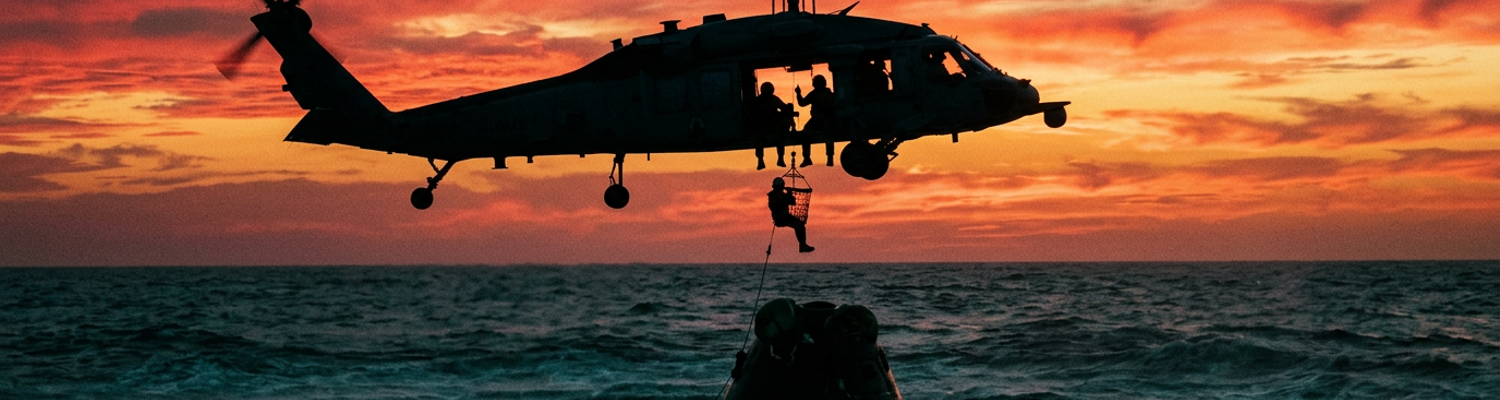
North Korean shore gunners turned their newly supplied artillery pieces toward the water, firing directly at downed naval aviators floating in the harbor. Downed aviators prompted immediate search and rescue scrambles by Sikorsky utility helicopters operating from Task Force 77 ships. Helicopter pilots flew into howling sub-zero headwinds that coated windshields and rotor mechanisms with thick sea spray ice, pushing their radial engines to maximum power. Crewmen worked mechanical rescue hoists while leaning through open cabin doorways, dropping sling collars into thirty-degree water where floating airmen faced loss of consciousness from hypothermia in less than twenty minutes. Carburetor icing and small internal fuel tanks left the utility helicopters with only brief intervals to find dye markers in the rough waves and haul exhausted pilots aboard before low fuel gauges forced the aircraft to turn back toward open water.
Helicopters retreating toward the carrier left behind several airmen stranded in the inner shoals where coastal crossfire prevented hovering. Plane-guard destroyers steamed close inshore under active North Korean shore battery fire to recover aircrews and suppress artillery. Navigators drove the ships past the five-fathom line at full speed, placing their steel hulls between the trapped airmen and fortified gun revetments along the rocky bluffs. Geysers of cold seawater erupted around the warships as Communist artillerymen bracketed the ships with high-velocity coastal guns. Metal splinters tore through topside rigging, severed radio aerials, and gouged deep gashes into splinter shields as lookouts shouted firing coordinates down to plotting rooms below. Gunners inside the twin five-inch mounts returned fire without pause, hammering the ridgelines with hundreds of rounds to knock out gun emplacements and lay down dense smoke screens across the water.
Projectiles from these naval barrages collapsed cave entrances and silenced several hostile batteries, but the furious pace of fire stripped the destroyers of their combat reserves. Handling rooms exhausted their ready service racks, forcing sailors to haul heavy powder canisters and high-explosive shells by hand from lower magazines along freezing pitch-black passageways. Overheated gun barrels suffered severe rifling wear from continuous rapid salvos, reducing shell velocity and degrading firing accuracy against distant ridgelines. Damage control teams worked through smoke and flying debris to extinguish small electrical fires in ruptured conduits and weld steel patches over shrapnel punctures near the waterlines. Captains found their magazines depleted and their main batteries compromised, compelling task group commanders to order the damaged destroyers to disengage and withdraw from the harbor perimeter.
Artillerymen on the bluffs exploited this naval retreat by hauling hidden reserve field guns back onto the heights overlooking the main shipping lanes. Labor battalions cleared rock debris from damaged bunker tracks and dragged fresh ammunition crates into reinforced positions before replacement warships could arrive. Communist commanders turned these reestablished batteries into a lethal perimeter, locking down the approaches to Wonsan harbor against future surface incursions. Task Force 77 officers discovered that saving the downed aviators had cost the fleet its inner gunline, leaving remaining surface vessels vulnerable to renewed shore bombardment. Naval planners reallocated upcoming carrier strike schedules to target coastal artillery positions, diverting bombs away from the primary rail lines where Communist trains continued to roll inland.
Strategic Repercussions for Naval Aviation Doctrine
Freight trains rolling unhindered through the mountain passes forced Task Force 77 commanders to halt unescorted photo-reconnaissance target marking across the combat zone. Photographic reconnaissance jets had suffered severe damage while flying at wave-top heights to mark artillery targets, leaving the fleet without the high-altitude photography needed to map enemy rear areas. Stripping these aircraft of weapons and sending them down into narrow valleys had exposed defenseless pilots to massed automatic gunfire, while the resulting target markers produced only marginal improvements in shore bombardment accuracy. Task force leadership issued urgent operational orders requiring armed fighter escorts on every photographic sortie and mandating higher minimum pullout altitudes for fleet pilots. Tactical doctrine shifted back toward high-altitude mapping and armed reconnaissance sweeps, pushing Navy aircraft high above the narrow valleys where Communist flak batteries waited.
Fighter escorts assigned to shield the camera planes crowded onto carrier flight decks that were never built to handle high-tempo jet operations. Flight deck crews aboard ships like Bon Homme Richard had to stage dozens of heavily fueled aircraft along narrow wooden flight decks, creating dangerous bottlenecks between the arresting wires and the forward catapult tracks. Straight-deck carrier layouts required landing aircraft to touch down on the aft deck while parked planes, fuel hoses, and deck crews crowded the bow only yards behind steel wire crash barriers. Barrier engagements constantly risked a catastrophic collision with the forward deck park, turning ordinary landing mishaps into fires that threatened to gut the entire flight deck. Sub-zero temperatures and high launch tempos pushed the hydraulic catapults far beyond their engineering limits, producing cracked seals, warped pistons, and persistent fluid leaks across machinery spaces below deck. Launch officers frequently had to hold up combat strike schedules while repair crews flushed fouled hydraulic fluid and replaced warped launch pistons on the forward deck.
Bureau of Ships engineers analyzed these combat maintenance reports, drafting blueprints to modernize Essex-class hulls with angled decks and steam catapults. Engineers concluded that the traditional straight-deck layout and hydraulic launching systems could no longer support the weight and landing speeds of modern jet aviation. British operational trials with an angled landing area offered a physical solution, canting the landing strip several degrees off the centerline so that boltering aircraft could climb away safely without crashing into parked planes on the bow. British steam catapult technology also demonstrated that tapping high-pressure steam directly from main propulsion boilers could accelerate thirty-thousand-pound strike aircraft smoothly without tearing hydraulic seals apart. Fleet commanders forwarded urgent operational assessments urging immediate modernization funds for the active carrier force, warning that straight-deck operations off eastern Korea had pushed ships and air wings to the edge of structural exhaustion. Naval shipyards prepared comprehensive overhaul blueprints known as the SCB-27C and SCB-125 modernization packages, earmarking existing wartime hulls for structural rebuilding the moment they rotated out of the Sea of Japan.
Bon Homme Richard steamed away from the Korean combat zone toward San Francisco Naval Shipyard to undergo the extensive reconstruction demanded by its hard winter deployment. Shipyard workers stripped away the original wooden flight deck and cut deep into the forward hull to install an enclosed hurricane bow. Shipfitters removed the worn hydraulic machinery and mounted twin steam catapults connected directly to the high-pressure boilers of the ship. Construction teams welded a canted flight deck extension over the port side, creating a separate angled landing lane that kept returning aircraft completely clear of the forward parking area. Riggers positioned heavy-duty arresting engines and modernized deck barricades into the gallery spaces below the new flight surface. Yard mechanics completed the installation of high-capacity deck-edge elevators and reinforced blast deflectors, ensuring the modernized carrier could launch and recover heavy swept-wing jet fighters simultaneously, sending a new generation of naval aircraft roaring off the bow.