
Topography and Infiltration Northwest of Khe Sanh
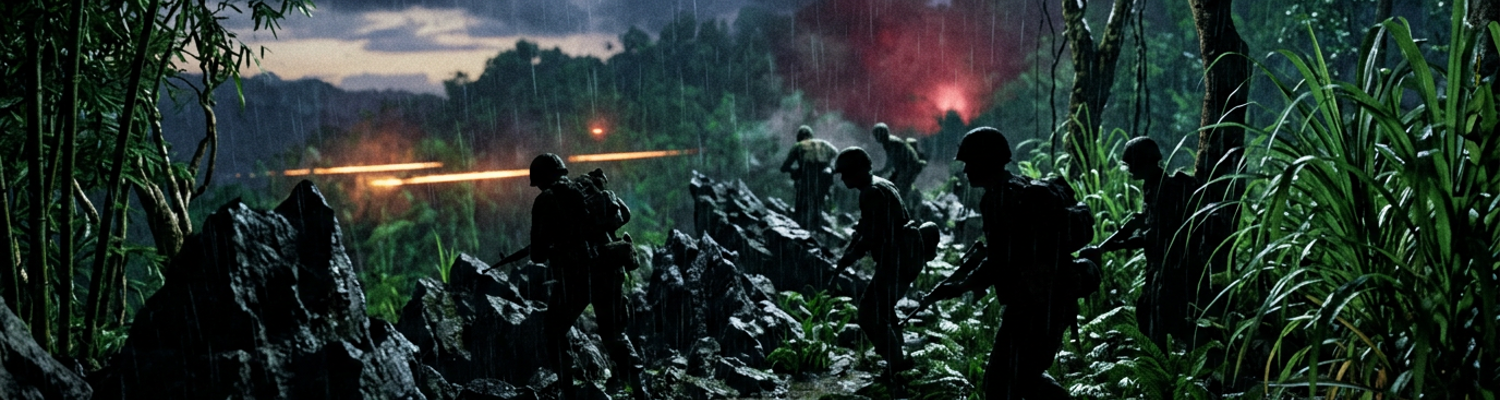
Team Breaker detected the metallic snap of an enemy weapon selector switch twenty meters down the slope. The patrol leader signaled an immediate freeze with a clenched fist. Radio operators instantly unclipped their handsets to transmit an urgent contact warning back to the combat operations center. Battalion staff officers scrambled quick reaction helicopter gunships and alerted standby artillery batteries. Alpha Company of the 3rd Reconnaissance Battalion operated in the dense canopy and elephant grass ridgelines surrounding Hill 665 northwest of Khe Sanh. Razor sharp elephant grass stalks and interwoven bamboo thickets slashed through standard jungle utilities, slowing the seven man reconnaissance team to a grueling pace of fewer than one hundred meters per hour. Constant tropical moisture saturated canvas rucksacks, rotted cotton harness stitching, and coated rifle receivers in thick coats of abrasive red mud.
Mud fouled M16 rifle chambers and caused worn extractors to slip off soft cartridge rims. Expanded brass casings wedged tightly inside overheated barrels. Detached military assistance command map overlays failed to capture the micro terrain and severe movement constraints confronting seven man reconnaissance patrols on the ground. Headquarters commanders tracked operations with wide grease pencil arrows across smooth two dimensional contour charts. The actual terrain fractured into jagged volcanic ravines and vertical drop offs blanketed under triple canopy rainforest. Scouts carrying eighty pound loads had to crawl along slippery cliff edges where thick ground vines concealed sheer hundred foot plunges into rocky creek beds. Erratic magnetic anomalies in the iron rich soil caused standard lensatic compasses to spin wildly along the razorback ridges, forcing patrol navigators to calculate positions entirely by dead reckoning through the underbrush.
Underbrush concealed an extensive network of hostile defensive bunkers and freshly dug supply pits cut directly into the hillside reverse slopes. Elements of the PAVN 325C Division established concealed base areas and logistics corridors connecting the Ho Chi Minh Trail in Laos to western Quang Tri Province. North Vietnamese infantry units transported heavy mortar components, rocket crates, and medical stockpiles along these camouflaged corridors. American aerial reconnaissance planes circling above the jungle ceiling could not spot the men moving beneath the canopy. Enemy combat engineers fortified each staging dugout with heavy teak logs, rock layers, and packed clay capable of deflecting direct hits from high explosive aerial munitions. Marine scouts moving along the contours repeatedly uncovered fresh foot impressions, discarded ration packaging, and insulated communication wires running parallel to these hidden foot trails.
Wires led directly toward an active transit corridor barely fifty meters from where the Marines lay concealed in the ferns. The patrol leader pulled a wax grease pencil from his utility pocket to mark the exact grid coordinates on a plastic wrapped map board. He assigned defensive sectors to his team with silent hand gestures. Point men quietly planted an antipersonnel claymore mine into the soft soil of the approach avenue, carefully aiming the convex plastic face toward the tree line. Moisture continued to degrade the patrol electronic gear as rain soaked through the rubber seals of the AN/PRC-25 radio and drained its dry cell battery life. The wounded radio operator rotated the power knob to high output and whispered the verified coordinates into the damp handset to call in pre planned defensive artillery fires.
Insertion of Recon Team Breaker on Hill 665
Gunners at the fire direction center plotted those whisper relayed defensive coordinates on acetate maps established when the seven man Recon Team Breaker inserted along a steep ridgeline on Hill 665 on May 9, 1967. Sergeant James Neil Tycz led the patrol across the drop zone while his platoon commander, Second Lieutenant Heinz Ahlmeyer Jr., accompanied the team to observe reconnaissance procedures in rough border terrain. Rotor wash from the departing transport helicopters flattened the surrounding brush and blew gritty red soil directly into open weapon receivers. Riflemen thumbed their dust covers shut before sprinting off the touchdown point. Waterlogged canvas harnesses dug into shoulders under eighty pound rucksacks as the men struggled up slick volcanic slopes where monsoonal mud stripped the traction from standard combat boots. Ahlmeyer motioned the file toward a razorback finger ridge to get beneath the dense canopy before North Vietnamese observation posts spotted the fresh tracks.
Scouts chopped through dense bamboo and wild vines to reach the shadow of the ridge crest. They concealed their boots in damp humus to hide their movement. Team Breaker discovered an active thirteen bunker PAVN staging complex overlooking primary infiltration routes within hours of landing. Heavy log revetments and clay parapets formed interlocking shooting lanes down the draw, positioned to sweep any force traveling north toward the Laotian border. Scouts crouched motionless behind ferns and counted freshly dug communication trenches lined with field telephone wire and discarded canvas webbing. Warm cooking coals and half eaten rice rations inside the central dugouts confirmed that enemy troops occupied the staging area only minutes before the patrol crawled into the brush.
Tycz signaled an immediate withdrawal from the perimeter of the bunkers, recognizing that seven Marines could not clear an active enemy staging battalion. Dampness caused the team weapon mechanisms to collect red silt, which fouled the bolt carriers of their M16 rifles and threatened failure during close quarters firing. Marines used field knives to scrape sticky clay from their ejection ports while stepping backward in each other footprints to avoid leaving obvious trails in the undergrowth. Radio pack straps stretched and snapped under the weight of wet canvas. The communicator lashed the AN/PRC-25 frame directly to his belt with lengths of parachute cord. Ahlmeyer selected an elevated rocky spine roughly one hundred meters above the bunker complex, designating the narrow knoll as their overnight surveillance hide site.
Riflemen crawled along the rocky knoll to set up a tight circular perimeter facing outward into the darkening elephant grass. Corroded safety pins resisted when team members planted defensive claymore mines along the narrow ridgeline paths. Pliers from weapons cleaning kits were required to bend the cotter keys free. Moisture seeped through the rubber gaskets protecting spare battery packs, leaving the patrol with only one fully functioning radio unit to direct defensive fires. Tycz distributed remaining tracer ammunition and assigned interlocking coverage sectors to each Marine while darkness settled over the slopes of Hill 665. Enemy movement clicked along the surrounding bamboo within an hour of sunset as PAVN reconnaissance squads began probing the perimeter to test the defensive line.
Mechanical Degradation of Jungle Infantry Equipment
Tycz fired a three round burst into the dark bamboo to break up the enemy advance, but his weapon instantly seized up on an empty casing. Jungle grit, rain, and carbon buildup caused frequent extractor jams and cycling failures in early issue M16 service rifles. Saturated red dirt mixed with unburnt powder inside the rifle receivers, creating a thick sludge that fouled the bolt carrier groups within minutes of damp combat exposure. Small steel claw extractors lost their grip on soft cartridge rims, leaving expanded spent brass stuck firmly inside swollen firing chambers. Carlson and Lopez repeatedly dropped to the dirt under incoming fire to clear these stoppages, using three piece cleaning rods to ram jammed casings out through the muzzle ends. Hand cycling charging handles reduced the patrol defensive fire to single manual shots while hostile rounds shredded the vegetation around their fighting holes.
Marines struggled to shift away from that incoming fire because waterlogged canvas M1956 web harnesses and saturated packs significantly impeded mobility through razor sharp elephant grass. Heavy cotton suspenders stretched under the added weight of ammunition pouches and canteen covers, sagging against the men hips and pinning them into the mud. Stiff canvas flaps swollen with rainwater bound tightly, forcing riflemen to tear at rusted metal eyelets and slide lock keepers just to retrieve fresh twenty round magazines. Thick stalks of grass caught on protruding field gear and slashed through sodden jungle trousers, cutting open exposed skin on hands and faces as the team dragged supplies closer to the central command point. Ahlmeyer ordered the team to drop their excess packs and consolidate their remaining ammunition around the highest outcrop of volcanic rock to establish better fields of fire. Automatic rifleman Britt Friery hauled the patrol light machine gun into the rocky cleft to lay down rapid suppressive fire against the surrounding tree line.
Friery fired rapid bursts into the bamboo to keep the North Vietnamese assault teams back. Sustained bursts through dense foliage led to overheating and thermal degradation of light automatic weapons during prolonged contact. Extreme heat warped the gas cylinder and expanded the steel barrel, causing the automatic mechanism to bind and slow its rate of fire to an irregular pace. Gun oil and damp tropical residue boiled away into acrid white vapor along the hot receiver group, leaving bare friction surfaces to scrape against each other without lubrication. Sharp tapped spare ammunition belts into the feed tray while heat blisters formed on Friery fingers through his canvas mittens. Burning metal began cooking off chambered rounds prematurely before the bolt fully locked, threatening catastrophic receiver ruptures in the middle of the firefight. Tycz ordered the gunner to conserve ammunition and restrict his fire to short three round pulses while enemy fighters crawled within thirty meters of their perimeter.
Grenades detonated across the rocks where Team Breaker lay pinned, showering the defensive perimeter with jagged steel fragments. Miller crawled across the shale to patch bleeding wounds while Carlson squeezed the rubber booted M57 firing device of a defensive claymore mine. The circuit had shorted by ground water. Moisture leaked through the wire splices and fouled the blasting cap, leaving the explosive plastic block inert in the mud. Lopez wiped a thick layer of red sludge from the casing of the AN/PRC-25 radio as the handset speaker crackled with static from water damaged circuits. Ahlmeyer reached for the damp microphone to report that their automatic weapons were failing and the enemy was assaulting the knoll. Shrapnel from a sudden explosion severed the radio whip antenna and wounded the lieutenant, leaving the patrol with compromised firepower as the final assault hit the ridge.
Midnight Perimeter Breach and Command Casualties
Ahlmeyer collapsed against the radio frame with blood pumping through his torn utility jacket. A company sized PAVN element stumbled directly into Team Breaker night defensive position shortly after midnight on May 10, 1967. Over one hundred North Vietnamese soldiers from the 325C Division pressed up the rocky spine from three directions at once, firing fully automatic AK-47 bursts through the smoke and throwing concussion grenades into the small clearing. Sergeant James Neil Tycz rose from his fighting depression to direct the team remaining rifles and return fire into the charging assault wave. Hand grenade fragments and point blank small arms fire killed Sergeant James Neil Tycz and Second Lieutenant Heinz Ahlmeyer Jr. in the opening minutes of the perimeter breach. Both leaders died instantly along the crest of the knoll, leaving the command post destroyed and the patrol without an officer or noncommissioned officer to direct defensive fires. Enemy riflemen stepped right over the low brush and fired downward into the central crater where the radio lay on the shattered shale.
Sharp charged out from his fighting hole toward the central crater to recover the radio and push the advancing enemy infantry back down the rocks. Navy Hospital Corpsman Malcolm Miller scrambled right behind him through the crossfire with his canvas medical bag, attempting to treat the catastrophic chest wounds Ahlmeyer had suffered. Heavy machine gun fire and potato masher stick grenades converged on the exposed outcrop where the corpsman knelt over the command position. Lance Corporal Samuel Sharp and Navy Hospital Corpsman Malcolm Miller were killed while attempting to repel the initial assault, leaving three survivors pinned beneath the overhanging stone. Sharp fell across the ammunition crates with his rifle half cycled, while Miller was struck by multiple chest rounds before he could bandage his own shrapnel wounds. Both men collapsed beside the dead patrol leaders, leaving their bodies exposed on the bare rock under relentless automatic fire.
Friery ducked behind a fractured slab of volcanic stone with Carlson and Lopez as the incoming fire chewed through the vegetation above their heads. The three surviving Marines flattened themselves against the mud, surrounded by the bodies of their four fallen comrades and cut off from any line of retreat down the ridgeline. North Vietnamese assault squads fanned out along the outer perimeter, lobbing grenades toward the remaining pockets of resistance and searching the darkness for movement. Red tracer fire crisscrossed inches above the volcanic rocks, punching through waterlogged canvas rucksacks and shattering spare water canteens. Carlson emptied his rifle into an enemy scout crawling through the ferns less than ten feet away. The extractor jammed on the fifth shot and forced him to drop behind the rock face to clear the swollen brass casing.
Lopez crawled through the wet soil toward the battered AN/PRC-25 transmitter lying beside the dead lieutenant to establish emergency contact with the battalion fire direction center. Shrapnel had shredded the canvas carrying harness and gouged deep grooves into the green aluminum casing, but the receiver speaker still produced a faint hissing static. Enemy troops closed to within twenty yards of the hide site, shouting commands and firing blindly into the brush as they swept across the fallen Marines. Lopez reached out with trembling, mud caked fingers and gripped the stub of the severed antenna to test for a signal. His hand closed around the toggle switch on the top panel, flipping the control knob to override the squelch and transmit their desperate coordinates for immediate defensive artillery fire.
Defensive Artillery Coordination via AN/PRC-25 Radio
Batteries inside the transmitter hummed to life as eighteen year old Private First Class Steven Lopez assumed communication duties using the team mud slicked AN/PRC-25 radio under continuous fire. Mud coated the selector dials and seeped into the battery casing, but Lopez pressed the rubberized microphone bar and spoke directly into the handset grill. Automatic rifle fire from advancing North Vietnamese soldiers chewed through the bamboo overhead, showering the crater with shredded leaves and hot copper jacket fragments. Friery and Carlson crouched against the fractured volcanic rock on either side of Lopez, firing short, disciplined rifle bursts to suppress muzzle flashes emerging from the elephant grass. Battery personnel at the distant Marine firebase acknowledged the urgent distress transmission and prepared their gun crews for an immediate high explosive fire mission.
Lopez adjusted defensive 105mm artillery barrages to impact within meters of the team defensive perimeter to break assaulting enemy infantry. High explosive 105mm howitzer rounds ripped through the dark canopy and detonated along the narrow ridgeline with deafening force. Blast concussions lifted the three surviving Marines off the wet shale, driving shockwaves through their chests and filling their eyes with flying dirt and blinding smoke. Hot steel casing fragments sheared through the surrounding bamboo stands, tearing into the assault waves of the PAVN 325C Division as they surged up the slope. Enemy riflemen screamed in the darkness as the explosive wall collapsed their approach trenches and stripped away all natural vegetation shielding their advance.
Shells detonated along both flanks of the knoll where the point blank high explosive artillery fire disrupted PAVN flanking maneuvers and prevented the complete overrun of the surviving trio. Hostile squads attempting to crawl through the dead space on the southern gully caught the full brunt of successive 105mm airbursts. Severed tree trunks and razor sharp stone splinters showered down upon the enemy survivors, forcing their remaining platoons to break contact and pull back into the tree line. Lopez remained flat in the red mud with the radio handset locked against his jaw, calling in fresh corrections whenever muzzle flashes flickered along the ridgeline. Carlson wiped burning powder residue from his eyes and chambered another round into his rifle while Friery fed the final belt of ammunition into his battered machine gun.
Friery locked the feed tray cover down and leveled the hot machine gun barrel across the shattered rocks. Lopez toggled the AN/PRC-25 transmitter back to the battery frequency, relaying defensive check fires to maintain an impenetrable ring of high explosive around their perimeter. Monsoonal rain began to fall through the torn canopy, washing red mud across the faces of their fallen comrades and hissing against overheated weapon receivers. Surviving enemy scouts fired sporadic rifle rounds from deep within the ravine, but the relentless artillery umbrella kept them from closing within grenade range. Lopez pressed the transmitter switch to report that Team Breaker still held the crest of Hill 665, securing the radio frame against his chest to await daylight extraction helicopters.
Aviation Suppression and Extraction Under Anti-Aircraft Fire
Headphones crackled inside the cockpits of incoming aircraft as Lopez emergency coordinates brought a flight of Marine helicopters flying toward Hill 665. Responding Marine UH-1E gunships and CH-46A Sea Knight transport helicopters encountered coordinated PAVN automatic weapons fire upon approach. Flight leaders spotted green tracer rounds rising from camouflaged fighting holes and fortified trenches along the lower saddles, where North Vietnamese heavy machine guns waited in interlocking kill zones. Heavy machine gun fire ripped through aluminum fuselage panels and shattered canopy glass, filling cockpits with acrid electrical smoke and spraying pilots with jagged metal splinters. Hostile gunners had zeroed their weapon sights along every natural avenue of approach, trapping the lumbering troop carriers in overlapping fields of continuous fire that tore away exterior antennas and cracked rotor cowlings.
Helicopters circling the ridge took continuous hits as concealed anti aircraft positions around Hill 665 prevented transport helicopters from executing conventional landing zone touchdowns. Transport pilots attempting to establish a stable hover over the stunted brush caught intense fire from 12.7mm machine guns. Severed hydraulic lines and punctured fuel cells forced flight leaders to wave off their primary landing attempts. Hovering motionless over the jagged rock face would have guaranteed the catastrophic loss of the tandem rotor Sea Knights, while the steep volcanic slope offered no level clearing wide enough for aircraft landing gear to make physical contact. Heavy smoke from burning elephant grass and smoldering brush drifted across the entire ridgeline, blinding the approaching aircrews and hiding the shell crater where the three wounded reconnaissance survivors remained pinned. Enemy assault squads took immediate advantage of the standoff to crawl closer to the perimeter, hurling stick grenades and firing disciplined rifle bursts to overrun the position before American aircraft could reach the ground.
Marine aircrews conducted low altitude strafing runs to suppress enemy automatic weapons while establishing radio contact with PFC Lopez. Gunship pilots dropped their aircraft noses below the ridgeline crest, firing salvos of 2.75 inch high explosive rockets and thousands of rounds from multi barrel miniguns directly into the ravines flanking the knoll. Lopez pressed his cracked handset against his ear despite the deafening blast concussions of nearby rocket impacts, shouting precise directional coordinates to guide the aerial fire directly into active North Vietnamese bunker apertures. Door gunners leaned outward against their canvas safety harnesses and emptied linked machine gun belts into enemy muzzle flashes visible across the fractured bamboo thickets. High explosive rocket warheads and continuous machine gun bursts tore through the advancing North Vietnamese assault lines, driving the surviving riflemen back into the secondary tree line and opening an immediate path for an emergency extraction.
Cables lowered from an extraction helicopter hovering above the muddy shale of the crest as the pilot dropped through the lingering rocket smoke to attempt a desperate hoist pickup. Crewmen leaned out of the open cargo doorway into the swirling dust and guided the steel rescue collar down toward Carlson, Friery, and Lopez stranded on the wet stone. Automatic weapon fire clattered against the aircraft armor plating and tore jagged holes through the cabin bulkheads as the crew chief winched the wounded Marines up through the canopy. Enemy gunners converged on the exposed clearing from three directions, striking the tail boom with armor piercing bullets while the turbine engine ran at maximum torque to overcome the downdrafts. Pilots pulled full collective, rocking the battered helicopter forward off the hover and climbing away through the morning clouds, leaving the crest of Hill 665 under a heavy barrage of secondary artillery strikes.
Emergency Cable Hoist Extraction and Strategic Impact
Turbine engines screamed under maximum torque as the aircraft climbed out of the canyon. The desperate operation concluded when the three wounded survivors of Team Breaker were extracted after an unarmed UH-1E helicopter touched down directly on the crest. Hostile gunners concealed in the surrounding bamboo concentrated automatic weapons fire directly into the open cargo hatch during the winching operation. Intense hostile fire forced the recovery helicopter to depart before the remains of the four fallen patrol members could be retrieved from the crest. Second Lieutenant Heinz Ahlmeyer Jr., Sergeant James Neil Tycz, Lance Corporal Samuel Sharp, and Hospital Corpsman Malcolm Miller remained behind in the red clay, covered by falling debris from friendly artillery shells detonating across the perimeter. Crew members inside the shuddering fuselage applied field dressings to gaping shrapnel wounds across Carlson, Friery, and Lopez while the aircraft cleared the ridgeline and accelerated toward Khe Sanh Combat Base.
Surgeons sprinted across the metal runway matting to meet the landing skids the moment the transport touched down outside the underground medical bunker at Khe Sanh. Corpsmen transferred the three litter cases directly into reinforced operating rooms to stabilize Friery punctured abdomen and excise shell fragments from Lopez and Carlson. Intelligence officers from the 3rd Reconnaissance Battalion immediately retrieved the patrol blood spattered map overlays and recovered the frequency logs from the battered AN/PRC-25 radio. Lopez provided target grids and bunker locations between medical treatments, detailing the thirteen fortified fighting positions and transit trails discovered along the ridgeline. Battalion staff officers matched these fresh coordinates against aerial photo reconnaissance strips, confirming that an entire North Vietnamese regiment occupied the concealed bunker complex northwest of the base.
Marine analysts at the combat operations center verified the enemy unit identification using captured equipment and documents recovered along the ridgeline. The reconnaissance action on Hill 665 confirmed major PAVN 325C Division staging operations preparing for the conventional siege of Khe Sanh. North Vietnamese commanders had moved full combat regiments into forward assembly zones barely ten kilometers from the airstrip, utilizing concealed mountain passes to stockpile heavy artillery shells and mortar ammunition. Headquarters staff had previously assessed enemy presence in western Quang Tri Province as scattered border infiltration rather than massed conventional units. Team Breaker violent contact refuted those optimistic headquarters assessments, exposing a fortified front line network designed to isolate and encircle the combat base.
Commanders at the 3rd Marine Division immediately shifted defensive posture across the plateau to counter the documented troop buildup. Artillery batteries registered concentrated interdiction fires on Hill 665 and its surrounding ridgelines, firing thousands of high explosive rounds to collapse the discovered bunker systems. Air Force B-52 bombers executed Arc Light strikes across the verified infiltration routes, tearing deep craters through the jungle canopy to disrupt enemy assembly points before massed infantry assaults could begin. Marine infantry battalions maintained and reinforced fortified outpost positions on the dominant peaks of Hills 881 North, 881 South, and 861, which had been secured days earlier. Rifle companies dug deep fighting trenches along those crests, anchoring the northern perimeter of Khe Sanh against the North Vietnamese siege divisions massing in the valleys below.