
The Myth of Clean Discovery
The operational environment of Pacific aerial reconnaissance was one of profound isolation and high mechanical risk. Popular perception, shaped by simplified war narratives, frames these missions as clean, decisive acts of discovery. The documented record, found in operational logs and maintenance reports (NARA Record Group 38), presents a different picture. It was a contest against machines, weather, and the mind-numbing emptiness of the sea.
A close review of logs from Pacific patrol squadrons reveals a litany of life-threatening challenges. The PBY Catalina, an early workhorse, was slow and vulnerable. Its two Pratt & Whitney R-1830 engines were susceptible to carburetor icing in humid air and persistent oil leaks that could drain an engine’s lifeblood over a 12-hour patrol. Navigation was a constant, intense struggle. Without modern aids, crews relied on dead reckoning, calculating their position from speed, time, and heading. A small error in estimating wind drift over a featureless ocean could result in an aircraft missing its target or failing to find its home base. Celestial navigation with a bubble sextant was a backup, but frequent Pacific cloud cover often made it impossible. Sudden, violent thunderstorms could appear with little warning, testing the limits of an airframe. The endless expanse of water and sky created a disorienting backdrop that made spotting a small fleet a monumental task.
Survival was not guaranteed.
The cinematic narrative of a lone scout spotting the enemy, radioing a perfect report, and triggering a battle is a gross oversimplification. A contact report was often the beginning of another set of problems. Poor visibility, high fleet speeds, and deception tactics could lead to inaccurate reports. The act of transmitting a report was dangerous. A reconnaissance plane turning on its high-frequency radio risked giving away its position to enemy direction-finding equipment, which could vector fighters to intercept. For reports that did get through, the information was often incomplete or quickly obsolete. A report of “several ships” could mean anything from a supply convoy to a carrier battle group. By the time the message was decoded, analyzed, and a strike force launched, the enemy could be miles away on a different course. The discovery of the Japanese fleet at Midway was preceded by an erroneous report on June 3rd that misidentified the main force, leading to an ineffective B-17 strike.
The Workhorses: Privateers and Photo-Corsairs
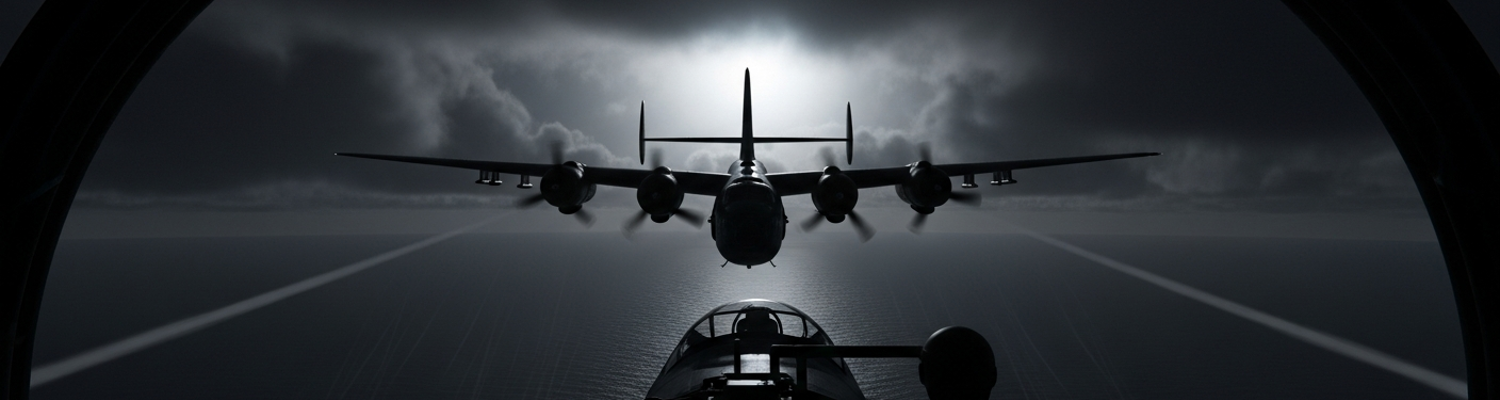
The primary tool of America’s late-war, long-range reconnaissance was the PB4Y-2 Privateer. A naval derivative of the B-24 Liberator, the Privateer entered service in early 1944 with squadrons like VPB-118 and VPB-119. Consolidated Aircraft stretched the fuselage by seven feet, replaced the B-24’s twin tail with a single large vertical stabilizer for better low-altitude stability, and removed the turbosuperchargers from its four Pratt & Whitney R-1830 engines to optimize it for maritime patrol. These aircraft were flying data-collection platforms, carrying a crew of 11. For photographic missions, the bomb bays were filled with a suite of high-powered cameras, typically multiple Fairchild K-17s using 9x9-inch film plates. Lone Privateers would launch on 2,000-mile missions from captured airfields on Guam, Tinian, or Iwo Jima, flying for over 12 hours into the heart of the Japanese empire. Though armed with twelve .50-caliber machine guns, a single Privateer was a large, relatively slow target on a predictable straight-line course for its camera runs.
For quick dashes over heavily defended targets, the Navy and Marines used photographic variants of fighters. The F4U-4P Corsair was a modification of the gull-winged fighter with a camera bay in its fuselage. These missions represented a different tactical problem. Instead of a long, high-altitude flight, the Corsair pilot flew a high-speed, low-level profile. The pilot flew alone, responsible for navigating hundreds of miles, locating a target, operating the camera with a cockpit-mounted intervalometer, and flying the aircraft while scanning for interceptors. Carrier-based Corsair squadrons, like VMF-124 and VMF-213 aboard the USS Essex, began operations in late 1944. The intelligence they returned was immediate and specific, capturing close-up imagery of new ship construction or defensive preparations that a high-altitude bomber could not.
These missions launched from the edge of the American advance. The carrier task forces of Task Force 38 or 58 provided floating airfields. A more permanent solution came from advanced bases on recently captured islands. Airfields on Morotai, Peleliu, and later Iwo Jima became critical staging points. From these strips of crushed coral and volcanic ash, squadrons like Patrol Bombing Squadron 120 (VPB-120) on Shemya Island launched their Privateers. Their deep penetration flights were essential for the strategic bombing campaign, providing target folders for B-29 strikes against mainland Japan. The cameras looked for factory complexes, rail yards, and urban infrastructure, methodically mapping the enemy’s industrial capacity for destruction.
The Tyranny of Distance and Duration
Operational logs for units like Patrol Bombing Squadron 120 (VPB-120) reveal the brutal baseline of Pacific reconnaissance. Flight times were extraordinarily long. Sorties in aircraft like the PBY Catalina and PB4Y-2 Privateer routinely pushed past 10 and sometimes exceeded 16 hours. Specialized RAAF Catalina missions and Qantas-operated mail runs from Australia to Ceylon could keep a crew airborne for over 20 hours, with one recorded flight lasting over 32 hours. This duration was dictated by the scale of the Pacific Ocean. An aircraft needed the endurance to fly a thousand miles out, search a patrol sector, and then make the thousand-mile journey home. This demand strained mechanical components to their breaking point. Engines burned oil, magnetos fouled, and fuel systems offered no margin for error. For the eleven-man crew of a Privateer, the mission was a monotonous, physically punishing ordeal of noise, vibration, and confinement.
Inside the unpressurized hull of a PB4Y-2 or B-17, temperatures at altitudes above 20,000 feet routinely plunged to between -40 and -60 degrees Fahrenheit. Frostbite was a constant threat. Early in the war, electrically heated flight suits like the F-1 model were unreliable. Wired in series, they would often fail completely if a single wire broke, leaving a man without heat. This could result in severe burns from short circuits followed by the rapid onset of frostbite. Gunners in waist blisters or tail turrets were particularly vulnerable. The thin metal skin of the aircraft offered no insulation, and frost would coat interior surfaces. Clearing a jammed .50-caliber machine gun often required a gunner to remove his gloves, a choice that could mean losing fingertips in minutes. Crews greased their faces to prevent frostbite from exposed skin.
This combination of extreme duration and cold produced a pervasive, mission-degrading fatigue. After ten hours of deafening engine noise, constant vibration, and intense cold, the physical and mental performance of the crew was severely compromised. A navigator, his hands numb and his mind dulled, could make a small but catastrophic miscalculation. A pilot’s reaction time slowed, increasing the danger during landings or when reacting to enemy fighters. Archival records and post-war medical studies show a clear correlation between long-duration flights and a condition termed operational fatigue. The strain was visible; flight surgeons noted that crews eager at the start of a tour would become sallow and withdrawn after just a few long missions. This was a cumulative physiological breakdown, where lack of sleep and relentless stress could lead to impaired judgment, poor coordination, and a higher rate of accidents.
The Enemy Within: Mechanical Failure
Operational logs for Pacific patrol squadrons show that the ocean was a more consistent killer than the Japanese. For every aircraft lost to enemy action, others were lost to the mechanical strain of operating at maximum range. The Pratt & Whitney R-1830 Twin Wasp engine, used in the PBY Catalina and PB4Y-1 Liberator, was a reliable design, but the Pacific theater subjected it to stresses beyond its intentions. The corrosive salt-air environment attacked everything. A primary killer was the long, slow climb to altitude with a full load of fuel, followed by hours of low-RPM cruising that fouled spark plugs. Oil leaks were constant and could become a catastrophic failure over a 12-hour mission. A single engine failure in a twin-engine PBY hundreds of miles from base was often fatal. Even the four-engine PB4Y Privateers were not immune. A failure in one engine placed additional strain on the others, creating a cascade effect.
Ditching was not a rescue. It was an event with a low probability of survival.
The logistical chain supporting these missions was perpetually stretched. Advanced bases were often hastily constructed airstrips lacking facilities for complex repairs. Spare parts and fuel were precious commodities. This meant many aircraft flew with patched-up systems and worn components. Official communiques, focused on combat victories, almost never mentioned non-combat losses. They did not report on crews forced to cannibalize one aircraft to keep another flying, or the planes that vanished without a trace. Records show that in the Hawaiian Islands operational area alone, nearly 1,500 aircraft were lost to non-combat accidents during the war. Each loss represented a failure of the man-machine system, a moment when the combined stresses of distance, weather, and mechanical frailty overwhelmed the crew.
The Woolley Report's Internal Warfare
Between June and August of 1945, the Navy Department issued the first part of an internal intelligence assessment known as the Woolley Report. Its timing was not accidental. A fierce debate was being waged within the American war machine over the strategy for ending the war. The Army Air Forces championed the idea that strategic bombing alone could force a Japanese capitulation. The Navy, responsible for the sea blockade and the prospect of landing millions of men under Operation Downfall, required a different kind of proof. The Woolley Report was created to assess the effects of strategic bombing and gauge enemy resolve, but its function was to provide a data-driven counter-narrative to USAAF claims and ground the final decision of the war in a naval-centric analysis.
It was an instrument of internal strategic debate.
A close review reveals the report’s direct challenge to the metrics of victory favored by air power advocates. Where the USAAF presented progress through statistics of bomb tonnage, the Woolley Report delved into secondary effects. The analysis indicated that while major industrial centers were being erased, Japanese war production had not been annihilated. It had dispersed. A significant portion of manufacturing had been decentralized into thousands of small, residential workshops and subterranean facilities, a network of cottage industries immune to conventional area bombing. The report assessed that while the physical destruction of cities was absolute, it had not yet translated into the strategic paralysis of the Japanese military’s command and control or its ability to equip the millions of soldiers being amassed for the final defense of the homeland.
Morale Collapse on Both Sides
The public narrative of the air war was one of resolve, but internal military records reveal a darker picture of psychological decay. For the American aircrews of the XXI Bomber Command, the low-level firebombing campaign against Japan was psychologically corrosive. Flying B-29s at altitudes between 5,000 and 9,000 feet, crews were no longer detached observers. During the 9-10 March 1945 raid on Tokyo, crews reported violent turbulence from the superheated air rising from the city. An odor described by many as burning flesh filled the cabins. This sensory immersion stood in sharp contrast to official communiques. The cumulative stress of these missions led to a documented rise in operational fatigue. More than half a million US service members suffered some form of psychiatric collapse during the war, with 40 percent of all medical discharges being for psychiatric conditions. The strain was acute in the Pacific, where 40% of medical evacuations in 1943 were for psychiatric reasons.
This was not a wound that appeared on casualty lists.
On the ground, the psychological strain on the Japanese populace was absolute. The United States Strategic Bombing Survey, a post-war analysis by over 1,100 personnel, documented the collapse of civilian morale. Its findings were unequivocal: air attacks were the single largest cause for the 64 percent of the population who felt personally unable to continue the war. The survey’s Morale Division conducted thousands of interviews, revealing a population gripped by fear. The constant threat from unopposed B-29s destroyed the national myth of inviolable home islands. This was compounded by a loss of faith in official information. An estimated 8.5 million people fled the cities, becoming refugees in their own country. Government incompetence exacerbated the crisis, with citizens forced from their homes to create firebreaks and then given no alternative accommodations.
Official narratives of both nations masked these cracks in morale. Japanese propaganda continued to broadcast a message of unbending will, even as analysts at the Joint Intelligence Center, Pacific Ocean Areas (JICPOA) synthesized data showing the opposite. The underlying civilian will to fight had been hollowed out by starvation, disease, and the terror of the bombing. On the American side, the psychological cost to its airmen was carefully managed. The condition of operational fatigue was often treated at forward aid stations with rest and sedatives, with the goal of returning men to duty. This approach often hid the deeper, long-term trauma. The public saw images of determined young men, not the reality of psychiatric casualties that, in some Pacific campaigns, surpassed the number of men wounded in battle.
Command's Burden of Imperfect Knowledge
CINCPAC (Commander in Chief, Pacific Fleet) planning documents from 1944-1945 reveal a command group operating under crushing constraints. The decision to deploy a PB4Y-2 Privateer from Guam was a calculated gamble where the known high probability of failure was weighed against a complete void of intelligence. Planners at JICPOA in Pearl Harbor stared at maps where vast areas of ocean surrounding the Japanese Home Islands were blank. The effective combat radius of carrier groups and the extreme range required for land-based aircraft created a dead zone where Japanese movements went unobserved. Sending a lone aircraft on a 14-hour, 2,000-mile flight was an acceptance of a high attrition rate. Non-combat losses for patrol squadrons often matched or exceeded combat losses. Command was forced to trade lives and expensive aircraft for even a fleeting glimpse of a shipping convoy.
This was a brutal calculation.
The intelligence requirements for Operation Downfall, the planned invasion of Japan, redefined the mission for reconnaissance units. The focus shifted from hunting fleets to meticulously mapping the geography of a fortress nation. Planners for Operation Olympic, the invasion of southern Kyushu scheduled for November 1945, required a new form of intelligence. They needed stereo-pair photographic mosaics of landing beaches near Miyazaki and Kagoshima to analyze gradients for landing craft. They needed to identify every coastal artillery emplacement and anti-aircraft battery. The discovery of a massive Japanese troop buildup on Kyushu, rising from a few divisions to over fourteen by summer 1945, was a direct result of this intensified reconnaissance. This information, gathered by photo-recon Corsairs and Privateers, dramatically altered casualty projections for the invasion. The missions were no longer just about finding the enemy; they were about creating a detailed blueprint for one of the largest amphibious assaults in history, forcing aircraft to fly predictable patterns deep inside the most heavily defended airspace on the planet.
The Ethical Weight of Data Acquisition
Pacific aerial reconnaissance operated on an actuarial logic. The decision to send a lone PB4Y-2 Privateer on a 14-hour mission was a conscious acceptance of a high probability of loss. Planners at CINCPAC and JICPOA were forced to weigh the statistical certainty of attrition against the strategic imperative of knowing the enemy’s disposition. Operational records show that in many patrol squadrons, non-combat losses from mechanical failure, weather, and navigational error equaled or surpassed those from enemy action. The potential data from a single successful flight was deemed more valuable than the crew and aircraft sent to acquire it.
These assets were not easily replaced. A PB4Y-2 Privateer was a collection of specialized technology, packed with high-resolution Fairchild K-17 cameras and electronic surveillance gear, operated by a crew of eleven specialists. Losing a single aircraft meant the loss of a massive investment in training. A naval aviator’s training pipeline was a multi-stage, months-long process. The navigator, radioman, and flight engineer each had their own extensive training programs. The loss of an entire veteran crew represented tens of thousands of man-hours of irreplaceable experience. Squadrons like VPB-109, operating from Tinian or Iwo Jima, were tasked with photo-reconnaissance over the most heavily defended targets in the Japanese home islands, such as the Kure Naval Arsenal. In total, 61 PB4Y-2 Privateers were recorded as combat losses during the war, each one taking a highly skilled crew with it.
This decision-making process carried an agonizing ethical weight. As Allied forces prepared for Operation Downfall, the demand for intelligence reached a fever pitch. Initial estimates of Japanese strength on Kyushu were dangerously low. High-risk reconnaissance flights throughout mid-1945 revealed a shocking truth: the Japanese were massing a gargantuan force, with estimates climbing to over 600,000 troops by August. This intelligence, gathered by crews flying directly into the teeth of the planned defenses, completely changed the strategic picture. It forced American commanders like Nimitz and MacArthur to confront casualty projections for the invasion that ran into the hundreds of thousands. A squadron commander on Okinawa might be ordered to send a crew on a photo run over southern Kyushu, knowing that Japanese intelligence had anticipated their invasion plans and had concentrated thousands of aircraft for kamikaze attacks. He was ordering men to their likely deaths to gather the very information that might convince his superiors to avert the even greater slaughter of an amphibious landing.