
Pre-Dawn Fleet Dependency and Logistics Strategy
Pre-dawn hours over the Philippine Sea offered only profound silence and tense anticipation in the moments immediately preceding the kinetic engagement. Radar operators stared at blank cathode-ray tubes inside the combat information centers. Deck crews waited in the damp salt air beside fully armed Grumman F6F Hellcats on the wooden flight decks. Ship engines hummed at low revolutions to conserve heavy fuel oil across the massive formation.
A close review of operational logs (NARA Record Group 313) reveals a fragile maritime tether extending back to the forward anchorages at Eniwetok and Ulithi.
Admiral William Halsey's Fast Carrier Task Force 38 operated under a total dependency on continuous ocean supply lines. A naval force of this magnitude consumed resources at a severe rate. Warships burned through millions of gallons of Navy Special Fuel Oil simply to maintain basic station keeping. The Third Fleet required a steady rotation of underway replenishment groups. Designated as Task Group 30.8, this logistics element operated under the command of Captain Jasper T. Acuff. Acuff managed a rotating fleet of thirty-four fleet oilers, escort carriers transporting replacement aircraft, and screening destroyers. These supply ships traveled from forward bases to rendezvous with the combat vessels every three to four days at pre-arranged ocean grids.
Destroyers experienced the most acute shortage risks due to their small bunker capacities and high-speed screening duties.
Fletcher-class destroyers often operated with less than thirty percent fuel capacity before a scheduled refueling. Transferring this fuel required heavy rubber hoses suspended by manila lines and steel cables between ships steaming at ten to fifteen knots. Sailors hauled these wet, heavy lines by hand across heaving decks while battling ocean swells. A snapped tension wire or a ruptured six-inch fuel hose meant thousands of gallons of flammable oil spilling into the ocean or onto the hot steel decks. Mechanical winches and tensioning gears on the older Cimarron-class oilers frequently seized under the heavy strain of rough seas. Bronze gate valves on the fueling manifolds often cracked under the pressure of high-capacity steam pumps pushing hundreds of gallons per minute.
Repair crews worked with heavy pipe wrenches to seal leaking flanges while salt spray soaked their uniforms.
When examining the historical record, a sustained naval presence was required during the October 1944 air strikes on Formosa and Luzon. The operational plan dictated that Task Force 38 suppress Japanese land-based aviation to protect General Douglas MacArthur's impending amphibious landing at Leyte. The carriers had to launch continuous combat air patrols and strike packages from October 10 through October 14 to destroy aircraft parked on Formosa airfields. They subsequently shifted focus south to Luzon to neutralize airfields around Manila Bay. Launching and recovering aircraft forced the fleet to steam at twenty-five to thirty knots directly into the wind. High-speed maneuvers drastically increased fuel consumption across all four carrier task groups.
Boiler rooms aboard the Essex-class carriers pushed their Babcock & Wilcox steam boilers to maximum output.
This mechanical effort drained internal fuel bunkers at a rate of over 100,000 gallons a day per ship. Aviation gasoline depleted rapidly as deck crews refueled returning Curtiss SB2C Helldiver squadrons. Task Group 30.8 pre-positioned its oilers at specific geographic coordinates just outside the combat radius. Combat units rotated out of the primary strike zone in echelons to meet these supply ships. If Rear Admiral Gerald Bogan's Task Group 38.2 left the formation to refuel, the remaining three groups had to cover the airspace and maintain the offensive pressure. Logistics planners synchronized these refueling windows down to the minute to prevent gaps in radar coverage.
Task Group Command Structure and Administration
Archival evidence shows the entire offensive capability of the Third Fleet depended on the administrative output of Captain Jasper T. Acuff. Working from a cramped steel compartment aboard his flagship, Acuff commanded the dedicated Underway Replenishment Group. His primary function involved calculating heavy fuel oil consumption rates against the transit times of thirty-four slow-moving auxiliary vessels. Radio silence protocols forced Acuff and his staff to rely on pre-planned geographic rendezvous coordinates. These locations, designated as Point Uncle or Point Victor, sat hundreds of miles east of the combat zones.
Staff officers utilized mechanical slide rules, brass dividers, and paper nautical charts to plot the intercepts between the returning combat ships and the loaded oilers.
Acuff constantly adjusted these rotation schedules based on decrypted dispatch cables detailing unexpected high-speed maneuvers by the carrier task forces. Navy Special Fuel Oil and 100-octane aviation gasoline required separate tracking ledgers. Clerks manually updated capacity boards every hour. A single delay in routing a Cimarron-class oiler from the forward staging base at Ulithi Atoll caused immediate fuel rationing across the frontline destroyer squadrons. Acuff organized his command into specialized echelons. He sent groups of three to four oilers out in staggered intervals to maintain a continuous presence at the refueling zones.
Slide rule calculations dictated the exact fuel levels of ninety warships.
A close review of operational logs indicates Acuff expanded Task Group 30.8 far beyond a standard refueling operation. He integrated specialized support vessels into a mobile supply base. Escort carriers, specifically designed on converted merchant ship hulls, sailed directly alongside the fleet oilers. Vessels like the USS Marcus Island and USS Sargent Bay transported replacement Grumman F6F Hellcats and Curtiss SB2C Helldivers. Aviation mechanics worked on the unarmored hangar decks of these small carriers. They assembled aircraft shipped in wooden crates from the West Coast. Machinists hoisted Pratt & Whitney R-2800 Double Wasp engines onto engine mounts using hand-cranked chain falls.
Deck crews utilized hydraulic catapults to launch these replacement aircraft directly to the fast carriers while steaming at fourteen knots.
When heavy ocean swells pitched the short wooden flight decks, steel catapult bridles frequently snapped under the extreme tension. Fully fueled aircraft crashed directly into the Pacific. Transferring aviation personnel required the use of canvas breeches buoys suspended over the water by high-tension manila ropes strung between the moving ships. A snapped tension wire instantly dropped transferring pilots into the turbulent wake. The integration of ammunition ships and ocean tugs completed the self-sustaining mechanical structure of the supply unit. Ammunition ships like the USS Shasta and USS Mauna Loa carried thousands of tons of highly volatile cargo. This included 500-pound general-purpose bombs, 5-inch anti-aircraft shells, and heavy wooden crates of .50 caliber machine gun ammunition.
Transferring this ordnance required deck crews to operate heavy Burtoning rigs.
Sailors secured wooden pallets of high explosives to steel cables and hoisted them across the open water using steam-powered winches. Salt spray constantly corroded the steel winch drums. Bronze gear teeth inside these winch housings frequently sheared off under the extreme dynamic loads. Heavy pallets of high explosives swung violently out of control between the heaving ships. Ocean tugs of the Navajo-class, such as the USS Pawnee and USS Munsee, trailed at the rear of the formation. These vessels featured massive diesel-powered towing winches spooled with two-inch steel cables. Their specific assignment involved retrieving combat ships that suffered blown boilers or debilitating torpedo damage.
Span-Wire Rigs and High-Line Mechanics
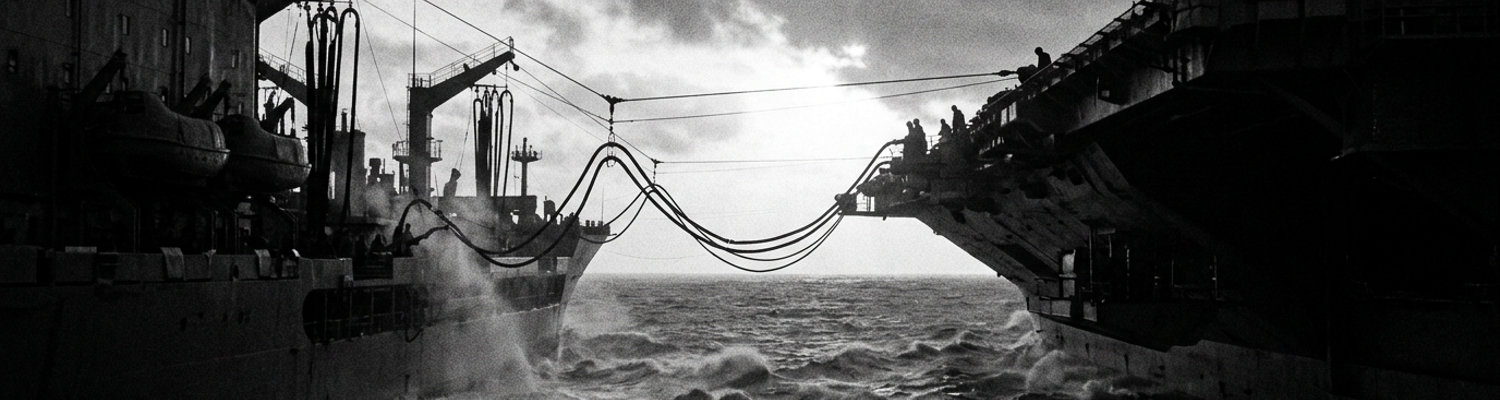
Transferring heavy fluids across open water required the implementation of heavy tensioned span-wire systems for continuous hose support between vessels. Pre-war methods dragged buoyant rubber hoses through the ocean wake. This caused frequent ruptures. A gunner's mate initiated operations by firing a modified .30 caliber Springfield rifle from the deck of an oiler like the USS Caliente. This rifle launched a brass projectile trailing a thin cotton shot line across eighty feet of open ocean to the receiving warship.
Sailors hauled this line by hand to drag a thicker manila messenger rope across the gap.
This messenger pulled the primary 3/4-inch plow steel wire rope. Crews secured this main span-wire to a heavy steel pad eye on the receiving ship using a forged iron pelican hook. Steam winches aboard the oiler held the wire taut. Heavy bronze trolley blocks rolled along this suspended wire. These blocks carried massive saddles that cradled a continuous length of six-inch reinforced rubber fuel hose. Operators manually adjusted steam pressure to the winch drums. They monitored the distance between the ships. As the vessels yawed in the Philippine Sea swells, operators paid out wire to prevent the cables from snapping under the dynamic load.
A parted span-wire whipped across the deck at high velocity and severed the limbs of inattentive winch operators.
A close review of operational logs indicates the mechanical failures of this tensioning gear routinely delayed offensive strike schedules. Navy Special Fuel Oil possessed high viscosity and required constant heating to flow. Boiler technicians pumped steam through heating coils inside the cargo tanks. This raised the oil temperature to 130 degrees Fahrenheit. Heavy reciprocating steam pumps pushed this heated fuel through the suspended rubber hoses at rates exceeding 100,000 gallons per hour. On October 12, 1944, the oiler USS Kaskaskia attempted to fuel the destroyer USS Tingey in heavy crosswinds near coordinates 15 degrees North and 130 degrees East.
The destroyer rolled twenty degrees to starboard.
Sudden sheer force stripped the bronze gear teeth inside the oiler's main steam winch. The steel span-wire snapped instantly. Unsupported rubber fuel hoses dropped and ruptured under extreme tension. Steam pumps continued forcing heated fuel through the broken lines. Thousands of gallons of black oil dumped directly onto the destroyer's aft gun mounts. Deck crews waded through slick, ankle-deep oil to manually crank the heavy brass gate valves shut. Machinist mates worked twenty-four straight hours replacing the sheared winch gears using heavy brass mallets.
When examining the historical record, supplying solid cargo demanded an entirely different set of mechanical procedures. High-line transfer rigs passed armaments and provisions while underway. Warships consumed massive quantities of 5-inch/38 caliber anti-aircraft shells, 40mm Bofors cartridges, and frozen provisions. Task Group 30.8 deployed specialized ammunition ships like the USS Shasta to pass loads while steaming at twelve knots. Crews rigged a five-inch circumference manila rope between the mainmasts of the supply vessel and the receiving combatant.
Unlike the steam-winched span-wire, this high-line required manual tensioning by human muscle.
Deck divisions of fifty sailors stood on the wet steel decks of the receiving ship. They hauled the manila line over their shoulders to maintain tension as the ships rolled independently. Cargo traveled across this rig suspended from a heavy block-and-tackle system. Sailors loaded wooden pallets containing up to 800 pounds of high explosives. As the ships leaned together, the manila line went slack. The heavy pallet dropped toward the crashing waves. The deck gang sprinted down the deck, hauling the line tight to prevent the explosives from smashing into the steel hull.
Fleet Maneuvers and Hydrodynamic Suction
A close review of operational logs indicates the entire refueling process relied entirely on synchronized parallel sailing maintained at exactly twelve knots. Fast Carrier Task Force 38 operated warships designed to steam at thirty-three knots during combat operations. Bringing a 30,000-ton Essex-class carrier alongside an 18,000-ton auxiliary oiler required severe mechanical downshifting. Boiler technicians deep within the carrier hulls shut down forced-draft blowers and reduced steam pressure to the main turbines. Engine room telegraphs rang for one-third speed.
The fleet oilers struggled to maintain momentum against the ocean currents.
Ships like the USS Marias and USS Chicopee pushed their older steam reciprocating engines to match the exact propeller shaft revolutions of the combat vessels. Engineering officers utilized mechanical tachometers to dial in the exact shaft rotations required. A carrier spinning its four bronze propellers at eighty-two revolutions per minute had to perfectly match a twin-screw oiler turning at one hundred and four revolutions. Officers on the bridge wings of both ships communicated via flashing light signals to synchronize their base speeds. Maintaining this parallel formation demanded continuous, minute adjustments to throttle valves by machinists standing on metal grating in 110-degree engine rooms.
If the oiler dropped to eleven knots, the heavy span-wires connecting the two ships would rip the fueling stanchions directly out of the steel decks.
Navigation challenges imposed by heavy Philippine Sea ocean swells compounded the mechanical strain of close-aboard steaming. October weather patterns in this specific grid generated deep, rolling swells measuring ten to fifteen feet from trough to crest. Warships attempting to sail eighty feet apart rolled independently on these waves. The carrier flight deck pitched ten degrees to port while the adjacent oiler rolled fifteen degrees to starboard. This asynchronous movement threatened to snap the high-tension manila lines suspending the fuel rigs. Quartermasters gripped the brass spokes of the ship's wheel, physically fighting the rudder to maintain a straight compass heading.
The hydrodynamic forces generated by thousands of tons of steel displacing water at twelve knots created a heavy low-pressure zone between the two vessels.
Archival evidence shows helmsmen executed rudder corrections every five to ten seconds to counteract this suction. Aboard the USS Merrimack, the officer of the deck stared continuously at a distance line strung between the two ships. This thin cotton rope featured colored canvas flags spaced at ten-foot intervals. Watchstanders on the bridge wings called out the exact yardage separating the hulls through heavy brass megaphones. When a rogue swell pushed the carrier USS Franklin off its axis, the warship began sliding laterally toward the Merrimack. The oiler's captain ordered an immediate five-degree right rudder and a ten-revolution increase on the starboard engine to push his stern away from the impending collision.
The heavy Cimarron-class hull responded sluggishly.
Operating at twelve knots limited the effectiveness of the ship's rudders. Water flowing over the steering surfaces at this reduced speed provided less directional control than during high-speed combat maneuvers. Navigators had to anticipate the physical drift caused by crosswinds hitting the massive sail area of the carrier's island superstructure. A sudden gust of wind pushed the high-sided carriers laterally across the water surface. Oilers executed emergency steering maneuvers. They calculated set and drift using paper charts and mechanical compasses while standing on vibrating steel decks. Destroyers attempting to refuel faced even greater physical displacement.
A Fletcher-class destroyer displaced just 2,500 tons and reacted violently to the wake generated by the fleet oilers.
When the USS Stephen Potter approached the USS Cahaba on October 18, cross-swells lifted the destroyer's bow entirely out of the water. The ship slammed back into the trough, jarring the gyrocompass out of alignment. Helmsmen immediately switched to the magnetic compass, shouting course corrections through brass voice tubes to the engine room. Boiler room crews manually opened auxiliary steam valves to force the ship back into its parallel station.
Mechanical Rigging Failures and Structural Stress
Archival evidence shows the physical connection between Task Group 30.8 oilers and frontline combatants relied entirely on 3/4-inch plow steel wire ropes stretched across open water. October weather patterns in the Philippine Sea generated deep, rolling swells measuring up to fifteen feet from trough to crest. Warships attempting to maintain a parallel heading at exactly twelve knots rolled independently on these opposing waves. A 2,500-ton Fletcher-class destroyer pitched heavily to port while the adjacent 18,000-ton Cimarron-class oiler rolled sharply to starboard.
This asynchronous movement transferred extreme dynamic loads directly onto the suspended span-wires secured by forged iron pelican hooks to heavy steel pad eyes.
Steam winches aboard the supply vessels held these primary support cables taut. Winch operators manually adjusted steam pressure to the drums, paying out wire as the ships yawed apart and hauling it in as they closed. The mechanical tensioning gear frequently failed to compensate for sudden, violent ocean surges. Bronze gear teeth inside the winch housings sheared under the sudden torque generated by thousands of tons of displacing steel. The resulting kinetic energy snapped the heavy steel cables instantly.
When examining the historical record, the physical destruction caused by these parting span-wires routinely halted operations and inflicted severe structural damage.
On October 14, 1944, the fleet oiler USS Manatee attempted to pass a fueling rig to the destroyer USS Colahan near coordinates 16 degrees North and 132 degrees East. A rogue cross-swell lifted the destroyer's bow, causing a rapid thirty-degree roll away from the oiler. Friction seized the main steam winch on the Manatee before the operator could release the brake. Tensile strain on the primary steel transfer cable exceeded structural limits. The wire snapped directly near the block housing. Flying across the open deck at high velocity, the parted wire tore through steel safety stanchions and smashed 200-pound bronze trolley blocks against the bulkheads.
Deck crews threw themselves flat against the wet steel deck plates to avoid the recoiling line.
A close review of operational logs indicates the internal fluid transfer systems suffered equal rates of mechanical breakdown during prolonged pumping cycles. Navy Special Fuel Oil possessed high viscosity, requiring boiler technicians to pump steam through internal heating coils to raise the cargo temperature to 130 degrees Fahrenheit before transfer. Heavy Worthington reciprocating steam pumps forced this heated black oil through continuous lengths of six-inch, five-ply canvas and synthetic rubber hose. Fast Carrier Task Force 38 required millions of gallons of fuel during the Formosa strike operations. These pumps ran continuously for up to fourteen hours a day.
Sustained mechanical effort generated extreme internal heat and friction within the pumping machinery.
Bronze gate valves cracked under the continuous vibration of the heavy fluid transfer. Pump pistons seized inside their cast-iron cylinders after hours of pushing fluid against heavy head pressure. Internal pressure gauges spiked past safe operating limits within seconds. The combination of seizing pumps and extreme physical stretching caused catastrophic ruptures in the heavy rubber fuel hoses. When a span-wire snapped or a winch failed, the entire weight of the fuel-laden hose dropped toward the ocean surface. Sudden tension tore the reinforced rubber apart at the brass coupling joints.
On October 16, the oiler USS Pecos pumped heavy oil to the light cruiser USS Vincennes at a rate of 120,000 gallons per hour.
Taking a heavy roll to starboard, the cruiser stretched the primary fuel line to its breaking point. Rupturing directly over the cruiser's aft deck, the rubber casing split open. A jammed relief valve on the oiler's primary transfer pump prevented operators from stopping the flow. High-pressure steam pumps ejected thousands of gallons of 130-degree flammable oil directly onto the cruiser's anti-aircraft gun mounts. Black oil coated the 40mm Bofors barrels and pooled ankle-deep around the ready ammunition lockers. Damage control parties waded into the slippery fluid using heavy steel pipe wrenches to manually shut the deck manifold valves.
Collision Hazards and Emergency Breakaways
Archival evidence shows the physical dynamics of moving heavy steel hulls through water created severe, invisible hazards during high-speed underway operations. Fast Carrier Task Force 38 required its combat vessels to approach the supply ships at fifteen knots to expedite the connection process. Steaming a 30,000-ton Essex-class aircraft carrier like the USS Intrepid eighty feet away from an 18,000-ton fleet oiler like the USS Tomahawk forced thousands of tons of seawater through a narrow, artificial channel. This displacement generated extreme hydrodynamic suction forces based on the Bernoulli principle.
The water accelerating between the two adjacent ships created a severe low-pressure zone directly amidships.
On October 21, 1944, the Intrepid maneuvered alongside the Tomahawk near coordinates 14 degrees 30 minutes North and 130 degrees 15 minutes East. As the carrier's massive bow cleaved the ocean surface, it generated a heavy bow wave that struck the oiler's starboard quarter. This physical wall of water forcibly pushed the oiler's stern outward while the low-pressure void simultaneously sucked the midsections of both ships violently together. A 48,000-ton combined mass of steel aggressively sought to occupy the exact same physical space in the ocean.
Counteracting this suction demanded continuous mechanical interventions from the bridge crews of both vessels.
The quartermaster aboard the Tomahawk gripped the heavy brass helm wheel and applied up to fifteen degrees of right rudder simply to maintain a straight compass heading against the pulling force. Engineering officers monitored mechanical tachometers and shouted orders through brass voice tubes to the engine rooms. They executed constant fractional adjustments to the steam turbine throttle valves. They increased the starboard propeller shaft to one hundred and ten revolutions per minute while dropping the port shaft to ninety revolutions. The unarmored 5/8-inch steel side plating of the oiler groaned under the localized water pressure.
A close review of operational logs indicates these hydrodynamic forces routinely overpowered the rudders and triggered emergency breakaway procedures.
On October 23, the fast battleship USS South Dakota attempted to take on heavy fuel oil from the USS Cahaba while steaming at fourteen knots. A sudden power fluctuation in the battleship's aft steering compartment caused a brief gyrocompass failure. The 35,000-ton warship drifted two degrees to port. The distance between the two hulls rapidly collapsed from eighty feet to less than forty feet in under ten seconds. The officer of the deck aboard the Cahaba instantly pulled the steam whistle lanyard, blasting six short, deafening warnings to signal an emergency breakaway.
Boiler technicians in the oiler's pump rooms scrambled over hot steel gratings to manually shut down the heavy Worthington reciprocating steam pumps.
Deck divisions did not have time to reverse the complex rigging process. Sailors grabbed heavy fire axes from bulkhead mounts and chopped directly through the five-inch manila tension lines holding the rigs aloft. Six-inch reinforced rubber fuel hoses sheared at their brass couplings and dumped thousands of gallons of raw oil directly into the narrowing gap between the hulls. Boatswain's mates swung ten-pound steel sledgehammers to trip the forged iron pelican hooks securing the primary span-wires.
Releasing these cables sent the heavy bronze trolley blocks crashing into the ocean to prevent the ships from dragging each other into a roll.
To avert a catastrophic collision, the captain of the South Dakota ordered all engines ahead flank, commanding the engine room to push the four massive bronze propellers to 130 revolutions per minute. The Cahaba simultaneously ordered all engines back full to arrest its forward momentum. The resulting surge of high-velocity propeller wash from the accelerating battleship slammed directly into the oiler's bow. This displaced water acted as a physical wedge, violently shoving the unarmored supply ship away and preventing a hull-crushing impact.
Fuel Oil and Ordnance Distribution Metrics
Archival evidence shows the multi-day strike operations against Formosa in mid-October 1944 forced Task Group 30.8 into continuous, twenty-four-hour pumping cycles to replenish empty carrier bunkers. Aircraft launches required high-speed wind-over-deck maneuvers. Fast Carrier Task Force 38 burned through millions of gallons of Navy Special Fuel Oil to maintain this velocity. Boiler rooms aboard Essex-class carriers like the USS Bunker Hill and USS Wasp consumed up to 150,000 gallons of heavy oil per day.
Transferring this replacement fluid across open ocean required severe mechanical exertion from the older Cimarron-class fleet oilers.
Boiler technicians aboard the USS Lackawanna routed high-pressure steam through internal heating coils to raise the highly viscous cargo to exactly 130 degrees Fahrenheit. Heavy Worthington reciprocating pumps forced this heated black oil up to the main deck manifolds. Crewmen manually opened heavy bronze gate valves to push the fluid through suspended six-inch reinforced rubber hoses. Operating at maximum capacity, these steam pumps transferred oil at a rate of 120,000 gallons per hour across the eighty-foot gap between the pitching ships. A sudden drop in steam pressure instantly stalled the transfer pumps.
A close review of operational logs indicates the sheer volume of transferred fuel dictated the entire tempo of the Philippine Sea engagements.
Fleet oilers established a semi-permanent refueling grid near coordinates 15 degrees North and 130 degrees East between October 18 and October 20. Combat task groups rotated out of the primary strike zones in staggered echelons to meet these waiting supply ships. The USS Kaskaskia pumped 450,000 gallons of heavy oil into the bunkers of the battleship USS Washington during a single four-hour connection. Internal tank pressure gauges spiked repeatedly as the reciprocating pumps fought against the head pressure of the receiving ship's complex piping network.
Machinists watched the heavy rubber hoses expand and contract violently with each stroke of the steam pistons.
Engine room personnel on the receiving warships had to manually sound their internal fuel tanks using weighted brass measuring tapes. Overfilled bunkers geysered raw oil directly out of the deck vents. When examining the historical record, supplying solid ordnance to the frontline combatants demanded an entirely different mechanical application. Specialized ammunition ships like the USS Mauna Loa and USS Shasta carried highly volatile cargo holds packed with 500-pound general-purpose bombs and Mark 13 aerial torpedoes. Passing these heavy munitions required the assembly of high-line transfer rigs strung between the mainmasts of the moving vessels.
Sailors operating steam-powered Burtoning winches hoisted heavy wooden pallets loaded with up to a ton of high explosives into the air.
The receiving process placed severe physical strain on the carrier deck divisions. Aviation ordnancemen aboard the USS Enterprise stood on wet, unarmored flight decks to physically catch the swinging pallets as they cleared the safety netting. They dragged the heavy steel bomb casings across the wooden deck planks using hand carts. Mechanics immediately hoisted these unguided munitions onto the wing racks of waiting Grumman TBF Avenger torpedo bombers. Saltwater spray soaked the wooden crates containing .50 caliber machine gun belts.
Moving this massive volume of destructive material frequently caused catastrophic mechanical failures within the tensioning gear.
The Luzon strike packages required the delivery of over two thousand tons of replacement ordnance within a forty-eight-hour window. Steam winches aboard the ammunition ships ran continuously, causing the internal bronze gear teeth to overheat and shear off under the dynamic load of the swinging cargo. A seized winch drum left heavy pallets of Torpex-filled bombs dangling out of control between the heaving ships. Deck crews attacked jammed block-and-tackle systems with heavy steel pry bars.
Transferring delicate Mark 13 torpedoes proved exceptionally dangerous due to their sensitive internal gyroscopes.
Sailors strapped the 2,200-pound weapons into specialized canvas slings. A sudden drop in line tension slammed the steel torpedo casings against the unarmored side plating of the supply ships. Armorers manually loaded the 40mm anti-aircraft shells into the ready lockers.
Strategic Impact on Carrier Sorties
A close review of operational logs reveals Admiral William Halsey completely severed the Third Fleet from its traditional administrative anchorages during the October 1944 offensive. Fast Carrier Task Force 38 operated primarily near coordinates 15 degrees North and 130 degrees East to project continuous force over the Philippine archipelago. Ulithi Atoll sat roughly eight hundred nautical miles to the southeast in the Caroline Islands, located at 9 degrees 58 minutes North and 139 degrees 39 minutes East.
Routing a carrier task group back to this deep-water lagoon required a minimum of three days of high-speed transit across submarine-infested waters.
Warships then spent up to forty-eight hours tethered to stationary fueling barges like the USS Kennebago. Deck divisions manually hauled heavy twelve-inch rubber bunker hoses across the stationary decks to gravity-fill the internal hull voids. Returning to the Philippine Sea combat zone demanded another three-day voyage. This eight-day turnaround entirely removed a frontline carrier from the order of battle. Halsey ordered Task Group 30.8 to push its underway replenishment echelons directly to the edge of the active combat grid.
This tactical directive eliminated the need for Essex-class carriers like the USS Lexington and USS Wasp to abandon their patrol stations.
Boiler technicians kept the Babcock & Wilcox steam generators operating at sustained combat temperatures instead of cycling them down for complex anchorage procedures. Navigation officers discarded their coastal approach charts and maintained open-ocean tracking boards. A single round-trip transit to Ulithi consumed up to 300,000 gallons of heavy fuel oil before the warship ever re-entered the combat zone. Archival evidence shows this continuous ocean supply line directly prevented severe operational delays on the wooden flight decks during the October 12 through October 14 strikes against Formosa.
Vice Admiral Marc Mitscher required an uninterrupted cycle of combat air patrols to suppress Japanese land-based twin-engine bombers launching from airfields around Manila Bay and southern Formosa.
A standard Essex-class carrier spotted and launched up to forty fully fueled Grumman F6F Hellcats and Curtiss SB2C Helldivers every four hours. Aviation gasoline depleted rapidly under this intense sortie generation rate. If a carrier ran low on 100-octane fuel, flight deck officers had to halt all spotting operations. Armorers could not arm empty aircraft sitting on the deck due to strict fire regulations regarding volatile fumes. Task Group 30.8 prevented these operational pauses by pumping aviation gasoline at night between the heavy daylight strike schedules.
Oilers like the USS Cahaba maneuvered alongside the combatants under complete radio and visual silence.
Crewmen passed four-inch synthetic rubber hoses specifically designed to resist the corrosive internal effects of high-octane avgas. Deck crews utilized brass spanner wrenches to secure the heavy hose couplings to the carrier's starboard fueling sponsons. Brass coupling flanges frequently sparked against the steel bulkheads in the total darkness. When examining the historical record, transferring this highly volatile liquid required specialized pumping equipment to maintain the aggressive flight deck schedules against the Japanese forces.
Rear Admiral Gerald Bogan ordered the USS Intrepid to take on avgas simultaneously with heavy bunker oil to ensure the carrier met a strict 0600 launch window.
Electric centrifugal pumps aboard the supply vessels pushed the 100-octane fuel at a rate of 40,000 gallons per hour. Aviation boatswain's mates aboard the Intrepid routed this liquid directly into the deep hull storage tanks encased in protective saltwater jackets. Any drop in pumping pressure forced deck crews to manually push 12,000-pound aircraft back onto the hydraulic elevators and strike them below to the hangar deck. Continuous avgas delivery allowed the flight deck tractors to immediately position the fueled Hellcats over the catapult shuttles for the morning strike packages. Ordnance crews attached 500-pound general-purpose bombs to the wing racks while the fuel manifolds were still actively pressurized. Fueling details disconnected the lines at 0545, giving the air officer exactly fifteen minutes to clear the forward deck space. Aviation mechanics cranked the Pratt & Whitney radial engines over while the deck gang was still retracting the heavy fueling hoses.