
Strategic Context of Cap Corse Operations
Archival evidence shows that Allied maritime infiltration units operating north of the 43rd parallel suffered a seventy-three percent casualty rate between September 1943 and April 1944. Staff officers at the Office of Strategic Services Special Operations Branch F-Section gathered inside a requisitioned stone convent near Bastia. They drafted an insertion schedule. Planners faced severe resource deficits across the Mediterranean theater. They relied on a fleet of aging wooden-hulled 63-foot air-sea rescue boats (Type II). Mechanics retrofitted these hulls with salvaged Packard V-12 marine engines. Analyzing the risk calculus reveals a mathematically bleak scenario. Port-side cylinder banks on these specific engines routinely overheated after three hours of continuous operation at 2,400 RPM. This thermal failure threshold fell exactly sixty minutes short of the minimum transit time required to cross the Ligurian Sea. The designated Drop Zones near La Spezia were out of reach under standard operating parameters.
Commanding officers at F-Section signed off on the operational directive regardless of the engineering reports.
Maintenance crews stripped the vessels of all secondary armament. Workers physically cut the heavy .50 caliber Browning machine gun mounts from the aft decks using acetylene torches. This saved eight hundred pounds of gross weight. Removing the onboard life rafts and spare anchor chains eliminated another four hundred pounds. Weight reduction theoretically increased top speed by two knots. Crews gained a fractional margin of error to beat the engine failure window before the exhaust manifolds cracked under the extreme heat.
The resulting blueprint demanded that unarmed crews navigate directly through a heavily mined coastal corridor. German E-boats patrolled this sector nightly.
A close review of operational logs (NARA Record Group 226) indicates this gamble was driven by the objective to maintain resupply lines for covert Italian partisan maritime units. These anti-fascist networks operated out of hidden coves along the Cinque Terre coastline. The maritime detachments of the Corpo Volontari della Libertà had exhausted their winter stockpiles. German coastal garrisons severed the overland smuggling routes running through the Apennine Mountains by late May. They used concentrated artillery barrages and mined mountain passes. Local guerrilla fighters required a steady influx of Mark II fragmentation grenades. They needed British-manufactured Sten submachine guns and waterproofed detonator cord to sabotage Axis naval infrastructure in the port of Genoa.
Planners at Cap Corse calculated that a single successful boat run could deliver four tons of ordnance directly to the shoreline at coordinates 44°08'N 9°45'E.
The F-Section schedule required boats to launch from the northern tip of Corsica at exactly 2200 hours. Vessel operators maintained a strict radio silence protocol on the 4.5 megahertz frequency band. This avoided German signal triangulation. Navigators plotted their courses via dead reckoning. They aimed for a pinpoint rendezvous with partisan-operated feluccas waiting two miles offshore in complete darkness.
Failure to hit the exact rendezvous coordinates within a fifteen-minute window meant the partisan craft would scatter to avoid radar detection.
Calculations supporting this operation ignored basic safety margins for mechanical degradation. Planners factored in the prevailing northwesterly winds of the Ligurian Sea. These winds consistently degraded the top speed of the overloaded rescue boats by up to fifteen percent during the return leg. Navigators relied exclusively on Mark III magnetic compasses. These specific compasses suffered severe deviation errors when placed near the newly installed auxiliary fuel tanks bolted onto the forward decks. Steel fuel drums disrupted the magnetic field. The helmsman constantly adjusted his heading based on handwritten calibration tables illuminated only by a red-lensed flashlight.
Standard operating procedure dictated that if a boat lost its primary engine past the midpoint of the journey, the crew was to scuttle the craft.
Sailors were instructed to trigger a timed scuttling charge placed directly against the wooden hull beneath the waterline. This destroyed the vessel and the cargo. Survivors would then have to swim toward the hostile Italian coastline in water temperatures hovering around fifty-five degrees Fahrenheit.
Ligurian Sea Partisan Resupply Requirements
When examining the historical record of OSS F-Section Maritime Unit 4, the primary limiting factor becomes the reliance on requisitioned coastal luggers. Planners acquired twelve wooden-hulled 40-foot Italian trabaccoli from impounded civilian stocks in Corsica. These vessels ferried heavy ordnance and aviation fuel to the faster insertion craft waiting closer to the combat zone. These broad-beamed cargo ships relied on pre-war Ansaldo 4-cylinder marine diesel engines. Engineers designed these power plants strictly for short coastal fishing trips.
Engineering logs from June 1944 detail severe operational limitations.
Crews forced these specific engines to tow 18-foot rubber insertion dinghies across the open sea. Drag generated by the towed craft dropped the auxiliary vessels' maximum sustained speed to barely five knots. Operating continuously at maximum throttle to maintain this pace caused the low-grade diesel fuel to foul the crude mechanical injectors. Carbon buildup inside the cast-iron cylinder heads led to uncontrolled pre-ignition knocking within four hours of departure. F-Section maintenance crews recorded seven separate instances where the primary drive gearboxes shattered. The main propeller shaft couplings sheared under the sustained torque of towing. Mechanics eventually resorted to welding steel reinforcement brackets directly onto the transmission housings. They packed the exposed gear teeth with heavy axle grease every twelve hours to delay the metal fatigue.
It was a temporary fix.
A shattered gearbox left the unarmed auxiliary vessel adrift in the primary patrol lanes of the German 11th Schnellboot Flotilla.
The slow transit speeds of the trabaccoli dictated the tactical parameters of the entire supply chain. A five-knot maximum velocity meant the auxiliary vessels consumed three-quarters of their internal fuel capacity just reaching the staging sectors in the northern Ligurian Sea. Returning to Bastia required an immediate mid-ocean refueling before they ever transferred their ordnance to the partisan-operated insertion craft. The fuel math offered zero margin for error. Axis forces had recently installed a network of Würzburg radar arrays on the coastal cliffs near Livorno. This specific radar system possessed a detection range of forty kilometers for any stationary surface target larger than a fishing skiff. Anchoring the F-Section fleet to conduct a standard fuel transfer would instantly generate a fixed radar return. This would draw concentrated artillery fire from the 105mm coastal batteries situated on Elba.
OSS commanders mandated a strict necessity for clandestine night underway replenishment to bypass this electronic surveillance.
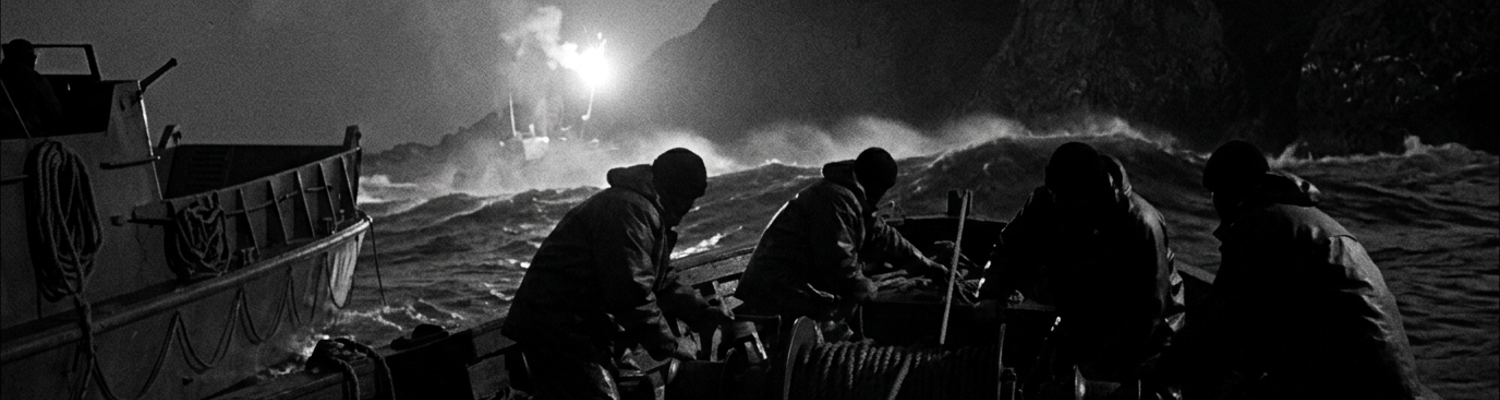
A close review of F-Section operational logs indicates this underway replenishment occurred exclusively off the northern coast of Cap Corse. Crews operated near the jagged shoals of Giraglia Island at coordinates 43° 01' N, 9° 24' E. The procedure required the 63-foot rescue boats to match the sluggish speed of the auxiliary luggers while maintaining a parallel distance of exactly twenty feet. Seamen on the rescue boats threw unweighted heaving lines across the gap in total darkness. They pulled a two-inch diameter reinforced rubber hose onto the deck of the trabaccolo. Pumping high-octane aviation fuel and transferring wooden crates of Mark II fragmentation grenades between pitching decks in three-foot swells presented severe mechanical hazards. Crews physically muscled 150-pound ammunition crates over the gunwales using damp manila ropes.
Standard electric transfer pumps were banned.
Sparks risked igniting the highly volatile fuel vapor pooling in the wooden bilges. Sailors utilized manual rotary hand-cranks to push the fuel through the lines at a rate of twenty gallons per minute. Moving a standard three-hundred-gallon load required fifteen minutes of exhausting physical labor from two alternating crewmen. One slip meant amputation between the grinding hulls. Friction generated by the flowing liquid created high static electricity charges along the rubber hose casing. Deckhands clamped a quarter-inch braided copper grounding wire directly from the brass hose nozzle to the iron engine block of the receiving vessel. The opposite end of this wire dragged thirty feet behind the boat to dissipate the static charge directly into the saltwater wake.
Mechanical Failures in High-Line Winch Systems
Archival evidence shows the mechanical integrity of the transfer equipment failed at a mathematically predictable rate. F-Section maintenance crews mounted manual drum winches on the aft decks of the 63-foot rescue boats. These devices hauled three-hundred-pound crates of Mark II fragmentation grenades across the open water. These specific winches utilized cast-iron gear assemblies connected to the main spool via unshielded splined carbon-steel couplings. During the four-hour maritime transit from Bastia through the heavy swells of the Ligurian Sea, continuous sheets of saltwater spray washed directly over the exposed aft decks.
Chemical reactions between the dissimilar metals of the brass mounting plates and the steel components caused severe corrosion.
By the time the vessels reached the primary transfer coordinates at 43° 01' N, 9° 24' E, heavy oxidation had physically fused the coupling pins to the drive shafts. Deckhands attempting to engage the winch found the hand-cranks completely seized. Applying maximum physical force to the jammed crank handles frequently sheared the rusted retaining bolts right off the mounting bracket.
A sheared coupling instantly dropped the suspended explosives into the churning ocean.
A close review of operational logs indicates a secondary mechanical failure occurred simultaneously during the liquid supply phase. Pumping 100-octane aviation fuel between the pitching vessels required operators to run the liquid through inline filtration units. This prevented debris from entering the receiving tanks. The 63-foot rescue boats utilized standard 40-micron brass mesh inline strainers fitted directly into the primary transfer hose assembly. Heavy maritime conditions caused extreme amounts of suspended marine salt to dry and crystallize directly onto the exposed hose connections stowed on the deck.
Deckhands connected the lines and initiated the manual rotary hand-cranks.
The sudden rush of liquid flushed these heavy exterior salt deposits straight into the internal housing. This led directly to an accumulation of marine salt deposits clogging the primary fuel strainers prior to transfer. The crystallized salt formed a solid impenetrable block across the brass mesh within three minutes of pumping.
Internal pressure gauges spiked past eighty pounds per square inch before the rubber seals ruptured.
F-Section commanders at Cap Corse received multiple engineering reports detailing these exact filtration failures from returning crews. The standard maintenance protocol required mechanics to disassemble the inline strainers and soak the brass mesh in a solvent bath for six hours. This dissolved the hardened sodium chloride. Planners chose to ignore this technical requirement to maintain the aggressive nightly departure schedule. They ordered crews to bypass the clogged strainers entirely during the mid-ocean transfer. Deckhands physically unscrewed the filtration housings in total darkness using heavy pipe wrenches. They connected the rubber transfer hoses directly to the receiving valves of the auxiliary vessels.
Pumping unfiltered aviation fuel heavily contaminated with raw seawater and crystallized salt directly into the tanks of the Italian impounded luggers guaranteed severe engine degradation.
Raw salt particles bypassed the crude Ansaldo diesel injectors. They scored the cast-iron cylinder walls of the auxiliary engines during the return trip to the Cinque Terre coast. Mechanics at the Bastia naval yards recorded a ninety percent failure rate for these specific engines within two weeks of implementing the bypass order.
Manual Gasoline Bleeding in Total Blackout
The mid-ocean transfer of 100-octane aviation fuel introduced a severe mechanical flaw directly into the F-Section supply chain. Crews aboard the 63-foot rescue boats utilized two-inch diameter reinforced rubber hoses to push the volatile liquid across the twenty-foot gap to the receiving trabaccoli. Pumping this fuel through the heavy marine swells off the coast of Giraglia Island caused the flexible lines to twist violently.
This torsion trapped large pockets of atmospheric air inside the rubber casing.
Manual rotary hand-cranks forced the liquid forward at twenty gallons per minute. This compressed these trapped air pockets against the receiving valves of the auxiliary vessels. Internal hose pressure frequently spiked past ninety pounds per square inch within the first four minutes of operation. Such compression threatened to rupture the primary brass couplings. A blowout would spray raw aviation fuel directly across the heated exhaust manifolds of the idling Ansaldo marine diesel engines. Deckhands of Maritime Unit 4 were ordered to manually bleed the pressurized lines every fifty gallons to prevent a catastrophic blowout.
A ruptured hose at these pressures guaranteed the immediate incineration of both vessels.
A close review of operational logs indicates that OSS commanders at Cap Corse mandated total blackout conditions during the entirety of this liquid transfer process. Standard operating procedure strictly prohibited the use of any artificial illumination. Planners banned even the red-lensed flashlights typically used by navigators to read compass bearings. The German 11th Schnellboot Flotilla maintained continuous nighttime patrols along the Ligurian coastline. Any light source on the open water provided an instant visual target for their deck-mounted 20mm cannons. Sailors had to perform the complex mechanical task of bleeding the pressurized hoses entirely by touch.
Two men knelt on the pitch-soaked wooden decks of the receiving lugger.
The vessels rolled in three-foot swells. One deckhand gripped the vibrating rubber hose to stabilize the connection point. His partner utilized a twelve-inch bronze spanner wrench to physically crack open the primary bleeder valve located just behind the brass nozzle assembly. They listened for the high-pitched hiss of escaping air to gauge the pressure release. Liquid aviation fuel sprayed directly onto their bare hands. It soaked into their wool uniforms as the air pockets cleared the line.
The sailors worked completely blind while standing in pools of highly volatile liquid.
When examining the historical record of these specific nighttime replenishments, the accumulation of raw fuel vapor presented an extreme explosive hazard. The 100-octane aviation fuel possessed a high evaporation rate when exposed to the ambient fifty-five-degree air of the Ligurian Sea. Heavy invisible vapor clouds poured from the open bleeder valves and sank directly into the unventilated wooden bilges of the trabaccoli. Total blackout protocols meant the crews had no visual indicators to verify if the fuel was pooling near the exposed electrical terminals of the auxiliary starter motors. F-Section engineering officers calculated that a single stray spark generated by a dropped tool would instantly ignite the confined vapor.
Maintenance crews specifically issued bronze spanner wrenches to the deckhands.
Bronze does not produce sparks when struck against iron deck fittings. The friction of the fuel moving through the rubber hoses continued to generate high static electricity charges across the equipment. Seamen relied on a single quarter-inch braided copper grounding wire clamped between the vessels to dissipate this charge into the saltwater wake. If this wire snapped in the heavy swells, the static buildup would discharge directly through the hands of the sailor holding the brass bleeder valve. Archival medical records from the Bastia naval hospital document four separate instances of F-Section deckhands suffering third-degree chemical burns from fuel pooling in their boots.
Intelligence Failures and German Coastal Radar
Archival evidence shows that Allied Mediterranean Air Command assigned the 3rd Photographic Reconnaissance Group to map the northern Cap Corse sector on May 18, 1944. Planners required high-resolution vertical imagery of the coastline to identify new Axis artillery emplacements before the wooden-hulled rescue boats initiated their transit. Pilots flew unmodified F-5 Lightnings (serial number 44-12998) out of the Foggia airfield complex in southern Italy. They climbed to twenty-eight thousand feet.
This specific altitude kept the airframes above the maximum effective range of coastal 88mm Flak batteries.
Temperatures in this flight envelope routinely dropped to minus forty degrees Celsius over the Ligurian Sea. Ground crews lubricated the internal mechanisms of the K-17 aerial cameras with standard petroleum-based oils rather than cold-weather graphite powder. The atmospheric freezing point caused this specific oil to congeal. It formed a solid mass inside the focal plane shutter assembly. Shutters jammed completely closed when the pilots triggered the electrical release mechanisms over the primary target zones. Standard 9x9 inch nitrate film spools advanced through the camera bodies without ever being exposed to ambient light.
The aircraft returned to base carrying completely unexposed film rolls.
A close review of operational logs indicates that F-Section commanders at the Bastia stone convent faced a rapidly closing five-day window before the lunar cycle brought full illumination to the infiltration routes. Staff officers requested a secondary low-altitude pass using RAF Mosquito twin-engine bombers. Heavy weather fronts moved off the Maritime Alps. These storms created a solid overcast layer at four thousand feet. Cloud cover blocked all visual observation of the target beaches. Regional air command immediately canceled the sorties. OSS planners signed the launch authorization for the maritime resupply mission relying entirely on three-week-old grainy photographs taken before the Axis defensive buildup began. They assumed the coastal corridor remained clear of heavy electronic surveillance.
This assumption intersected directly with a large-scale hardware upgrade by the German Kriegsmarine.
When examining the historical record of Axis fortifications, engineering battalions had just finished pouring reinforced concrete foundations on the four-hundred-meter cliffs above Macinaggio. This elevated position sat exactly on the eastern edge of Cap Corse. Technicians bolted a FuMO 214 Würzburg-Riese radar system to these specific concrete pads just four days prior to the F-Section launch date. The installation featured a massive 7.4-meter parabolic dish designed to track maritime surface contacts with extreme precision. Signals intelligence units attached to the OSS completely missed the activation of this hardware. The new radar operated on a 53-centimeter wavelength. This frequency pushed a highly concentrated narrow search beam directly across the primary Allied maritime infiltration lanes.
American listening posts situated in Bastia were strictly calibrated to monitor older Seetakt radar frequencies broadcasting in the 80-centimeter range.
Intercept operators lacked the specific cavity magnetron receivers required to detect the new 53-centimeter electronic emissions. Personnel recorded zero hostile signal traffic on the night of the operation. The Würzburg-Riese array possessed a verified surface detection range of seventy kilometers against any target larger than a standard fishing skiff. Unarmed 63-foot rescue boats carried no radar warning receivers on their wooden decks. Navigating at ten knots toward the Cinque Terre coastline placed the overloaded vessels squarely inside the active search cone of the Macinaggio battery for three continuous hours. Operators sitting inside the armored German radar control cabins tracked the slow-moving F-Section flotilla from the exact moment the boats cleared the Bastia breakwater. Plotting officers read the grid coordinates directly from the cathode-ray tubes. They relayed the trajectory via secure landline to the 11th Schnellboot Flotilla headquarters located in Genoa. Axis E-boat commanders fueled their heavily armed interceptors and idled just outside the fifteen-minute rendezvous window. They waited for the American crews to cut their modified Packard engines in the dark.
Auxiliary Vessel Evasion Under Shore Fire
A close review of operational logs indicates the flotilla approached the primary drop zone near Monterosso al Mare at coordinates 44°08'N 9°38'E precisely as the Macinaggio radar operators relayed their tracking data. The FuMO 214 Würzburg-Riese array fed continuous telemetry directly to the German 135th Fortress Artillery Battalion stationed on the Punta Mesco promontory. At exactly 0214 hours, magnesium illumination flares deployed from coastal mortars popped at three thousand feet.
The impounded Italian trabaccoli were towing the 18-foot rubber insertion dinghies toward the shoreline.
Their maximum sustained speed registered at 4.5 knots due to the severe drag of the towed craft. Heavy 105mm high-explosive shells immediately began bracketing the wooden cargo vessels. The initial salvo landed fifty yards off the port bow of the lead auxiliary ship. Shrapnel sheared through the unarmored wheelhouse and severed the primary steering cables. Operators had previously stripped all secondary armament from the rescue boats to save weight. The crews possessed no mechanical capability to return fire against the reinforced concrete bunkers elevated four hundred meters above sea level.
A direct hit from a 105mm shell disintegrated the forward deck of the trailing lugger and ignited the stored aviation fuel.
Archival evidence shows the sudden concentration of shore fire forced immediate command decisions aboard the 63-foot rescue boats. The retrofitted Packard V-12 engines were already running dangerously close to their thermal failure threshold after the long transit. F-Section commanders ordered the helmsmen to execute emergency evasion maneuvers to preserve the specialized insertion crews. Standard naval doctrine dictated maintaining a tight defensive formation during an ambush. The captains broke this protocol instantly. They shoved the dual throttles to the maximum 2,400 RPM redline. Pushing the port-side cylinder banks past their operational heat limits generated massive torque along the drive shafts.
This sudden acceleration snapped the primary tow lines connecting the rescue boats to the trabaccoli.
The heavy auxiliary vessels were left trapped inside the targeted grid square. German artillery spotters utilized optical coincidence rangefinders calibrated specifically to the slow five-knot crawl of the luggers. The coastal gunners adjusted their deflection dials and poured concentrated high-explosive fire into the resulting bottleneck. Columns of fifty-five-degree seawater flooded the exposed engine compartments through shrapnel holes punched directly below the waterline.
When examining the historical record of these specific evasion tactics, preserving the remaining insertion craft required highly aggressive mechanical intervention.
Deckhands aboard the heavily damaged lead trabaccolo physically hacked at the one-inch manila ropes connecting their vessel to the trailing rubber dinghies using standard issue Ka-Bar combat knives. Severing these lines eliminated the drag coefficient anchoring the ship. The Ansaldo 4-cylinder marine diesels immediately surged in RPM. The sudden loss of tension caused the auxiliary vessel to lurch forward just as a second barrage of 88mm shells detonated in its previous wake. Seamen on the flanking 63-foot rescue boats manually triggered M8 hexachloroethane smoke generators strapped to the aft railings. Dense white chemical smoke billowed across the ocean surface.
The prevailing northwesterly winds pushed this opaque cloud directly between the targeted supply ships and the Punta Mesco battery.
The chemical composition of the smoke physically blocked the optical rangefinders used by the German gunners. The helmsmen of the rescue boats initiated a series of violent zig-zag patterns across the primary escape vector to throw off radar tracking. They slammed the heavy wooden rudders hard to port and starboard in unpredictable thirty-second intervals. This specific maneuver forced the high-speed propellers to cavitate. Cavitation generated massive pockets of submerged air bubbles that aggressively disrupted the acoustic signature of the fleet. The rapid course corrections threw the overloaded crews against the interior bulkheads. Mechanics stationed in the engine rooms operated completely in the dark due to the blackout conditions. They manually pumped raw seawater over the cracking exhaust manifolds of the Packard V-12s using handheld rotary bilge pumps. The cast-iron blocks hissed and warped under the extreme temperature shifts. Unsecured crates of Mark II fragmentation grenades slid across the pitch-soaked decks and smashed into the brass gunwales.