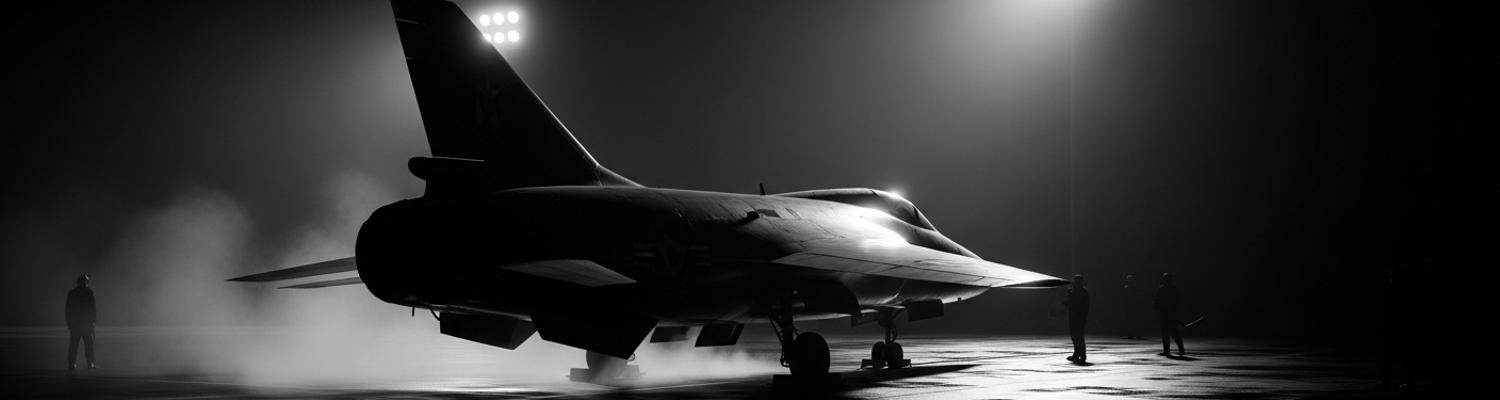

Project Nightingale Cold War Genesis
The directive arrived on the desks of the Air Research and Development Command in autumn 1954. Strategic Air Command required an operational asset capable of surviving anticipated Soviet air defenses within six years. This was before the public unveiling of the SA-2 Guideline surface-to-air missile system, yet intelligence estimates already projected a dense, integrated network that would make conventional high-altitude reconnaissance and bomber penetration missions impossible. The requirement was for an aircraft that could fly deep into hostile territory, gather specific intelligence, and provide localized support to isolated units, all while remaining effectively invisible to enemy radar. This order from the highest levels of the United States Air Force initiated the search for a new kind of weapon. It was the formal genesis of Project Nightingale.
A close review of operational logs from early Arctic reconnaissance missions, such as Project Nanook, highlights the strategic void Nightingale was intended to fill. These earlier efforts used modified B-29s and B-17s, demonstrating both the importance and the difficulty of operating in the high north. By the mid-1950s, the USAF, under the influence of commanders who saw the polar region as a likely point of origin for a future global conflict, formalized its need for a dedicated Arctic-capable intelligence platform. The project office was quietly established at Wright-Patterson Air Force Base, Ohio. Its mandate was to create a survivable, deep-penetration asset.
The core problem was the rapid evolution of Soviet air defenses. Planners anticipated the deployment of sophisticated radar and missile systems across the Kola Peninsula, the heavily militarized gateway to the Soviet Union’s northern territories. USAF planners needed an aircraft that could slip through this emerging electronic fortress undetected.
The design philosophy centered on the poorly understood principles of low-observable technology. Archival evidence shows that engineers at the Skunk Works, then concurrently exploring stealth concepts for the A-12 OXCART program, contributed foundational research. Nightingale’s proposed airframe was a compromise. It blended faceted surfaces intended to scatter radar waves with curved forms dictated by the aerodynamic realities of subsonic flight. Its primary stealth feature was a thick, iron-ferrite paint, an early form of radar-absorbent material that proved exceptionally difficult to maintain. Test reports from secure facilities in Nevada detailed how the coating, which added significant weight, would crack and peel in the extreme temperature variations of its intended theater. The powerplant, a pair of experimental non-afterburning J58-P-2 turbojets, was designed for a suppressed infrared signature. This was achieved by mixing hot exhaust with cold bypass air in elongated shrouds, a design that reduced the engine’s heat bloom at the cost of reliable performance. Test pilots frequently reported flameouts and stalls during anything other than straight-and-level flight.
The aircraft’s primary purpose was intelligence gathering in the harsh environment of Northern Europe. Its mission was not to drop bombs, but to map the electronic order of battle. The core of the Nightingale was its specialized sensor package, specifically the AN/ALR-46(V) terminal threat warning system and a suite of receivers designed to detect and categorize Soviet radar emissions from installations like the Hen House network. The operational plan was to fly clandestine routes over the Barents Sea and along the Norwegian coastline, cataloging the frequencies and locations of early-warning and fire-control radars. This data was considered essential for programming the electronic countermeasures of Strategic Air Command’s bomber fleet. The Arctic itself was as much of an adversary as the Soviets. Low temperatures below -40°C caused hydraulic fluid to thicken, slowing the response of flight controls and landing gear. Whiteout conditions frequently confused the terrain-following radar, leading to mission aborts. The unreliability of magnetic compasses near the pole made navigation a constant and severe challenge.
Unconventional Doctrine and Funding Obstacles
Project Nightingale existed in a state of bureaucratic isolation. Its very purpose defied the neat organizational charts favored by the Pentagon’s administrative state in the mid-1950s. The aircraft was not a strategic bomber, which fell cleanly under the powerful domain of the Strategic Air Command (SAC). It was not a tactical fighter, which had its own clear lines of authority within Tactical Air Command. It was a specialized, low-observable intelligence asset, designed for the amorphous mission of unconventional support in a high-threat environment.
This ambiguity was a curse.
Archival evidence from the Air Research and Development Command (ARDC) reveals the project was shunted between oversight committees, each with its own procurement standards and conflicting priorities. For a period in 1955, the Nightingale program office at Wright-Patterson answered to both the Special Projects Review Board and the Air Materiel Command’s Non-Standard Procurement Office. This dual-hatted reporting structure resulted in months of delays as conflicting directives (per ARDC Memo 11-45A) stalled the sourcing of basic components like the non-magnetic beryllium-copper fasteners required for the aircraft's sensitive avionics bays.
This bureaucratic friction was amplified by intense inter-service rivalry. The U.S. Army, then heavily investing in its own organic aviation capabilities for special operations, viewed Nightingale’s proposed mission as a direct encroachment. A review of after-action reports from Operation Polar Thrust, a 1956 joint-service Arctic exercise, shows that commanders from the Army’s 10th Special Forces Group argued that their own helicopter detachments could perform insertions and gather intelligence more effectively. Their arguments ignored the fact that slow-moving helicopters would be annihilated by the same Soviet radar and missile networks Nightingale was designed to evade. The U.S. Navy was equally hostile. Focused on its global power projection through carrier groups, the Navy’s leadership saw the land-based Nightingale as a wasteful diversion of funds. Minutes from a tense 1957 meeting at the Pentagon detail Navy officials arguing that any intelligence-gathering in the Barents Sea was the exclusive domain of their submarine fleet and P-3 Orion patrol aircraft operating from Keflavik, Iceland. This rivalry directly impacted operational planning, with the services competing over the right to collect electronic intelligence on Soviet submarine pens near Murmansk.
These doctrinal and inter-service battles created a perfect storm for funding disputes. Lacking a powerful, high-ranking champion within a major command, the program was a vulnerable target during every budget cycle. In hearings before the Senate Subcommittee on Strategic Forces, legislators, influenced by lobbyists from conventional bomber manufacturers, openly questioned the high cost and unproven nature of the aircraft. Reports of the iron-ferrite stealth coating cracking in ground tests and the persistent flameouts of the experimental J58 engines provided ample ammunition for skeptics. The fiscal year 1957 budget slashed the project’s funding by nearly forty percent. The consequences were immediate. The planned Type II hydraulic system upgrade, designed to fix the dangerous sluggishness of the flight controls in extreme cold, was abandoned. To keep the primary prototype, N-01, airworthy for its sensor-package trials, engineers were forced to cannibalize the second airframe, N-02, for spare parts. This effectively grounded it and brought the already protracted test schedule to a crawl.
Nightingale Aircraft Covert Capabilities
The N-01 airframe was a machine defined by its operational contradictions. A close review of its design specifications reveals an aircraft built for two opposing flight regimes. For high-altitude transit, its long, thin wings provided efficient lift in the thin air above 60,000 feet. For low-altitude penetration, those same wings made the aircraft dangerously susceptible to turbulence and placed high stress on the wing roots, where early fatigue cracks were a persistent issue during testing at Groom Lake. The cockpit was a single-seat affair, intentionally isolating the pilot to reduce the platform’s cross-section and thermal signature. This decision placed an extraordinary load on one individual, who had to simultaneously fly the unstable aircraft, manage its experimental defensive systems, and operate the complex sensor package. The primary flight controls were a hybrid fly-by-wire system, one of the first of its kind, which used analog computers to interpret pilot inputs and translate them into hydraulic actions. This system, lacking the redundancy of modern designs, was a known point of failure. Test flight logs document several near-catastrophic incidents where momentary electrical power fluctuations caused the control surfaces to lock, forcing pilots into harrowing recovery maneuvers.
The machine was a collection of unproven systems.
Its internal architecture was difficult to maintain. To preserve its low-observable characteristics, access panels were few and secured with non-standard beryllium-copper fasteners that required specialized, non-magnetic tools. A simple hydraulic leak, a common occurrence given the temperature extremes, could ground the aircraft for days while maintenance crews navigated the cramped, hazardous internal spaces.
The Nightingale’s initial tasking, as outlined in a 1956 ARDC directive, was the clandestine deployment of unattended ground sensors (UGS) along the heavily fortified Kola Peninsula. This was an active delivery operation into the heart of the Soviet Union’s northern bastion. The primary payload was the Pebble series sensor, a seismic and acoustic device designed to be dropped along Soviet military supply routes to monitor truck and armor movements. Operational planning documents from the 4477th Test and Evaluation Squadron detail the intended deployment method with precision. The Nightingale would ingress at extremely low altitude over the Barents Sea, using its terrain-following radar to hug the waves. Upon reaching a pre-designated point inland, the pilot would execute a high-G pop-up maneuver, climbing just enough to clear local terrain before ejecting the sensors from a specialized ventral bay. This bay was itself a major engineering challenge. Its doors had to open and close in under two seconds to minimize the aircraft’s radar-cross section spike. The ejection system used a compressed gas charge, but tests showed that in the arctic cold, the gas pressure would sometimes drop, causing the sensor package to tumble and fall short or, in one documented case, strike the aircraft’s own horizontal stabilizer. The entire maneuver was a high-risk gamble. The pop-up exposed the Nightingale to Soviet early-warning radars like the P-14 Tall King, and the energy bloom from the brief climb was a beacon for infrared search-and-track systems. Planners calculated the window of vulnerability to be between ten and fifteen seconds. For the pilot, it was an eternity.
A shift in strategic focus during 1958 forced a significant redesign of the Nightingale’s mission profile and hardware, optimizing it for the politically charged environment of the Baltic Sea. Archival evidence from the project’s review board indicates that the high risks and low success rate of the Kola Peninsula sensor drops were deemed unacceptable. The new area of operations was fundamentally different. Instead of a desolate arctic wasteland, the Baltic was a crowded theater, teeming with commercial shipping, fishing vessels, and civilian air traffic from neutral Sweden and Finland, alongside Warsaw Pact and NATO forces operating in close proximity.
Deniability became the prime directive.
This new theater demanded a different kind of stealth. The focus shifted from deep penetration to standoff electronic intelligence collection. The problematic sensor bay was stripped out of the N-01 prototype and replaced with additional fuel bladders to extend loiter time. The primary sensor package was now the AN/ALQ-77, a sophisticated suite of passive receivers designed specifically to intercept and analyze emissions from East German and Polish air defense radars, particularly the SA-2 Guideline systems guarding the coast. The Nightingale’s flight path was a tightrope walk along the edge of international airspace, sometimes weaving through the narrow gap of the Fehmarn Belt. The aircraft’s mission was to build a precise electronic order of battle, cataloging the unique frequencies and pulse repetition rates of every radar site from Rostock to Kaliningrad. This data was essential for programming the defensive electronics of B-52s and B-47s. To reduce the risk of visual identification from Swedish air patrols or civilian airliners, the later N-03 airframe was painted in a specific matte gray camouflage pattern designed to blend in with the hazy, overcast skies common to the region, a departure from the original black radar-absorbent coating. The J58 engines received new, elongated exhaust shrouds packed with heat-dissipating ceramic tiles, a modification aimed at suppressing the infrared signature during the long, straight-line flights just outside hostile territory.
Baltic Coast Improvised Rescue Mission
A review of operational logs from the 4477th Test and Evaluation Squadron reveals the genesis of the disaster in a mission codenamed Operation KESTREL, dated to a moonless night in late 1959. The objective was a deep penetration of the East German coastline, a high-risk insertion of a three-man Defense Intelligence Agency team tasked with placing a passive tap on a critical Warsaw Pact undersea communications cable near the Darss Peninsula. The Nightingale N-03 airframe was selected. Its AN/ALQ-77 sensor bay was stripped and replaced with a rudimentary personnel drop system. The catastrophic error began before the aircraft even crossed the coast. A persistent drift in the inertial navigation system, a known flaw the project office had not yet been funded to fix, resulted in a two-mile deviation from the planned drop zone. Instead of a secluded stretch of beach, the DIA team landed directly in the path of a routine patrol from the East German 6th Border Brigade Coast. The ensuing firefight was brief. One agent was killed on the ground, and the team’s communications specialist was severely wounded. The team leader, pinned down and with his entire operational package compromised, sent a single, desperate burst transmission before destroying his radio.
The response from United States Air Forces in Europe was immediate and conflicted. Strategic Air Command, which technically owned the N-03 airframe, forbade its re-entry into a now-alerted hostile air defense network. The asset was considered too valuable to risk. For the CIA station in West Berlin, the priority was the wounded operative, who possessed extensive knowledge of agency collection methods. A direct order, its origins still debated by historians but likely originating from European Command, overrode SAC’s objections. The Nightingale N-03 was ordered back in. It was no longer an insertion platform. It was now a makeshift ambulance tasked with an aeromedical evacuation it was never designed to perform. The plan, formulated in minutes, was a desperate gamble. The pilot was to attempt a short, unpaved landing on a narrow strip of coastal road identified from reconnaissance photos. The wounded DIA operative was to be loaded into the N-03’s empty electronics bay. This was an unheated, unpressurized compartment barely large enough for a man to lie prone, surrounded by the sharp-edged mounting brackets for the removed AN/ALQ-77 system. There were no provisions for medical support. Survival for the passenger was a secondary consideration. The primary goal was extraction of the intelligence asset, dead or alive.
The Nightingale’s return flight was an exercise in pure survival. The entire Warsaw Pact air defense network along the Baltic coast was active and searching. Declassified logs from listening posts in Denmark show a sky saturated with emissions from Soviet P-15 Flat Face and East German Spoon Rest acquisition radars. The pilot brought the N-03 in at less than one hundred feet, the aircraft’s terrain-following system struggling to keep it just off the waves. The landing and recovery of the operative took less than ninety seconds, but it was enough. As the N-03 powered up for takeoff, it was illuminated by multiple searchlight and radar systems. The escape was a low-altitude, high-speed run through a gauntlet of anti-aircraft fire. The primary threat came not from missiles, which could not achieve a lock at that altitude, but from a dense concentration of radar-directed 57mm S-60 and 37mm M1939 anti-aircraft guns. Shells tore through the air around the airframe. A near-miss from a 57mm round sent shrapnel ripping through the right horizontal stabilizer and punctured the fuselage near the engine bay. The pilot registered multiple system failures simultaneously. Main hydraulic pressure began a steady, irreversible drop. The fly-by-wire system flashed warnings of intermittent control response in the right aileron. The aircraft was bleeding, its low-observable skin shredded and its flight characteristics dangerously altered, carrying a wounded man in its unshielded gut as it limped back over the cold Baltic water.
Covert Air Operations Policy Shift
The moment the damaged N-03 Nightingale cleared hostile airspace, a flash cable from the Commander of United States Air Forces in Europe landed on the desk of the Air Force Chief of Staff. The near-loss of a top-secret, low-observable asset during an improvised and unsanctioned rescue mission for another agency’s compromised operation sent shockwaves through the Pentagon. Political pressure from the White House was immediate. The operation was seen as an unacceptable risk, a gamble that could have delivered the nation’s most advanced aeronautical secrets directly into Soviet hands. Within hours, the program’s opponents in the Navy and Army capitalized on the failure, arguing to congressional committees that Project Nightingale was an uncontrollable, doctrinally unsound program that threatened national security. A formally worded directive from the Secretary of Defense ordered the immediate grounding of the entire Nightingale fleet, pending a full review. It forbade any further operational sorties of any kind. The asset was to be hidden, its existence denied.
The most damaging assessment arrived a week later in a top-secret dossier stamped CIA, Sweden, Situation Report 7. A review of this document, declassified decades later, reveals a catastrophic intelligence breach. While the N-03 had successfully evaded the primary Warsaw Pact air defense radars during its ingress, its damaged return flight was a different story. The shrapnel-torn fuselage and compromised right engine exhaust shroud had dramatically increased the aircraft’s radar cross-section and thermal signature. Swedish air defense radar stations on the island of Gotland, technically neutral but highly vigilant, tracked the struggling aircraft for over fifty miles. Their detailed radar returns, which the CIA station in Stockholm acquired through established backchannels, provided a partial but usable signature profile of the supposedly invisible aircraft. The report also contained analysis of East German border troop radio traffic, which confirmed they knew a hostile aircraft had landed and taken off, even if they misidentified it as a helicopter. The CIA’s analysis was blunt: the mission had not only failed but had actively compromised the core secrecy of the entire low-observable program by exposing it to a non-NATO nation. The principle of plausible deniability had been shattered.
In response, the Air Force launched a deep and painful internal investigation led by the Air Force Office of Special Investigations. The inquiry, codenamed Project BLUE BOOK (no relation to the more famous UFO study), was twofold. First, a technical team from Wright-Patterson dismantled the wounded N-03 airframe. Their findings cataloged extensive damage: over 20 shrapnel perforations in the fuselage and right stabilizer, contamination of the primary hydraulic system with de-icing fluid, and stress fractures on the main wing spar that suggested the aircraft was moments from catastrophic structural failure during its final approach. Second, the investigative board reviewed the entire command-and-control chain of Operation KESTREL. Their final report, issued in early 1960, placed blame squarely on the doctrinal ambiguity that had plagued Nightingale from its inception. The investigation concluded that using a strategic reconnaissance asset for a direct-action mission for which it had no training, equipment, or command oversight was a predictable disaster. The report’s primary recommendation was absolute: the Nightingale program was to be stripped of any and all personnel insertion or extraction capabilities. Its mission was to be permanently restricted to standoff electronic intelligence. The days of deep penetration were over.
Nightingale Platform Obsolescence and Aftermath
The political fallout from Operation KESTREL was absolute. A directive from the Office of the Secretary of Defense, issued before the damaged N-03 had even been fully assessed at its West German airbase, placed Project Nightingale on indefinite hold. The program was deemed a political liability. The analysis of the Swedish radar data from Gotland confirmed the Pentagon’s worst fears: the Nightingale’s low-observable characteristics were not infallible. When the airframe was damaged, it became glaringly visible. Internal USAF memoranda from this period reveal a command structure paralyzed by the risk of a future shoot-down. The thought of a Nightingale airframe, or even a significant piece of its wreckage, being displayed in Moscow was enough to terminate any further deep-penetration missions.
Early decommissioning was not an option. The surviving airframes, the original N-01 prototype and the battle-scarred N-03, were too sensitive to be scrapped through conventional channels and too valuable as technological demonstrators to be simply destroyed. A review of Air Materiel Command disposition logs shows the two aircraft were quietly disassembled, loaded onto C-124 Globemaster II transports, and flown to the remote test ranges at Groom Lake, Nevada. There, they were reassembled and assigned to a newly formed, deeply classified unit, the 4450th Tactical Group. Their mission was inverted. Instead of being hunters, the Nightingales became the hunted. The aircraft were stripped of their sensitive sensor suites and used as aggressor platforms, flying simulated attack profiles against new generations of USAF and Navy radar systems. Engineers and tacticians used the data from these mock engagements to develop the very doctrines and technologies that would be used to counter low-observable threats. The Nightingale’s final purpose was to teach its own side how to kill it, its revolutionary design reduced to a training aid. Airframe N-03, with its patchwork of repairs from the Baltic mission, was particularly useful in demonstrating how battle damage could compromise a stealth aircraft’s signature.
The psychological toll on the small, anonymous cadre of Nightingale pilots proved to be the program’s most destructive legacy. A review of declassified flight surgeon reports and post-service medical records from the early 1960s paints a grim picture. The pilots were subjected to a unique combination of stressors. The single-seat cockpit design placed the entire burden of flying an unstable aircraft, managing experimental systems, and executing a high-stakes mission on one person for hours on end, in complete radio silence and isolation. This led to a condition that medical officers privately termed profound dissociation and hypervigilance. Pilots reported persistent auditory hallucinations mimicking the specific high-frequency whine of the AN/ALQ-77 cooling pumps. They described tactile phantom sensations, feeling the shudder of a failing hydraulic actuator in their hands and feet long after they had left the cockpit. The extreme secrecy of the program was a critical factor. It forbade them from discussing their experiences with anyone, including their families or standard military medical staff, creating a perfect prison of anxiety. After the program’s termination, most of the pilots were quietly reassigned to mundane transport or training roles. Their specialized experience was erased from their official records, leaving them to process the trauma of their covert service in complete isolation.