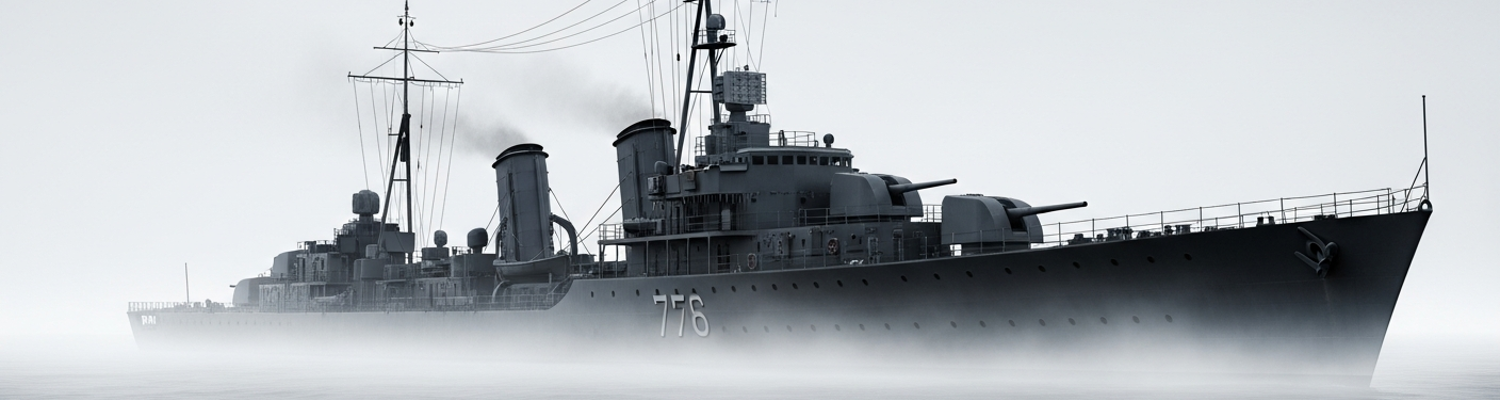

Post-WWI Baltic Naval Presence
Exhaustion was the baseline condition. Archival records for U.S. Navy Destroyer Division Eight describe a punishing Atlantic crossing in the spring of 1919 that savaged both men and machines. The ships were Wickes-class destroyers, the famed four-pipers mass-produced for anti-submarine warfare. Vessels like the USS Little (DD-79) and USS Sampson (DD-63) were never designed for comfort. They were 1,200-ton platforms built around a powerful propulsion system and a heavy torpedo armament. Their scantlings were light. Their hulls rode low in the water, a design choice that guaranteed a wet and violent passage through North Atlantic gales. A review of operational logs (NARA Record Group 38) indicates that persistent mechanical failures plagued the division. The Yarrow-type boilers, in particular, were known to deteriorate rapidly under the strain of continuous high-speed steaming. This fact haunted engineering crews who spent their transit patching steam lines and repacking bearings instead of sleeping. The men arrived in European waters not as a victorious force but as a weary one, their bodies aching, aboard ships already showing advanced material fatigue.
They were sailing into a political vacuum.
The Baltic Sea of 1919 was a multi-sided conflict zone where the clear battle lines of the Western Front had dissolved. The collapse of the Russian and German empires left a power void that numerous factions rushed to fill. Bolshevik forces sought to reclaim the newly independent states of Estonia and Latvia, whose people were fighting for national survival. Simultaneously, White Russian armies, loosely supported by the Entente, launched counter-offensives aimed at capturing Petrograd. Adding another layer of complexity were the German Freikorps. These were well-armed, highly organized mercenary units of demobilized German soldiers who refused to accept defeat. Units like the Iron Division fought against the Bolsheviks under the nominal approval of the Allies but pursued their own agenda of establishing a German-dominated state, even briefly overthrowing the Latvian government. All of this unfolded under the watch of the dominant naval power in the region, the British Royal Navy. Their own extensive campaign, Operation Red Trek, was aimed at blockading the Bolsheviks and supporting the new Baltic states. This created a maritime environment where allegiances were fluid and the waters were thick with mines from multiple wars.
Into this environment sailed the American destroyers. Their mission was deliberately ambiguous and observation-focused. Formally a component of the Allied Naval Armistice Commission, their dispatch to the Baltic carried a distinct intelligence mandate. The primary function was not combat. It was to see, listen, and report. Operational orders directed commanders to gather intelligence on Bolshevik naval strength, particularly the status of their fleet at the heavily fortified Kronstadt naval base. They were to monitor the movements of German Freikorps units and report on their compliance with Allied directives to withdraw. The destroyers also served as floating symbols of American interest, their presence intended to influence the calculations of the warring factions. This required a delicate touch, navigating a space where their powerful British allies were already running a major combat operation. The American crews were tasked with being the eyes and ears of an administration thousands ofmiles away, filing reports on everything from Bolshevik warship readiness to the price of flour in local ports.
Radio Intelligence Gathering Demands
A close review of operational logs from early 1919 reveals a distinct pivot in the mission. Initial directives centered on armistice enforcement were superseded by specific orders mandating a deep commitment to radio intelligence. These were not passive instructions. Commanders were directed to dedicate their vessels and specialist personnel to the sustained interception of all significant radio traffic in the eastern Baltic. The explicit targets were the Bolshevik naval forces at Kronstadt and the chaotic communications of German Freikorps units in Latvia and Estonia. The destroyers were now mobile listening posts, not gun platforms. It was a duty for which they were unprepared. The orders placed an enormous strain on the ships’ small cadre of trained radiomen, who were now tasked with a 24-hour cycle of signals intelligence gathering on top of their regular duties.
The mission presupposed a technical capacity that was stretched to its absolute limit.
Sustained radio intelligence operations placed a heavy burden on the fragile hardware of the Wickes-class destroyers. Archival evidence shows the ships were equipped with a mix of then-standard long-wave and short-wave radio antennas, strung from tall main and foremasts. The primary receivers were often rudimentary crystal sets, notoriously difficult to tune and highly susceptible to atmospheric interference and the electrical noise generated by the ship’s own systems. Keeping these sets operational was a constant struggle. The operational core of the mission, however, was the human element. The small team of radiomen on each destroyer lived a life dictated by the constant crackle and hiss in their headphones. They worked in shifts in cramped, poorly ventilated radio shacks, manually sweeping frequencies and straining to copy messages sent in Morse code. The work was mentally exhausting, demanding intense concentration to distinguish a faint, distant signal from background static. Every character had to be transcribed by hand, a slow and laborious process. This was made more difficult by the poor signal discipline of many of their targets. Bolshevik transmissions, in particular, were often sent with weak signals or by poorly trained operators.
The electromagnetic environment of the eastern Baltic was dense and confusing. The destroyers were tasked with untangling a complex web of signals emanating from multiple factions. The highest priority was traffic from the Bolshevik Baltic Fleet. Intelligence on the readiness, movements, and intentions of the warships at Kronstadt was of paramount importance to the Allied naval command. Simultaneously, the American listeners focused on the communications of German Freikorps units. These signals were often more professional but were critical for tracking German movements and assessing their compliance with Allied withdrawal orders. Layered over these primary targets was a sea of other transmissions: White Russian forces coordinating with British advisors, nascent Estonian and Latvian military units attempting to organize their defenses, commercial shipping traffic, and the high-volume communications of the Royal Navy’s own powerful flotilla. Success required not just interception but rapid analysis to identify the origin and importance of a given message from the noise, a process that happened in real-time within the confines of a rolling destroyer.
Coaling Station Logistical Vacuum
The mission's operational tempo outstripped the mechanical endurance of the Wickes-class destroyers. These ships were built for high-speed dashes, not for the grueling, non-stop patrols required in the Baltic. A close review of their engineering specifications reveals a critical design trade-off: their powerful geared steam turbines, capable of pushing the ships to 35 knots, were exceptionally thirsty. The constant need to maintain position, shadow suspect vessels, or race to an area of reported activity meant that engineering crews could rarely operate the plants at their most economical cruising speed. The destroyers burned through their fuel bunkers at a rate that far exceeded planning estimates. A Wickes-class destroyer had a limited fuel capacity, and some vessels in the class had significantly less endurance than others due to variations in construction. This forced commanders into a relentless cycle of calculating fuel consumption against mission requirements.
The leash was perilously short.
This problem was amplified by a severe scarcity of friendly refueling points. The strategic map of the eastern Baltic in 1919 offered no easy solutions for an American naval commander. There were no Allied-controlled coaling stations in the operational area. The nascent states of Estonia and Latvia, while friendly, possessed no naval infrastructure capable of supporting modern warships. Their ports were small, undeveloped, and lacked the specialized piers and machinery for rapid refueling. German ports were politically off-limits. Bolshevik-held harbors like Kronstadt were the objective of the intelligence mission, not a source of support. This created a logistical void. When a destroyer ran low on fuel, it could not simply pull into a friendly port. The only alternative was the slow, back-breaking process of coaling from a collier or lighter, an all-hands evolution that could take a ship out of action for over a day. The procedure involved manually shoveling coal into large canvas bags, hoisting the heavy bags aboard the destroyer, carrying them to the bunker hatches, and then dumping the contents below. The entire warship would be covered in a thick layer of black dust, a filthy and demoralizing process for an already exhausted crew.
The American flotilla’s only lifeline was the Royal Navy. With no infrastructure of their own, the U.S. destroyers became completely dependent on the logistical train established by the British for their own extensive campaign, Operation Red Trek. The Royal Navy had designated ports like Copenhagen as primary staging bases and used a fleet of colliers and oilers to create forward-operating anchorages closer to the fight, often near Reval (modern-day Tallinn). For the American ships, this meant that every ton of fuel had to be formally requested from the British command. A destroyer low on coal had to disengage from its patrol, sail to a designated British anchorage, and wait its turn alongside the far more numerous British cruisers and destroyers also in line for fuel. Archival records show this created a clear hierarchy of need. American requests often took a backseat to the immediate combat requirements of the Royal Navy’s own units. This dependence compromised the American mission’s autonomy, placing U.S. commanders in a subordinate position and ensuring that the pace of their intelligence gathering was ultimately dictated by British logistical priorities.
Spare Parts and Medical Shortfalls
Post-armistice demobilization created a logistical vacuum. Wartime supply chains, built to support a massive global conflict, were being systematically dismantled at the exact moment the Baltic mission demanded their support. For the Wickes-class destroyers, this was a catastrophic failure point. These ships, mass-produced with inconsistent workmanship, were already showing severe material fatigue. Engineering logs from the period document a constant battle against mechanical failures. The Yarrow boilers were a persistent source of trouble, along with fragile condenser tubes that were highly susceptible to corrosion from saltwater. Under normal circumstances, a tender or shore-based depot would provide replacement parts. But in the Baltic, there were no American depots. Every request for a specific tube, bearing, or gasket had to be channeled through the Royal Navy’s already-strained supply system. The result was a critical shortage of the most basic components needed to keep the destroyers functioning.
The ships were cannibalizing themselves to stay operational.
A close review of squadron records (File Ref: DESRON 8-1919) reveals a desperate and unsustainable situation. When a critical component failed on one destroyer, the only source for a replacement was often another American destroyer that was already non-operational. Maintenance teams would be dispatched to strip parts from a sidelined vessel to get another one back on patrol. This practice of controlled cannibalization highlights the extreme scarcity of resources. It created a fleet where the number of fully mission-capable ships was constantly shrinking, not due to enemy action, but because of a simple lack of spare parts. Commanders were forced into an unwinnable triage, deciding which destroyer was most essential and sacrificing others to keep it moving. This mechanical attrition directly impacted the intelligence mission, as ships were frequently forced to operate at reduced speeds or were confined to port entirely.
Men were breaking down as fast as the machinery. The human cost of these logistical failures was just as severe. Archival medical records from the period show a force suffering from both physical and psychological strain. The ships were dangerously ill-equipped for the conditions they faced. There were no dedicated hospital ships assigned to the American flotilla, and the destroyers themselves had only rudimentary sick bays managed by a single pharmacist’s mate. Supplies were inadequate for a prolonged deployment in a harsh climate. Records from similar naval operations of the era note the importance of taking precautions against scurvy and other diseases related to poor nutrition and sanitation. The crews subsisted on a monotonous diet of preserved rations. Fresh food was a rare luxury obtained only during infrequent port calls. The perpetually cold, damp living conditions inside the thin-skinned, uninsulated hulls of the destroyers created an ideal environment for the spread of respiratory illnesses and other communicable diseases.
Electronic Fog of War
Operational logs from the American destroyer division in the Baltic expose an intelligence mission severely hampered by its own technology. The capacity for radio signal triangulation was, in 1919, more theoretical than practical. The Wickes-class destroyers were fitted with tall main and foremasts to carry long and short-wave radio antennas, but the direction-finding (DF) equipment itself was primitive. An operator, straining to hear a faint Morse code signal through a constant hiss of atmospheric interference, would have to manually rotate a loop antenna, listening for the quietest point, the null, to determine a bearing to the transmission. This process was fraught with ambiguity. The ship’s own steel superstructure could reflect and distort incoming radio waves, creating false bearings or making the true null frustratingly broad. On the rolling Baltic seas, keeping a stable bearing was nearly impossible. For triangulation to work, at least two destroyers, separated by a significant distance, had to take simultaneous bearings on the same signal. The operational tempo and vast patrol areas made this a rare event. More often, one destroyer would record a vague bearing, and hours later, another ship might record a second. By then the target, a Bolshevik destroyer or German freighter, had moved, rendering the plotted fix a uselessly large ellipse on the naval chart.
The technical shortcomings were compounded by an uncoordinated Allied intelligence structure. The American destroyers were operating inside a larger British naval campaign, Operation Red Trek, which had its own clear combat objectives and secure intelligence channels. Archival analysis of command directives reveals that the U.S. flotilla was a junior partner, often cut out of the primary intelligence loop. While American radiomen were tasked with intercepting Bolshevik and German Freikorps signals, they frequently lacked the context or cryptographic keys held by the Royal Navy. A US destroyer might successfully intercept a coded Bolshevik naval message but be unable to act on it. The information sat inert in a logbook while the British, who held the cipher, conducted their own operations. There was no central Allied clearinghouse for signals intelligence in the theater. The British, Americans, French, White Russians, and the nascent Estonian and Finnish navies were all running separate, sometimes competing, intelligence-gathering efforts. This created an environment where vital information was hoarded, not shared.
This combination of crude technology and poor coordination created a constant and dangerous risk of electronic misidentification. To a radioman in a cramped shack aboard a pitching destroyer, the airwaves were a confusing mess of signals with few reliable authenticators. Bolshevik naval operators were often poorly trained. Their Morse code fist, or unique sending style, was frequently sloppy and hard to distinguish from that of a civilian merchant ship or a fledgling Estonian patrol boat. There was no electronic equivalent of an Identification Friend or Foe system. An American listener had to rely on clues like transmission frequency, call sign, and signal strength to guess at a sender’s identity and intent. A German Freikorps unit could use captured Bolshevik call signs. A British auxiliary might operate with a faulty transmitter that made its signal sound like a hostile warship. A mistaken report of a Bolshevik squadron heading for Reval could trigger a fleet-wide alert, burning irreplaceable coal and pulling ships from critical patrol stations. A genuine threat could be ignored as atmospheric static.
USS Manley Friendly Fire Incident
In the crowded waters of the eastern Baltic, the line between ally and enemy was thin. A review of operational logs from the American destroyer division in April 1919 documents one such event, a near-catastrophic case of mistaken identity. The incident centered on the USS Manley (DD-74), a Caldwell-class destroyer operating with the flotilla. Unlike the mass-produced Wickes-class ships, the Manley was one of six prototypes for the flush-decker design, a transitional vessel. While on patrol, likely in the shipping lanes toward Estonia, its lookouts made a contact: an unidentified warship, matching the silhouette of a destroyer, was closing on a converging course without displaying any recognizable signals.
Tension on the Manley’s bridge was immediate. In a theater where Bolshevik destroyers or German Freikorps vessels could appear with little warning, an unidentified contact was treated as presumptively hostile. Standard procedure dictated challenges using signal lamps. The Manley’s signalman sent the coded recognition signal.
No response.
The lamp flashed again across the gray water. The strange destroyer continued its approach, silent and dark. Onboard the Manley, the general quarters alarm sounded, sending men scrambling to battle stations. Gun crews on the ship’s 4-inch main battery loaded and aimed, their gun pointers tracking the approaching silhouette. In the torpedo rooms, crews prepared the 21-inch torpedo tubes. The decision to open fire rested with the Manley’s commander, a choice to be made in seconds based on incomplete information.
Only at the last possible moment was the approaching vessel identified. It was a British destroyer. The ship was operating as part of the Royal Navy's aggressive Operation Red Trek, a full-scale combat campaign intended to blockade the Bolsheviks. British commanders, focused on ambush and interception, often ordered their ships to maintain absolute electronic and visual silence to avoid tipping off Bolshevik naval forces. This uncoordinated mission protocol, while effective for British combat operations, placed the American observation patrols in extreme danger. The British destroyer, intent on its own secretive patrol, failed to appreciate that its silent approach would make it appear as a direct threat to an American vessel operating under a completely different set of orders. After-action reports documented the incident, highlighting the fundamental risk of having two allied navies conduct separate missions in the same confined battlespace without a unified command or shared communication protocols.
Harsh Baltic Environmental Impact
An analysis of the American naval mission in 1919 reveals an operation fundamentally shaped by an unforgiving physical environment. The Baltic spring was not a gentle thaw. It was a drawn-out collision of winter and summer. For the crews of the U.S. destroyer flotilla, this translated into relentless exposure to freezing rain, sleet, and persistent, gale-force winds whipping across the cold sea. The Wickes-class destroyers were notoriously wet ships. Their flush-deck design and low freeboard offered little protection from the waves. Historical accounts describe their normal condition in rough weather as being akin to a submersible. Constant sea spray and breaking waves washing over the decks created uniquely hazardous conditions. Metal surfaces, from railings to antenna wires, became coated in thick layers of ice, adding precarious weight and threatening the fragile radio equipment essential for surveillance duties. The simple act of standing watch on the open bridge or in lookout positions was a punishing physical ordeal, exposing sailors to extreme wind chill and drenching them in near-freezing salt water.
The ship's own systems magnified the misery. Archival reviews of destroyer designs from the period show that habitability was a distant secondary concern to speed and armament. The onboard heating systems of the Wickes-class were woefully inadequate for the Baltic climate. These systems typically relied on diverting low-pressure steam from the ship’s main propulsion boilers to small radiators located in select compartments, primarily the wardroom and officer’s quarters. Enlisted berthing and mess decks, where the vast majority of the 122-man crew lived and worked, often had minimal or no heating. The true problem was the ship’s construction. The thin, uninsulated steel hull acted as a massive conductor, radiating the intense cold of the Baltic water inwards. Any warmth generated by the feeble heating system was quickly lost. This temperature differential also created rampant condensation, coating every interior surface with a permanent layer of clammy moisture. Men came off watch soaked and frozen, only to enter a living space where their bedding was damp and the air was cold and heavy with humidity.
This environmental assault was met with insufficient protection. A survey of U.S. Navy uniform regulations and clothing stocks from 1919 indicates that the sailors were issued standard cold-weather gear designed for North Atlantic patrols, not a sustained sub-arctic campaign. The primary garments were heavy wool pea coats, flannel shirts, and wool trousers. While effective when dry, this clothing offered almost no defense once it became wet. Wool loses its insulating properties when saturated, and the American destroyers lacked any specialized waterproof or windproof outerwear. A sailor on lookout, drenched by a wave, was left wearing a heavy, waterlogged coat that actively leached away body heat. Compounding the problem was the lack of adequate drying facilities aboard the cramped destroyers. A man’s clothes, once soaked, often remained damp for days, forcing him to put on cold, wet gear for his next watch. This systemic failure to provide appropriate clothing for the operational theater created a direct path to exhaustion, frostbite, and respiratory illness.
Crew Health and Operational Readiness
Official muster rolls from the American destroyer flotilla in April 1919 provide a clinical, quantified look at the human cost of the Baltic deployment. These documents became grim ledgers of declining health. Entries for destroyers like the USS Sampson show a persistent percentage of the crew marked Sick in Quarters. These were not men with minor complaints; they were sailors incapacitated by their environment. The constant rotation of names on the sick list reveals a force where, on any given day, a significant portion of a destroyer’s 122-man complement was unfit for duty. This had an immediate and cascading effect on the ship’s operation. A reduced number of able-bodied men meant watch sections were stretched thin. Sailors who should have been resting were instead forced to stand extra watches on the frigid bridge or in the cacophonous engine rooms, accelerating their own physical decline. The shortage of healthy personnel was particularly acute among specialized ratings. When a trained radioman or boiler tender fell ill, there was often no one qualified to take his place.
The cold was a weapon.
The primary culprits behind the debilitating sick lists were respiratory illnesses and cold-weather injuries. The third wave of the 1918-1919 influenza pandemic was a recent and deadly memory, and the conditions aboard the destroyers were a perfect breeding ground for its resurgence. The perpetually damp, cold, and crowded enlisted berthing compartments fostered the rapid spread of influenza, bronchitis, and pneumonia. Medical logs from the period document men suffering from high fevers, wracking coughs, and lethal fluid buildup in the lungs. At the same time, sailors exposed to the elements on deck fell victim to frostbite. Lookouts, gun crews, and signalmen, often clad in inadequate, waterlogged wool gear, suffered tissue damage to their hands, feet, and faces. What began as numbness would progress to severe pain and blistering, and in the worst cases, gangrene. With no hospital ship and only a single, overworked pharmacist’s mate armed with a rudimentary medical locker, treatment was minimal. These were not combat casualties, but they were casualties nonetheless, lost to a campaign of attrition waged by the climate itself.
A warship is a complex machine that requires a full complement of healthy operators. A destroyer with a fifth of its crew on the sick list was a crippled vessel. Archival analysis shows a direct correlation between high rates of sickness on a particular ship and a reduction in its patrol hours. Commanders were frequently forced to make the difficult decision to pull their ship off its assigned intelligence-gathering station and seek shelter in a port like Copenhagen, not for fuel or repairs, but because there were not enough healthy men to safely operate the vessel at sea. This created significant gaps in the Allied intelligence screen. The mission depended on constant presence. Every time a destroyer was sidelined by sickness, a piece of the picture went dark. The flotilla's readiness was not a function of enemy action. It was a direct reflection of how many men were well enough to stand watch.