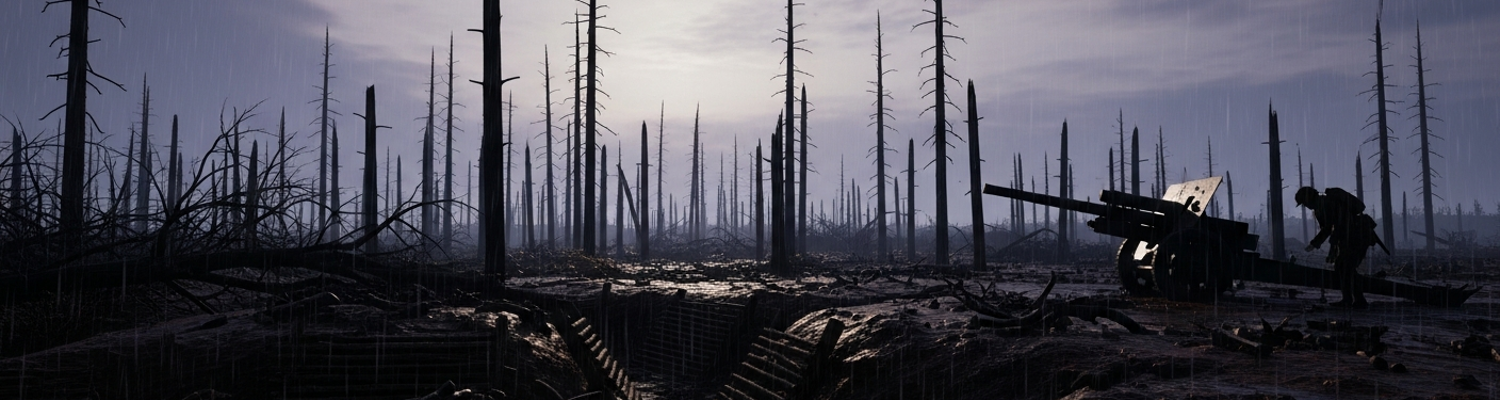

The Offensive Begins
The courier’s motorcycle engine seized in the thick Argonne mud. Its final cough was lost in the percussive thud of distant artillery. This failure was a symptom of the entire American front on September 26, 1918. The Meuse-Argonne Offensive had begun, marking the largest military operation in American history. Over 1.2 million soldiers of the American Expeditionary Forces (AEF), many inexperienced, were committed to a 24-mile front between the Argonne Forest and the Meuse River. The operation formed the right pincer of the Allied Hundred Days Offensive, a grand strategy to break the German Army on the Western Front. The objective was direct: advance north and sever the German rail lines at Sedan and Mézières. These railways were the primary supply artery for German armies in northern France and Belgium. Cutting them would trigger a strategic collapse. The U.S. First Army was supported by 2,700 artillery pieces, 189 tanks, and over 800 aircraft, most supplied by the French.
The American advance faced the Hindenburg Line. This was not a single trench but a deep, complex defensive system, the pinnacle of German engineering. The section facing the Americans was one of its strongest, composed of four main defensive belts over a depth of fifteen to twenty-four kilometers. The AEF’s primary task was to breach this zone. Archival evidence (NARA Record Group 120) details the layers. The first line, the Etzel-Giselher Stellung, was a forward position to absorb the initial shock. Behind it lay the main battle line, the Kriemhilde Stellung, an integral part of the Hindenburg Line proper. This line incorporated the commanding heights of Romagne and Cunel. A final defensive belt, the Freya Stellung, stood further north. Each was a network of interlocking trenches, concrete shelters, hidden machine-gun nests, and dense barbed wire.
Operational logs show the strength of the German positions. For four years, the Germans had fortified this sector. The terrain itself was a defensive multiplier, a landscape of rugged hills, steep ravines, and the dense Argonne Forest. The German Fifth Army under General Georg von der Marwitz and elements of the Third Army defended it. These were not second-rate troops. Though worn by years of war, units like the 1st Guards Division were elite formations familiar with the ground. German doctrine emphasized defense-in-depth. Forward positions were lightly held to slow attackers and channel them into pre-registered killing zones for artillery on the heights east of the Meuse. German artillery was the primary killer, accounting for a high percentage of American casualties. The entire defensive scheme was designed to bleed an attacking force before it could reach the main battle positions of the Kriemhilde Stellung.
The Race to Break German Ciphers
The airwaves over the Meuse-Argonne crackled with German radio traffic. Each message was a potential clue shrouded in a cryptographic veil. AEF listening stations, operated by the Signal Corps, copied thousands of messages, but the contents were gibberish. A review of logs from the AEF’s intelligence section, G-2, reveals desperation. The Germans had introduced a new field cipher in June 1918, designated ADFGVX. It was a sophisticated fractionating transposition cipher invented by Lieutenant Fritz Nebel, designed to be secure even if intercepted. It worked in two stages: first, it substituted plaintext letters for pairs of letters from the set 'A,' 'D,' 'F,' 'G,' 'V,' 'X' using a Polybius square; second, it scrambled these letter pairs using a columnar transposition. The Germans believed it was unbreakable. For the unprepared American codebreakers of G-2-A-6, the AEF's nascent radio intelligence section, it was a nightmare. While their French allies, particularly Lieutenant Georges Painvin, had achieved some successes, the work was agonizingly slow. As American divisions slammed into the German defenses, the need for battlefield intelligence created a high-stakes race against the clock.
Every intercepted ADFGVX transmission represented a critical intelligence gap.
This race was tied directly to the tactical reality on the ground. The objective for American intelligence was to anticipate German counter-moves. AEF High Command needed to know where General von der Marwitz’s Fifth Army was shifting its reserves, where stormtrooper units were massing, and which artillery batteries were being repositioned. This information was hidden in the ADFGVX traffic. A breakthrough could reveal the exact location of a pending assault on depleted American units struggling near the Kriemhilde Stellung. The ability to read even a few messages could provide advance warning, allowing commanders to reinforce a threatened sector or reposition their own artillery. Signal Corps listeners forwarded intercepted messages to G-2 personnel, who searched for patterns and analyzed frequencies. Failure meant American soldiers would be attacking blind into prepared killing grounds.
The pressure from General Pershing’s headquarters was driven by daily casualty reports. The Meuse-Argonne Offensive was the deadliest campaign in American history, with losses mounting at an unsustainable rate. Over 26,000 were killed and nearly 100,000 wounded in 47 days. Each failed frontal assault against an unseen machine-gun nest added to a toll that shocked the AEF command. This attrition created a demand for any intelligence that could provide a tactical edge. Breaking the ADFGVX cipher was seen as a direct path to saving lives. A single decrypted message pinpointing a German divisional boundary or a supply dump was more valuable than a dozen patrols. The small, overworked teams of American cryptanalysts, including Colonel Parker Hitt, understood their intellectual struggle was connected to the physical struggle in the mud. The weight of projected casualty figures lent their work a terrible urgency.
Command Decisions with Incomplete Intelligence
The push to break the German lines placed an extraordinary burden on intelligence and command structures. The inability of Allied cryptanalysts to consistently break the ADFGVX cipher had a direct, negative effect on planning. While French codebreaker Georges Painvin had made some progress, the solutions were too slow to provide real-time battlefield intelligence. This meant that as American divisions like the 79th prepared to assault objectives such as the heights of Montfaucon, their G-2 sections were working with massive blind spots. Planners relied on outdated trench maps, intermittent aerial reconnaissance photos, and fragmentary prisoner interrogations. The stream of intercepted German radio traffic remained indecipherable. This forced commanders to authorize frontal assaults against defensive networks without knowing where the enemy had reinforced their lines. The result was operational planning built on guesswork, a flaw paid for by the infantry.
This intelligence failure cascaded down the chain of command. A captain or lieutenant leading a company was handed a map and an objective, but the ground often bore little resemblance to the paper in his hand. German defenses were a deep, layered network that did not always appear on Allied maps. A lieutenant ordered to take a specific patch of woods had to make decisions under direct fire with almost no reliable information. His field telephone lines were frequently severed by artillery. The signal flares he had were often of a single color and useless for complex communication. He was left to weigh his orders against the sight of machine-gun tracers converging from an unexpected direction. To follow the plan might mean leading his men into a prepared killing zone. To hesitate meant failing to keep to a rigid timetable. For these junior officers, command was a solitary experience, demanding impossible choices. Many divisions saw morale collapse under these conditions.
The AEF was operating under pressure from the top. Marshal Ferdinand Foch, the Allied Supreme Commander, had designed the Hundred Days Offensive as a series of coordinated attacks to break the German Army before winter. The American role was to thrust north and sever the German rail lines. AEF Commander General John J. Pershing translated this imperative into aggressive, often unrealistic, operational timelines. Divisions were expected to advance several miles per day through heavily fortified terrain. The attack on Montfaucon assigned the inexperienced 79th Division the objective of clearing over four miles of fortified ground on the first day. These timetables failed to account for the depth of German defenses. The pressure to meet objectives led to repeated frontal attacks against positions that had not been properly reconnoitered, resulting in horrific casualty rates. The 35th Division became combat-ineffective after just four days, having suffered nearly 50% losses in its infantry brigades.
Field Modifications to AEF Weaponry
The AEF confronting the Kriemhilde Stellung discovered that factory-issued weaponry was often insufficient. The German defensive system was a deep network of concrete pillboxes, hidden machine-gun nests, and vast belts of barbed wire. Standard AEF equipment, much of it French-made, struggled in the mud-soaked terrain. The French-supplied Chauchat automatic rifle, notorious for jamming when exposed to dirt, became a liability. This forced a grim innovation upon the soldier. A review of unit after-action reports reveals a widespread pattern of field modification, a form of battlefield engineering born from necessity.
One of the most significant adaptations involved the British-designed 3-inch Stokes mortar. This weapon, a simple tube, baseplate, and bipod, was designed for high-angle, indirect fire, dropping 11-pound high-explosive shells into trenches from over 800 yards away. Its gravity-fed mechanism allowed for a rapid rate of fire. Against the small apertures of German machine-gun bunkers, however, high-arcing fire was ineffective. Archival evidence from units like the 89th Division shows mortar crews developed a new technique: converting the mortar for direct fire. A platoon from the 77th Division, pinned down by interlocking fire, would manhandle the 108-pound weapon forward. They would jam the bipod legs deep into the earth to brace the tube at a nearly horizontal angle and drop a shell down the barrel. The resulting low-velocity shot acted as a man-portable cannon, delivering a direct-impact explosive against the bunker’s firing slit. The effect within the confined space was devastating.
Doughboys also jury-rigged solutions for barbed wire and fortified positions. Standard-issue wire cutters were often useless under machine-gun fire. While artillery could tear up wire, it often left a more impassable tangle. Soldiers created improvised charges by bundling multiple fragmentation grenades together, sometimes strapping them to planks of wood, and hurling them into the wire. More significant was the adaptation of captured enemy equipment. The AEF entered the war without its own effective flamethrower. When assault teams overran German positions, they frequently captured the Wechselapparat M1917, or "Wex." After-action reports detail American soldiers learning, under pressure, the mechanics of the captured devices. These captured flamethrowers were then turned against their former owners, used to clear trench sections and burn out resistance from deep bunkers immune to grenades and mortar fire.
The Scourge of Rain and Trench Foot
Operational logs from October 1918 reveal an enemy as formidable as any German division: the weather. As the offensive ground into its second month, the autumn rains began. They were a cold, relentless deluge that saturated everything. For the American infantryman, there was no escape. He was perpetually soaked. Shell holes, his only cover from artillery, quickly filled with water. The unending blasts of high-explosive shells, combined with the damp cold, created an environment designed to break the human mind. Soldiers were denied the ability to get warm or dry. Sleep became a near impossibility. This combination of physical misery and mental strain accelerated the onset of combat fatigue, then termed "shell shock."
The water was the enemy.
This constant rain turned the battlefield into a swamp. The region’s limey soil transformed into a thick, greasy mud that swallowed everything. It clung to boots in heavy cakes, making every step a monumental effort. It bogged down tanks and rendered horse-drawn supply wagons immobile. Roads dissolved into impassable quagmires, creating logistical chaos that starved the front lines of ammunition, food, and medical evacuation. Wounded men languished for days in shell holes as stretcher bearers struggled through the knee-deep muck. Hygiene became impossible. The mud filled trenches and contaminated water sources, leading to widespread dysentery and other illnesses that further depleted the fighting strength of units like the 79th and 35th Divisions.
In this environment of cold and wet, a specific affliction began to decimate the ranks: trench foot. AEF medical records document a surge in cases. This was a non-freezing cold injury caused by prolonged exposure of the feet to damp, unsanitary, and cold conditions. The pathology was insidious. It began with numbness. As circulation was restricted, the flesh would swell, turn waxy and pale, and become prone to blisters and open sores. In advanced stages, gangrene would set in, turning the foot black and requiring amputation. Though commanders issued directives for soldiers to massage their feet with whale oil and change into dry socks, such measures were a practical impossibility during a high-tempo assault. Taking off boots in a waterlogged foxhole under artillery fire was a suicidal absurdity. Trench foot became a significant source of non-combat casualties, removing thousands of men from the line.
Breaking Point: Combat Fatigue and Mental Torment
The psychological endurance of the American soldier was a finite resource, consumed by artillery and the operational tempo. Unit logs reveal the rapid disintegration of formations pushed beyond human limits. The 35th Division, composed of National Guardsmen from Kansas and Missouri, serves as an example. Thrown into the line with key leadership replaced by unfamiliar Regular Army officers days before the attack, the division’s cohesion was fragile. On September 26, they advanced. By September 29, they were a spent force. The division had run out of food and ammunition, communications had broken down, and a German counterattack by the 5th Guards and 52nd Divisions caused a near rout. The two brigades became entangled, and the divisional commander, General Peter Traub, was observed wandering the battlefield in a daze. After just four days, the 35th had suffered nearly 50% losses in its infantry brigades and ceased to exist as an effective fighting formation.
This was the breaking point.
For junior officers, the burden was uniquely corrosive. A lieutenant leading a platoon from the 79th Division in the assault on Montfaucon was caught between directives from high command and the physics of the battlefield. General Pershing had set an aggressive timetable, expecting the capture of the fortified heights on the first day. This was translated into direct orders for frontal assaults. The lieutenant on the ground could see the interlocking fields of fire from German machine guns. Field communications were a disaster; cotton-insulated telephone wire was easily cut, and runners often could not locate headquarters that had moved. The officer was isolated, forced to decide whether to obey the plan and lead his men into a kill zone or hesitate and face censure. This impossible choice, made alone and under fire, exacted a heavy toll.
The psychological erosion was systemic. Pershing’s demand for a continuous advance did not account for the inexperience of his troops or the effectiveness of the German defense-in-depth. Units like the 79th Division, which had only been in France for seven weeks, were expected to perform like hardened veterans. The result was a series of costly frontal attacks against the Kriemhilde Stellung that produced shocking casualties. The AEF suffered 26,277 killed and 95,786 wounded in 47 days. This attrition created "combat fatigue" or "shell shock" on a massive scale. Men exhibited symptoms from uncontrollable tremors to complete emotional detachment, a condition captured in the vacant "thousand-yard stare." The medical system was overwhelmed, with clearing stations designed for hundreds a day being flooded with thousands of casualties. Soldiers were being consumed by the battle itself.
The Lingering Scars
Veterans of the Meuse-Argonne returned to an America ill-equipped to handle their invisible wounds. Wartime trauma manifested as long-term anxiety, depression, and what we now recognize as post-traumatic stress disorder. Post-war medical studies show that veterans experienced intense flashbacks and nightmares, with loud noises triggering episodes that forced them to relive combat. Many men who endured the 47 days of fighting came home changed, haunted by what they had seen. This resulted in unemployment, alcohol abuse, and social withdrawal as they struggled to reintegrate into a society that could not comprehend their experience. For many, the war did not end on November 11, 1918, but continued for decades.
The tactical realities of the Argonne forced the AEF to learn at a punishing pace. Pershing’s pre-war doctrine, emphasizing open warfare, proved insufficient against layered German defenses. Survival depended on improvisation. After-action reports show that the AEF’s ability to devise new tactical solutions was a key factor in its eventual success. This "learning by fighting" became the Army’s primary method for tactical growth. The conversion of Stokes mortars into direct-fire cannons, the jury-rigging of grenade bundles, and the use of captured flamethrowers were part of a widespread pattern of bottom-up innovation. This experience demonstrated that rigid, top-down doctrine could fail and that empowering junior officers and enlisted men to adapt to local conditions was essential for modern warfare. The U.S. Army would build upon this battlefield experimentation during the interwar period.
The scale of psychological breakdown during the offensive forced the American military to confront mental health. The battle produced psychiatric casualties in large numbers. Dr. Thomas W. Salmon, the Chief Consultant in Psychiatry to the AEF, was a key figure. Having studied the British management of "shell shock," Salmon instituted new procedures for treating psychologically wounded soldiers. He recognized that the high-tempo, high-casualty fighting was a primary driver of these conditions. His work established a system to screen recruits and, most importantly, organized neuropsychiatric units to provide forward treatment, recognizing that early intervention was critical. After the war, Salmon’s advocacy was instrumental in the development of specialized veterans' hospitals to care for those with lasting mental conditions.