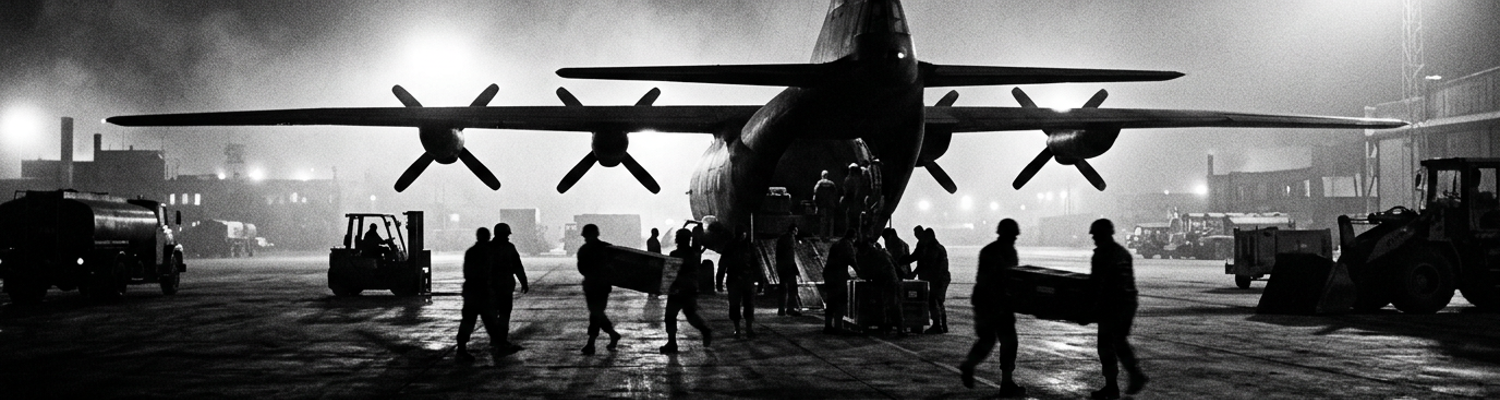

Post-Blockade Civilian Stockpile Mandates
Thirty Soviet combat divisions encamped throughout the surrounding Soviet Occupation Zone. They marshaled over 320,000 Red Army soldiers. These forces were backed by 2,800 combat aircraft deployed across airfields at Rechlin, Oranienburg, and Werneuchen. Against this concentrated strength stood isolated Western occupation garrisons numbering barely 20,000 personnel in West Berlin.
West Berlin sat fully encircled inside hostile territory.
Diplomatic settlements offered zero operational comfort to planners within the Combined Airlift Task Force. The formal lifting of the Soviet blockade on May 12, 1949, reopened rail lines through Helmstedt. Immediate strikes among Reichsbahn workers quickly paralyzed ground traffic. Renewed Soviet administrative checkpoint blockages followed. Military Air Transport Service commanders understood that rail lines could be closed again overnight. Headquarters issued directives mandating that round-the-clock flight operations continue without interruption until supply depots accumulated a full three-month civilian reserve.
A three-month reserve required 350,000 tons of food and fuel.
Displaced civilian workers and US Army quartermasters labored under arc lights at Tempelhof, Tegel, and Gatow. They stacked rough sacks of brown lignite and anthracite coal into open-air pyramids. Inter-service tensions escalated sharply as flight tempos showed no signs of slowing.
Archival evidence shows that directives dispatched from Washington throughout June insisted on maintaining full wartime flying schedules. These orders established daily delivery quotas exceeding 8,000 tons. Douglas C-54 Skymasters assigned to the 60th and 61st Troop Carrier Groups joined US Navy squadrons VR-6 and VR-8. They launched aircraft down the air corridors at intervals of under three minutes. Corrosive anthracite dust sifted through burlap cargo sacks. The dust entered cockpit bulkheads and ate away at flight cable pulleys. Pratt and Whitney R-2000-9 piston engines suffered heavy internal friction from grit ingestion. Cylinder heads cracked. Spark plugs fouled after minimal operational hours.
US Air Force maintenance officers and US Navy supply commanders engaged in bitter administrative battles over spare parts reserves. They disputed the distribution of replacement carburetors and magnetos stockpiled at Erding Air Depot. Mechanics worked eighty-hour weeks on unsheltered tarmac ramps at Rhein-Main, Celle, and Fassberg to keep planes airworthy.
Operational commands refused to grant flight crews downtime between corridor runs.
A close review of operational logs indicates that Allied transports hauled 260,851 tons of supplies into the isolated city during June 1949. This set an average daily pace of 8,695 tons. Major General William H. Tunner enforced strict instrument flight rules. He separated aircraft by five hundred feet of altitude and three minutes of elapsed time down twenty-mile-wide flight corridors past Soviet ground-based radar at Doberitz. Aircrews flew three continuous turnaround sorties per shift. They ate cold field rations inside unpressurized cabins while ground teams shoveled coal out of cargo bays at Gatow airfield.
Naval and Air Force Operational Friction
Blue Navy work dungarees clashed immediately with Air Force khaki across the flight lines of Hesse.
The forced consolidation of naval aviation into the newly minted Military Air Transport Service triggered instant administrative resistance. Two full Navy transport squadrons received orders to deploy twenty-four Douglas R5D transports directly into the European theater. VR-6 arrived from Honolulu. VR-8 arrived from Moffett Field (Naval Aviation Circular 49-2). Major General William H. Tunner absorbed these squadrons into the Combined Airlift Task Force at Rhein-Main Air Base. He placed naval officers under the direct tactical direction of the USAF 61st Troop Carrier Wing (Headquarters MATS Order 114). Naval commanders resisted Air Force chain-of-command authority over internal unit discipline, aircrew scheduling, and operational paperwork.
Squadron commanders Commander James O. Vosseller of VR-6 and Commander James W. Darroch of VR-8 reported through a divided reporting chain. They answered tactically to Air Force wing headquarters. They routed personnel evaluations, equipment requisitions, and supply accounting back through naval bureaucratic channels in Washington.
USAF wing officers accused the naval units of clannish detachment.
Archival evidence shows that procedural discord centered squarely on maintenance protocols and ramp management at Rhein-Main. Air Force ground controllers operated the airhead on an industrial conveyor schedule. They insisted on strict thirty-minute turnaround limits for every arriving C-54. Centralized service pools run by Air Force maintenance officers replaced dedicated ground teams. These pools serviced any transport that taxied onto the apron. Naval aviation doctrine prohibited this practice. Navy flight crews assigned dedicated Aviation Machinists Mates to individual R5Ds. They required assigned plane captains to conduct physical inspections before signing off on any release to service.
Ramp marshals routinely ordered Navy aircraft to vacate hardstands. Naval flight engineers were often still checking fuel strainers, clearing fouled ignition harnesses, and inspecting brake assemblies for overheating. Disputes boiled over when flight dispatchers threatened to cancel corridor slots. This happened whenever Navy plane captains delayed taxi clearances to complete prescribed thirty-item naval checklist runs.
Neither branch yielded operational ground willingly.
A close review of operational logs indicates that the dispute peaked around the handling of Pratt and Whitney R-2000-9 radial engines degraded by heavy coal hauling. Coal dust accumulated inside engine cowlings. It filtered into rocker boxes and abraded cylinder walls during the three-minute full-throttle takeoff runs. Air Force depot mechanics at Rhein-Main pushed for rapid spark plug replacements and fast magneto checks on the apron. They wanted to return planes to flight status within the hour. Navy mechanics refused to bypass standard naval technical orders. These orders required twenty-hour spark plug removals, full compression checks, and oil screen flushes whenever rpm drops exceeded seventy-five revolutions per minute on dual-magneto run-ups (Technical Order 02A-1-39).
Air Force maintenance superintendents attempted to impound Navy airframes to enforce Air Force service cycles. Navy officers locked their tool chests. They withheld engineering sign-offs. They grounded four operational transports rather than accept Air Force line inspections. Colonel Jack O. Caldwell of the 61st Troop Carrier Group filed formal complaints regarding Navy non-compliance. Commander Darroch bypassed the local wing to send detailed protests directly to the Chief of Naval Operations. Tunner intervened directly at Rhein-Main in the spring of 1949. He imposed standardized MATS maintenance forms across all units. He granted Navy crews the autonomy to run their own dedicated maintenance docks. This ended the dispute through sheer bureaucratic separation.
Airborne Anthracite Hazards Inside Cargo Holds
Ten tons of anthracite turned every cargo hold into an airborne hazard zone.
The physical packaging of solid fuel created an immediate flight safety crisis out of Fassberg and Celle. Cargo handlers loaded hard anthracite into standard military canvas duffel bags, salvaged burlap sacks, and multi-ply paper envelopes. These containers split open under heavy vibration. The four Pratt and Whitney R-2000 engines transmitted constant shudder through the corrugated aluminum floor of the Douglas C-54 Skymaster. This ground the coal lumps against one another during flight. Microscopic, jagged carbon particulates escaped the coarse weave of the bags. They rose into cabin air currents.
The unpressurized fuselage lacked bulkhead seals between the cargo deck and the forward cockpit.
Fine black powder drifted directly across the radio operators desk and settled behind the pilot consoles. Archival evidence shows that maintenance crews regularly discovered thick layers of conductive anthracite dust blanketing open terminal blocks, 28-volt direct-current bus bars, and inverter wiring harnesses beneath the cockpit floor. The abrasive dust entered sealed instrument cases. It gummed up directional gyros and fouled the exposed contact points of landing gear position switches. Flight crews reported sluggish throttle linkages and sticking elevator trim tab cables. Abrasive grit packed into the exposed control cable pulleys running along the lower fuselage.
Short circuits ignited inside instrument panels during instrument approach descents into Tempelhof.
A close review of operational logs indicates that the physical properties of Pennsylvania and Ruhr anthracite made it vastly more destructive than standard soft lignite. Anthracite fractures into microscopic shards with high electrical conductivity and extreme hardness. Flight mechanics pulling twenty-five-hour inspections at Erding Air Depot found that this powder worked its way into sensitive radio compass relays and the open slip rings of engine generator assemblies. Ground controllers at Tempelhof recorded instances where airborne dust caused complete navigational receiver failures. This happened while transports flew through the five-hundred-foot vertical separation ceilings over the Soviet border.
Maintenance squadrons attempted to protect electrical runs using adhesive tape and canvas covers. Cabin drafts drawn by cockpit ventilation scoops pulled airborne particulates into every exposed crevice. Toggle switches on overhead circuit breaker panels jammed mid-throw. Aircrews flying through heavy corridor turbulence frequently operated primary flight controls against friction caused by coal dust packed tight into grease inside fuselage guide fairleads.
Protective equipment never reached the airheads.
US Air Force supply depots failed to distribute industrial dust masks or standard M9 service respirators (Stock Class 4240) to flight lines handling bulk fuel. Cargo handling squadrons at Rhein-Main and German civilian labor details at Tempelhof shoveled ruptured sacks with completely bare faces or improvised bandanas tied across their noses. Men worked ten-hour shifts inside enclosed, unventilated C-54 cargo compartments. Suspended dust clouds dropped visibility to under ten feet. German laborers unloading ten-ton payloads at Gatow breathed dense carbon clouds for hours. They routinely coughed up dark anthracite sputum during shift rotations.
Flight engineers monitoring cargo tie-down chains developed acute laryngitis and persistent chemical-style bronchitis within two weeks of assigned corridor flying. Base medical dispensaries at Fassberg treated hundreds of personnel for chronic bronchial irritation, inflamed mucous membranes, and corneal abrasions caused by windblown coal fragments on the tarmac. Flight surgeons attached to the 61st Troop Carrier Wing noted that over sixty percent of line mechanics and loadmasters displayed persistent, hacking chest coughs. These coughs persisted long after their aircraft cleared the unloading ramps at Berlin. Base hospitals recorded twenty-two cases of acute pulmonary distress among German stevedores at Tempelhof during the first week of June alone.
Staged Documentation by Motion Picture Teams
Public relations officers fought an image war across the tarmac.
Military leadership treated photographic documentation as an instrument of inter-service supremacy. Squadrons from the Air Force 7th Camera Repair and 7th Motion Picture units received direct tactical assignments. They established permanent recording stations at Tempelhof Central Airport in Berlin and Rhein-Main Air Base outside Frankfurt. Technicians operated heavy 35mm Bell and Howell Eyemo cameras (Model 71-Q) alongside tripod-mounted Mitchell Standard motion picture rigs. They carried portable chemical processing baths into temporary base darkrooms.
Department of the Air Force authorities in Washington demanded visual proof of transport aviation efficiency. They leveraged this against Department of the Navy budget allocations during congressional hearings over post-war defense spending.
USAF public information officers demanded constant ramp access. MATS operations officers viewed the film details as an active hazard to flight scheduling. Line mechanics threatened to smash camera equipment with torque wrenches whenever film crews delayed the mandatory thirty-minute turnaround cycle. Lens crews set up their tripods along taxiway perimeters. They competed with US Navy VR-6 ground handlers for physical space while Douglas C-54 Skymasters taxied past with Pratt and Whitney engines running at high idle.
The lens turned away from the real flying conditions.
Archival evidence shows that directives from the Wiesbaden public information office ordered camera teams to film strictly sanitized sequences. Flight line supervisors pulled select Douglas C-54 airframes out of active flight rotations. They washed exterior aluminum skins with high-pressure kerosene sprays and water detergents before camera crews arrived. Public relations staff hand-selected flight engineers and pilots with freshly pressed olive-drab fatigue uniforms. They directed them to smile broadly toward the lens and wave from open cockpit side windows.
Memorandums circulating between Rhein-Main and USAFE headquarters instructed camera operators to reject any composition showing soot-stained overalls, coal-blackened hands, or airframes streaked with hydraulic fluid leaks.
Motion picture directors arranged close-up shots of flight personnel receiving hot coffee from American Red Cross volunteers. They framed out the mountains of ruptured coal sacks piling up behind the mobile snack canteens. Technical directors systematically omitted the heavy, pervasive black coal grime that saturated the flight line. Sacks of coal were deliberately replaced with clean canvas bags of flour or white cardboard crates of powdered milk during recorded cargo handling demonstrations. German civilian labor details were ordered out of the camera frame. Staged loading operations took place on dry, swept concrete ramps under midday sun. This hid the cracked Plexiglas, split burlap sacks, and oil-streaked nacelles that characterized everyday corridor operations.
Actual cargo decks stayed unlit.
A close review of operational logs indicates that camera crews encountered severe mechanical breakdowns whenever they attempted to film authentic coal-hauling flights. Airborne anthracite powder penetrated the winding mechanisms of the Eyemo cameras. It gummed up 35mm shutter leaves and scratched cellulose negative stock inside the magazines. Fine carbon particles worked into optical lens mounts. This turned focus rings stiff and abraded delicate antireflective lens coatings. Base information officers regularly reviewed undeveloped rolls before shipment to the United States. They confiscated film strips that inadvertently captured black-faced crewmen spitting dark mucus onto the ramp at Tempelhof.
Maintenance logs reveal that ground crews at Rhein-Main spent four hundred man-hours staging clean-airframe filming runs during the peak fuel delivery push of June 1949. By the end of that month, the 7th Motion Picture Unit shipped over thirty-five thousand feet of staged celluloid to the Pentagon. They did not catalog a single interior shot of an active coal flight.
Flight Line Morale and Chaplaincy Welfare Logs
Brass crucifixes rested on raw packing crates beside twenty-ton coal mounds.
European Command public relations directives instructed installation chaplains at Rhein-Main Air Base and Fassberg to move religious observance out of base chapels and directly onto active flight aprons. Air Force public information officers worked alongside camera operators from the 7th Motion Picture Unit. They established specific filming sectors on the concrete pads of the 61st Troop Carrier Wing. Protestant and Catholic chaplains received operational memorandums directing them to conduct open-air services within camera range of taxiing Douglas C-54 Skymasters.
Public relations planners arranged portable field altars between mobile fuel tankers and cargo loading ramps. They demanded wide optical shots that captured knelt transport crews against the backdrop of four-engine transports.
Filming schedules took precedence over chapel calendars. Camera crews positioned Bell and Howell 35mm cameras within fifteen feet of the improvised pulpits. They required chaplains to repeat liturgies and prolong responsive readings until sound technicians balanced audio against the continuous roar of Pratt and Whitney R-2000-9 radial engines idling across the adjacent perimeter. Wing operations officers repeatedly complained that staged religious services obstructed primary taxiways and delayed standard fifteen-minute turnaround windows.
Corridor flying left no margin for theatrical piety.
Archival evidence shows that public information personnel selected specific airframes based purely on visual cleanliness. They routed polished aircraft away from coal chutes to serve as physical backdrops for newsreel crews. Camera operators instructed fatigue-clad mechanics and exhausted flight engineers to drop their tools. They assembled them in tight formations around the flightline altar and told them to hold devotional postures while film magazines rolled. Technicians adjusted lighting reflectors to bounce harsh mid-morning sunlight onto washed aircraft fuselages. This deliberately masked the oil leaks dripping from hydraulic cowl flap actuators.
Ground controllers at Rhein-Main logged three separate incidents where religious filming runs blocked tractor tugs. These tugs were hauling 10-ton coal trailers toward waiting aircraft of the 313th Troop Carrier Group. Navy plane captains from transport squadron VR-6 outright refused Air Force directives to position their naval ground crews within these promotional film frames.
Behind the staged cameras lay documented physical collapse.
A close review of operational logs indicates that base chaplain welfare records told a drastically different story from the uplifting narratives packaged for domestic newsreels. Monthly counseling reports compiled by chaplains assigned to the 60th and 61st Troop Carrier Wings recorded dangerous levels of physical exhaustion, acute sleep debt, and mounting bitterness among transport personnel. Flight crews regularly logged eighty-five flight hours per month across sixty round-trip corridor sorties. They snatched two-hour naps on canvas cots inside drafty maintenance hangars while ground crews loaded five-hundred-pound burlap sacks into unpressurized cabins.
Chaplains noted that pilots exhibited severe eye strain, involuntary hand tremors, and auditory degradation caused by continuous exposure to cockpit decibel levels exceeding one hundred decibels (USAF Medical Report 49-B). Crews expressed intense hostility toward public relations units. These units forced them to wash off industrial carbon grime and simulate joyful expressions for news cameras after completing grueling round-the-clock runs into Tempelhof. Interviews conducted by squadron chaplains documented open anger over promotional publications portraying corridor missions as cheerful sightseeing journeys. They pointed out that twenty-four airmen had died in operational crashes during instrument-only descents through foul European weather.
Chaplains filed formal memoranda to station medical commanders noting that over forty percent of active flight engineers showed clinical signs of combat neurosis and chronic fatigue. Line pilots openly boycotted base recreation halls where USAFE information services screened the resulting newsreels. They mocked promotional footage that replaced black anthracite dust with clean bags of flour. Records preserved from Fassberg Air Base detailed sixteen formal complaints in a three-week span regarding public relations officers. These officers ordered sleep-deprived aircrews off transport bunks to stage smiling handshakes for visiting press correspondents. On June 18, 1949, a flight engineer from the 19th Troop Carrier Squadron confronted a camera crew on the Rhein-Main tarmac. He kicked over their reflector stands after twelve consecutive corridor sorties.
Internal Command Inspections at Celle and Wiesbaden
Paperwork threatened to ground more planes than mechanical attrition.
Confidential command evaluations conducted by the USAFE Inspector General at Celle Air Base in Lower Saxony exposed acute operational breakdown inside the 317th Troop Carrier Wing. Junior lieutenants and captains flying Douglas C-54s faced relentless administrative oversight from Combined Airlift Task Force