
A Soviet submarine, Track-Tango-Nine, was deviating from its expected patrol route. Its signal strength was worryingly low, its direction steady. The transmission was a request for assistance, not for rescue, but for more ears. One station alone was not enough. The Cold War’s electronic battleground had just expanded. A global network was the only possible response.
Establishing the remote listening posts necessary to create this network was a physically demanding enterprise. Archival evidence shows that simply selecting a site was a significant challenge. Planners required locations with minimal electronic interference, which meant extreme geographic isolation. These locations were often in punishing environments. Naval Security Group Activity (NSGA) Adak was established on a treeless, volcanic island in the Aleutian chain, approximately 1,200 miles from Anchorage, Alaska. Personnel there contended with relentless winds, constant fog, and seismic activity. Construction crews and technicians faced immense difficulties. Standard construction materials behaved differently in the extreme cold. Metal became brittle, lubricants froze, and the simple act of pouring concrete required specialized heating techniques. The williwaw winds, sudden and violent katabatic gusts, could rip unsecured structures from their foundations. Supply lines were long and precarious, entirely dependent on air and sea lifts, which were themselves at the mercy of the violent Bering Sea and unpredictable arctic weather. Any mechanical failure, from a generator part to a vacuum tube in a receiver, meant a long wait for replacements, a delay that could create a dangerous gap in intelligence coverage. A close review of operational logs (NARA Record Group 38) indicates high rates of stress and fatigue among personnel enduring long periods of isolation in cramped, unforgiving conditions.
The initial placement of Naval Security Group (NSG) stations was dictated by cold, hard geographic and strategic necessity. The primary targets were the Soviet Union’s Northern and Pacific Fleets. To monitor the Northern Fleet’s movements into the Atlantic, NSGA Winter Harbor was established on the Schoodic Peninsula in Maine. Its position on Big Moose Island, secured in the 1930s, offered an isolated, interference-free environment ideal for intercepting high-frequency radio transmissions from Soviet submarines and surface vessels leaving the Barents and Baltic Seas. In the Pacific, NSGA Adak served as a critical sentinel, its location in the Aleutians placing it directly in the path of Soviet naval forces transiting from Petropavlovsk and Vladivostok. Further west, NSGA Kamiseya, Japan, established near Yokosuka after World War II, became a cornerstone of SIGINT operations against the Soviet Pacific Fleet, China, and North Korea. Its location was chosen after the original intercept site at the Yokosuka shipyard proved to be compromised by excessive electrical interference. These stations formed the foundation of a growing worldwide network, positioned to create overlapping fields of coverage and enable direction-finding through triangulation.
A massive, often unglamorous, infrastructure was required to support this nascent global network. The most visible components were the antenna arrays. At many sites, this meant the construction of the AN/FRD-10 Circularly Disposed Antenna Array (CDAA). These arrays consisted of two concentric rings of antennas, an outer ring of 120 monopoles and an inner ring of 40 folded dipoles, encircling a two-story, bunker-like operations building. The entire complex could span a diameter of nearly 1,000 feet and required extensive ground screening to function. Pouring the foundations and erecting the hundreds of towers for these arrays in locations like Adak or remote parts of Maine was a significant engineering feat. Beyond the antennas, each station required a self-contained ecosystem: power plants, water purification systems, barracks, mess halls, and secure communication links to tie the site back to Naval Security Group Headquarters. A dedicated supply chain, relying on a constant flow of ships and cargo planes, was the lifeline that kept these remote outposts running, delivering everything from specialized electronic components and encryption materials to food and mail. The failure of any single link in this chain could degrade the operational effectiveness of a multi-million dollar intelligence facility.
The global network’s effectiveness was entirely hostage to its tenuous and difficult supply chains. Archival evidence shows that logistical planning for remote SIGINT sites was a constant battle against geography, weather, and mechanical failure. Planners at Naval Security Group Command had to forecast supply needs months, sometimes a year, in advance, creating a rigid push system of logistics. For a station like NSGA Adak, located 1,200 miles from the nearest major logistics hub in Anchorage, there was no alternative. Everything from cryptographic key material and magnetic tapes to highly specific vacuum tubes for the AN/GRC-109 receivers had to be ordered and shipped on a predetermined schedule. The system lacked flexibility. An unexpected series of equipment failures or a change in operational tempo could exhaust stocks of a critical component with no possibility of rapid replenishment. Inventory logs from this period often show a paradoxical situation: warehouses filled with a surplus of mundane items like paper forms and cleaning supplies, alongside a crippling shortage of a single, irreplaceable bearing for an antenna rotator.
The delivery of these supplies depended on a small, chronically overtaxed fleet of transport assets. For bulk cargo, food, fuel, and construction materials, the sites relied on the Military Sea Transportation Service (MSTS). These ships, often World War II-era Victory ships, faced the perilous journey through waters like the Bering Sea. A barge season limited by sea ice to the months between April and September meant that an entire year's worth of non-perishable supplies had to be delivered in a narrow window. A delay caused by a storm or an early freeze could be catastrophic. For high-priority items and personnel, the lifeline was airlift, primarily provided by C-124 Globemasters and, later, ski-equipped C-130 Hercules aircraft. These aircraft were themselves subject to the tyranny of weather. Adak’s single runway was frequently shrouded in fog or blasted by violent williwaw winds, grounding flights for days at a time. A grounded C-130 carrying a replacement magnetron for a radar system did not just represent a delayed flight; it represented a blind spot in the intelligence network, a gap where a Soviet submarine could pass undetected. The extreme cold also wreaked havoc on the aircraft themselves, requiring specialized maintenance and pre-heating procedures that further constrained an already limited operational capacity.
The geographical remoteness fundamentally warped logistical planning. It turned routine maintenance into a high-stakes strategic calculation. A close review of operational logs from Adak and other Arctic sites reveals a constant preoccupation with the state of transport availability. The failure of a single generator on the island could force commanders into a desperate triage, deciding which intelligence-gathering systems to power down first. The lead time for even a relatively simple replacement part ordered from a depot in California could stretch to months. This forced an extreme reliance on local maintenance personnel, who became masters of improvisation, cannibalizing parts from non-essential equipment to keep primary systems online. The entire architecture of the SIGINT network, from the massive AN/FRD-10 antenna arrays to the sensitive receivers in the operations bunker, was built on the assumption of a steady flow of parts and technical support. When that flow was interrupted, the technological edge was blunted by the simple problem of a broken part and an empty supply shelf thousands of miles away.
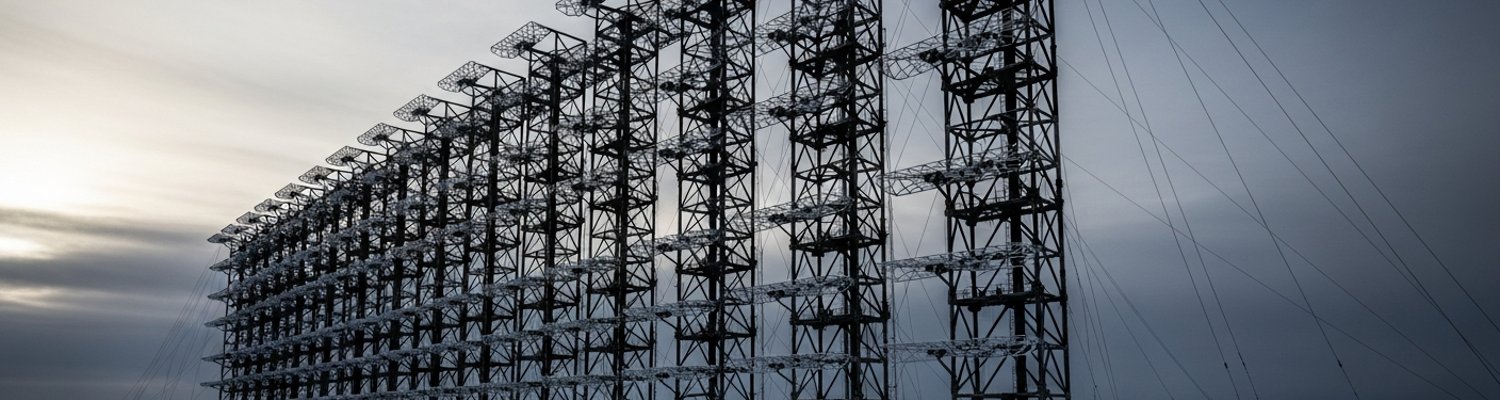
The large, web-like structures of the AN/FRD-10 antenna arrays were the most visible representation of the global SIGINT network. They were also its most physically vulnerable point. Archival evidence shows that the mechanical systems of these colossal arrays were a constant source of failure. At sites like NSGA Adak, the goniometer, the core rotating mechanism that electronically swept the antenna’s directional beam, was subject to extreme environmental stress. Its precision bearings and drive motors, not initially designed for sustained operation in environments with relentless salt spray and volcanic dust, would seize. A maintenance log from the period details a catastrophic failure of a primary rotator during a high-stakes monitoring operation targeting a Soviet naval exercise. Technicians had to perform a perilous climb in freezing winds, only to discover that metal fatigue had shattered a key drive shaft. With replacement parts located thousands of miles away and subject to the unpredictable airlift schedule, the station was forced to rely on a less capable, fixed-direction backup antenna, creating a significant blind spot for days. The antenna elements themselves, hundreds of delicate monopoles and dipoles, were also a point of weakness. Extreme winds, like the violent Aleutian williwaws, could snap elements or cause the massive ground screening wires to break, altering the antenna’s electrical characteristics and corrupting incoming signal data until repaired.
Inside the operations bunkers, another war of attrition was being fought against the hardware itself. The electronic components of the 1960s were notoriously unreliable. A close review of operational logs from any SIGINT station of the era reveals that maintenance technicians spent the majority of their time not on intercept operations, but on troubleshooting and repair. The racks of receivers, often Collins R-390As, were filled with dozens of vacuum tubes that had a limited operational life and were highly susceptible to failure from vibration and heat. A single tube failure could render a receiver deaf. Technicians kept detailed logs of tube hours, preemptively replacing them to avoid a failure at a critical moment. Beyond the tubes, passive components like capacitors and resistors would drift out of tolerance or fail outright, causing intermittent problems that were maddeningly difficult to diagnose. A capacitor in a receiver’s automatic gain control (AGC) circuit failing could cause signal levels to fluctuate wildly, making it impossible for an operator to lock onto a weak, distant transmission. The magnetic tape machines used to record intercepts were another major point of failure; the complex mechanical transports would stretch or snap tapes, and recording heads would fall out of alignment, rendering priceless intelligence recordings unintelligible.
Compounding these material failures were deep-seated design flaws inherent to the proprietary, contractor-built systems. In the rush to field new capabilities, hardware was often developed in isolation by different defense contractors. An analysis console from one company would be incapable of directly interfacing with a decryption unit from another. This forced the creation of unique, custom-built interface boxes, often poorly documented and themselves a source of bizarre, untraceable errors. Furthermore, the systems lacked robust, built-in diagnostic tools. When a complex decryption machine like the KW-26 failed, it presented a system with no self-test capability. A technician’s only recourse was to manually trace signals with an oscilloscope through dense, tangled wire-wrap boards, a process that could take days. This brittle architecture meant that a single, unidentified fault, a faulty power supply causing a voltage drop of a few millivolts, for instance, could introduce subtle errors that corrupted the final intelligence product without alerting the operator to a hardware problem. It created a constant, low-level uncertainty about the integrity of the collected data.
The intricate, often custom-built, hardware of the global SIGINT network was its greatest strength and its most profound vulnerability. Delays in obtaining unique and specialized repair parts were not an occasional inconvenience; they were a constant, corrosive feature of remote station operations. Archival maintenance requisitions show that even seemingly simple components could halt a multi-million dollar intercept operation for weeks. A failed bearing in an antenna rotator was not an off-the-shelf item. It was often a precision-milled component specific to that model of antenna, with no commercial equivalent. When one failed at a site like NSGA Adak, a cascade of logistical hurdles began. A technician first had to diagnose the failure, then submit a high-priority CASREP, or Casualty Report, which would begin a slow journey through the naval supply system. The part itself might only exist in a single depot in California or Pennsylvania. Its journey to the Aleutians was then entirely at the mercy of the overstretched airlift capacity, competing for space with food, mail, and other cargo. An early winter storm or persistent fog could ground the C-130 carrying the component for days, leaving the station’s primary high-gain antenna locked in one direction, creating a massive and dangerous blind spot in its area of responsibility.
The problem was not limited to large mechanical parts.
Inside the climate-controlled operations buildings, a different battle of attrition was waged against the electronics. The ubiquitous Collins R-390A receivers, the ears of the network, were complex machines packed with 32 vacuum tubes. While built to military specifications, tube failures were a simple matter of physics and probability. Technicians spent an enormous amount of time preemptively replacing tubes based on logged operational hours to prevent a failure during a critical intercept. A more insidious problem was the failure of passive components. Paper-in-oil capacitors, common in early models, would degrade and fail, sometimes shorting out and destroying irreplaceable mechanical filters in the process. A single faulty capacitor, worth less than a dollar, could render a receiver deaf or cause its automatic gain control circuit to fluctuate wildly, making it impossible to lock onto a faint signal from a distant submarine. Identifying which of the hundreds of capacitors had failed was a painstaking process of elimination. The replacement part, if not in the station’s limited stock, would join the queue of parts requests, waiting for its turn on the next available aircraft.
Repair procedures for this proprietary hardware were often complex and poorly documented, turning technicians into forensic electronics detectives. The TSEC/KW-26 (ROMULUS) encryption machine, a rack-mounted system of vacuum tubes and magnetic core logic, was a prime example. It was a system without simple diagnostics by design. When it failed, a technician’s only recourse was to use an oscilloscope to manually trace signals through dense fields of wire-wrapped backplanes, guided by technical manuals that were often vague. This process could take days of continuous effort from a highly trained specialist. A single voltage drop from a failing power supply tube could introduce errors so subtle they might not be immediately obvious, corrupting outgoing intelligence reports without any clear indication of a hardware fault. As these machines aged, their mechanical components, like the punched-card readers for loading daily crypto-variables, became unreliable. Maintenance logs from the era describe technicians struggling to get worn contacts to engage properly so a new key card could be loaded.
This maintenance burden had a direct and severe impact on operational readiness. Every hour a technician spent troubleshooting a faulty receiver or a malfunctioning crypto machine was an hour they were not monitoring target frequencies. A downed antenna array or a deaf bank of receivers was not just a technical issue; it was a hole in the West’s electronic defenses. A commander at a station like NSGA Winter Harbor, facing a critical shortage of a specific vacuum tube for the R-390A receivers, had to make difficult choices. They might order technicians to cannibalize parts from receivers assigned to lower-priority targets to keep the primary mission systems online. This created calculated risks, accepting a gap in coverage of one area to maintain focus on another. During periods of high operational tempo, such as a large-scale Soviet naval exercise, the failure of a single KW-26 could sever a secure communications link, forcing traffic onto less secure, slower backup systems and delaying the transmission of time-sensitive intelligence to fleet commanders. The entire system was brittle, with the strategic vigilance of the network constantly undermined by the mundane failure of a single capacitor, bearing, or vacuum tube thousands of miles from a replacement.
The operational environment for a seaborne Cryptologic Technician was one of severe physical and mental compression. Aboard converted World War II-era cargo vessels like the Banner-class technical research ships, the intelligence collection spaces were an afterthought. These areas, often windowless steel boxes welded to the deck, were crammed with racks of intercept receivers, analysis consoles, and recording equipment. A review of ship schematics for vessels like the USS Pueblo (AGER-2) shows these spaces were barely large enough for a handful of operators to work back-to-back. The daily routine was a physically taxing cycle of long watch shifts, often 12 hours on and 12 hours off for weeks on end. Personnel sat for hours in poorly ventilated rooms, headsets clamped on, straining to isolate faint, fleeting signals from a constant wash of static. The perpetual motion of the ship, the slow, constant roll in open seas or the sharp, jarring pitch in rough weather, induced a unique and draining fatigue. This was not a passive environment; it was an active antagonist to concentration and physical well-being.
Maintaining the sensitive electronic hardware in a maritime environment was a losing battle against salt and humidity. The air itself was corrosive, and despite efforts to climate-control the SIGINT spaces, moisture was pervasive. Technicians assigned to vessels like the Belmont-class AGTRs spent a significant portion of their time not on intercept, but on preventative maintenance. A close examination of maintenance logs from this period details a constant fight against failing components. The high-wattage vacuum tubes in the R-390A receivers were particularly susceptible to failure from the ship’s vibration. Power fluctuations from the ship’s generators could introduce maddeningly hard-to-trace errors in delicate analysis equipment or cause magnetic tape recorders to drift in speed, corrupting priceless recordings. Repairing this equipment at sea was an exercise in extreme difficulty. Attempting to solder a replacement capacitor onto a crowded circuit board during a heavy swell required a surgeon’s steadiness, a task made harder by poor lighting and cramped access. Specialized tools and parts were in short supply, and the failure of a single, non-standard component could render a primary collection system useless for the remainder of a patrol.
The psychological pressure was relentless. These ships often operated alone, sailing provocative routes close to hostile shores to trigger a response. The entire crew knew their mission made them a high-value target. The fates of the USS Liberty in 1967 and the USS Pueblo in 1968 were reminders of this vulnerability. The SIGINT detachment, typically a small group of Naval Security Group specialists, existed in a state of professional isolation from the rest of the ship’s crew. Due to the classified nature of their work, they could not discuss their duties, successes, or fears, creating a social barrier that bred suspicion and alienation. This isolation was compounded by long periods without any contact with the outside world, a deliberate measure to maintain radio silence. Archival accounts from former crew members describe a potent mixture of boredom, fear, and intense pressure. Every unidentified radar signal or approaching aircraft could be the precursor to an attack, forcing the small detachment into a state of hypervigilance for days on end. The capture of the Pueblo crew and their subsequent 11-month ordeal served as a brutal illustration of the ultimate risk.
The daily existence for a Cryptologic Technician at a remote listening post was a study in monotonous, grinding repetition. Inside the two-story, bunker-like operations building at the heart of an AN/FRD-10 array, life was dictated by the clock and the demands of the mission. A close review of operational logs shows that personnel worked grueling shifts, often twelve hours on and twelve off, for weeks at a time in windowless, climate-controlled rooms humming with the sound of electronics. For the linguists, designated Cryptologic Technicians Interpretive (CTI), the day consisted of sitting at a console, clamped into a headset, manually tuning an 85-pound R-390A receiver through a target frequency band. Their entire world was the wash of static, hunting for the faint, almost imperceptible whisper of a foreign voice or the rhythmic beat of a Morse code transmission. Success meant hours of transcription, translating foreign language intercepts that were often clipped, filled with jargon, and deliberately obscured.
It was a physically and mentally taxing routine.
For the technicians, designated Cryptologic Technicians Maintenance (CTM), the grind was different but no less demanding. Their battle was against entropy. They were not listening for the enemy, but for the subtle signs of equipment failure: the slight whine of a misaligned tape head, the flicker of a power supply, or the characteristic hum of a failing vacuum tube in a receiver rack. A significant portion of their shifts was dedicated to preventative maintenance, meticulously logging the operational hours of components and replacing them before they could fail at a critical moment. The work required intense focus and a delicate touch, performing repairs on complex, modular circuit boards in cramped quarters. The environment itself was an antagonist, with the constant low-level noise and the sterile, recycled air contributing to a unique form of sensory fatigue.
The psychological demands of continuous monitoring were immense. A condition known as ear fatigue was a common complaint, a state of mental exhaustion brought on by hours of straining to separate signal from noise. Operators were under constant pressure, knowing that a momentary lapse in concentration could mean missing a critical piece of intelligence, the broadcast of a new naval order, the coordinates of a patrol, or a change in readiness status. This produced a state of sustained hypervigilance, a low-level anxiety that permeated every shift. Studies of similar intelligence roles show that this deployed-in-garrison lifestyle, where operators are psychologically engaged in a conflict from a remote location, leads to high rates of burnout and stress. Unlike a soldier in the field, there was no physical release for the tension; it was a quiet, internal battle fought in a swivel chair under fluorescent lights. The only feedback was the endless hiss in their headphones, a sound that many former operators reported hearing long after their shifts had ended.
This internal pressure was amplified by external isolation. At a station like NSGA Adak in the Aleutians, personnel were confined to a treeless, volcanic rock 1,200 miles from Anchorage, constantly battered by fog and violent winds. The base itself was the entire world, a small pocket of military order surrounded by a vast, indifferent wilderness. Social circles were small and unchanging, and the classified nature of their work meant they could not even discuss the source of their stress with comrades in other departments, creating a sense of alienation. At other locations, like NSGA Kamiseya in Japan, the isolation was cultural rather than geographic. While physically located near bustling Japanese cities, the personnel were largely confined to the base. Their top-secret duties prevented any meaningful integration with the local population, turning the host country into little more than a backdrop seen from behind a security fence.
A close review of operational logs from Naval Security Group listening posts reveals that piecing together Soviet naval transmissions was a form of forensic artistry. The raw material was a chaotic flood of fragmented signals. Soviet doctrine emphasized radio discipline, meaning transmissions were kept exceptionally short, used low power to avoid detection, and often jumped between different frequencies on a predetermined schedule. An analyst at NSGA Adak might catch only a few seconds of a Morse code message before it vanished into the static. The primary technique for reconstruction was traffic analysis, a painstaking process of data correlation. For every intercepted snippet, an operator logged the call sign, the frequency, the exact time, and any direction-finding bearings. This data, collected from multiple stations across a hemisphere, was then plotted on massive wall charts. The goal was to build a mosaic, linking disparate transmissions by findin