
Early Pacific War Logistics Constraints
Projecting a mechanized naval strike force three thousand miles across the Aleutian trench in the winter of 1942 presented a mathematical impossibility under existing supply frameworks.
Archival evidence shows that United States Navy doctrine heavily emphasized fleet mobility while entirely neglecting heavy-weather fueling protocols. During Fleet Problems IX through XX conducted between 1929 and 1939, admirals prioritized pushing carrier task forces to high transit speeds across the calm waters of the Caribbean and the Southern California coast. Bureau of Ships engineers designed alongside-refueling rigs based on the assumption of maximum sea states of Beaufort 4 or 5. This proved mathematically inadequate for northern latitudes. Crews aboard early fleet oilers like the USS Neches and USS Kanawha utilized standard 10-inch manila towing hawsers and 6-inch reinforced rubber transfer hoses suspended by rudimentary wooden saddles. When examining the historical record from these exercises, commanders rarely authorized fueling operations in swells exceeding five feet. Planners at the Naval War College assumed any fleet operating in the North Pacific would simply anchor in protected coves to transfer bunker oil. Operating near coordinates 53 N, 165 W in the Bering Sea exposed ships to freezing spray, fifty-knot sustained winds, and twenty-foot rogue waves. These forces easily snapped untreated manila lines. Bronze quick-release couplings connecting the heavy fuel hoses between destroyers and fleet oilers required manual operation by deck hands. These men stood completely exposed on the wet well decks. The thick, viscous nature of Navy Grade A bunker fuel meant it had to be heated by internal steam coils before it could even flow through the hoses.
A single slip on the oil-slicked steel plating meant falling between the crushing hulls of two ships.
The extreme geographic scale of the Pacific theater made underway replenishment an absolute requirement for deep-sea carrier strike operations. A standard Yorktown-class aircraft carrier like the USS Enterprise carried approximately 1.5 million gallons of Fuel Oil Special. This volume provided an operational radius of roughly 7,000 nautical miles at a cruising speed of fifteen knots. Task Force commanders frequently ordered combat speeds exceeding thirty knots during evasion maneuvers or flight operations. Fuel consumption climbed exponentially at these velocities. The ships burned up to 15,000 gallons per hour when all boilers were firing at maximum pressure. Escorting Farragut and Mahan-class destroyers carried only 400 tons of fuel in their lower hull tanks. Pushing their turbine engines to maximum output drained their bunkers in less than seventy-two hours. Admiral Robert Theobald took command of Task Force 8 in May 1942 with orders to defend the Aleutian chain from Japanese incursions. The distance from the primary fleet base at Pearl Harbor to the forward operating area near Dutch Harbor spanned over 2,000 nautical miles of open ocean. Ships arriving on station immediately required thousands of barrels of oil just to maintain a basic defensive patrol pattern around Umnak Island.
Fleet oilers had to transport their heavy liquid cargo across the same punishing transit routes.
A close review of operational logs indicates that the lack of specialized heavy-weather tensioning winches caused immediate breakdowns during the first week of the Aleutian campaign. The USS Guadalupe attempted to refuel the destroyer USS Monaghan on June 3, 1942. This occurred in moderate Bering Sea swells just south of Makushin Bay. Standard operating procedure required the destroyer to steam parallel to the oiler at exactly ten knots with a lateral separation of forty feet. Deck logs record that a sudden twelve-foot cross swell pushed the Monaghan outward. This instantly maxed out the tensile strength of the forward spring line. Tension snapped the heavy manila rope. The break generated a sharp acoustic crack that echoed across the water. Recoiling violently, the broken line whipped back across the destroyer deck, shattering a steel stanchion and fracturing the collarbone of a boatswain mate. Sudden lateral pull then ruptured the connected fuel hose at the bronze flange. Three hundred gallons of heavy black bunker oil pumped directly into the freezing ocean before the oiler chief engineer could manually spin the main gate valve shut.
Task Force Sixteen North Pacific Deployment
Supplying heavy warships under extreme gale conditions en route to a deep penetration strike inside the Japanese defensive perimeter was a mechanical impossibility.
Archival evidence shows that Vice Admiral William F. Halsey departed Pearl Harbor in early April 1942 with Task Force 16. He charted a direct course through the northern latitudes to launch sixteen Army B-25 bombers against the Japanese home islands. Planners intentionally routed the aircraft carriers USS Enterprise and USS Hornet along the 40th parallel north to evade enemy radio picket boats stationed closer to Midway. This specific navigational track threw the entire fleet directly into a continuous low-pressure frontal system characteristic of the North Pacific spring. Deck logs from the heavy cruisers USS Northampton and USS Vincennes record sustained forty-knot winds beginning on the morning of April 14. Massive thirty-foot green water swells repeatedly crashed over the weather decks of the escorting destroyers. Seawater flooded down through the ventilation ducts of the Farragut-class ships. The salt water shorted out electrical switchboards in the forward compartments. Shipboard clinometers registered violent rolls exceeding twenty-eight degrees. This severely tested the structural integrity of the hull framing. Below decks, boiler technicians struggled to maintain their footing on wet steel grating while manually adjusting superheated steam valves. Topside personnel tied themselves to bulkheads using heavy manila lines just to complete basic watch changes without being swept overboard. The constant pitching motion forced helmsmen to fight the ship wheel continuously to maintain the designated base course.
Freezing spray coated the exposed steel decks in a solid two-inch sheet of ice.
Executing the covert Tokyo raid demanded a prolonged high-speed transit. This rapidly drained the task force internal fuel reserves. Escorting destroyers burned through their limited 400-ton capacity within four days while fighting the heavy head seas at fifteen knots. Pushing the carriers within the required launch distance of four hundred nautical miles from the Japanese coastline meant every vessel required an immediate transfer of fuel oil before detaching the slower support ships. Halsey brought two specially equipped fleet oilers. The USS Cimarron and USS Sabine were deployed specifically to conduct this underway replenishment operation. When examining the historical record from April 17, the oilers attempted to pass their six-inch reinforced rubber transfer hoses to the flanking cruisers in the middle of a severe squall. The extreme sea state forced the ships to maintain a highly dangerous lateral separation of up to eighty feet. Deck hands fired solid brass projectiles attached to light messenger lines across the gap using specialized line-throwing rifles. Wind gusts repeatedly blew these lightweight lines wildly off course. The lines entangled in the complex wire arrays of the carriers external radio antennas. Retrieving the fouled lines required sailors to climb the frozen mast structures with zero safety harnesses.
A single miscalculation in rudder angle threatened to slam thousands of tons of steel together.
Once the heavy towing hawsers were finally secured to the deck cleats of the USS Nashville, the physical transfer process began. Steam coils located deep inside the Cimarron heated the thick Navy Grade A bunker oil to 120 degrees Fahrenheit to lower its viscosity enough for pumping. Powerful steam-driven centrifugal pumps pushed the dark fluid through the suspended hoses at a rate of two thousand gallons per minute. The asynchronous rolling motion of the two massive ships generated severe shock loads on the connecting rigs. Uncompensated tension instantly snapped the forward manila spring line on the Sabine. The sudden release of physical pressure caused the heavy fuel hose to whip violently backward against the oiler outer hull plating. Bronze coupling flanges fractured into jagged pieces upon impact with the armor belt. Pumping systems continued forcing heated, highly pressurized oil through the broken connection for another forty-five seconds. Three thousand gallons of black fuel rained down onto the churning ocean surface before the chief engineer could manually crank the heavy iron main gate valves completely shut. The fleet was forced to abandon the fueling attempt and proceed toward the bomber launch point with partially empty bunkers.
Fuel Oil Transfer Mechanics and Hardware
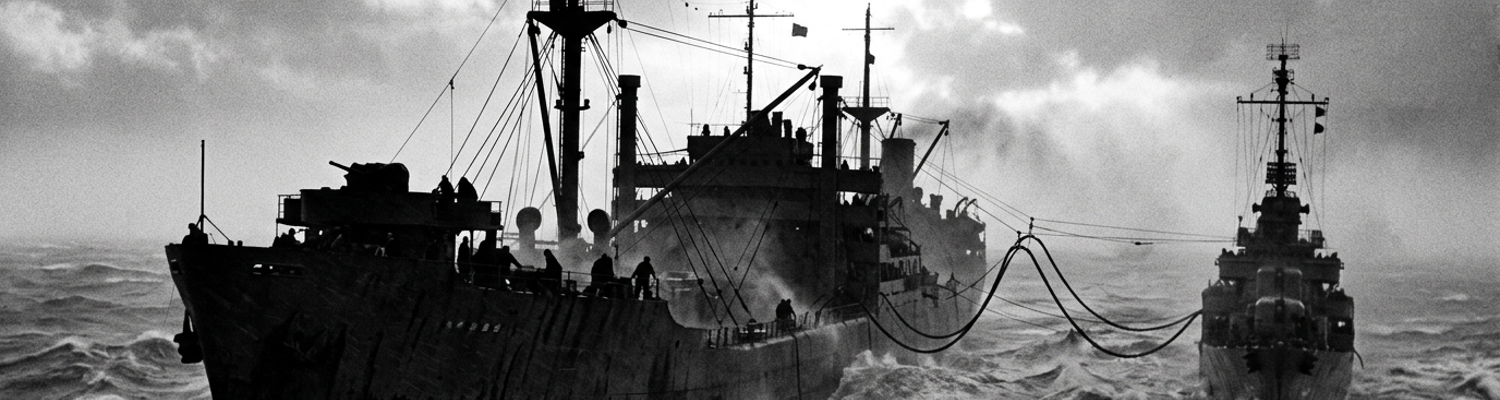
Archival evidence shows that early 1942 Pacific operations forced a rapid mechanical evolution in underway replenishment hardware. Fleet oilers used span-wire tension rigs to pump heavy fuel oil to accompanying warships across the violently pitching gaps of the northern latitudes. Earlier fueling methods relied on the towing method, where a destroyer trailed behind the supply ship. The severe sea states of the Aleutian theater rendered this approach mathematically unworkable due to the high probability of stern collisions. Bureau of Ships engineers quickly mandated the broadside method. This required an array of steel cables suspended between two moving vessels. The span-wire rig consisted of a 3/4-inch plow-steel wire rope stretched from the oiler high kingpost to a reinforced deck pad eye on the receiving ship. Heavy 6-inch reinforced rubber transfer hoses hung from this primary wire via heavily greased bronze trolley blocks called saddles. Keeping the heavy fuel oil flowing required constant mechanical tension on the span-wire. Operating the steam-driven constant-tension winches required three trained machinists standing on the exposed upper platforms. They monitored pressure gauges that dictated exactly when to manually override the automatic payout systems. The extreme viscosity of Navy Grade A bunker fuel demanded that internal steam coils heat the liquid to 120 degrees Fahrenheit before the centrifugal pumps could push it through the lines.
A frozen winch brake drum resulted in an immediate, catastrophic cable snap.
A close review of operational logs indicates the oiler USS Cimarron bore the primary responsibility for refueling escorting destroyers during these early northern deployments. Commissioned in 1939 as a T3-S2-A1 type fleet oiler, this specific vessel carried a maximum cargo capacity of 146,000 barrels of fuel. Command assigned the ship to the North Pacific with strict orders to keep the fuel-hungry screen of Farragut and Mahan-class destroyers operational. These escort vessels possessed a maximum reserve of just 400 tons. Steaming at anti-submarine patrol speeds of eighteen knots through thirty-foot swells drained their lower hull tanks in less than four days. As the destroyers consumed their bunkers, their draft decreased. Riding dangerously high in the water severely exacerbated their roll rates. The Cimarron had to match the exact course and speed of these smaller warships to initiate a transfer, usually settling at ten knots. Maintaining a lateral separation of exactly sixty feet required continuous, exhausting rudder adjustments from the helmsman. Deep in the hull, four large steam reciprocating pumps pushed the liquid upward. Engineers routed the heated bunker fuel from the lower holding tanks through a series of heavy iron gate valves located on the main weather deck.
Deckhands stood completely exposed to freezing fifty-knot wind gusts.
They manually hauled the heavy messenger lines across the open water.
When examining the historical record from an attempted transfer on May 10, 1942, near coordinates 51 N, 160 W, the physical limitations of the span-wire rig became highly apparent. Operations began in Beaufort Force 6 conditions with the Cimarron attempting to pass a fuel hose to the destroyer USS Dewey. Deck logs show the oiler had already transferred 12,000 gallons when a twenty-foot cross-swell struck the smaller warship. Rolling violently to starboard, the destroyer generated an immediate shock load on the primary tension wire. Sudden kinetic force exceeded the 45,000-pound breaking strength of the plow-steel cable. The line failed instantly. Snapping near the kingpost block, the severed wire whipped across the open gap. Unsecured rubber fuel hoses dropped directly into the freezing ocean between the two hulls. Lateral drag instantly sheared the bronze quick-release coupling connecting the hose to the Dewey deck manifold. The connection shattered completely. Highly pressurized, 120-degree black bunker oil pumped straight into the Bering Sea at a rate of two thousand gallons per minute. Sprinting across the ice-coated steel deck plating, the Cimarron chief engineer reached the primary cutoff manifold. Two machinist mates had to help him physically break the ice seal on the threaded valve stem before the flow could be arrested.
The broken steel cable wrapped tightly around the destroyer port propeller shaft.
Rigging Failures in Severe Sea Swells
A close review of operational logs indicates that North Pacific weather systems systematically dismantled standardized underway replenishment protocols during the final week of May 1942. Task Force 8 operated near coordinates 53 N, 168 W, maintaining a defensive perimeter fifty miles north of Umnak Island. Continuous low-pressure cells dominated the area, generating Beaufort Force 8 gales. Sustained forty-five-knot winds pushed thirty-foot sea swells directly across the fleet navigational track. Operations on the morning of May 28 saw the fleet oiler USS Brazos attempt to pass a standard broadside fueling rig to the destroyer USS Gridley. Deck crews suspended a heavy six-inch reinforced rubber transfer hose from a three-quarter-inch plow-steel span wire. Heavily greased bronze trolley blocks carried the hose across the sixty-foot gap of open ocean separating the two moving hulls. Maintaining this exact lateral distance required the helmsmen on both ships to constantly fight the violent pitching motions while adjusting rudder angles every few seconds.
The asynchronous roll rates of the two vessels generated immediate structural overload on the connecting hardware.
Archival evidence shows the physical failure sequence began when the 1,500-ton destroyer dropped steeply into a deep wave trough while the 14,000-ton oiler crested the adjacent swell. This opposing vertical motion instantly maxed out the required length of the span wire. Steam-driven constant-tension winches aboard the Brazos were designed to automatically pay out cable to compensate for this exact scenario. Night transit had allowed heavy rime ice to freeze solid around the winch primary brake drum. Payout mechanisms jammed completely. Tension on the primary wire spiked past its 45,000-pound breaking limit in less than two seconds. Shearing violently near the kingpost block, the plow-steel cable recoiled across the deck. Sudden structural failure transferred the entire kinetic load of the ships separation directly onto the six-inch rubber fueling hose. Internal canvas reinforcement layers tore under the extreme physical strain. Bronze quick-release couplings connecting the hose to the Gridley deck manifold sheared completely off their threads.
The severed heavy rubber line dropped straight into the churning sea gap.
When examining the historical record of the spill, the mechanical delay in securing the pumping systems compounded the physical damage. Deep inside the oiler lower hull tanks, four massive steam reciprocating pumps continued operating at maximum output. They pushed heated Navy Grade A bunker fuel up to the weather deck at a rate of two thousand gallons per minute. The chief engineer sprinted across the ice-coated steel plating to reach the primary cutoff manifold. Frozen sea spray entirely encased the heavy iron gate valves. Three machinist mates had to physically smash the ice seal using solid brass mallets before they could grip the manual turning wheel. Slipping continuously on the wet deck, it took them eighty-five seconds to manually crank the threaded valve stem completely shut. Pumps forced pressurized black bunker oil out of the ruptured hose during this entire window. Nearly three thousand gallons of 120-degree liquid fuel poured directly into the 34-degree Bering Sea.
The heated fuel hit the freezing ocean water and instantly congealed into thick tar mats.
Fifty-knot wind gusts caught the heavy oil slicks and whipped the viscous material violently back across the Gridley open well deck. The black sludge coated the ship exposed steel walkways, depth charge racks, and primary ventilation intakes. Deckhands abandoned any attempt to retrieve the fouled rigging hardware as the slick surfaces made standing upright physically impossible without sliding toward the unguarded lifelines. Commanders aboard the Brazos signaled a complete abort of the transfer operation and altered course to the south to clear the immediate hazard area. The destroyer remained on station with less than fifteen percent of its maximum fuel capacity remaining in the lower hull bunkers.
The ruined fueling gear left the task force critically short of operational range.
Bureau of Ships post-action reports (NARA Record Group 38) noted that replacing the lost six-inch rubber hoses required returning to port at Dutch Harbor. Fleet oilers carried limited spare lengths of transfer hose due to cargo space restrictions. Every snapped connection reduced the total number of destroyers the Brazos could service simultaneously. Task Force 8 had to continuously rotate its screen vessels back to base. This severely weakened the defensive anti-submarine perimeter around the heavy cruisers.
Emission Control and Visual Signal Traffic
Archival evidence shows that executing a heavy-weather underway replenishment in the spring of 1942 required absolute radio silence to prevent detection by Japanese coastal listening stations. Task Force 16 navigated near coordinates 42 N, 170 E on April 14, operating well within the maximum interception range of the Imperial Japanese Navy high-frequency direction-finding network based on Marcus Island. Vice Admiral William F. Halsey issued direct orders to physically disable all transmission capabilities across the sixteen-ship formation. Chief radiomen aboard the aircraft carrier USS Enterprise and the heavy cruiser USS Salt Lake City unscrewed the primary power fuses from their Model TBK and TBL high-frequency transmitters. Technicians disconnected the coaxial cables linking the radio rooms to the external wire antennas strung between the mastheads. Even the short-range TBS VHF voice radios were completely powered down and locked out at the breaker panels. This strict emission control protocol eliminated the possibility of accidental keying by inexperienced operators. It also completely removed the primary method commanders used to coordinate the highly dangerous ship-handling maneuvers required for passing heavy fuel hoses between moving warships.
The fleet operated in a state of total electronic isolation.
They attempted to execute complex mechanical transfers in thirty-foot swells.
A close review of operational logs indicates that deck crews relied entirely on visual signal traffic to synchronize engine revolutions and rudder angles during the covert transit. Approaching the fleet oiler USS Cimarron on the morning of April 17, the destroyer USS Fanning had to match a base speed of exactly twelve knots while maintaining a lateral separation of sixty feet. Quartermasters stationed on the exposed signal bridge utilized directional Aldis lamps to transmit Morse code directly to the oiler bridge wing. These portable, handheld signal lights featured a highly focused beam designed to prevent ambient light scatter from reaching enemy submarines. Operating the trigger switch required the signalman to keep the internal crosshairs perfectly aligned with the receiving ship bridge structure. The violent twenty-five-degree roll rates of the Farragut-class destroyer made holding the heavy brass lamp steady physically impossible. Seawater crashing over the bow frequently obscured the line of sight entirely. Thick North Pacific fog banks dropped visibility to less than one hundred yards, absorbing the low-wattage incandescent light before it could penetrate the gloom.
Freezing spray directly impacted the hot glass lenses of the signal projectors and shattered them instantly.
When examining the historical record of the April 17 fueling attempt, the mechanical breakdown of visual communication directly caused a severe rigging failure. The Cimarron chief engineer needed to instruct the Fanning to reduce speed by two revolutions per minute to slacken the primary span wire. A signalman on the oiler starboard bridge wing activated a twelve-inch carbon arc searchlight fitted with mechanical shutter blinds. Heavy rime ice had accumulated inside the shutter assembly during the night watch. The internal brass return springs froze solid against the steel housing. When the operator depressed the transmission lever to send the first dash of the Morse sequence, the louvers jammed in the open position. A continuous, blinding beam of white light flooded the destroyer bridge instead of the required coded sequence. Blinded by the glare, the Fanning helmsman instinctively applied five degrees of left rudder to pull away from the sudden light source. The sudden outward sheer exponentially increased the kinetic load on the connected fueling rig.
Tension snapped the three-quarter-inch plow-steel cable in less than four seconds.
Daylight operations offered no relief for the quartermasters attempting to coordinate the heavy-weather maneuvers. Standard naval doctrine dictated the use of semaphore flags for short-range communication between adjacent ships. Deck logs from the cruiser USS Northampton record that sustained forty-five-knot wind gusts routinely ripped the wooden semaphore sticks directly out of the signalmen hands. The lightweight cotton fabric of the flags shredded against the steel wire halyards within minutes of exposure to the gale-force winds. Attempting to hoist standard tactical flag signals proved equally unworkable. Heavy ice coated the primary signal halyards, freezing the manila ropes solidly to the steel yardarms. Deckhands had to climb the mast structures with brass mallets to physically shatter the ice blocks before they could run up a speed indicator flag. The time delay required to clear the frozen lines meant that by the time the oiler signaled a course change, the receiving destroyer had already drifted dangerously out of position. Uncompensated drift placed immediate, localized stress on the heavy rubber transfer hoses suspended between the hulls.
A delay of ten seconds in reading a course correction resulted in a sheared bronze hose coupling and a massive bunker oil spill.
Tactical Delays Across the Escort Fleet
Archival evidence shows that visual communication breakdowns directly triggered a massive backlog in the underway replenishment schedule during the final week of May 1942. Task Force 8 commanders operating near coordinates 52 N, 166 W required strict emission control to avoid Japanese radio direction finders. This protocol forced the fleet to rely entirely on directional Aldis lamps and semaphore to coordinate complex fuel transfers. A close review of operational logs indicates the heavy cruiser USS Honolulu attempted to organize a synchronized refueling matrix for its screen of four destroyers with the fleet oiler USS Tippecanoe. Sustained Beaufort Force 7 gales generated thick freezing spray across the formation. Ice coated the glass lenses of the signal projectors almost instantly. Signalmen aboard the destroyer USS McCall spent forty-five minutes attempting to read a simple base course heading from the oiler. Receiving quartermasters had to continuously wipe the rime from their binoculars while standing on an exposed bridge wing pitching at twenty-five degrees. Missing this specific communication sequence meant the McCall lost its designated zero-eight-hundred approach window.
The entire fueling timetable for the task force collapsed instantly.
Strained visual signal traffic revealed severe, cascading fueling delays across the fleet. Deck logs from the Tippecanoe record that by 1400 hours on May 26, three different Farragut-class destroyers were circling the oiler in a holding pattern. Each warship burned through its rapidly depleting lower hull bunkers while waiting for a clear visual confirmation to begin an approach. Radio silence forced the oiler captain to hoist physical numerical pennants to designate the next ship in line. Freezing temperatures locked the manila halyards to the steel yardarms. Deckhands required brass mallets to shatter the ice blocks, delaying the hoisting of these flags by up to an hour per ship. Idling in the heavy sea swells caused the destroyers to lose forward momentum. Boiler technicians fired maximum steam pressure just to keep the bows pointed into the wind while wallowing in the troughs of thirty-foot waves.
Engineers reported less than ten percent usable bunker oil remaining in the lower tanks.
Destroyers required multiple dangerous re-approaches alongside oilers in rough seas. When examining the historical record of the USS Case on May 27, the physical mechanics of bringing a 1,500-ton warship alongside a 14,000-ton supply vessel proved highly unstable. Officers initiated the first approach at 0915, attempting to match the oiler base speed of ten knots and a designated base course of zero-four-five degrees. A sudden forty-knot crosswind pushed the lighter warship violently to starboard, overriding the established rudder angle. Helmsmen spun the brass steering wheel hard to port to compensate. The ship electro-hydraulic steering gear responded too slowly against the kinetic force of the gale pushing against the high forward superstructure. Lateral separation between the two hulls closed from sixty feet to less than twenty feet in eight seconds. Command ordered an emergency backing bell to avoid a catastrophic impact. Engine room machinists manually threw the heavy steam throttles into reverse, grinding the turbine gears and arresting the ship forward momentum just before the steel armor belts collided.
Bridge personnel forced the warship to fall back completely and restart the entire sequence.
Aborting an approach required the destroyer to execute a wide, three-mile turning circle through the heavy swells before lining up for another attempt. Navigating this turn exposed the ship broadside to the thirty-foot waves, inducing violent thirty-degree rolls that threw unsecured equipment across the compartments. The Case required four separate approaches over a five-hour period before deckhands could successfully fire a solid brass projectile attached to a light messenger line across the sixty-foot gap using a specialized line-throwing rifle. Every failed attempt consumed roughly two thousand gallons of heated Navy Grade A bunker fuel from the ship emergency reserves. Deep below decks, boiler technicians struggled to maintain superheated steam pressure as the fuel pumps began sucking air and sea water from the nearly empty lower tanks. Constant shifting of engine telegraphs from ahead one-third to full astern placed extreme mechanical strain on the reduction gears. Topside crews stood exposed on the wet steel plating for the entire five-hour duration. Heavy green water crashed continuously over the bow while the sailors waited to catch the oiler rigging.
Three men suffered severe hypothermia before the first hose was even connected.
Interwar Naval Refueling Doctrine Legacy
Executing a deep-water liquid cargo transfer during a North Pacific winter required mechanical tolerances that did not exist in the 1942 United States Navy inventory.
Archival evidence shows the initial Aleutian deployments of Task Force 8 systematically dismantled the standard underway replenishment hardware issued by the Bureau of Ships. Interwar engineering boards had designed the primary fueling tackle based on the calm sea states of the Caribbean. They mandated the use of ten-inch manila towing hawsers and cast-bronze trolley blocks to suspend six-inch canvas-reinforced rubber hoses between ships. North Pacific weather systems exposed the severe structural weaknesses of these specific components almost immediately. When the fleet oiler USS Platte attempted to service the destroyer USS Hughes near coordinates 54 N, 163 W on July 10, 1942, ambient air temperatures hovered at ten degrees Fahrenheit. Sub-zero spray instantly soaked into the porous natural fibers of the manila spring lines. The wet ropes froze into rigid, inflexible columns of ice. Standard manila rigging normally provided a small degree of physical stretch to absorb the kinetic shock of two ships rolling asynchronously in heavy swells. The frozen lines lost all elasticity. A sudden twenty-five-foot cross swell pushed the Hughes outward, instantly transferring the entire kinetic load of the 1,500-ton warship directly onto the frozen manila spring line. The rope snapped with a concussive crack.
The rigid cast-bronze trolley blocks physically sheared through the exterior layers of the frozen rubber fueling hoses.
Without the spring line to absorb the tension, the heavy three-quarter-inch plow-steel span wire violently jerked the suspended transfer hose. The canvas-ply reinforcement layers inside the hose had become highly brittle in the freezing temperatures. Hard bronze saddles crushed the stiffened rubber against the steel wire. The hose ruptured in three separate locations simultaneously. Highly pressurized Navy Grade A bunker fuel pumped out of the tears at a rate of two thousand gallons per minute, coating the ice-slicked weather decks of the destroyer in a thick layer of 120-degree black sludge. Deckhands scrambling to manually close the heavy iron gate valves found the bronze quick-release couplings entirely fused by the freezing spray. They had to physically beat the locking pins out with heavy brass mallets while sliding uncontrollably across the oiled steel grating.
A close review of operational logs indicates these exact mechanical failures prompted rapid, large-scale redesigns of heavy-weather fueling tackle at the Puget Sound Naval Shipyard.
Bureau of Ships engineers reviewed the damage reports from the Aleutian theater and immediately ordered the removal of untreated manila rope from all underway replenishment inventories. Supply officers replaced the natural fiber ropes with newly developed synthetic nylon hawsers. This specific chemical compound retained its structural integrity in sub-zero temperatures and provided up to thirty percent elasticity under extreme tension. Engineers completely discarded the heavy cast-bronze trolley blocks. They substituted lightweight, flexible wire-mesh slings that distributed the physical weight of the fuel hose evenly, preventing the localized friction that had caused the canvas-ply lines to tear. To address the communication breakdowns that plagued early refueling attempts, the shipyard introduced a standardized distance line. Riggers constructed a light messenger cable fitted with brightly painted canvas flags permanently attached at twenty-foot intervals. Quartermasters stationed on the exposed bridge wings could visually track these markers to gauge exact lateral separation without relying on fragile glass signal lamps or frozen semaphore flags.
Deckhands received solid steel pelican hooks designed to be tripped instantly with an eight-pound sledgehammer.
Upgrading the primary transfer hardware required retrofitting the steam-driven constant-tension winches aboard the T3-class fleet oilers. Mechanics installed heavy steel housings directly over the primary payout brakes and routed auxiliary steam lines inside the metal casings. This continuous heat source prevented rime ice from locking the winch drums during night transits. Supply depots phased out the early-war canvas transfer hoses entirely. They issued heavy-duty wire-reinforced rubber conduits capable of withstanding massive internal pressure spikes and severe external abrasion. Shipfitters welded heavy steel stanchions directly to the well decks of the destroyers to provide dedicated attachment points for the new rigging, eliminating the need to tie lines to fragile superstructure components (Bureau of Ships File 44-129). When the fleet oiler USS Kaskaskia deployed to the northern latitudes in November 1942, these specific mechanical upgrades completely altered the pace of operations. The reinforced span-wire rigs allowed the Kaskaskia chief engineer to safely pump heated Fuel Oil Special into flanking destroyers while steaming through Beaufort Force 7 gales. Riggers utilized the new quick-release pelican hooks to drop the heavy wire-mesh saddles into the ocean the exact second a warship rolled too far down a wave trough.
The Kaskaskia completed twenty-two separate fuel transfers in a single week without snapping a single plow-steel cable.