
CIA to SAC Operational Transfer
Between 1955 and October 1962, sixteen U-2 airframes crashed during training and operational sorties. Twelve pilots died in these incidents.
A close review of operational logs indicates that the physical threat environment transformed on October 12, 1962. The Kennedy administration transferred reconnaissance overflights over Cuba from the Central Intelligence Agency to the Strategic Air Command. Prior to this shift, covert flights fell under Project IDEALIST. Civilian contractors flew these missions out of secluded installations. Photographic identification of Soviet surface-to-air missile batteries near San Cristobal upended that command structure. White House officials determined that an American pilot downed inside Cuban territory needed to wear a military uniform. This would prevent immediate execution as an espionage agent. Orders went out to Major Richard S. Heyser and Major Rudolf Anderson Jr. Both men belonged to the 4080th Strategic Reconnaissance Wing at Laughlin Air Force Base in Del Rio, Texas. McCoy Air Force Base near Orlando, Florida, served as the forward staging airfield.
Entering the cockpits, the SAC pilots confronted specialized CIA U-2C models.
These airframes featured high-output Pratt and Whitney J75-P-13 engines instead of the lower-thrust J57 units standard in their training aircraft. Sensor suites inside the payload bays included unfamiliar System VI radar-warning receivers. They also housed complex Type B reconnaissance cameras. These cameras required different electrical switching sequences than standard Air Force flight protocols dictated. Pilots received less than forty-eight hours to master the modified cockpit switches.
Archival evidence shows that this rapid transition sparked immediate friction between Central Intelligence Agency Director John McCone and Air Force Chief of Staff General Curtis LeMay. McCone argued before the Special Group that agency personnel should maintain control. He noted that civilian flyers held thousands of hours in the specific U-2C airframes. They understood the narrow margin of the high-altitude stall-buffet envelope. LeMay dismissed these warnings. He demanded absolute command over operational military airspace. He insisted that Strategic Air Command handle all overflight targeting.
Interagency friction created severe communication bottlenecks.
Flight paths drafted at Langley required manual military clearance from the Joint Chiefs of Staff. This clearance had to occur before transmission over secure teletype lines to SAC headquarters at Offutt Air Force Base in Nebraska. Encrypted coordination cables between Offutt, the Pentagon, and McCoy frequently stalled for hours. Conflicting cryptographic routing authorizations caused these delays. Ground crews from the 4080th at McCoy struggled to service the aircraft. They possessed incompatible diagnostic test sets for the CIA-owned avionics bays. The organizational breakdown left exhausted flight crews sitting on the tarmac inside pressurized MC-3 suits.
When examining the historical record of October 14, 1962, the human strain became visible inside the pre-breathing van at McCoy. Pure oxygen inhalation was required for two hours prior to takeoff. This process flushed nitrogen from the blood and reduced the threat of debilitating bends at 72,000 feet. Any teletype hold ordered from the Pentagon forced pilots to remain strapped into rubberized MC-3 partial-pressure suits. They sweated heavily in the subtropical Florida humidity while awaiting launch approval. Core body temperatures climbed. Heart rates accelerated. Dehydration began before the Pratt and Whitney engine was even cranked. Major Heyser took off in ship 56-6679 from runway 36R at 0330 hours. He initiated a twelve-hour flight requiring altitude holds within a narrow five-knot margin between Mach overspeed buffet and subsonic stall. After Heyser landed back at McCoy and unfastened his harness, ground crewmen observed his physical state. He had lost multiple pounds of body weight. He stumbled as he walked across the tarmac.
Forward Staging at McCoy Air Force Base
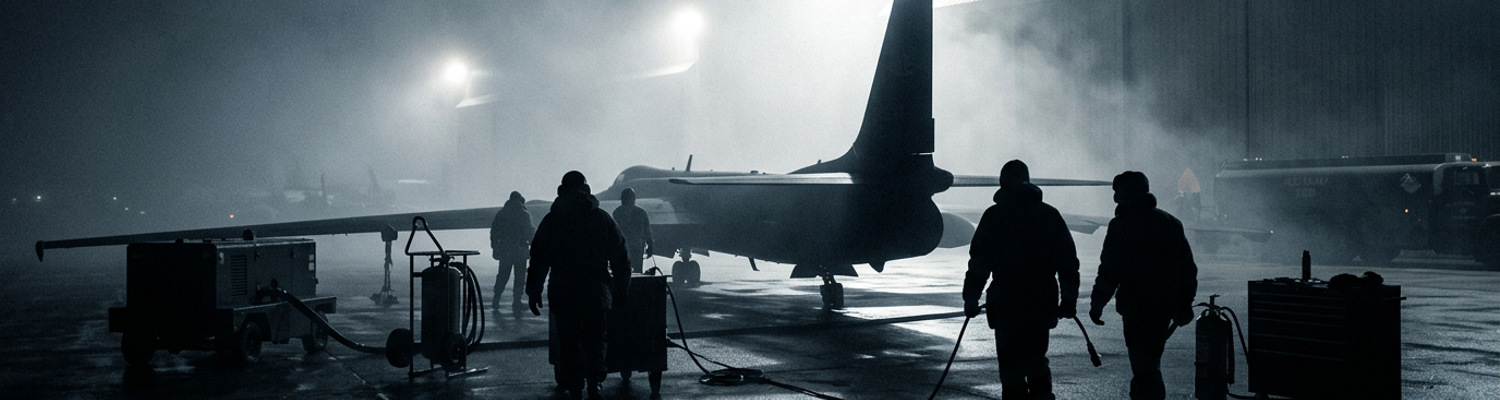
Operational flight logs confirm that on October 14, 1962, Strategic Air Command initiated Operation Blue Springs. This established a forward operating location for the 4080th Strategic Reconnaissance Wing at McCoy Air Force Base in Orlando, Florida. Base coordinates at 28 degrees 25 minutes North and 81 degrees 18 minutes West positioned four black-painted U-2C reconnaissance aircraft directly alongside the alert aprons of the 306th Bombardment Wing. General Thomas S. Power at Offutt Air Force Base mandated this southern redeployment from Texas. The move eliminated five hours of dead-head transit time across the Gulf of Mexico.
Ground personnel from the 4028th Strategic Reconnaissance Squadron carved out an isolated compound behind double-strand concertina wire. They stationed portable trailers along the eastern flight line.
Subtropical humidity immediately damaged the specialized ground-support machinery. Condensation jammed the hydraulic valves in the mobile engine-start carts. Electrical short-circuits plagued the sensitive vacuum heaters inside the Type B camera bays. Rail flatcars delivered drums of specialized JP-TS fuel. Ground crews hand-filtered this fuel through chamois skins to prevent ice crystal formation at high altitudes. Technicians converted a vacant maintenance shed into a secure darkroom. They worked through the night to prepare chemical vats for incoming aerial film.
Sleep ceased entirely.
A close review of operational logs indicates that the Pentagon demanded continuous reconnaissance passes over the Caribbean. This created an unrelenting flight schedule for the six operational pilots stationed at the Orlando detachment. Flight operations required ten-hour mission blocks over high-threat air defense sectors. These flights were followed by film offloads and four hours of mandatory tactical debriefing. Pilots then received sudden assignments to the next dawn launch roster. Combat pilots barely received three hours of broken rest in temporary barracks. Flight surgeons routinely summoned them back to the ready room before dawn. Strategic Air Command commanders refused to rotate reserve aircrews into the queue. They cited the specific handling limits of the CIA-configured U-2C airframes. Maintenance teams ran low-pressure leak checks on cockpit seals every six hours. This confirmed the cockpit pressure vessel could maintain a differential of 3.88 pounds per square inch. Aircraft landed with scorched turbine exhaust rings and depleted nitrogen tanks. Seized flap actuators forced mechanics to work throughout the darkness using hand tools.
The schedule broke them down.
Pilots could not simply strap into the ejection seat and throttle up the Pratt and Whitney J75 turbojets. Operating in the near-vacuum above 70,000 feet required an exhausting pre-flight denitrogenation process. This prevented lethal decompression sickness. Inert nitrogen dissolved in blood and fat tissue expands rapidly during ascents past Armstrong's Line at 63,000 feet. This expansion causes joint embolisms, choking spells, and circulatory collapse. Physiological training technicians strapped each pilot into a contour chair inside a chilled mobile van two hours before engine start. Pure medical oxygen was pumped continuously through rubber facecones at positive pressure. This scrubbed every trace of atmospheric nitrogen from the pilot's system. Breathing cold, dry oxygen for 120 minutes parched oral membranes. It triggered intense headaches.
If morning fog or a diplomatic delay postponed takeoff, the pilot remained trapped on the pure oxygen hose. They sat immobilized inside heavy rubberized pressure layers for up to five hours.
Archival evidence shows that repeating these denitrogenation cycles across consecutive days produced acute oxygen toxicity. Pilots suffered severe nausea and optical migraines. High cockpit temperatures on the McCoy runway combined with the sealed rubber MC-3 garments. This caused rapid physical dehydration. The process stripped up to five pounds of water weight from each pilot before liftoff. Major Rudolf Anderson Jr. completed three separate pre-breathing sessions within thirty-six hours. He endured severe inner ear pain and vomiting during pre-launch holds. His final pre-flight denitrogenation cycle on the morning of October 27 concluded with an elevated pulse of 112 beats per minute. He had cracked lip tissue inside the locked MA-2 helmet visor. Flight medical officers tightened his restraint harness by two full inches. This secured his shrunken torso into the ejection seat.
Physiological Confinement in MC-3 Pressure Suits
Archival evidence shows that the MC-3 partial-pressure suit manufactured by the David Clark Company locked the pilot inside a rigid mechanical clamp. Built from heavy rubberized fabric and dense nylon, the garment relied on capstan tubes running externally along the arms and legs. These tubes laced tightly against the pilot's limbs. They exerted pneumatic counter-pressure in the event of cockpit depressurization. Strapped into the unpadded ejection seat of a U-2C for ten continuous hours, aviators were physically unable to shift their hips. They could not recline their spines. Coarse interior seams ground continuously against sweat-softened skin.
Flight logs from the 4028th Strategic Reconnaissance Squadron record severe physical trauma. Friction from the capstan laces stripped layers of epidermis across the shoulders, inner thighs, and lumbar spine. Deep contact blisters formed under the tight pressure bladders. These blisters ruptured during flight. They soaked the rubberized suit lining in tissue fluids. Pilots bled directly into their cotton underwear. The restrictive garment pinched their torsos with every minute adjustment of the control yoke.
Pilots could not turn their heads more than thirty degrees.
When examining the historical record of the McCoy Air Force Base detachment, flight surgeons documented recurring soft-tissue trauma. The rigid MA-2 pressure helmet caused most of this damage. The heavy fiberglass shell clamped onto an aluminum neck ring. This ring rested directly against the pilot's clavicles. It bruised the bone during routine flight turbulence. Internal breathing bladders pressed forward across the occipital bone and jawline. This forced positive-pressure oxygen into the lungs. It drove the hard rubber edges of the oral-nasal mask deep into the facial cartilage. Aviators could not touch their faces. They could not scratch irritated skin. They could not clear fluid from the visor seal. Sweat ran into their eyes unchecked. It stung the corneas for hours at a time. Mechanical tension across the jaw joint brought on severe temporomandibular spasms. Pilots were unable to chew solid food for twenty-four hours after landing.
The heat began on the concrete.
A close review of operational logs indicates that the standard flight profile subjected pilots to severe thermal shock. Temperatures swung across more than one hundred and fifty degrees Fahrenheit within forty-five minutes. Midday temperatures on the forward alert apron at McCoy regularly hit ninety degrees. Relative humidity sat at eighty percent. Solar radiation beat through the unshaded canopy glass. The cockpit interior turned into an oven exceeding one hundred and ten degrees during pre-takeoff ground delays. Sealed inside non-breathable rubber layers, aircrews sweated uncontrollably. They lost up to five pounds of water weight before the Pratt and Whitney J75 engine even spooled up.
Relief did not follow the steep climb out over the Florida Straits.
Reaching an operational ceiling of 72,000 feet, the aircraft encountered outside atmospheric temperatures plunging past minus sixty degrees. Bleed air routed off the J75-P-13 engine compressor stage failed to heat the lower cockpit compartment. The rudder pedal wells dropped to sub-zero temperatures. Cockpit floor panels dropped below freezing. Sweat-soaked socks and glove liners turned into stiff layers of frost. The pilots struggled to maintain rudder authority in high-altitude turbulence. Maintenance crews at McCoy used warm saline solutions to unstick frozen flight suits from raw flesh after shut-down.
Aerodynamic Constraints of High-Altitude Flight
A close review of operational logs indicates that maintaining level flight at 70,000 feet pushed the human brain to the edge of sensory collapse. Strategic Air Command flight charts designated the upper operational envelope as the coffin corner. This aerodynamic squeeze narrowed the boundary between subsonic stall and supersonic buffet to a lethal sliver. At an indicated airspeed of barely 100 knots, the U-2C airframe sliced through highly thin air. The difference between minimum controllable flying speed and Mach overspeed divergence dropped to fewer than four knots.
Flying three knots too fast produced local shockwaves across the ultralight 80-foot wings. This triggered Mach tuck. It caused severe control reversal and structural failure of the tail assembly. Allowing the airspeed indicator to slip three knots too slow detached airflow across the laminar-flow wing roots. This pitched the nose upward into an unrecoverable deep stall. It instantly starved the Pratt and Whitney J75-P-13 turbojet of air. Aviators spent eight continuous hours locked into the instruments. They fixated on a Mach indicator where the needle sat clamped between two red-lined mechanical limits.
A four-knot deviation meant immediate mid-air breakup.
Archival evidence shows that holding this narrow airspeed margin required continuous physical exertion. The U-2 completely lacked hydraulic control boost. Kelly Johnson designed the reconnaissance platform as an ultra-lightweight glider. He routed mechanical steel cables over pulleys directly from the pilot's control yoke to the ailerons, elevator, and rudder surfaces. At minus sixty-five degrees Fahrenheit in the lower stratosphere, differential thermal contraction occurred. The aluminum fuselage and the steel cables contracted at different rates. This altered control cable tension. The controls stiffened. Mechanical resistance increased against every movement of the yoke. Aviators had to fight the control yoke with two hands. They exerted up to thirty-five pounds of direct manual force to counter clear-air turbulence. They fought high-altitude atmospheric waves over the Caribbean basin. Autopilot units of the era lacked the reaction speed to handle the narrow aerodynamic margin. Aircrews of the 4080th Strategic Reconnaissance Wing had to manually grip the vibrating control yoke without pause while cruising across hostile target tracks.
Muscle fatigue set into the shoulders and forearms within the first ninety minutes.
When examining the historical record, flight surgeons discovered that this manual workload collided with total sensory detachment. Outside the canopy at 72,000 feet, scattering dust and tropospheric moisture vanished. The midday sky turned into an empty, ink-black void. The pilot could discern the curvature of the earth below. The standard auditory cues of flight disappeared. Acoustic dampening from thin air and the placement of the J75 turbojet far behind the cockpit left the cabin dead silent. The only sound was the rhythmic, mechanical hiss of the MA-2 oxygen regulator cycling gas into the pilot's face mask. Locked inside the rigid fiberglass helmet, aviators heard only their own labored respiration. They heard the rapid pulse hammering in their temples.
External visual references were reduced to the periscopic drift sight. This sight was mounted low between the pilot's knees. It required leaning forward while maintaining rigid heading markers across Soviet-operated air defense grids near Banes and San Cristobal.
The silence inside the helmet was absolute.
Cockpit instrumentation required continuous cognitive processing under severe physiological stress. Pilots monitored turbine exhaust temperatures. They tracked system fuel balances across six internal wing tanks. They watched radar warning receiver strobes and target drift indexes. Blood nitrogen levels fluctuated inside their veins. Micro-adjustments to the manual throttle quadrant were needed every few minutes. Atmospheric temperature shifts directly altered J75 compressor efficiency. This threatened to pitch the aircraft out of its narrow flight corridor without warning. Flight debriefs at McCoy Air Force Base documented acute spatial disorientation. Pilots suffered tunnel vision and involuntary hand tremors upon descending into denser air over Key West. Post-flight inspections of ship 56-6679 recorded that ground crews routinely drained pooled sweat from the cockpit floorboards. Flight surgeons treated pilots for muscle spasms in both forearms.
Soviet Air Defense Radar Tracking
The sound in the headset never stopped.
Archival evidence shows that every reconnaissance track across Cuban airspace exposed U-2 pilots to continuous electromagnetic tracking from Soviet air defense forces. Cockpit audio channels fed directly into the pilot's MA-2 helmet from the onboard System VI electronic intelligence package. This system translated incoming radar pulses into raw acoustic tones. Early warning sweeps from Soviet P-12 Spoon Rest radar installations operated in the very-high-frequency band between 147 and 161 megahertz. These registered as steady, low-frequency clicks spaced at regular intervals. As the reconnaissance aircraft crossed coastal landfall near Mariel or Banes, ground operators handed target vectors over to the missile battalions.
That handoff triggered the SNR-75 Fan Song fire-control radar. This system transmitted synchronized ten-centimeter and six-centimeter tracking beams. Inside the pilot's sealed helmet, the intermittent clicks instantly collapsed into a sharp, high-pitched audio shriek. This continuous tone signaled that the Fan Song transmitter had achieved angle and range lock. It was calculating lead-angle intercept trajectories for launch rails below. System VI offered no active countermeasures. Pilots sat listening to the tone for forty straight minutes. They lacked an onboard jammer, chaff dispenser, or decoy to disrupt the tracking loop.
Evasive maneuvers were aerodynamically impossible.
A close review of operational logs indicates that the Soviet 11th and 12th Air Defense Divisions had established thirty-six operational S-75 Dvina surface-to-air missile sites spanning the Cuban landmass. Each site contained six revetted launch rails. These rails were loaded with V-750 missiles carrying 430-pound high-explosive proximity warheads. They commanded an effective engagement ceiling of 82,000 feet. Strategic Air Command mission directives forced 4080th Reconnaissance Wing pilots to fly rigid, level flight profiles directly across these missile rings. The heavy Type B panoramic camera mounted in the equipment bay required an unyielding gyro-stabilized platform. Bank angles exceeding two degrees blurred the high-resolution film strips. Altitude shifts corrupted the optical focal length calibrated for seventy thousand feet. Pilots were ordered to hold absolute wings-level trim along fifteen-minute straight-line photo runs. They maintained heading markers directly into the center of known missile kill zones. Diving away or breaking hard meant instantly crossing into the high-speed Mach buffet. It meant triggering an unrecoverable stall.
The aircraft was a captive target.
When examining the historical record of October 1962, flight debriefings reveal that this passive exposure broke the composure of veteran aircrews. The pilot flew blind to physical missile launches. He was unable to look downward through the floorboards. He could not scan the cloud deck while locked into the instrument cluster and the narrow drift sight. Aviators spent hours waiting for a proximity-fused blast to shred the fragile airframe. They listened to the Fan Song lock tone reverberate in their eardrums without any tactical recourse. Blood pressure spiked. The heart hammered against the tight chest bladders of the MC-3 pressure suit. This produced rapid shallow breathing that depleted onboard oxygen supplies ahead of flight plan estimates. Perspiration poured down the forehead. It blurred vision inside the sealed helmet visor where hands could not reach to wipe it away. Returning to McCoy Air Force Base after nine hours in the target area, pilots exhibited extreme motor tremors. They had glazed eyes and severe cognitive dissociation. Mechanics pulling flight logs noted that aviators sat frozen in their harnesses for several minutes after the Pratt and Whitney turbojets spooled down. They stared straight ahead at dead cockpit panels.
The Loss of Rudolf Anderson Jr
At 1019 hours on October 27, 1962, radar tracking stations in Key West lost the transponder beacon of aircraft 56-6676.
A close review of operational logs indicates that Major Rudolf Anderson Jr. was cruising at 72,000 feet over the nickel-mining port of Banes along Cuba's northeastern coastline. The Soviet 507th Anti-Aircraft Missile Regiment acquired his airframe. Soviet personnel manned the target acquisition radars. They reported the intruder directly to the command bunker at El Chico outside Havana. Lieutenant General Stepan Grechko served as deputy commander of the Group of Soviet Forces in Cuba. He bypassed Moscow's standing engagement restrictions. He issued the order to destroy the target.
At 1017 hours, battery commander Captain Ivan Gerchenov fired two V-750 surface-to-air missiles from their revetted launch rails at coordinates 20 degrees 58 minutes North and 75 degrees 42 minutes West. The missiles were propelled by solid-fuel boosters before their kerosene-nitric acid sustainer engines ignited. The radar-guided interceptors climbed at three times the speed of sound toward the thin upper atmosphere. The first missile detonated behind the U-2. The second missile detonated close aboard the left wing root. It spewed thousands of steel fragments through the unarmored aluminum skin.
Shrapnel punctured the cockpit pressure shell and the pilot's MA-2 helmet visor.
Archival evidence shows that rapid decompression occurred in less than half a second at minus sixty degrees Fahrenheit. This exposed Anderson's body to an ambient pressure lower than the boiling point of human blood. High-velocity blast fragments tore through the rubberized fabric of the MC-3 suit. They severed the oxygen delivery hose. Metal shards drove into the pilot's neck ring. Anderson died instantly from shrapnel trauma and immediate barotrauma before the automatic parachute deployment mechanism could cycle. Severed control cables prevented any aerodynamic recovery. With its port wing sheared and the tail assembly disintegrated, aircraft 56-6676 entered an inverted spin. It fell 72,000 feet through cloud cover before slamming into farmland near the village of Veguitas. Cuban militiamen recovered the wreckage. They extracted the pilot's body from the mangled cockpit forward fuselage. Soviet radar crews gathered telemetry strips detailing the intercept for transmission to Moscow.
McCoy Air Force Base waited in silence.
When examining the historical record of October 27, flight surgeons at McCoy documented acute combat stress among the surviving pilots of the 4028th Strategic Reconnaissance Squadron. Anderson had been the unit's most experienced aviator. His sudden disappearance transformed the alert trailer into a room of frozen terror. Major Richard Heyser and Captain Buddy Brown sat strapped inside their pressurized flight gear on the alert apron. They were ordered to prepare immediate contingency launches while Strategic Air Command leadership weighed executing retaliatory air strikes under OPLAN 312. Flight debriefs show that physical shock incapacitated the forward detachment. Aviators exhibited violent hand tremors. They experienced uncontrollable sweating inside their chilled oxygen masks. Resting pulse rates surged above 130 beats per minute. Two pilots vomited repeatedly into their flight suit neck seals. Others sat staring blankly at mission routing maps without speaking. Flight medical officers detected cognitive dissociation so severe that crews failed basic cockpit switch verification checks. They were unable to read heading coordinates or properly calculate J75 fuel burn rates. Strategic Air Command suspended all forward daytime reconnaissance runs over Cuban airspace for forty-eight hours. Four fueled aircraft sat parked on the McCoy tarmac with engines cold.
General Curtis LeMay's staff canceled the afternoon photo sorties at 1600 hours.