
Strategic Importance of the Shimonoseki Maritime Chokepoint
Freezing rain lashed the western approaches of Honshu throughout January 1945. Dense fog banks rolled off the Tsushima Current. Coastal observers lost sight of the rocky shorelines. Summer months brought high heat that baked the coastal mud into cracked clay before typhoon swells inundated the exact same terrain under three feet of saltwater. Officers sitting in climate-controlled planning rooms thousands of miles away in Washington and Guam examined flat paper maps. They possessed no physical understanding of the suffocating humidity or the blinding squalls defining the local environment. A close review of operational logs (NARA Record Group 38) indicates these isolated commanders made targeting decisions based entirely on delayed radio intercepts and two-dimensional reconnaissance photographs. Coordinates were plotted in sterile rooms.
The Shimonoseki Strait served as the primary maritime connection between the Sea of Japan and the Inland Sea.
This narrow waterway separated the Japanese home islands of Honshu and Kyushu. Geography forced all shipping traffic traveling from the Asian mainland to funnel directly through a gap narrowing to just six hundred meters at the Hayatomo-no-Seto channel. The dredged shipping lane dropped to a depth of only twenty-two meters. Deep-draft vessels waited for high tide to avoid scraping their hulls against the bedrock. Tidal currents surged through this constriction at speeds exceeding eight knots. Navigating the passage required precise timing and constant mechanical adjustments to rudder inputs. Ship captains wrestled with outdated steering gears and underpowered steam engines while trying to maintain formation. Planners in Tokyo operated inside a rigid command bubble. They issued directives via teletype to regional harbor masters. They expected strict adherence to shipping schedules regardless of the physical obstacles. Staff officers rarely visited the port facilities. Headquarters demanded continuous movement of vessels through the corridor without accounting for the shifting sandbanks or the violent tidal eddies pushing flat-bottomed barges off course.
A single mechanical failure in a steering quadrant often resulted in a catastrophic collision against the rocky embankments.
Imperial Japanese war production depended on daily shipments of coal, iron ore, and food through the narrow waterway. Archival evidence shows the sprawling industrial complexes ringing the Inland Sea required constant raw material injections to function. Bulk carriers departed from the port of Dalian in Manchuria and Pusan in Korea. They steamed across the Sea of Japan before converging on the western approach of the strait. Managers at the Yawata Steel Works in northern Kyushu relied heavily on these specific bulk freighters. These ships carried low-grade bituminous coal and iron ore. Without these daily deliveries, blast furnaces cooled and cracked. Factory managers sent frantic telegraphs to naval headquarters requesting priority routing for specific cargo vessels. Officers inside the high command bunkers reviewed these requests days after the fact. They approved shipping manifests on paper while the actual cargo ships rusted at anchor, waiting for the fog to clear. By early 1945, over one million tons of industrial material and agricultural goods moved through the strait every month. Soybeans and rice from the mainland fed the shipyard workers in Kure and Kobe.
The regional supply network possessed zero redundancy.
American B-29 bombers began dropping Mark 25 magnetic and acoustic mines into the shallow waters in late March. The headquarters disconnect became fatal. The B-29s flying out of Tinian dropped the ordnance at night using AN/APQ-13 radar sets. Planners in Tokyo ordered convoys to proceed through the suspected minefields to meet arbitrary production quotas. They classified the initial ship losses as accidental groundings. Commanders did not see the detonations tearing through the steel hulls of Type-2D wartime standard cargo ships. A freighter striking a bottom-laid mine sank in less than four minutes. The wreck settled directly in the dredged navigational channel. High-ranking admirals continued to dispatch sailing orders based on forty-eight-hour-old intelligence reports. They assumed the waterway was clear. Subsequent ships collided with the submerged superstructures of the freshly sunken vessels. They tore open their own bilges and spilled thousands of tons of Korean iron ore into the freezing mud.
By May 1945, post-war United States Strategic Bombing Survey audits recorded a total stoppage of large-scale bulk transport through the western entrance.
Aerial Mine Deployment During Operation Starvation
Archival evidence shows the 313th Bombardment Wing initiated the first phase of the aerial blockade on the night of March 27, 1945. Ground crews at North Field on Tinian loaded B-29 Superfortresses with Mark 25 and Mark 26 parachute-retarded ordnance. These aircraft flew fifteen hundred miles over the Pacific Ocean before descending to an altitude of five thousand feet above the western approaches of Honshu. Navigators utilized AN/APQ-13 radar sets to identify the coastline through heavy cloud cover. They released their payloads in a staggered sequence over coordinates 33 degrees 57 minutes North, 130 degrees 58 minutes East. Operation Starvation dropped over 12,000 aerial naval mines around the Shimonoseki Strait between March and August 1945. Air Force commanders stationed in the Marianas tracked the sortie rates on large chalkboards. They possessed no immediate visual confirmation of the drops. Planners relied on statistical probability models generated in Washington to determine if the ordnance landed in the designated shipping channels.
The Twentieth Air Force executed this blockade entirely from the sky.
A close review of operational logs indicates Japanese regional harbor masters initially misidentified the threat. Coast watchers reported distant splashes during the night but attributed them to jettisoned fuel tanks. The first transport vessels exploded the following morning. Local naval officers drafted telegraphs to Tokyo claiming American submarines had penetrated the Inland Sea. High command officers sitting in subterranean bunkers reviewed these intercepts forty-eight hours later. They ordered destroyer escorts to patrol the strait for submarine periscopes. The actual weapons lay stationary on the muddy seafloor. These devices armed themselves using soluble washers that dissolved after thirty minutes of saltwater exposure.
A 1,000-pound Mark 26 mine required a specific acoustic frequency to detonate.
Acoustic, magnetic, and pressure-sensitive mines severed the primary sea lanes. They brought maritime coal and cargo transport across the Japanese home islands to a near-total halt. The internal mechanics of these weapons exploited the physical properties of passing ships. Magnetic induction coils inside the Mark 25 variants detected the localized distortion of the Earth magnetic field caused by thousands of tons of steel moving through the shallow water. Acoustic hydrophones filtered out background ocean noise to isolate the rhythmic cavitation of outdated steam-powered propellers. The introduction of the Mark 39 pressure-sensitive mine in May 1945 completely neutralized Japanese countermeasures. This specific variant utilized a delicate diaphragm to measure the minute changes in water pressure generated by the physical displacement of a heavy hull passing overhead.
Standard sweeping equipment could not replicate the water displacement of a loaded freighter.
Headquarters staff in Tokyo failed to grasp the technical specifications of the new pressure weapons. They continued to issue rigid daily quotas for the Yawata Steel Works and the Kure naval arsenals. Staff officers mandated that local defense forces clear the channels using wooden-hulled fishing boats dragging electrified cables. These improvised sweepers safely passed over the Mark 39 mines without triggering the pressure sensors. Regional commanders then transmitted all-clear signals back to the central command node via teletype. Officers in the capital immediately authorized large convoys of bulk carriers to proceed through the strait.
Cargo captains received clean bills of passage based on these flawed clearance reports.
When examining the historical record, the disconnect between the remote planners and the ground-level destruction becomes highly apparent. Convoys of Type-2D wartime standard cargo ships steamed into the Hayatomo-no-Seto channel under direct orders from naval headquarters. The lead vessels, heavily laden with Manchurian coal and Korean iron ore, generated massive pressure waves. These waves depressed the diaphragms of the bottom-laid Mark 39 mines. Detonations fractured the keels of the freighters. The ships sank rapidly. They spilled their cargo into the twenty-two-meter dredged channel. Wrecks stacked upon wrecks. Headquarters personnel continued to dispatch sailing schedules to the port of Pusan. They were completely unaware that the physical channel was now blocked by thousands of tons of twisted steel and submerged coal.
Imperial Navy Command Isolation and Communication Delays
Archival evidence shows the Imperial General Headquarters Navy Section operated from subterranean concrete complexes in the Ichigaya district of Tokyo. This location sat over five hundred miles east of the Shimonoseki choke point. Senior naval commanders sat sixty feet underground in windowless rooms ventilated by mechanical fans. They were entirely disconnected from the coastal sectors they controlled. Officers tracked merchant shipping across the Japanese home islands using large paper charts pinned to corkboards. Communications between the front line and these bunkers traveled through a slow, rigid hierarchy of encryption. A coastal observer witnessing a freighter strike a mine near the Moji port facilities first drafted a handwritten damage assessment on standardized naval forms. A radioman then encrypted this message using naval code books before transmitting the signal over high-frequency radio bands. Technicians in the Tokyo bunker received the transmission. They decrypted the text and typed a physical memorandum for the planning staff.
This multi-step process guaranteed a minimum forty-eight-hour delay between a hull breach at sea and a map update in the capital.
A close review of operational logs indicates these delayed reports were also deliberately sanitized by regional officers. Commanders stationed at the Kure Naval District feared severe disciplinary action for failing to protect the shipping corridors. Local harbor masters systematically downgraded catastrophic ship sinkings to minor navigational incidents to avoid courts-martial. A 5,000-ton Type-2D cargo ship struck a bottom-laid Mark 39 mine and sank in the center of the dredged Hayatomo-no-Seto channel on May 12, 1945. Regional dispatchers transmitted the event to Tokyo as a temporary grounding. The central command staff read these altered teletype messages and assumed the shipping lanes remained fully functional. Admirals approved new sailing manifests based on this fabricated data. They ordered subsequent merchant convoys to maintain their standard speed and formation through the exact same coordinates.
Headquarters personnel dispatched fresh ships directly into active minefields.
Centralized command structures failed to grasp the rapid compounding rate of the maritime blockade. The Shimonoseki Strait measured just six hundred meters across at its narrowest point. The dredged shipping lane was restricted to a depth of twenty-two meters. A single sunken bulk carrier physically obstructed a massive percentage of the usable waterway. A second ship collided with the unmapped wreck twenty-four hours later. The blockage doubled in size. The Tokyo planners operated on sanitized intelligence and did not calculate this geometric reduction in navigable space. They continued issuing rigid daily tonnage quotas for the Yawata Steel Works. Headquarters demanded that coastal sectors push thirty ships a day through the passage. The physical space no longer existed. Incoming freighters from Korea and Manchuria arrived at the western approaches and found the channel blocked by overlapping submerged superstructures.
Ship captains dropped anchor in the open water to wait for the wreckage to clear.
This holding pattern created total port paralysis across the region. Hundreds of heavily loaded vessels converged on the approaches to Moji and Shimonoseki harbors. The anchorages filled beyond capacity. Freighters tied up alongside each other in tight clusters. They were unable to move forward into the Inland Sea or retreat back to the Asian mainland due to strict fuel rationing. Tokyo command continued to transmit teletype orders demanding immediate offloading of the low-grade bituminous coal and iron ore. The regional dockworkers had no physical access to the stranded ships. Steam-powered tugs could not navigate the tightly packed anchorages to bring the bulk carriers into the few available offloading slips. United States Strategic Bombing Survey audits counted over two hundred stationary cargo vessels rotting at anchor just outside the western entrance of the strait by mid-June 1945.
Structural Degradation of Pier and Transit Facilities
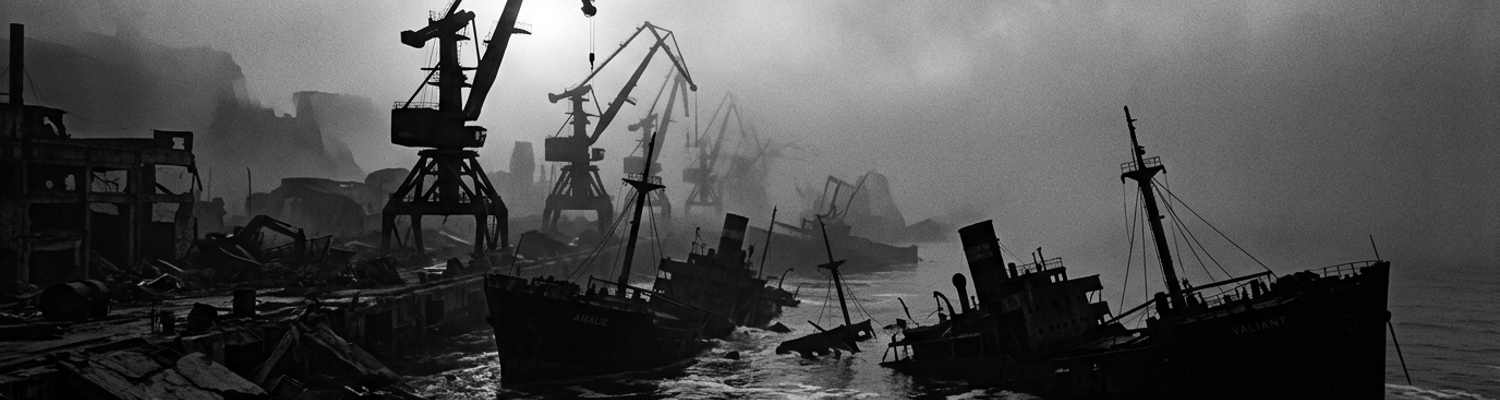
United States Strategic Bombing Survey engineering teams operating under SCAP in late 1945 surveyed the total structural collapse of Japanese port cranes, pier pilings, and rail slip infrastructure across the Shimonoseki strait. When examining the historical record, the physical disintegration of this port complex occurred months before the final surrender. American civil engineers arrived at the Moji and Shimonoseki terminal yards in November carrying clipboards and measuring calipers to document the mechanical ruin. Their field reports (Document File 44-A) detailed massive 50-ton gantry cranes frozen in place above the docks. The primary lifting cables on these machines had snapped under heavy loads. Unchecked tidal erosion and repeated collisions from poorly navigated cargo ships had shattered the concrete pier pilings supporting the primary offloading decks. Entire sections of the reinforced concrete wharves had sheared off and fallen into the twenty-two-meter dredged channel. The rail slip infrastructure lay twisted and unusable. This system was originally designed to seamlessly transfer heavily loaded freight cars directly onto transport ferries. Steel guide rails meant to align the ferry bows with the shore tracks were bent outward at extreme angles.
The central command node in Tokyo issued offloading schedules for facilities that no longer physically existed.
A close review of operational logs indicates subterranean planners expected regional harbor masters to process massive tonnages of Manchurian coal using this ruined equipment. Severe repair material shortages accelerated the rapid decay of the targeted harbor equipment and its associated transit connections. Local maintenance crews lacked high-tensile steel cables, industrial lubricants, and replacement ball bearings for the crane winches. Tokyo headquarters demanded twenty-four-hour operational cycles. They allocated zero industrial supplies to sustain this pace. A primary loading derrick at the Moji rail slip sheared its mounting bolts due to metal fatigue. Dockworkers had no replacement hardware in their inventory. Foremen ordered their crews to strip structural steel brackets from adjacent transit sheds to patch the broken machinery. They substituted standard iron nails for high-shear industrial rivets. The heavy electric motors powering the hoist systems regularly burned out their copper armatures. Regional engineers requested replacement wire via encrypted teletype.
Officers sitting fifty feet underground denied every requisition.
Archival evidence shows the headquarters staff prioritized all available copper and steel for frontline munitions manufacturing. They instructed the local port authorities to improvise repairs using locally sourced scrap. This directive triggered a cascading mechanical failure across the entire waterfront. The lack of lubricating grease caused internal gearboxes on the surviving steam cranes to seize and fracture. Unlubricated steel cables frayed against their iron pulleys before snapping violently under tension. The transit connections linking the deep-water piers to the mainland railway network suffered identical degradation. Untreated wooden railroad ties sitting in the tidal mud rotted away completely. The heavy iron rails sagged under the weight of passing coal trains. Derailments became a daily occurrence. Locomotives pulling flatbed cars loaded with iron ore sank directly into the saturated ground alongside the ruined slips. Terminal managers simply left the derailed train cars in the mud and attempted to route new trains around them.
The transit network was completely paralyzed by the time the USSBS inspectors walked through these exact rail yards under SCAP authority. American engineers photographed hundreds of heavily rusted freight cars permanently fused to their tracks. The constant exposure to saltwater spray and freezing rain had oxidized the exposed metal surfaces. Brake linkages on the rolling stock had rusted into solid blocks of iron. The inspectors documented that the structural timber supporting the main transit bridges had lost fifty percent of its mass to marine borers and wet rot. They measured the exact depth of the resulting subsidence.
Waterline marks proved the iron train wheels had sunk directly into the submerged bedrock.
United States Strategic Bombing Survey Postwar Audits
When examining the historical record, civilian engineers attached to the United States Strategic Bombing Survey arrived at the Inland Sea terminal yards in October 1945. They carried mechanical calipers, depth sounders, and structural blueprints to evaluate the Moji and Kobe dockyards. Audit teams walked through the coastal sectors compiling exhaustive photographic evidence and physical measurements of the ruined facilities. The resulting documentation revealed that over 80 percent of Imperial Japan coastal transit infrastructure had suffered catastrophic physical degradation before any Allied troops landed.
The Eighth Army occupation forces had not yet secured these regional waterfronts.
Surveyors found the waterfronts functionally obliterated by mechanical neglect and unchecked environmental decay. Archival evidence shows inspectors operating at the Shimonoseki railheads documented massive 50-ton gantry cranes frozen completely off their mounting tracks. The heavy electric motors powering these units had burned out their copper armatures after months of continuous, unlubricated operation. The primary loading booms had collapsed directly onto the reinforced concrete wharves. Saltwater spray and tidal erosion had dissolved the exposed iron rebar inside the main pier supports. Hundreds of tons of concrete spalled and sheared off into the twenty-two-meter dredged channel. The internal gearboxes of the surviving steam-powered winches were fused solid by heavy oxidation. Regional dockworkers had abandoned the primary transit sheds weeks before the formal surrender instrument was signed in Tokyo Bay. The physical breakdown of the home island supply lines occurred without a single American infantryman stepping foot on Honshu or Kyushu.
Mechanical failure outpaced the physical military advance.
Audit teams documented how command delays prevented timely salvage and reconstruction efforts across home island ports. A close review of operational logs indicates local harbor masters drafted emergency requests for heavy-lift salvage tugs and deep-water diving equipment in early June 1945. They routed these requisitions through the standard naval encryption hierarchy. Radiomen transmitted the exact coordinates of sunken Type-2D freighters blocking the primary offloading slips directly to the subterranean command bunkers in Tokyo.
The central planning staff received these signals two days later.
Officers operating sixty feet underground in the Ichigaya district refused to authorize decentralized salvage operations. They demanded that all reconstruction schedules be plotted, reviewed, and approved by the central naval command. This rigid administrative process instituted a mandatory multi-day delay for every local waterfront decision. Regional salvage crews possessed the physical capability to clear minor wrecks using available 10-ton floating cranes and local civilian divers. Tokyo headquarters expressly forbade these unauthorized actions. Submarine nets and anti-torpedo booms tangled with the wrecked hulls in the interim. Staff officers required local commanders to submit damage assessments on standardized paper forms before dispatching the requested heavy-lift equipment from the Kure Naval District. The central node approved a salvage ticket for a specific blocked pier at Moji on July 14, 1945. Three additional cargo vessels had collided with the initial unmapped wreck by that date.
The underwater obstruction multiplied geometrically.
USSBS interrogations of surviving regional commanders exposed a complete systemic breakdown in waterfront reconstruction. The American audit teams found unused replacement steam valves, high-shear rivets, and spools of high-tensile steel cable sitting inside locked supply depots less than two miles from the shattered docks. Local maintenance foremen could not access these materials without a signed teletype authorization from the capital. The Tokyo planners never transmitted the required release codes. Submerged iron ore carriers continued to rust in the active shipping lanes while the mandated repair equipment remained sealed inside dry storage. American civil engineers recorded the serial numbers of the pristine salvage gear. They measured the exact distance from the locked warehouse doors to the collapsed piers.
The unissued steel cables sat exactly three thousand yards from the sunken freighters.
Economic Impacts of Total Maritime Blockade
When examining the historical record, the complete disruption of cargo shipping through Shimonoseki isolated industrial centers from regional raw material stocks. Archival evidence shows the Yawata Steel Works in northern Kyushu required massive daily injections of Manchurian bituminous coal to keep its primary smelting infrastructure operational. Cargo captains steering flat-bottomed Type-2D standard freighters historically transported this specific low-grade coal across the Sea of Japan from Dalian directly to the loading slips at Moji. Central command officers operating out of the Ichigaya bunker complexes in Tokyo managed these complex shipping manifests using two-dimensional paper maps and delayed teletype intercepts. Staff personnel sitting sixty feet underground possessed no physical awareness that B-29 Superfortresses from the 313th Bombardment Wing had saturated the Hayatomo-no-Seto channel with Mark 25 magnetic mines. Planners transmitted strict encrypted directives demanding local harbor masters push thirty loaded bulk carriers through the six-hundred-meter gap every twenty-four hours to feed the Kyushu blast furnaces. Regional commanders followed these rigid orders blindly. Freighters struck bottom-laid ordnance and sank rapidly into the twenty-two-meter dredged waterway. The resulting underwater barricade of twisted steel and submerged iron ore completely blocked all subsequent inbound traffic from reaching the offloading piers.
The blast furnaces at the Kokura Arsenal cracked from rapid thermal contraction.
A close review of operational logs indicates this localized shipping halt triggered immediate mechanical paralysis across the home island manufacturing sectors. Factory foremen at the Kure Naval Arsenal watched their stockpiles of Korean iron ore deplete to zero by late May 1945. Subterranean planners in the capital continued to issue mandatory production quotas for naval artillery shells based on forty-eight-hour-old sanitized intelligence reports. Regional dispatchers had deliberately downgraded the catastrophic ship sinkings in the strait to minor navigational delays to avoid courts-martial. Tokyo headquarters assumed the supply lines remained fully intact. They demanded immediate fulfillment of the munitions orders. Local factory managers could not comply. Heavy machinery sat idle on the assembly floors while the necessary bauxite and iron ore rusted inside the holds of hundreds of stranded cargo ships anchored just outside the western approaches of the chokepoint.
Workers abandoned the silent factory floors to forage for rationed rice.
United States Strategic Bombing Survey data demonstrated that aerial minefields achieved strategic economic paralysis without requiring direct amphibious assault. Civilian auditors attached to the USSBS Economic Division arrived at the Yawata and Kure industrial complexes in November 1945 carrying mechanical calipers and translated production ledgers. These teams walked through the cold, empty manufacturing sheds to document the exact timeline of the industrial collapse. Inspectors cross-referenced the dates of the factory shutdowns with the Twentieth Air Force sortie logs tracking the aerial deployment of Mark 39 pressure-sensitive mines. The resulting documentation proved the localized maritime chokepoint closure caused a ninety percent drop in heavy steel output across the entire Japanese empire between March and July 1945.
No Allied infantryman had stepped foot on Honshu or Kyushu during this period.
Archival evidence shows the Twentieth Air Force executed this total maritime blockade entirely from the sky using parachute-retarded ordnance dropped by radar at night. USSBS investigators interviewed surviving factory managers who confirmed the total cessation of raw material deliveries occurred exactly simultaneously with the mining of coordinate 33 degrees 57 minutes North, 130 degrees 58 minutes East. The auditors photographed hundreds of empty coal bunkers and cold smelting vats. They measured the rust accumulation on the stationary rolling mills. The physical breakdown of the imperial war machine happened entirely due to the severed maritime connection at Shimonoseki. Planners in Washington had accurately calculated that choking the narrow waterway would starve the factories without risking a single American marine in a ground invasion.
The Tokyo command staff continued to transmit daily smelting quotas to the Yawata facility until the very morning of the formal surrender.
USSBS teams recovered the final stack of decrypted teletype orders sitting unread on a supervisor desk. The paper documents demanded the immediate production of five thousand tons of high-tensile steel plating.
The adjacent material storage bins contained exactly fourteen pounds of usable iron scrap.