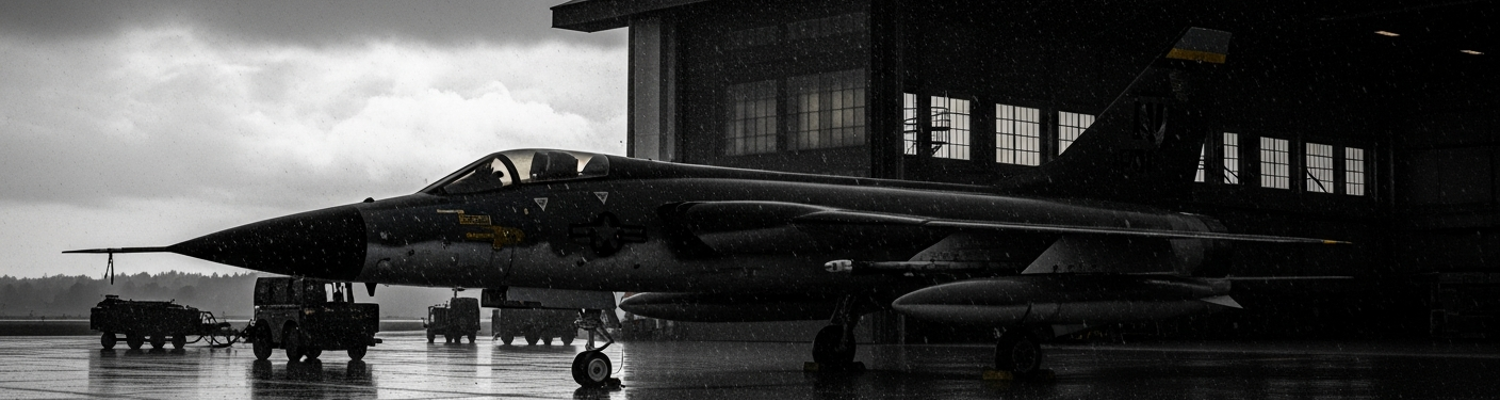

Project Iron Hand Strategic Imperatives
The silence in the cockpit was the first indicator of extreme danger. For American strike package crews, this quiet meant they had crossed into North Vietnamese airspace, leaving behind the familiar radio chatter. Below, concealed by jungle, the enemy waited. The outcome of their bombing run, and their survival, depended on an unproven tactic developed to counter a lethal and expanding threat.
This was the genesis of Project Iron Hand.
Its primary objective, derived from the severe lessons of Operation Rolling Thunder in 1965, was the suppression of enemy air defenses, a mission known by the acronym SEAD. U.S. aircraft, particularly the F-105 Thunderchief fighter-bombers, were suffering unsustainable losses. The appearance of Soviet-supplied SA-2 Guideline surface-to-air missile systems created a new reality over North Vietnam. A U.S. Navy RF-8A Crusader first photographed a distinctive six-pointed star SAM site on April 5, 1965, but strikes were not immediately authorized. After the first confirmed shoot-down of a USAF F-4C on July 24, 1965, the operational calculus changed. Initial retaliatory strikes were ineffective; of 46 F-105s sent to attack two SAM sites, six were shot down by conventional anti-aircraft artillery, only to discover the sites were abandoned. The North Vietnamese had established a flak trap. Bombing suspected locations was inefficient and dangerous. A dedicated countermeasure was required. The directive known as Iron Hand was issued to form a specialized force to hunt and destroy SAM sites, clearing a path for the main bombing force.
The core of this new strategy was the F-105G Wild Weasel. This two-seat variant of the Thunderchief was not a standard bomber but a specialized hunter-killer platform. Its mission profile was one of the most hazardous of the war. A close review of operational logs shows Weasel crews flew ahead of the main strike force, acting as bait. Their objective was to provoke North Vietnamese SAM crews into activating their Fan Song guidance radars. In the rear seat of the F-105G, an Electronic Warfare Officer (EWO), often recruited from Strategic Air Command, monitored a suite of sensitive receivers. The key equipment pieces were the AN/APR-25 and AN/APR-26 Radar Homing and Warning (RHAW) systems. These devices allowed the EWO to detect radar emissions, analyze their frequency, and determine their precise bearing. Once the Fan Song radar was painting their aircraft, the EWO would provide the pilot a target direction. The pilot would then launch an AGM-45 Shrike anti-radiation missile. This weapon did not require a visual on the target; it homed in on the enemy’s own radar beam, following it directly to the transmitting antenna. The Weasels were daring the enemy to shoot at them, using that aggression as a weapon.
This tactical innovation was driven by a rapid escalation of the threat. The North Vietnamese, with Soviet and Chinese support, did not remain static. Initially, their Soviet-built SA-2 sites were constructed in fixed patterns. They quickly learned from early U.S. attacks. Archival evidence shows that by 1966, SAM crews were employing sophisticated tactics. They kept their powerful Fan Song radars inactive until the last possible moment, denying Wild Weasel crews a signal. They developed mobile launch systems, constantly moving their batteries to avoid pre-planned strikes and creating uncertainty for U.S. mission planners. The density of SAM sites around targets like Hanoi and Haiphong grew. By the end of 1966, an estimated 150 active SAM sites dotted North Vietnam, organized into roughly 25 battalions. This created overlapping fields of fire, meaning a strike package could be engaged by multiple batteries at once. This network of integrated air defenses forced a continuous evolution in American SEAD technology, placing immense pressure on the development and deployment of the specialized sensor packages upon which the Wild Weasel concept depended.
AN/ALR-25/26 Receiver Failures
The electronic heart of the Wild Weasel mission was the AN/APR-25 Radar Homing and Warning (RHAW) receiver and its companion, the AN/APR-26 SAM launch warning system. These devices were intended to give the Electronic Warfare Officer in the F-105F a precise bearing to an active North Vietnamese Fan Song guidance radar. The APR-25 would translate incoming radar energy into a line on a circular cathode-ray tube display, giving the EWO a threat direction. The APR-26 was designed to detect specific guidance signals associated with a missile launch, triggering a warning light and an audible alarm that a SAM was airborne. This entire system was the foundational technology that allowed a Weasel crew to hunt.
Its failure, a distressingly common event according to operational logs, turned the hunter into the hunted.
A low Mean Time Between Failure (MTBF) rate plagued the early APR-25/26 units. This metric, calculating the average operational hours an equipment piece can run before a breakdown, was abysmal. While specific MTBF numbers from 1966 are difficult to isolate from declassified records, firsthand accounts from maintenance crews at forward bases like Korat and Takhli in Thailand consistently identified the RHAW gear as a primary maintenance problem. The systems were a dense collection of early-generation solid-state electronics and vacuum tubes, highly susceptible to G-forces, vibrations, and extreme temperature fluctuations of combat flight. Connectors worked loose, vacuum tubes failed, and sensitive crystal video receivers drifted out of calibration. For ground crews, this meant cannibalizing parts from damaged aircraft just to get a few mission-capable F-105s on the flight line. For aircrews, it meant taking off with a system that might fail at the worst moment.
The specific vulnerabilities of these early receiver models presented a tactical crisis. The AN/APR-25 was primarily designed to detect S-band frequencies used by the SA-2’s Fan Song-B radar. It had trouble distinguishing between the main tracking beam and the radar’s sidelobes, weaker emissions radiating from the side of the main antenna. An EWO could get a dangerously inaccurate bearing, pointing them toward empty sky instead of the actual launch site. The system was also susceptible to interference from other powerful American electronic warfare pods, carried for self-protection. North Vietnamese radar operators, with Soviet advisory support, learned to exploit these weaknesses. They adopted tactics of using very short, intermittent radar transmissions, preventing the APR-25 from getting a steady signal. They would coordinate with multiple SAM battalions, activating several radars at once from different directions to confuse the simple display, which could not effectively prioritize multiple threats. An EWO might be faced with a screen full of strobing lines, unable to determine which represented the most immediate danger. The AN/APR-26 launch detector was even more binary; it could only confirm that a SAM’s guidance signal was active, not its direction or which of the many detected Fan Song radars it was associated with. This left the crew with the terrifying knowledge they were being shot at, but with no clear data on how to react.
Sub-Component Manufacturing Bottleneck
The persistent in-flight failures of the AN/APR-25 and -26 receiver sets were not isolated electronic faults. A review of Air Force Logistics Command records from 1966 reveals a deeper, systemic crisis originating thousands of miles away. The root cause was a production bottleneck of the core receiver chassis, the densely packed heart of the system. These chassis, containing the delicate crystal video receivers and signal processing modules, were not arriving in sufficient numbers to equip new aircraft or replace the high number of units that failed in the field. Maintenance logs from Korat and Takhli show a desperate scramble for spares. Mission-capable rates for the F-105F Wild Weasel fleet were often dictated not by combat losses, but by the simple lack of functional RHAW gear. The operational tempo of the Iron Hand mission was throttled by a disruption in the manufacturing pipeline.
The problem was not in the jungles of Southeast Asia. It was on factory floors in California.
Responsibility for the AN/APR-25 and its sister unit, the AN/APR-26, fell to two key defense contractors: Itek Corporation and Applied Technology, Inc. (ATI). Archival evidence shows that ATI, a specialized electronics firm, was the prime contractor for the sensitive receiver chassis at the center of the production halt. These units were the technological core of the Wild Weasel, designed to translate raw radio frequency energy from North Vietnamese radars into actionable targeting data. The manufacturing process was complex, requiring the precise hand-assembly of early solid-state electronics alongside legacy vacuum tube components. The failure of these specific modules was not just a supply inconvenience; it represented a breakdown in the tactical chain. A Wild Weasel without its receiver was a blind hunter, able to deliver its AGM-45 Shrike missiles but unable to find its target. The Air Force's own internal communications from August 1966 show rising alarm, noting that the entire program to equip the F-4C fleet with the same sensors was at a standstill due to these unresolved hardware problems.
This manufacturing crisis was intensified by a significant civilian labor dispute. On July 8, 1966, the International Association of Machinists (IAM) initiated a massive strike against five major U.S. airlines. While the strike directly targeted commercial carriers like United and TWA, its effects rippled through the entire aerospace sector, which relied on the same pool of skilled labor and was influenced by wage negotiations. The strike, involving 35,000 workers and grounding 60 percent of the nation’s commercial air traffic, lasted for 43 days. The core of the dispute was wages; after years of lean profits while the industry converted to jets, airlines were posting record earnings in 1965, and the union was determined to secure a share of that prosperity for its workers, rejecting a 3.2 percent wage guideline promoted by the Johnson administration. Production at defense plants, including sub-contractors for the Wild Weasel program, slowed as the labor action dominated the industrial landscape, impacting the availability of specialized technicians and disrupting supply chains. The production line for the APR-25 chassis, already struggling to meet demand, effectively seized up.
Inter-Agency Procurement Bureaucracy
The manufacturing halt of the AN/APR-25 receiver chassis did not trigger a swift response from the national security apparatus. Instead, the crisis became ensnared in a rigid, multi-layered procurement bureaucracy ill-suited for the realities of war. Acquiring a technically complex system was never a simple transaction. For the Air Force, the process began with a formal requirement document that flowed from operational commands in the field, through Air Force Systems Command, and into the offices of the Department of Defense. Each step involved reviews, budget justifications, and contractual formalizations designed for deliberate, peacetime acquisition cycles. This system was built to ensure fiscal accountability and prevent fraud, not to react to an urgent component shortage that was grounding combat aircraft. The paper trail for a routine order was measured in months, a timeline that was untenable when Wild Weasel crews were facing an expanding SAM network with failing equipment.
This process was not designed for a crisis.
The paralysis was magnified by the overlapping jurisdictions of the Department of Defense (DoD) and the Department of Labor (DoL). The involvement of the DoD was a given. However, the 1966 International Association of Machinists strike dropped the problem squarely into the purview of the DoL. Federal law, specifically the Walsh-Healey Public Contracts Act of 1936, mandated that government contractors adhere to specific labor standards, including prevailing wages and safe working conditions. The purpose of the Act was to ensure the government’s purchasing power did not inadvertently drive down labor standards. This gave the Department of Labor a direct and powerful role in overseeing the defense contractors, like ATI, whose production lines had stopped. Any attempt by the DoD to force a resolution or bypass the striking workers would run directly into the legal authority of the DoL, which was tasked with ensuring fair labor practices. The Johnson administration was thus caught between two competing priorities: the immediate national security need to get sensor chassis to Thailand and the legal necessity of upholding federal labor law.
While instruments like the Defense Production Act (DPA) existed on paper to give the president authority to prioritize defense contracts, invoking such powers was a politically difficult and slow process. It required a formal declaration and a series of executive actions that the Johnson administration, already grappling with the political fallout of the strike, was hesitant to take. Records show that even as Air Force Logistics Command flagged the receiver chassis as a bottleneck, the request for emergency action had to filter up through the same bureaucratic channels it was meant to circumvent. The government did not declare a national emergency over the strike. The result was a tactical disaster born from administrative friction. For 43 days, the ATI production line remained silent. For weeks after, the logistical pipeline struggled to recover. This delay meant that not only were damaged AN/APR-25 units at Korat and Takhli not being replaced, but the new F-4C Wild Weasel IV aircraft slated to join the fight sat in depots, electronically incomplete and useless to the war effort. The number of SEAD-capable aircraft available for missions against the densest air defense system in the world was being dictated not by factory capacity or enemy action, but by inter-agency procedure.
Critical Hardware Deployment Delays
A review of Seventh Air Force operational timelines reveals the hardware deployment crisis reached its peak in the summer of 1966. The first eleven F-105F Wild Weasel aircraft arrived in Thailand in May and June, with another seven deploying in July. This small force was immediately tasked with the most dangerous missions of the air war. Their arrival coincided with a rapid expansion of the North Vietnamese air defense network. By August 1966, intelligence estimates showed over 100 active SA-2 sites, a dramatic increase from the handful present a year earlier. This created a severe operational imbalance; the demand for effective SEAD escorts was growing just as the supply of the hardware required to perform the mission was being cut off. The 43-day machinists' strike, which began on July 8, completely halted the flow of new and replacement AN/APR-25 receiver chassis from stateside production facilities.
This was a tactical disaster born from a supply-chain disruption.
The direct effects on Operation Rolling Thunder were immediate. Mission planners at the 388th Tactical Fighter Wing at Korat and the 355th at Takhli faced an impossible choice. They could scrub missions against heavily defended targets in the northern route packages, ceding the airspace around Hanoi and Haiphong, or they could send fighter-bombers into the world’s most advanced integrated air defense system with a compromised escort. Operational records show a shift in focus toward armed reconnaissance against targets of opportunity in the southern panhandle of North Vietnam, where the SAM threat was lower. Armed reconnaissance sorties increased by over 230 percent in 1966, while strikes against fixed, high-value targets dropped from over 30 percent of total sorties in 1965 to less than 3 percent in 1966. This was not a strategic choice but a tactical necessity driven by the lack of mission-capable Wild Weasels. For the F-105 strike pilots, the absence of a reliable Weasel escort meant flying lower to avoid SAMs, which in turn put them at greater risk from conventional anti-aircraft artillery. A hardware shortage on a California factory floor was directly translating to increased risk and decreased effectiveness for pilots over the Red River Delta.
Restarting the production line after the strike ended on August 19 was not simple. The manufacturing of the AN/APR-25 chassis was a complex process involving a hybrid of vacuum tube and early solid-state technologies. This was not a mass-production assembly line; it required specialized technicians for the hand-assembly of delicate components. A close examination of 1960s electronics manufacturing reveals challenges in restarting such a process. Test equipment had to be completely recalibrated. The supply chain for hundreds of individual sub-components, from resistors to vacuum tubes, had to be re-established and validated. Bringing a cold production line back to full capacity could take weeks, all while demand from the warfront remained at a crisis level.
SEAD Package Operational Deficiencies
A review of operational logs from the 388th Tactical Fighter Wing at Korat and the 355th at Takhli reveals that the summer of 1966 was defined by a persistent shortfall in available SEAD assets. The hardware shortages and maintenance failures meant that fully mission-capable F-105F Wild Weasels were a scarce commodity. On numerous occasions, planned strike packages targeting infrastructure in North Vietnam’s heavily defended Route Packages V and VI were forced to launch with delayed, incomplete, or entirely absent SEAD escorts. A typical Iron Hand flight consisted of four aircraft, tasked with arriving in the target area minutes ahead of the main strike force. Their job was to provoke the SA-2 Fan Song radars into emitting, allowing the Weasels to attack them with AGM-45 Shrike anti-radiation missiles and clear a safe corridor. When maintenance crews could not get enough Weasels into the air, or when an in-flight system failure forced a Weasel to abort, mission commanders faced a difficult choice: cancel the strike, or send the F-105 Thunderchief bombers in alone.
For the inbound F-105s, this deficiency was a potential death sentence.
Without a reliable Weasel escort, the burden of surviving the world’s most sophisticated integrated air defense system fell upon the individual strike pilots. The SA-2 Guideline missile was a significant threat, but the primary killer of F-105s was conventional anti-aircraft artillery (AAA). The two threats were linked. To avoid a SAM, a pilot’s main defense was to visually acquire the missile after launch and perform a violent, high-G maneuver, often a hard dive. This maneuver would bleed off energy and altitude, placing the large, non-maneuverable Thunderchief directly into the lethal envelope of the 37mm, 57mm, and 100mm cannons that ringed every SAM site. The North Vietnamese, with Soviet guidance, perfected these flak traps. The absence of an effective SEAD screen meant SAM operators could fire with impunity, forcing the strike package to descend into the AAA kill zones. The high loss rates for F-105s were a direct consequence of this tactical dilemma; of the 334 lost in combat, the vast majority fell to ground fire, often encountered while evading the very SAMs the Iron Hand missions were designed to suppress.
This had large-scale strategic implications, fundamentally altering the character of the Rolling Thunder air campaign in 1966. An analysis of targeting data shows a dramatic shift away from high-value industrial and military targets around Hanoi and Haiphong. Strikes against fixed targets, which constituted over 30 percent of sorties in 1965, dropped to less than 3 percent in 1966. In their place, sorties dedicated to armed reconnaissance increased by more than 230 percent. This was not a proactive strategic shift but a reactive measure forced by the inability to guarantee the safety of strike packages in the north. The Iron Hand hardware crisis effectively created a sanctuary for North Vietnam’s most important assets. The air war, intended to cripple the enemy’s war-making capacity, was relegated to a tactical campaign of interdiction in less-defended areas. The Johnson administration’s policy of graduated pressure was being undermined not by enemy action alone, but by a critical failure in the American supply chain.
Unintended Civilian Casualty Consequences
The systemic failure of SEAD packages, driven by the shortage of functional AN/APR-25 receiver chassis, had direct and lethal consequences beyond American aircrew losses. A review of operational logs and after-action reports from F-105 strike missions in 1966 reveals a recurring tactical pattern. When a Wild Weasel escort was absent or its RHAW gear failed, an inbound strike flight was left blind to North Vietnamese SA-2 threats. The first warning a pilot would receive of an active SAM battery was often the visual acquisition of the missile itself, a column of white smoke climbing at Mach 3.5. A pilot’s only recourse was a violent, physics-imposing evasive maneuver. This typically involved a hard, high-G break and a steep dive, attempting to out-turn the missile’s guidance or drop below its radar horizon. This was the textbook survival tactic. It also bled the F-105 of its altitude and airspeed, plunging the heavy fighter-bomber directly into the heart of the enemy’s second line of defense.
This desperation became a catalyst for inaccuracy.
A pilot engaged in a high-G defensive spiral, jinking to evade an SA-2 while absorbing heavy fire from 37mm and 57mm AAA batteries, had no capacity to execute a planned, precise bombing run. The calculated attack profile, a specific dive angle, airspeed, and release point designed to place ordnance on a designated aimpoint, was rendered impossible. The mission objective degraded in seconds from tactical destruction to pure survival. In this environment, ordnance delivery became a hurried, secondary act. Pilots were forced to release their bomb loads not for accuracy, but to lighten the aircraft for escape. Mission records show bombs being jettisoned in the blind or pickled off-target during the chaotic descent, with no realistic chance of hitting the intended military installation. The F-105, designed for high-speed, low-altitude strikes, was already a challenging platform for precision bombing. The failure of the SEAD screen made the required steady flight path a fatal liability, forcing pilots into chaotic maneuvers that guaranteed their bombs would fall wide.
The bombs had to land somewhere.
The direct, though unintended, result of this tactical chain reaction was an increase in collateral damage and civilian casualties. Bombs released inaccurately under duress did not vanish; they followed a ballistic trajectory into areas adjacent to the original target. A strike aimed at a railroad yard near Hanoi, disrupted by a SAM attack that forced F-105s into low-altitude evasive maneuvers, could result in 750-pound bombs impacting blocks away in residential or commercial districts. This was not a result of deliberate targeting policy. The Johnson administration’s rules of engagement for much of Rolling Thunder were famously restrictive, creating sanctuaries around population centers. The increase in civilian harm was a mechanical outcome of a technical failure. The inability to suppress SAM sites due to the sensor chassis shortage forced pilots into actions that made bombing accuracy impossible. The hardware bottleneck on a California production line was an indirect but contributing factor to civilian deaths in North Vietnam.