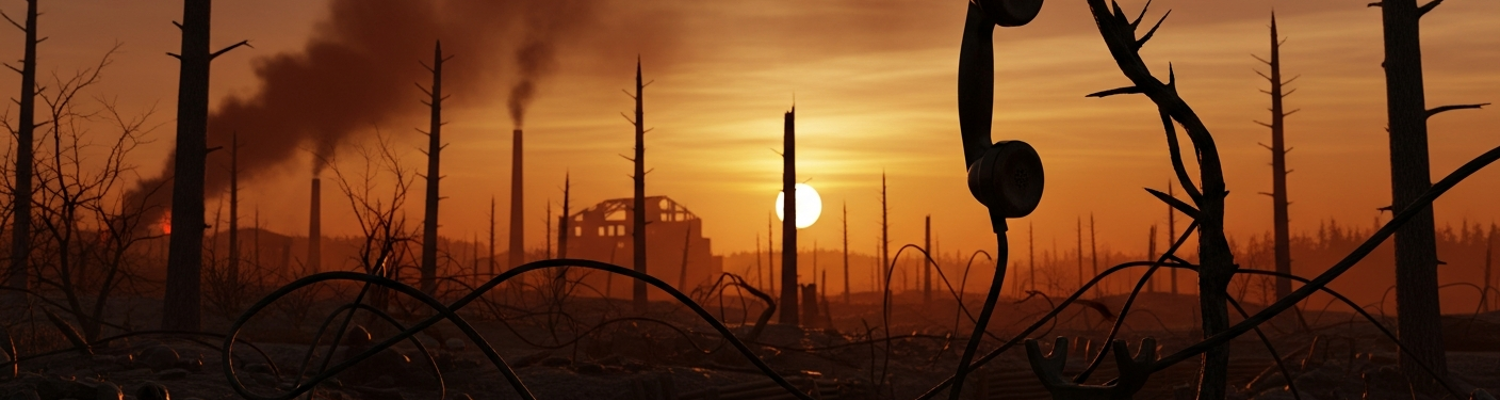

AEF Signal Corps Early Challenges
When the American Expeditionary Forces arrived in France, its Signal Corps was organized for a war that did not exist. A review of operational logs shows a force doctrinally prepared for mobile warfare, an inheritance from conflicts where field telegraph and telephones were deployed for divisions on the move. The standard equipment reflected this. It included visual signaling apparatus like heliographs, which used mirrors to flash sunlight, and signal flags. These methods were entirely dependent on clear weather and a direct line of sight.
They were wholly unsuited for the static, obscured, and constantly shelled landscape of the Western Front.
Pre-war field telephones existed, but they were designed with the assumption of stable command posts and relatively intact terrain, not the churned mud and chaos of trench networks. The American military’s general unpreparedness meant that upon entering the war, the Signal Corps was small. It lacked significant experience with the sheer scale of communications required.
The AEF’s initial communication strategy in 1917 was almost entirely dependent on two technologies. Wired field telephones and primitive radio sets. The telephone was the primary instrument for connecting command posts to the front. The Signal Corps ultimately installed thousands of miles of combat lines, creating an intricate grid of buried and surface-laid wires connecting forward outposts to rear headquarters. The system was, however, profoundly vulnerable. Radio technology was equally problematic. The Signal Corps arrived with sets like the SCR-49 and SCR-50, bulky, quenched-spark transmitters that could only send Morse code. Voice transmission was not possible. The SCR-49 pack radio required two or three mules to transport its components, including a hand-cranked generator. These early radios were not only cumbersome but also completely insecure. Any transmission was easily intercepted. The United States was so far behind its allies in this area that it was forced to adopt French radio designs, such as the one that became the SCR-54 crystal receiver, just to have functional equipment for artillery spotting.
The operational challenge was maintaining these fragile connections under the constant violence of industrial warfare. The wire was the primary target. German artillery barrages, specifically the box barrage tactic, were designed to sever a unit’s communication lines, isolating it completely before an attack. A single high-explosive shell could cut telephone contact for an entire sector. This blinded commanders to the status of an ongoing assault. The Signal Corps was forced to dedicate immense manpower to simply keeping the lines open. Soldiers known as linemen had the perilous job of patrolling sections of wire, often at night, to find and splice breaks while under direct threat of shellfire and snipers. The terrain itself was an enemy. The blasted, cratered, and water-logged ground made burying cable an exhaustive effort. Lines laid in trenches were often tripped over or damaged by friendly troop movement. Radio faced its own environmental threats. Beyond enemy interception, the sheer noise of the battlefield, both acoustic and electronic, interfered with the weak signals of early sets. For commanders in headquarters miles from the front, orders were sent into a void, with no certainty they were received or if the units receiving them were still operationally effective.
Command Isolation and Delayed Intelligence
The Headquarters Bubble was a defining condition for American Expeditionary Forces command during the Meuse-Argonne Offensive. General John J. Pershing’s General Headquarters, situated in a barracks at Chaumont, was a world away from the front. Corps commanders like Hunter Liggett of I Corps operated from rear-area chateaus or town halls, such as the one at Souilly. They were surrounded by staff officers, massive wall maps, and a steady stream of filtered reports. This physical and psychological distance created a disconnect from the conditions faced by assault troops. A close review of operational logs shows a command hierarchy where information moved glacially from the point of contact. A platoon pinned down in the ravaged Argonne Forest. Up a long chain of command posts. Each step, from battalion to regiment to division and finally to corps, was a node where critical details were lost, delayed, or distorted. A runner carrying a message could be killed. Telephone wires were frequently cut by artillery. Radio sets were too bulky and insecure for forward use. The pins on Pershing’s and Liggett’s maps represented units whose actual strength, position, and operational status were often hours, if not a full day, out of date.
The impact of this delayed and unreliable intelligence on strategic decision-making was direct. Orders for attacks were issued based on a picture of the battlefield that no longer existed. A division ordered to exploit a reported gap in the German line might arrive to find the gap had been closed for hours, walking directly into prepared machine-gun fields. Nowhere was this breakdown more clearly demonstrated than with the ordeal of the Lost Battalion of the 77th Division in early October 1918. When elements of the 308th Infantry Regiment under Major Charles Whittlesey advanced to their objective in the Charlevaux Ravine, units on their flanks failed to keep pace. They were left isolated deep behind enemy lines. For five days, they were cut off.
All attempts to communicate by runner failed. They were systematically picked off by German riflemen. The only link to the rear was by carrier pigeon, a desperate and unreliable method. The command’s blindness was so complete that, due to incorrect coordinates, American artillery was mistakenly directed onto the battalion’s own position, inflicting further casualties. The incident was a direct consequence of a system where frontline units could vanish into a communications void, leaving commanders at headquarters like the one in Souilly to guess their fate.
The pressure on commanders forced to operate under these conditions was extreme. During the Meuse-Argonne Offensive, the largest battle in U.S. military history, AEF leaders were committed to a relentless frontal assault doctrine. Pershing, in particular, resisted adopting the trench-warfare tactics of the British and French, favoring what he termed open warfare to break the stalemate. This doctrine demanded aggressive, continuous advances, yet the very commanders ordering them were often the blindest men on the battlefield. A general might order a full division of over 25,000 men to attack a ridge line like Montfaucon, a key German observation post, believing the previous day’s assault had weakened the defenders. In reality, the defending Germans might have reinforced overnight. The attacking American units could be walking into a slaughter with casualty rates soaring. The command structure was starved of accurate, timely information, forcing reliance on optimistic projections and incomplete reports from subordinate HQs, which were themselves often disconnected from their forward battalions. Decisions affecting thousands of lives were based on little more than educated guesswork, amplifying the stress on commanders who knew their orders were being sent into an information vacuum. The offensive succeeded, but at the cost of over 120,000 American casualties.
Meuse-Argonne Communication Blackouts
The German artillery method was targeted. A close review of operational logs from the Meuse-Argonne Offensive reveals that German counter-battery fire was not random. It was a deliberate effort to decapitate the American Expeditionary Forces’ command structure. German forward observers and intelligence assets identified the locations of American command posts, supply dumps, and, most critically, their communication lines. The primary connections for command and control were thousands of miles of telephone wire, often thin copper strands, laid hastily across the churned terrain or buried in shallow trenches. German artillery doctrine called for saturating these known and suspected communication pathways with high-explosive shells. A single well-placed 150mm shell could obliterate a trench junction, vaporizing the bundled telephone lines running through it and severing contact between a dozen different units. The spongy, shell-pocked soil of the Argonne made burying wires deeply an impossibility. Lines strung on poles were obvious targets. Even when buried, the vibrations from nearby shell impacts could break the delicate connections. The AEF’s primitive radio sets offered no viable alternative. They were bulky, required mule teams for transport, had extremely limited range, and their insecure Morse code transmissions were easily intercepted and located by German direction-finding teams.
This was not a system experiencing intermittent failures. It was a system undergoing total collapse.
The sheer volume of German fire created persistent communication blackouts across the entire front. The rate of destruction overwhelmed the AEF Signal Corps’ ability to effect repairs. A typical lineman team consisted of only a few soldiers responsible for miles of wire. Their work was among the most hazardous on the battlefield. Archival evidence shows these repair crews suffered exceptionally high casualty rates as they patrolled their sectors, often in darkness, searching for breaks while under direct observation and fire. A line repaired in one sector would be cut again moments later by another barrage a few hundred yards away. For attacking American infantry divisions, like the 35th or the 77th, this meant advancing into a void. An assault wave would move forward, and within minutes, its connection to the supporting artillery that was supposed to protect it would be gone. This created communication deserts. Zones of kilometers-wide frontage where no electronic message could get in or out for hours, sometimes days.
The result was the isolation of battalion-level command. A battalion, comprising up to 1,000 men, was the fundamental tactical unit, yet its commander was frequently the blindest man on the field. When the wires were inevitably cut, a battalion commander occupying a captured German dugout was left with only the most primitive methods of communication. His runners, dispatched to carry messages back to regimental headquarters, faced a gantlet of machine-gun fire and artillery. Few ever made it through. His only other link was often a handful of carrier pigeons, an unreliable last resort. The ordeal of the Lost Battalion of the 77th Division is the most famous example but was far from unique. After advancing into the Charlevaux Ravine on October 2nd, Major Charles Whittlesey’s command was cut off when flanking units failed to keep pace. With his telephone lines dead and runners unable to get through, his battalion was surrounded and besieged. This isolation was so complete that, due to incorrect coordinates from the last-known position, American artillery mistakenly fired upon the battalion, inflicting friendly-fire casualties. Whittlesey’s final, desperate pigeon-borne message reported his unit was being shelled by his own guns.
Informal Psychological Warfare Origins
A review of War Department files from 1917 shows the American Expeditionary Forces entered the European conflict with no formal doctrine for psychological operations at the tactical level. The concept of psychological warfare was institutionalized only at the highest echelons of the AEF, with the establishment of a Propaganda Section under the G-2 intelligence directorate. This small group, which became operational in August 1918, focused entirely on strategic-level actions, such as printing and disseminating over five million propaganda leaflets via aircraft and balloons. These leaflets were designed by a staff in the rear to erode the will of the German state and encourage surrender on a mass scale. There was a complete doctrinal void below this level. Field manuals for platoons and companies contained no instructions for waging psychological battles. For the infantryman in the mud of the Meuse-Argonne, this high-level organization was entirely disconnected from his fight.
This was a war fought in a communications vacuum.
The destruction of telephone wires and the unreliability of radio forced small units into isolation, where company and platoon leaders were left to their own devices. This battlefield condition made the invention of informal psychological tactics a matter of survival. The primary necessity was maintaining the fighting spirit of their own men. A close examination of troop behavior during the Meuse-Argonne Offensive indicates that leaders instinctively understood the need to project aggression and control, even when completely cut off from higher command. Surrounded by the psychological pressures of artillery bombardment, constant casualties, and the terrifying effects of neuropsychiatric collapse known as shell shock, maintaining unit cohesion was paramount. Simple, aggressive actions served to bolster the morale of the American soldiers, creating a sense of local superiority and purpose when none was communicated from the rear. The act of shouting taunts at the enemy, for example, was as much for the benefit of the shouter’s comrades as it was for the demoralization of the target. It was a projection of confidence in a situation defined by chaos and fear.
From this necessity, an unsanctioned brand of psychological warfare emerged from the front lines. AEF soldiers, particularly in the dense terrain of the Argonne Forest, began to use their own voices and weapons in unconventional ways to confuse and intimidate their German counterparts. Knowing that many German soldiers had previously lived in America, doughboys would yell across no-man’s-land in English, issuing fake commands, insults, or warnings of imminent, overwhelming attacks. This created confusion and paranoia within German trenches, forcing their soldiers to question their own intelligence reports. Archival evidence also points to the use of captured German equipment, such as flare guns, to send false signals and lure enemy patrols into ambushes. The sheer sound of American weapons, like the high-volume suppressive fire of the Browning Automatic Rifle or the distinct report of the M1897 Trench Gun shotgun, had a direct psychological impact, creating terror that often outweighed their tactical effectiveness.
Captured Propaganda and Battlefield Rumors
A close review of operational logs shows that German psychological efforts often became an inverted weapon in the hands of American troops. German artillery barrages were frequently accompanied by airdropped leaflets intended to demoralize AEF soldiers. These papers typically contained messages promising humane treatment for prisoners, questioning the alliance with France and Britain, or featuring lurid illustrations suggesting that wives and sweethearts back home were being unfaithful. For isolated American units in the Meuse-Argonne, cut off from their own command and supply, these leaflets were often the only intelligence they received for days. Instead of being demoralized, archival evidence from soldier accounts indicates these materials were repurposed with dark humor. Doughboys used the papers for everything from trench latrine tissue to a source of mockery. More significantly, they became tools in a spontaneous, ground-level counter-psyops campaign. AEF soldiers would alter the captured leaflets with crude drawings or scrawled insults and leave them on the bodies of German soldiers in no-man’s-land, hoping to sow confusion and anger among the enemy patrols tasked with recovering their dead.
This was psychological warfare by improvisation.
The breakdown of formal communication channels made the battlefield a fertile ground for rumor. With telephone wires shredded and runners unable to get through, information took on a life of its own, becoming both a threat and a tactic. AEF soldiers, particularly those of German-American heritage who were fluent in the language, engaged in an unsanctioned campaign of verbal deception. In the dense, foggy woods of the Argonne, where visibility was often limited to a few yards, a shouted command in German could halt an enemy advance or draw fire toward a phantom target, revealing machine-gun positions. Post-action reports contain numerous anecdotal accounts of small units yelling false warnings of gas attacks or flanking maneuvers across the lines, creating momentary panic and chaos within German trenches. This was not a centrally planned effort but a survival mechanism born of desperation. The intent was to make the German soldier doubt his senses and his officers, to believe he was surrounded by a much larger and more chaotic force than was actually present.
The results of these informal psychological methods were unpredictable and often terrifying for both sides. A rumor designed to deceive the enemy could easily bleed over into friendly lines, causing an American platoon to mistakenly fall back from a defensible position. A captured German flare pistol, fired to create a diversion, could be misinterpreted by American artillery observers miles away, bringing a barrage of high-explosive shells down on the wrong coordinates. Sometimes directly onto friendly troops. This created an environment of extreme psychological stress, where the truth was as dangerous a weapon as a lie. The condition known as shell shock was not only a result of artillery bombardment but also of this mental strain, a state of constant anxiety where no information could be trusted. An infantryman was not just fighting the enemy; he was fighting a war against information itself, where a misplaced rumor could be as lethal as a sniper’s bullet and friendly fire became a constant, horrifying possibility.
Combat Fatigue and Psychological Breakdown
The systematic destruction of communications inflicted a severe psychological toll on the individual American soldier. Post-action reports from the Meuse-Argonne Offensive reveal that this signal isolation created a unique form of battlefield anxiety. For an infantryman pinned down in a shell hole or a waterlogged trench, the severing of the telephone wire to his command post meant more than just a loss of contact. It was a descent into abandonment. All information ceased. He no longer knew if his officers were alive, if reinforcements were coming, or if his unit’s position was even marked on a map in the rear. The constant thunder of artillery, a defining feature of the battle, became an amorphous threat. Without communication, there was no way to distinguish the sound of a friendly creeping barrage from an incoming German bombardment. This bred a specific paranoia that one’s own guns could be the source of death.
This was a war against the unknown.
This isolation fed directly into the randomness of survival that characterized the Western Front. Artillery was responsible for the majority of all casualties, and its effects were arbitrary. A soldier’s training, skill, or bravery offered no defense against a high-explosive shell. Survival was a matter of pure chance. A function of which shell hole one chose for cover, or the random deviation of a shell’s trajectory. Archival analysis of AEF casualty reports shows men were killed or wounded not in heroic charges, but while waiting, lying in mud, or trying to sleep. This complete lack of agency over one’s own existence stripped away the soldier’s sense of control, a fundamental component of psychological resilience. The experience of witnessing a comrade vaporized by a direct hit, while emerging without a scratch, did not foster a sense of relief but rather a deep-seated fatalism and survivor’s guilt that steadily eroded mental stability. The mind could not process a reality where survival was entirely disconnected from action.
The result was a high incidence of what was then termed shell shock among AEF troops. By the end of the Meuse-Argonne campaign, the AEF was nearing a state of collapse, not just from physical losses but from widespread combat fatigue. This condition, now understood as a form of post-traumatic stress, manifested in a range of debilitating symptoms: uncontrollable tremors, fugue states, mutism, and functional paralysis. AEF medical officers, initially unprepared for the scale of these neuropsychiatric casualties, sometimes misdiagnosed the symptoms as cowardice or malingering. The problem was worsened by General Pershing’s doctrine of continuous frontal assault, which left divisions engaged until they were rendered combat-ineffective by casualties and exhaustion. For units like the 35th or 79th Divisions, which were thrown into the offensive with green troops and inadequate training, the combination of intense combat, communication blackouts, and the inability to rotate exhausted men out of the line created a perfect storm for psychological breakdown. Men were not only fighting a skilled enemy in fortified positions; they were battling the limits of their own sanity in a communications void.
April 1919 Muster Rolls Accounting
In the spring of 1919, five months after the armistice silenced the Western Front, a vast and somber accounting took place within the American Third Army’s occupation zone in the German Rhineland. From headquarters in Koblenz, orders directed company clerks and supply sergeants to conduct a full reconciliation of their unit muster rolls. This was not a simple headcount. It was a painstaking administrative process to finalize the status of every single soldier assigned to their company since its arrival in France. Each name on the paper rolls, often bearing the new service numbers issued in 1918, had to be squared against casualty lists, hospital intake forms, burial registrations from the Graves Registration Service, and transfer orders. In makeshift offices in German barracks, sergeants worked through the rosters, attempting to draw a final, definitive line under the human cost of the American Expeditionary Forces’ first great war.
This was a bureaucratic task that uncovered a reservoir of human suffering.
The paperwork revealed a grim tally of men who had simply vanished from the official record. As clerks cross-referenced their lists with reports from the Services of Supply and the sprawling network of AEF hospitals, they found thousands of soldiers who were neither present for duty nor officially listed as killed in action. A review of archival records from the period (NARA Record Group 120) shows that a large number of these men were un-evacuated wounded, still in French hospitals or American base hospitals far from the occupation zone, their parent units having moved on without them. The chaotic evacuation chains during the Meuse-Argonne Offensive had become overwhelmed, and men wounded in the final weeks of the war had been lost in the system. Even more disturbing was the large number of men designated with codes for psychological collapse. The rolls captured the first widespread, data-driven evidence of the war’s invisible wounds, with thousands of soldiers listed under the stark diagnoses of war neurosis or exhaustion, conditions that left them incapable of returning to duty.
This administrative audit became an unintentional but powerful record of communication failure. By analyzing the patterns that emerged from the reconciled April 1919 rolls, a direct correlation could be drawn between units that suffered the highest rates of unresolved casualties and psychological breakdowns and those same units’ experiences with command isolation during the Meuse-Argonne Offensive. Battalions that, according to Signal Corps operational logs, had their telephone lines perpetually severed and were forced to attack without artillery coordination or intelligence were the same ones whose 1919 muster rolls showed the most significant personnel discrepancies. The lists of shell-shock victims were longest in divisions like the 35th and 79th, units thrown into the meat grinder with green troops and which experienced near-total communication blackouts. The cold, hard data of the muster rolls, names, serial numbers, and status codes, provided the final, undeniable evidence of the cost of the headquarters bubble, transforming a routine clerical task into the definitive ledger of a broken command system.