
Radio Operator Immediate Aftermath
The high-frequency receiver hissed. In the communications room at the Tin City listening post, the air was a mix of hot vacuum tubes and stale coffee. A Radioman, Third Class, sat hunched over his console, headphones clamped tight. His job was a cycle of logging check-ins from weather flights and reconnaissance patrols skirting Soviet airspace. He was transcribing a routine report from a C-47 transport when a different signal cut through the static on the guard frequency. It was a frantic, broken voice, riding a carrier wave so weak it barely moved the meters.
The transmission was not scheduled. It was not routine.
A review of the station’s operational logs for that day (Log ID: AAC-TC-110952) shows a chaotic sequence. The first transmission was a partial voice call, distorted by engine noise. It was identified as a Navy AD-4W Skyraider, a three-man airborne early warning variant. The voice cut out, replaced by the high-pitched squeal of a Soviet Spoon Rest early warning radar. A second transmission, this time in Morse code, was pounded out with an unsteady hand. The operator logged fragments: MIG…15…ENGAGE. Then a string of garbled coordinates placing the aircraft perilously close to Wrangel Island. The signal strength fluctuated, a sign the aircraft was in a violent evasive maneuver. Another burst of voice, a whisper against the static wall: FIRE…WING. The radioman, sweating, tried to get a fix with the station’s direction-finding equipment. The signal was too unstable. His hands flew across the patch panel, routing audio to the recording machines and alerting the watch commander. The teletype machine fell silent. The final transmission was just three Morse code letters, the signal for an aircraft under attack and breaking off. K K K. Then only the hiss of the empty sky returned.
The room exploded into disciplined action. The young radioman was pulled from his seat as the watch supervisor and an Air Force intelligence officer took over, replaying the wax-disc recordings. The initial data was sparse. On a chalkboard, the officer began to scrawl the first, unprocessed lessons before the pilots’ fates were known. The first entry challenged established intelligence: Soviet GCI extends 50nm further than projected. American reconnaissance flights had operated under the assumption that the network of Soviet Ground-Controlled Intercept radar sites had a finite range. This incident suggested new, more powerful radars had been activated. The second lesson was a technological failure: AD-4W ECM suite ineffective against Spoon Rest search/acq freq. The Skyraider’s electronic countermeasures gear, designed to jam Soviet radar, had failed completely. The third notation was tactical: MiGs employing high-aspect, non-comm intercept. The attack appeared to be a well-coordinated ambush. A final note was added at the bottom: New airstrip? Wrangel? The speed of the intercept pointed to the possibility of MiGs operating from a forward base much closer than previously thought.
AD Skyraider Arctic Failures
The AD Skyraider was a powerful machine, but it was born of temperate climates. In the extreme cold of the high Arctic, its mechanical soundness fractured. A review of operational logs from Alaskan-based Navy and Air Force units in the early 1950s reveals a pattern of cold-weather failures. The massive Wright R-3350 Duplex-Cyclone engine was particularly susceptible. Its complex oil systems struggled as lubricants congealed to the consistency of molasses. This sluggish flow on startup led to increased internal wear and the potential for catastrophic engine seizure. Hydraulic fluids for flight controls and landing gear became thick and unresponsive. Rubber hoses and seals, embrittled by the deep cold, would crack and fail, causing fluid leaks. Even the AD-4L and -4NL winterized variants, which included additional heating, were not immune. The reality of a scramble intercept mission meant that the lengthy pre-heating procedures required to safely operate the R-3350 were often truncated. The engine became the aircraft's greatest liability.
Beyond the purely mechanical, the Skyraider’s electronic systems proved just as fragile. The AD-4W variant was packed with the sensitive vacuum-tube electronics of the era. Its primary AN/APS-20 search radar and associated passive detection gear were not designed for the temperature gradients over the Chukchi Sea. Archival evidence shows that rapid changes in temperature and humidity caused condensation to form inside electronic chassis, leading to short circuits. The vacuum tubes themselves became unreliable in the cold. Navigational systems, such as the G-2 compass and AN/ARN-6 radio compass, were already operating at their limits in a region where magnetic variation was extreme and long-range radio beacons were few. The added stress of cold-soaking further degraded their reliability, forcing crews into reliance on dead reckoning over a featureless landscape.
The operational environment of the Bering and Chukchi Seas offered no margin for error. The region is characterized by vast distances with an almost total lack of emergency divert airfields. Any significant mechanical failure became a life-threatening crisis. Flying over the broken sea ice offered no viable option for a forced landing, and survival time in the frigid water was measured in minutes. Weather was unpredictable, with sudden sea fog or disorienting whiteouts capable of appearing with little warning. Navigation was a constant struggle. The proximity to the magnetic North Pole rendered magnetic compasses erratic, forcing a heavy dependence on the same electronic systems that were prone to cold-induced failure. The geography of the Bering Strait acts as a choke point for weather systems, creating turbulent flying conditions. For a Skyraider crew dealing with a failing engine or a blacked-out radar scope, the operational area offered no safe harbor.
Whiteout Navigation Perils
Arctic whiteout is a treacherous atmospheric phenomenon. It occurs when an overcast sky diffuses sunlight over a uniform, snow-covered surface, eliminating all shadows. This optical event, also known as flat light, destroys depth perception and erases the horizon line. A review of operational manuals from the period shows that pilots were trained to recognize the slow onset as visual references disappeared. For the crew of a Skyraider on a low-level patrol over the Chukchi Sea, this meant the boundary between the ice pack and the sky would dissolve. The aircraft's primary navigation instruments offered little reliable help. Proximity to the magnetic North Pole rendered standard magnetic compasses erratic. Pilots were forced to rely on the AN/ARN-6 radio compass, an automatic direction finder that homed in on radio beacons. Yet over the vast stretches of the high Arctic, ground-based transmitters were sparse and their signals often weak. This forced a near-total dependence on dead reckoning, the practice of calculating one’s position by using a previously determined position and incorporating estimations of speed, heading, and time. Without a reliable compass or a visual fix, dead reckoning became a high-stakes guessing game.
The world outside the canopy ceased to exist.
The physical terrain of the Arctic provides almost no features for visual navigation, a problem made absolute by whiteout conditions. The patrol routes skirted a monotonous landscape of broken sea ice, open water leads, and low, snow-shrouded coastlines. Post-mission debriefings from similar Arctic patrols detail the difficulty in distinguishing low-lying stratus clouds from the ice surface even in clear weather. During a whiteout, this task became impossible. An aviator could be flying level one moment and, believing they were climbing to clear a cloud bank that was actually a rising ice field, impact the surface with no warning. The effect on the pilot is a complete loss of orientation. The human eye is hardwired to seek a horizon for equilibrium; when deprived of it, the pilot has to force an absolute trust in their instruments. This created a severe internal conflict, as they knew those very instruments were operating at the edge of their physical limitations.
This sensory deprivation is a direct path to spatial disorientation, a leading cause of aviation accidents in the 1950s. Analysis of U.S. Navy mishap data from the era (NARA Record Group 24) shows that spatial disorientation was a persistent factor in human-related accidents. When visual cues are removed, the pilot’s inner ear can send false sensations of turning, climbing, or diving. A pilot, believing they are in a gentle bank, might actually be in a steepening spiral dive. In the AD-4W, this danger was amplified by the crew arrangement. While the pilot sat forward, the two electronic warfare operators were stationed in a windowless compartment in the fuselage. They had no external view, feeling only the aircraft’s motion. A pilot fighting vertigo would make erratic control inputs, which would be felt by the crew as unexplained G-forces and lurches. The onset of a somatogravic illusion, where acceleration is misperceived as a steep climb, could cause a pilot to push the aircraft’s nose down into the unseen ice.
Combat Photographer Intelligence Role
The third man in the AD-4W Skyraider, seated in the dark fuselage, was not a pilot or a standard radar operator. He was a specialist, often a non-commissioned officer from a small naval intelligence unit. Mission manifests from Alaskan-based reconnaissance squadrons of the period list these men simply as observers, a designation that obscured their function. They were photographic intelligence technicians, tasked with direct visual confirmation. Their training went beyond photography; they were experts in high-speed, low-altitude aircraft recognition, could interpret the function of Soviet radar arrays from their shape, and were drilled in Arctic survival. They were a hybrid of technician and analyst, expected to operate complex camera equipment in a violently maneuvering aircraft while making intelligence assessments. The primary tool was often a modified K-24 aerial camera, a large device ill-suited for the cramped fuselage. For more detailed shots, they might use a handheld Graflex Speed Graphic, a camera that demanded precise manual operation with hands made clumsy by thick gloves.
Electronic intelligence could provide coordinates for a new Soviet radio transmission or the pulse of a new radar, but it could not confirm what was actually there. The strategic command needed pictures. A primary objective of these Chukchi Sea patrols was the visual documentation of a clandestine Soviet military buildup along their Arctic coastline. U.S. intelligence suspected the construction of new forward staging airfields for MiG-15 interceptors on the Chukotka Peninsula and Wrangel Island. They also sought visual evidence of expanded Spoon Rest and Knife Rest early warning radar sites. The photographer’s job was to fly low and fast, getting clear imagery of antenna types, runway construction, potential submarine pens, and the movement of Soviet icebreakers. This visual intelligence was the only way to turn electronic speculation into hard fact.
Operating a camera under these conditions was a fight against physics. The extreme cold was a relentless enemy of mechanical devices. Archival maintenance logs for photographic equipment from the era detail a constant struggle. Shutter mechanisms would become sluggish or freeze. Film stock, having lost its moisture in the dry, frigid air, would become brittle and snap mid-roll. The simple act of breathing could frost the small porthole or the camera’s viewfinder. Glare from the sea ice created extreme lighting conditions, forcing the photographer to make constant exposure adjustments. Condensation was a constant threat; bringing a cold-soaked camera into the relative warmth of the fuselage could fog the lens elements internally. These technical failures were compounded by the mission itself. The photographer had to achieve a steady shot of a target while the pilot was executing high-G evasive turns to avoid ground fire or an intercepting MiG.
1952 Patrol Film Recovery
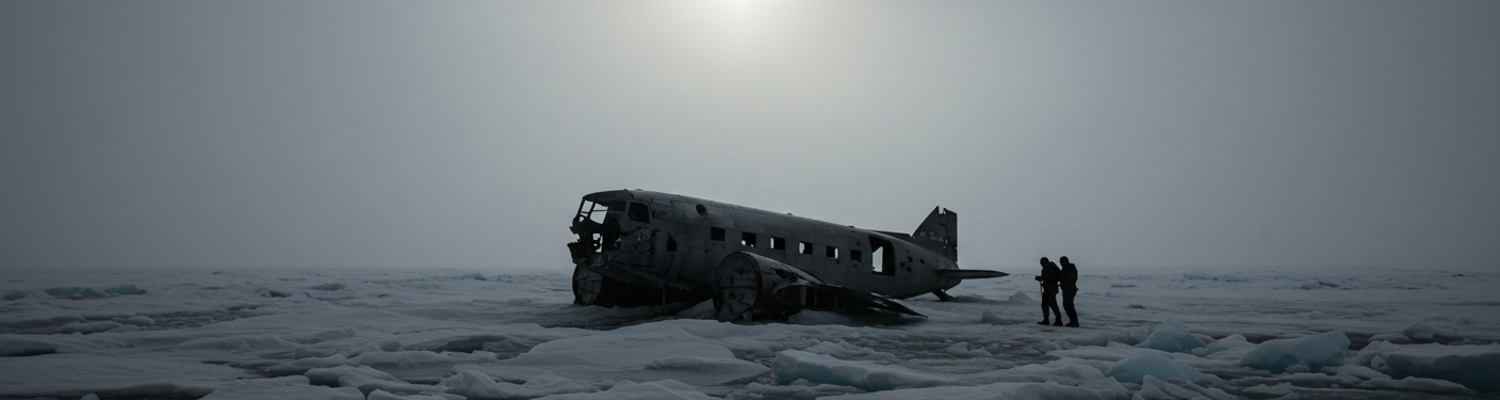
The wreckage was located by a Navy P2V Neptune from Naval Air Station Kodiak. Its crew spotted the dark gash in the ice pack 70 nautical miles northwest of Wrangel Island. After-action reports reveal that the initial search and rescue effort was immediately re-tasked as a high-priority salvage operation. An HO3S-1 helicopter, dispatched from the Coast Guard icebreaker USCGC Burton Island, was tasked with the recovery. The team consisted of two pararescue jumpers and an intelligence specialist. They were deposited onto the unstable ice floe. The Skyraider’s fuselage had broken in two just aft of the wing root. The forward section was destroyed by impact and fire, while the aft fuselage was relatively intact. The primary objective was not the crew. It was a small, reinforced metal box containing the film magazine from the K-24 camera. Recovery technicians found the camera shattered, but the magazine had been thrown clear into a snowdrift. Per cold-weather salvage doctrine, the specialist did not attempt to open the magazine on-site. The entire magazine was carefully wrapped in insulating material and placed into a specialized transport container for the flight back to the icebreaker.
Developing the film required specialized handling at a secure facility at Elmendorf Air Force Base before the images were flown to Washington D.C. The grainy, slightly blurred frames, shot through a small porthole during high-G maneuvers, provided intelligence that electronic surveillance could only hint at. A sequence of five usable frames, analyzed by photo-interpreters at the Naval Photographic Interpretation Center, confirmed the existence of a new, 7,000-foot concrete runway on Wrangel Island. Previous intelligence had only suggested a gravel strip. Another frame, taken at a low altitude, showed three MiG-15 fighters parked in newly constructed hardened aircraft revetments. A blurry image captured a previously uncatalogued radar array, a tall mast with a distinctive mattress-like antenna, which analysts theorized was a new GCI radar. This visual evidence invalidated existing threat assessments for the entire Chukchi Sea and Bering Strait region. All subsequent reconnaissance flight plans were immediately altered. The data forced a re-evaluation of SAC bomber routes that used the Arctic as a potential ingress path to the Soviet Union.
A forensic examination of the recovered wreckage provided a narrative of survival and death. The pilot’s section was riddled with 23mm cannon shell impacts, with analysis indicating he was likely incapacitated before the aircraft began its final plunge. The two operators in the aft compartment, however, were in a section of the fuselage that remained largely intact upon impact. Their harnesses were unbuckled. Their survival kits were found stowed, untouched. The official report concluded that while they survived the crash, the speed of the event and the G-forces of the final, uncontrolled spiral dive likely rendered them unconscious or disoriented. They perished from exposure on the ice within hours, never having regained the awareness to attempt to save themselves. Survival was a matter of which part of the airframe absorbed the initial cannon fire and which section broke away during the impact sequence.
Incident Operational Lessons
In the silence that followed the Skyraider’s final transmission, the intelligence cycle began in seconds. A review of the Alaskan Air Command’s after-action debriefing protocols from 1952 shows the first phase of analysis was a breakdown of the raw sensory data from the wax-disc recordings. Intelligence officers and senior radiomen from the 6985th Electronic Security Squadron replayed the audio fragments in a continuous loop. They were listening for more than words. The pitch and strain in the pilot’s voice were analyzed for signs of hypoxia or G-force impairment. The distinct squeal of the Soviet Spoon Rest radar, audible in the background, was isolated and its signal characteristics were compared against known threat libraries. Its clarity was damning evidence. The complete absence of distortion meant the Skyraider’s AN/APQ-35 electronic countermeasures suite had failed. The sound of the Wright R-3350 Duplex-Cyclone engine was also scrutinized, with technicians noting a change in RPM and an uneven cadence just before the final transmission, suggesting battle damage or a cold-induced mechanical failure.
From this chaotic collage of sound, the first hard lessons were documented on chalkboards and teletype bulletins before the search for the aircraft was fully organized. The primary insight was a refutation of established operational maps. All American reconnaissance flights had been planned with a theoretical 50-nautical-mile buffer from known Soviet Ground-Controlled Intercept radar sites. The attack’s location, triangulated from the garbled coordinates, proved this assumption wrong. A new line was drawn on planning charts: Soviet GCI reach was now presumed to be at least 75 nautical miles. This single failure invalidated hundreds of planned flight paths. The second documented failure was tactical. The MiG-15s had executed a high-aspect, non-communicating intercept, approaching from an angle that placed them outside the AD-4W’s limited visibility and attacking without warning chatter. This pointed to a more sophisticated Soviet GCI doctrine. The final documented insight was a question scrawled in block letters: WRANGEL ISLAND—ACTIVE? The speed with which the MiGs had appeared suggested only one possibility: the Soviets had secretly established a forward operating base on Wrangel Island.
These documented failures had immediate implications for all future Arctic reconnaissance missions. The presumed extension of Soviet radar coverage forced a halt to all patrols using existing routes. A new operational directive mandated that all future flights be plotted on more conservative tracks, pushing them further out into the Chukchi Sea. This increased flight times and placed greater strain on engines. The demonstrated ineffectiveness of the standard ECM package triggered a high-priority message to the Naval Research Laboratory in Washington D.C., demanding a crash program to develop a new jammer pod. In the interim, mission planners began pairing aircraft, sending Skyraiders out in two-ship formations. The potential for a MiG base on Wrangel Island altered the strategic calculus for the entire Alaskan Air Command, prompting an increase in P2V Neptune patrols and forcing Strategic Air Command to re-evaluate its own polar bomber routes.